 |
 Winlink using Robust Packet
 24 April 2013 | by
 Helge DF8LS has just published a web page showing how to send and receive email on HF using Winlink and the SCS Tracker TNC. I just sent an email to myself (isn’t this one of the signs of madness?) and it was received, so the instructions are obviously good!
 |
| A Winlink session on HF |
Mention of Winlink seems to cause strong emotions in some quarters. Personally I think using ham radio to send and receive email is rather cool, even if it is too slow to use for today’s level of email use. It’s a pity more hams don’t activate their Winlink account, which is callsign @ winlink.org .
If you use APRS then you can also send and receive email by that means using a feature called APRSlink. The trouble is, I use it so infrequently that I forget the commands. It would be wise only to use it if the APRS channel is quiet like it is here.
Julian Moss, G4ILO, is a regular contributor to AmateurRadio.com and writes from Cumbria, England. Contact him at [email protected].
Which non-English Morse characters are the most important ones?

The Morse code for the 26 letters of the English language and the digits, you can find everywhere, e.g. here on Wikipedia. All one-, two-, and three-symbol combinations are in use.
In the international alphabet all but four of the four-symbol combinations are used. They are:
| Morse | German ++ | Norwegian/ Danish | Spanish | Esperanto | Polish 16.3.2014 | Greek | Russian | Arabic |
| ·-·- | Ä | Æ | – | – | Ą | – | Я | ع |
| —· | Ö | Ø | – | – | Ó | – | Ч | ز |
| ··– | Ü | – | – | Ŭ | – | – | Ю | – |
| —- | Ch | – | Ch | Ĥ | – | Χ | Ш | ش |
The two or three first German letters are used in many other languages also, e.g. Swedish, Finnish, Turkish, Hungarian etc.
All other characters use five symbols. These are the ones that I have been able to find:
| Morse | Norwegian/ Danish/ Swedish/Finnish | French | Spanish | Esperanto | Polish 16.3.2014 | Icelandic 16.3.2014 |
| ·–·- | Å | À | – | – | – | – |
| ·-··- | – | È | – | – | Ł | – |
| ··-·· | – | É | – | – | Ę | – |
| -·-·· | – | Ç | – | Ĉ | Ć | – |
| -··-· | – | Ê (also /) | – | – | – | – |
| –·– | – | – | Ñ | – | Ń | – |
| ···-· | – | – | – | Ŝ | – | – |
| –⋅-⋅ | – | – | – | Ĝ | – | – |
| ⋅—⋅ | – | – | – | Ĵ | – | – |
| –··- | – | – | – | – | Ż | – |
| ··–· | – | – | – | – | – | Ð |
| ·–·· | – | – | – | – | – | Þ |
There are also six-symbol combinations in Polish: Ź which is –⋅⋅-⋅ (ZN) and Ś which is ⋅⋅⋅-⋅⋅⋅ (SB). The German Wikipedia even lists a Morse code for the double S: ß, ⋅⋅⋅–⋅⋅ or SZ, but I believe two consecutive S’s work well or even better.
I recently asked on the Elecraft list if the K3 Morse decoder could support some of these letters, and I asked specifically about Ä/Æ, Ö/Ø, Å, and Ü. These are the four which are shown in the first figure in the upper right-hand corner of this post.
Sources:
- Non-English Extensions to Morse (Wikipedia)
- Dik T. Winter’s list of Morse codes
- Morse Code Binary Table-Thingy
Sverre Holm, LA3ZA, is a regular contributor to AmateurRadio.com and writes from Norway. Contact him at [email protected].
Homebrew Buddistick Project – Part 2
I earlier posted about building a home-brew Buddistick antenna from the instructions posted by Budd Drummond. I posted the link to his site and instructions in the previous post. Look in the sidebar to the right for a quick way to the last post.
I delayed working on the antenna as I did not have a power supply for my radio so I was in no hurry. Well the power supply showed up this last Friday so Saturday morning, I was determined to finish the antenna and get on the air. The first this I did was finish wrapping the coils and crimp the Radio Shack connectors to the ends of the wires.

Next came long nut coupler which the antenna whip will screw into. A bolt is screwed into the nut coupler and the inserted into a small piece of PVC pipe. The nut coupler was a bit small so I made up the difference with a few wraps of electrical tape as Budd suggested in his instructions.

Next came the short piece of wire with a clip and ring terminal on each end. This is used to connect the top of a coil with the base of the antenna.

I bought a nice piece of RG-8X coax that had PL-259’s on each end. The instructions call for dividing the coax into the shield and center section and attach a Radio Shack clip to each of those. Well I spent a fair amount of money on this cable and did not really want to cut one of the connectors off the cable. I thought it would be nice to have some sort of adapter so I could use different lengths of cable over time if needed. This would allow me to have standard sections of cable with PL-259 connectors on the ends and be more versatile in the long run without having a cable dedicated to this antenna. To solve that problem, I came up with this little thing.

It is simply a chassis mount for a PL-259. I soldered two small wires to the center and outer portion of the mount and then added the blue clips. The center wire goes to the bottom of the vertical portion of the antenna, and the wire coming off the outer part of the chassis mount goes to the radial wire. I used different male/female connectors to avoid being able to connect it wrong so if I start making connections at the top near the whip and work down. Now I can simply attach a PL-259 to this “adapter”. I do plan on putting this little thing in a little box or somehow protecting it somehow. I might post what I come up with later.
Here is the completed antenna without the broom stick that holds it up. I am going to get a painter’s pole from the local home store soon so I can get it up higher than the broom stick.

I also am planning on getting a few tent stakes and parachute cord so I can guy it and make it self-standing if there is nothing available to secure the painters pole to.
So far I have had good performance with the antenna. I don’t have an antenna analyzer so I used an SWR meter and got the SWR as low as I could by adjusting the radial that I tied off to my fence across the yard. On 20 meters, I heard stations from both the east and west coast of the US along with scattered stations in between. I also heard Mexico, Canada, and a station in Istanbul, Turkey! I made a few contacts around the country and in Mexico. The guy in Turkey had a huge pile up so I didn’t get to work him. Considering this was the first time I have ever been on HF, I am sure there will be other chances. I then tried 40 meters. Again using the SWR meter I adjusted the radial to get the lowest reading and went to work. Again I had good results hearing stations around the country. I have yet to try any other bands yet but I will at some point in the future.
I may post a part 3 later if I learn something more about its use. . . . I would like to post a picture of it setup but it’s raining today. Maybe I’ll add that in the near future.
I also need to get a real kite winder for the radial wire as I doubt the cardboard will last very long. I also am planning on getting liquid electrical tape to finish things off a little nicer. And the last thing is to try to mount the chassis adapter maybe in a little box or something better than just hanging it with zip ties.
NOTE: I have decided to add a 80 meter coil and lengthen the counter poise. I’ll add a post about those results when I am done.
K5UNX


Wayne Patton, K5UNX, is a regular contributor to AmateurRadio.com and writes from Arkansas, USA. Contact him at [email protected].
Thoughts While Lawnmowing
“I wonder if that new antenna radial I dropped last fall settled into the grass enough by now?”
THWAAAAAAAAAAAAACK!
“No.”

Anthony, K3NG, is a regular contributor to AmateurRadio.com.
Fun on Fifteen
I have spent the entire day on 15m, mostly using PSK31. The band has been pretty lively all day. I worked a number of Russian stations including UB3YL Katya from Orel. That’s her picture below. Pity about the corrugated iron roof shadow.

I made a couple of contacts into the Far East. One was with Yasuda JA1OTT, the other was with Chen BG9GYI.

 |
| Youkits TJ2B |
Chen is a university student from Lanzhou. Chinese stations are becoming more common as more and more get on the bands. From the admittedly small sample I have managed to work Chinese hams form a different demographic from those from Europe or the USA. While your average EU or US ham is likely to be older than 60 (judging by those who tell me their age), Chinese hams seem to be mostly young people with an interest in technology.
It’s good, too, to see Chinese firms entering the ham radio market with QRP products such as the kits from Youkits (take a look at the new TJ2B SSB handheld!)
Julian Moss, G4ILO, is a regular contributor to AmateurRadio.com and writes from Cumbria, England. Contact him at [email protected].
For a Morse Enthuisiast: Something for the Shack
http://www.ebay.com/itm/Samuel-Morse-Historic-Photograph-Signed-Twice-w-Morse-Code-Holograph-Message-/190826936067?
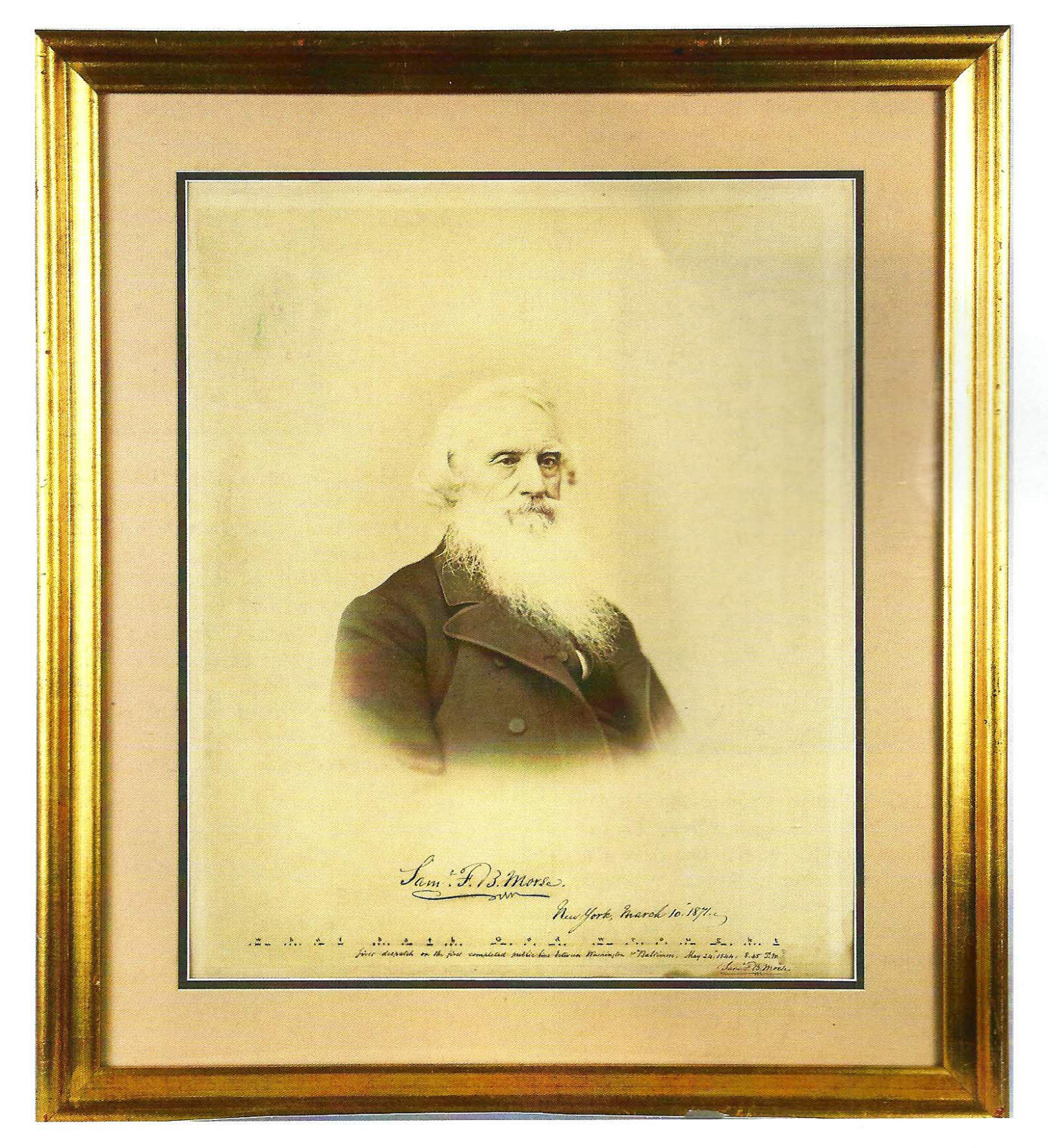
At the bottom of the photograph he has spelled out in Morse the famous message, "What hath God wrought". Noticed the slight differences in the "o" and the "r" morse characters.
Happy bidding.
Mike Crownover, AD5A, is a regular contributor to AmateurRadio.com and writes from Texas, USA. Contact him at [email protected].
Amazing Reverse Beacon Network
I haven’t called CQ for a long time on CW except in contests. Mostly I have just responded to DX calls with a super short “5nn TU” and that’s it. But this Saturday I heard a presentation at the Norwegian Ham Meeting by Roland, SM6EAT about a Swedish initiative to increase CW activity. It is called Scandinavian Open CW Activity (SOCWA) and it has at present 452 members from Scandinavia in a wide sense of the word. It really got me interested in improving my CW skills.
So now I have started to call CQ SAX and have had my first long CW QSOs for years with SM and OH.
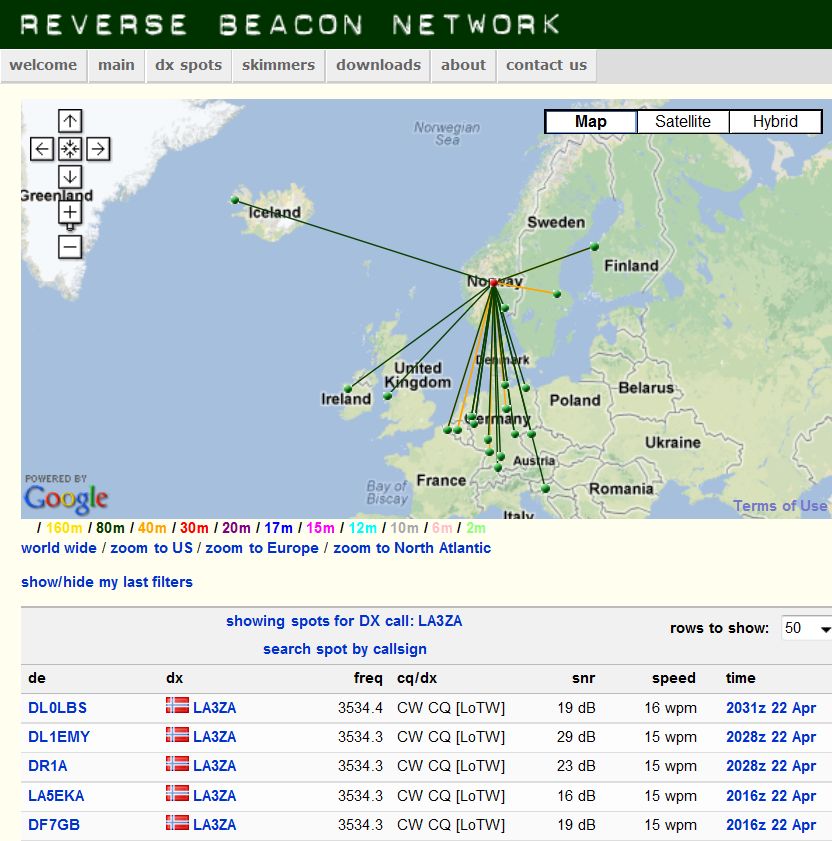
It is also amazing to look at the reverse beacon network and watch your own CQ being reported almost in real time from various Software Defined Receivers with CW Skimmers. Below is the result of the two CQs I have sent these two last days.
Sverre Holm, LA3ZA, is a regular contributor to AmateurRadio.com and writes from Norway. Contact him at [email protected].
 Ham Radio Deluxe |
 W5SWL Electronics |
 Ham Radio Prep |
 KB3IFH QSL Cards  Hip Ham Shirts  HamRadioAuctions HamRadioAuctions Reliance Antennas Reliance Antennas Enigma Shop Enigma Shop |  morseDX  Ni4L Antennas  R&L Electronics R&L Electronics antennas.us antennas.us QRV QRV |
- Matt W1MST, Managing Editor
