 |
 Series Six Episode Eleven – Slow Scan TV (SSTV)
 2 June 2013 | by
 Series Six Episode Eleven of the ICQ Amateur / Ham Radio Podcast has been released. The latest news, Martin Butler (M1MRB & W9ICQ) reviews Slow Scan TV (SSTV) and a report from our north American correspondent Frank Howell (K4FMH).

- Fox-1 has a launch date!
- Israel on 5 MHz with 8 channels
- Ham Radio your free social network tool
- South African 5 MHz operation - interesting propagation paths
- ZS2X VHF beacon now covering most of South Africa
- Oklahoma storm - Radio Hams respond
- Radio News in Irish
- Combining Software Defined Radios and Smart Phones

Colin Butler, M6BOY, is the host of the ICQ Podcast, a weekly radio show about Amateur Radio. Contact him at [email protected].
An Elk in the garden: satellite contacts with the FT817
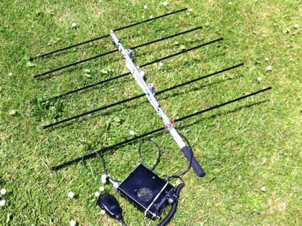
For some time, I have been keen to try some portable operation through some of the amateur radio satellites. I had been particularly inspired by Pete 2E0SQL’s portable operations through the satellites with his FT817 and hoped I could do the same.
Pete uses the Arrow 145/440MHz antenna and as far as I could see, it was not readily available in the UK. I contemplated ordering one from the USA but the thought of the import duty put me off a bit. AMSAT UK carry stocks of the ELK 145/440MHz log periodic which also have a good reputation albeit at a price. I’d recently disposed of a couple of bits of kit on eBay, so I felt I was in credit and ordered an ELK!
I was delighted when it arrived this morning. I wasted no time in making up a cable between the N connector on the ELK and the FT817. Assembling the antenna proved quite straightforward.
My first check with the antenna at ground level in the back garden was to see if I could hear GB3VHF, which I could, so given that’s not a huge signal, I was confident the antenna was working.
I looked at GoSatWatch on my iPhone to get some satellite predictions and as luck would have it, SO-50 was passing over at precisely that instant. I heard signals, so that was promising.
The next pass of SO-50 was a nice high one, so I was all prepared and sat out on the lawn with the FT817 and the antenna. R1AO was the first station heard, and although he had a little difficulty getting my callsign, we just about made it. IZ1DBY heard me and called as well, so that was very promising indeed.
I’m hoping to try some SSB operation through FO-29 as well.
The ELK antenna comes with a neat carrying case that will easily fit in a rucksack. It will form a very useful part of my backpack portable station I think. I’m also looking forward to doing some satellite work when we’re on holiday in Devon from a slightly rarer square than IO91!
Tim Kirby, G4VXE, is a regular contributor to AmateurRadio.com and writes from Oxfordshire, England. Contact him at [email protected].
WSJT-X v1 available
It was good to see, during the week that Joe Taylor, K1JT took WSJT-X from its Beta state to a ‘release’ version. If you’ve been reading this blog you’ll have seen that JT9, the mode produced by WSJT-X has been very usable for some months, so the last few weeks have seen a few tweaks to the software.
It works well and it has gained in popularity recently over recent weeks – with a very considerable amount of activity now available on the mode. Interestingly, Joe says that future plans for the program call for the integration of some of the more popular modes from the WSJT software. This sounds good – particularly incorporated in the very easy to use interface provided in WSJT-X.
Don’t delay, grab your copy of WSJT-X today!
Tim Kirby, G4VXE, is a regular contributor to AmateurRadio.com and writes from Oxfordshire, England. Contact him at [email protected].
Museum Ships Weekend
I am a big fan of the men and women who make up our Armed Forces. They’ve gone above and beyond for our country so many times – from 1776 right up to the present day. This weekend a really cool super special event is taking place to honor the men and women who have served in the respective navies of all of our countries and the ships that they have served on.
Thanks to the Battleship New Jersey Amateur Radio Station, this weekend has been organized and dedicated as Museum Ships Weekend. 106 restored military ships from around the world, which now serve as museums will be on the air this weekend.

72 de Larry W2LJ
Addendum – I got on the air for a bit tonight and worked seven stations commemorating various ships, some of which are sunk and some of which are museums. Unfortunately, the minority were found to be operating CW, so I had to resort to picking up that little black thingy – I think it’s called a microphone? Anyway, the ships I worked tonight were:
I also worked K1USN, but they’re not on the list of participating ships. So I am just under the halfway point towards earning a certificate.
Larry Makoski, W2LJ, is a regular contributor to AmateurRadio.com and writes from New Jersey, USA. Contact him at [email protected].
First Class Operator Club

I worked a station last night which was especially rewarding to me. Everyone on the bands this month is aware of the FOC – 75th Anniversary . I have eleven of them in my log book now. I’ve causally worked them “just because they’re on the air” and I love working “Special Event Stations”. Last night (the end of the GMT month) there were so many FOC stations on the air, they were impossible to ignore.
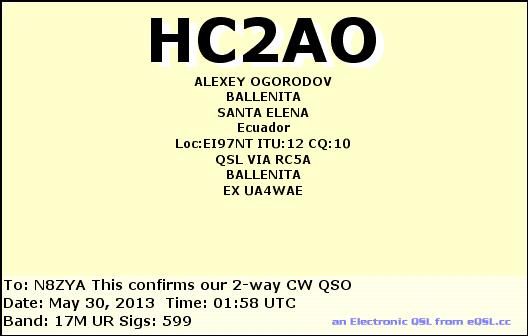
This month, not including the US stations, I’ve worked FOC stations in England, Bermuda, and France; and unexpectedly, I heard this Russian station (R75FOC) in the midst of a big pile up. This particular station was just above the Black Sea of the opposite side of Turkey. I’ve previously worked stations in this area, but never a “Special Event Station” at 5,573 miles.
In a swarm of bees, it’s not an easy task.
Needless to say, I especially enjoyed “spotting” this station and adding my QRP-3W designation. Personally, I like reading the “remarks” on DX clusters. I know they’re not necessary, but in my case, I just can’t waste the opportunity to let the world know that “QRP” is a viable option for DX work.
My DX contact into Russia last night, marks my 103rd for the single month of MAY.
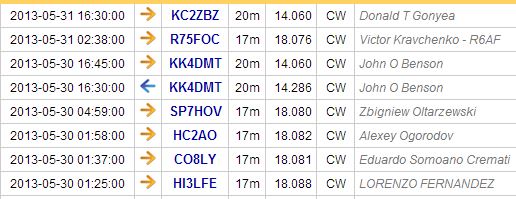
I’ve worked the Cuban station (CO8LY) so many times, I actually dropped my power down to one watt. The last few days, I’ve been listening to the 20 meter QRP frequency around “lunch time” and have been working stations regularly.
John Smithson, Jr., N8ZYA, is a regular contributor to AmateurRadio.com and writes from West Virginia, USA. Contact him at [email protected].
Sunny weather
I hope I don’t jinx it by writing this, but I think my weather station is now working. Everything is showing the values expected, including the rain which shows 0 mm as we haven’t had any. Trust the Cumbrian weather to not rain when you want it to.
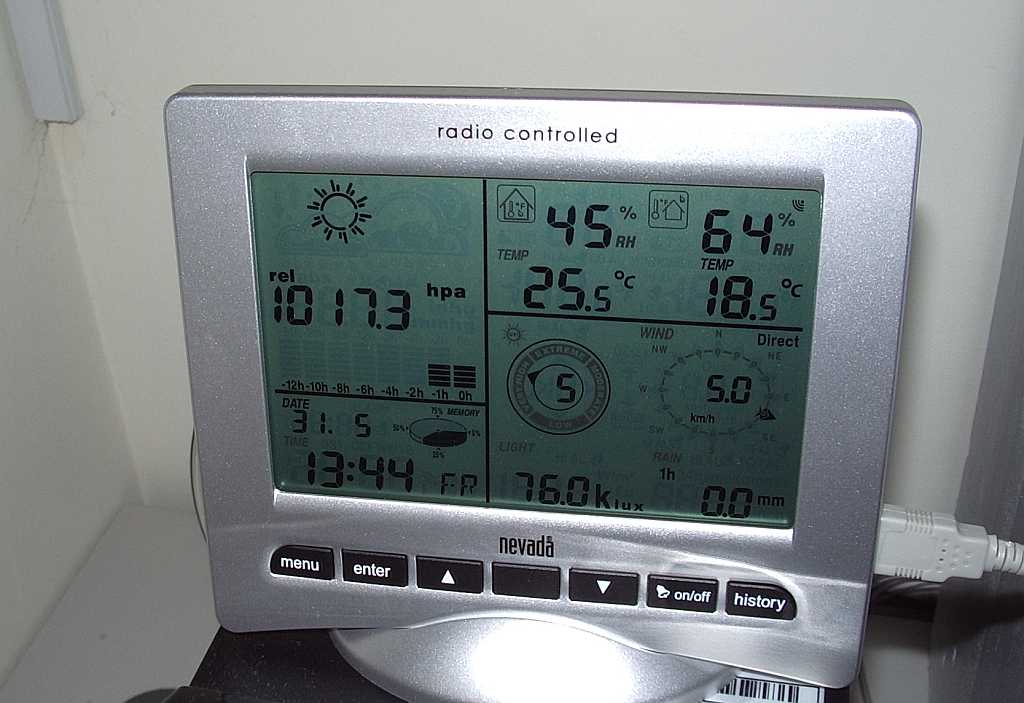
It was actually Olga who got everything working. I had lost patience with it and was all for sending it back. Olga patiently went through the manual (which she found was poorly written) and double-checked everything. She even used my test meter to check the voltage of the newly installed batteries. She found that the rechargeable alkaline batteries supplied for the sensor/transmitter unit were only giving 1.3V each. So she took them out and replaced them with some new Energizer alkaline cells. And everything including the rain sensor started working!
The manual says “Insert 2xAA 1.5V rechargeable batteries into the battery compartment of the remote sensor and immediately afterwards 3xAA alkaline batteries in the base station.” It didn’t say anything about charging them first. If I had provided my own rechargeable batteries I would obviously have charged them first. But as they came shrinkwrapped in the box I assumed they were ready to use. False assumption! It was as simple as that!
Julian Moss, G4ILO, is a regular contributor to AmateurRadio.com and writes from Cumbria, England. Contact him at [email protected].
Don’t play Ingress at Radio Observatories
A few weeks ago, the IPG got some curious email from some ABQ-ians asking if they could play Ingress at the VLA to capture some GPS-based portals. If you’ve never heard of Ingress, think of it as geocaching with a Virtual Reality spin. Check out their website here.
Ingress is played on smart devices, which require data connections to operate. These data connections are fine and dandy unless you’re at the world’s greatest radio observatory; here they aren’t so dandy.
RF-EMS
Below is a screencap of our RF-EMS (Radio Frequency-Environmental Monitoring System) which captured two WiFi access points (the darker blotches) from an RV containing a Verizon 4G hotspot and another router for something else.
 |
| Your VLA on WIFI |
In the last blog I described the 10′ dish for pinpointing RFI. We also have a (usually) 24/7 monitor that uses some pretty nifty antennas and preamps on a 50′ tower, sending it to an HP 70000 Spectrum Analyzer in a RF-shielded room from which we can record and upload plots like the one above, every day for the past 5+ years.
 |
| RF-EMS Tower and Bunker |
The biggest downfall is adequate locating of interfering transmitters. Currently, I’m designing a method which will allow the IPG to quickly and accurately pinpoint people with any kind of transmitter, be it a cell phone, hotspot, or vehicle keyfob (if we wanted to locate such things). My idea is based on multilateriation, which uses multiple receivers around the site which compare arrival times to calculate a four dimensional location. Keeping the bill of materials as low as possible, simplicity, ease-of-use and network integration (without causing RFI itself) a prime focus.
It may be overkill, but it gives me something to do in the free time.
Other Doin’s: Testing out and Debugging the 74 MHz System
When I’m not having free time, this is what I’m doing. A new feature of the Expanded-VLA is observations on the 4 meter band. The current system in place uses these simple crossed dipoles hoisted a few meters below the sub-reflector.
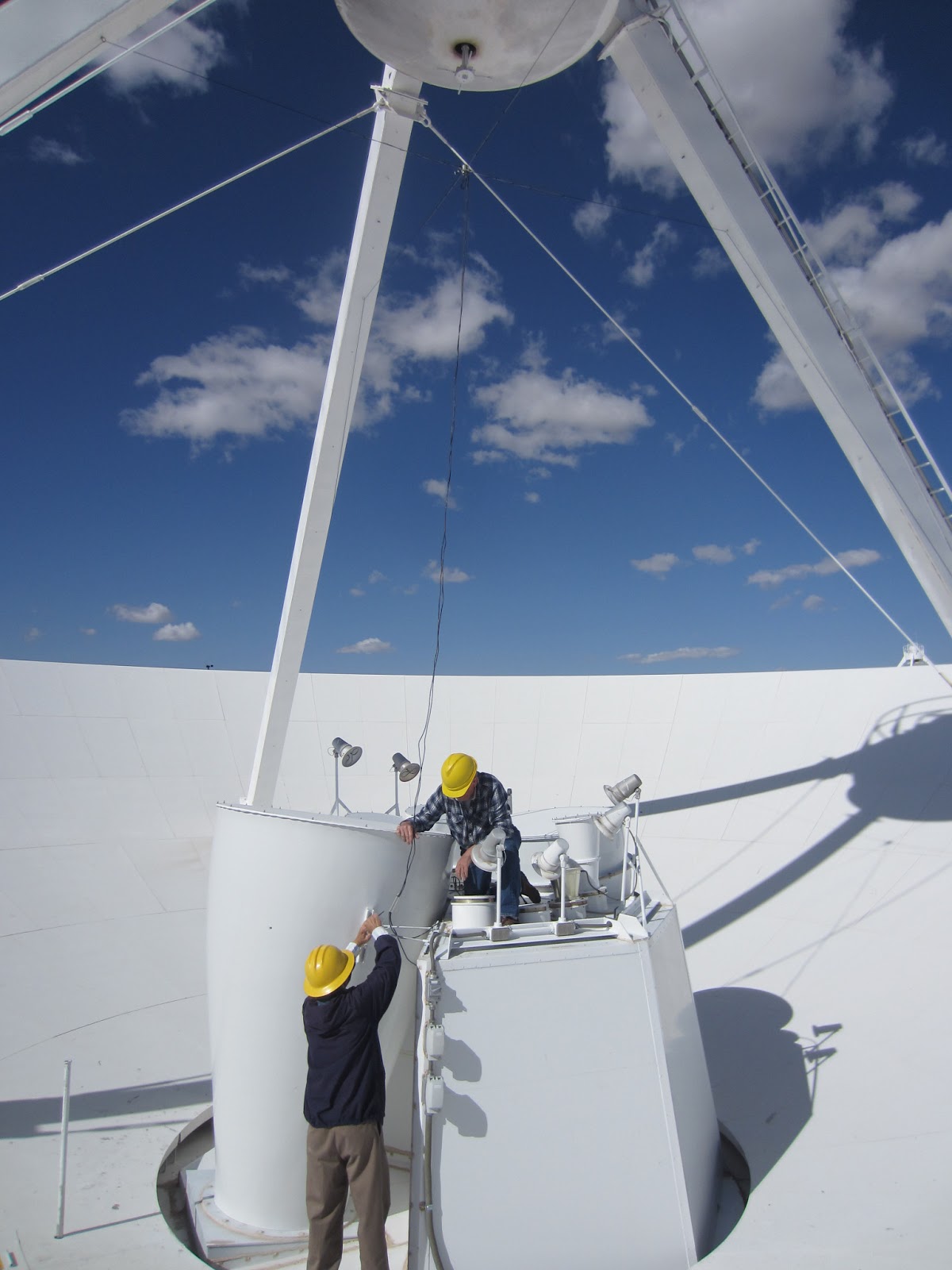
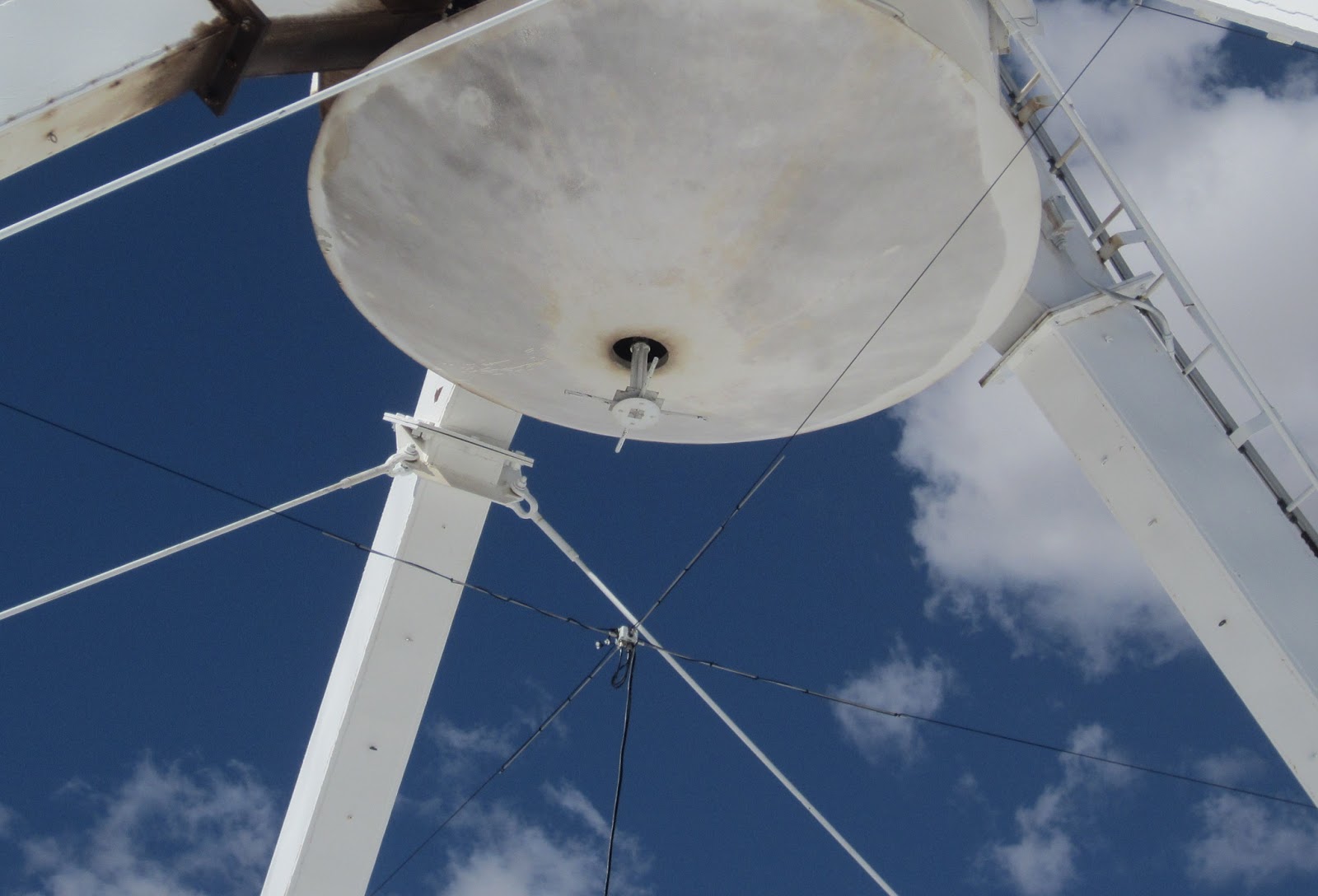
The cross dipoles connect to our receiver, which hooks up to the rack that magically digitizes the signal and turns it into pulses of light which the correlator feeds upon.
One of the problems we face are things broken that don’t have to do with our antennas and receivers. For example, the first test we do to examine the receivers performance is a band pass plot. Often times, we see something like this:
 |
| A bad bandpass plot caused by a faulty relay in the T301. |
This is ugly! What we want to see is this:
 |
| A beautiful bandpass! You can see 4 band on the left, and P-band in the middle with RFI spikes all over. |
First we go digging in the LO-IF and FE racks for a place to stick a spectrum analyzer to…
|
| Eric the BAMF next to the LOIF and FE rack. Our culprit is on the left, in the middle of the top rack of modules |

And from that we figure its’ this T301 which does the first IF up-conversion from 0-1GHz to 1-2GHz.
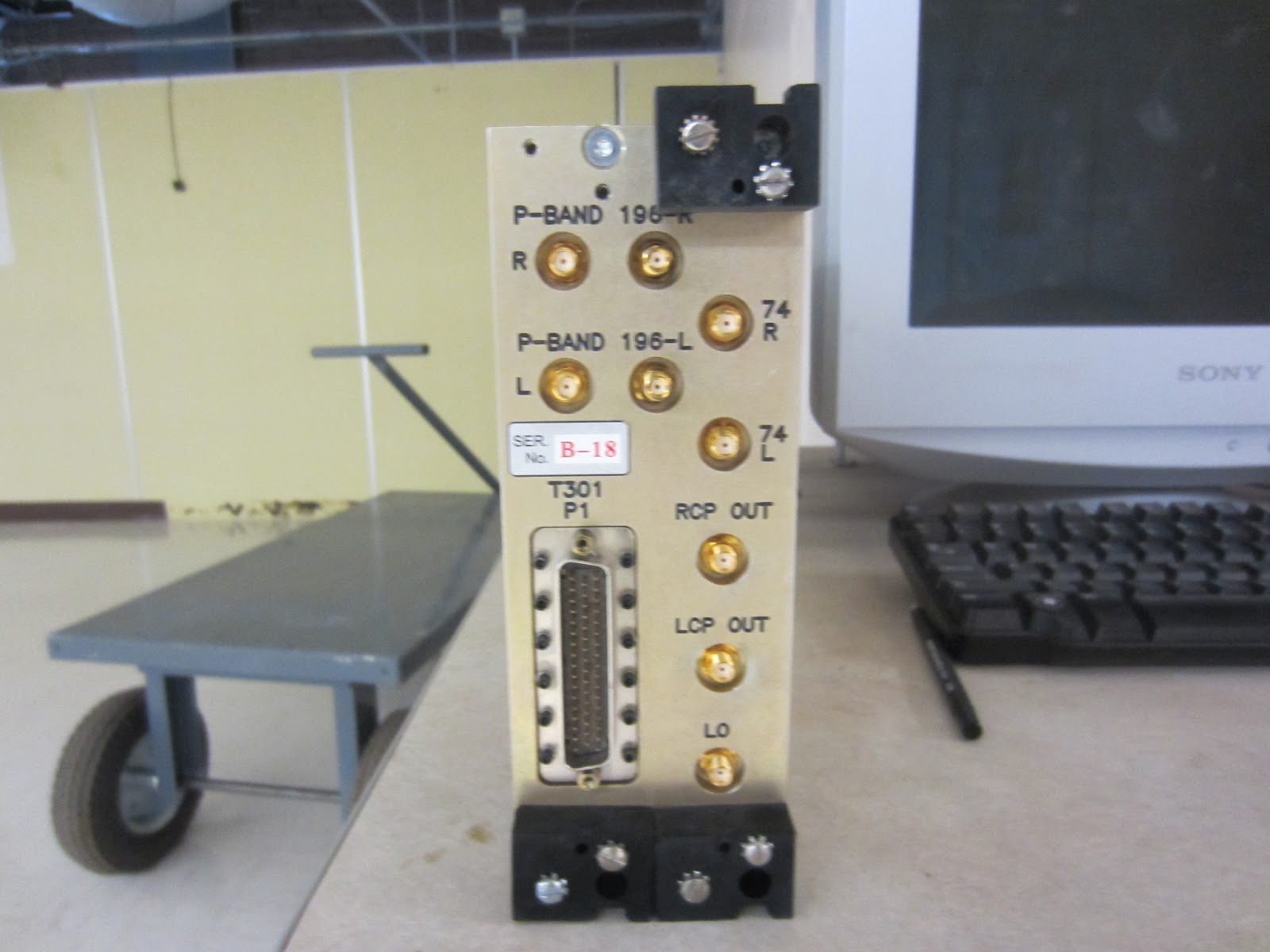
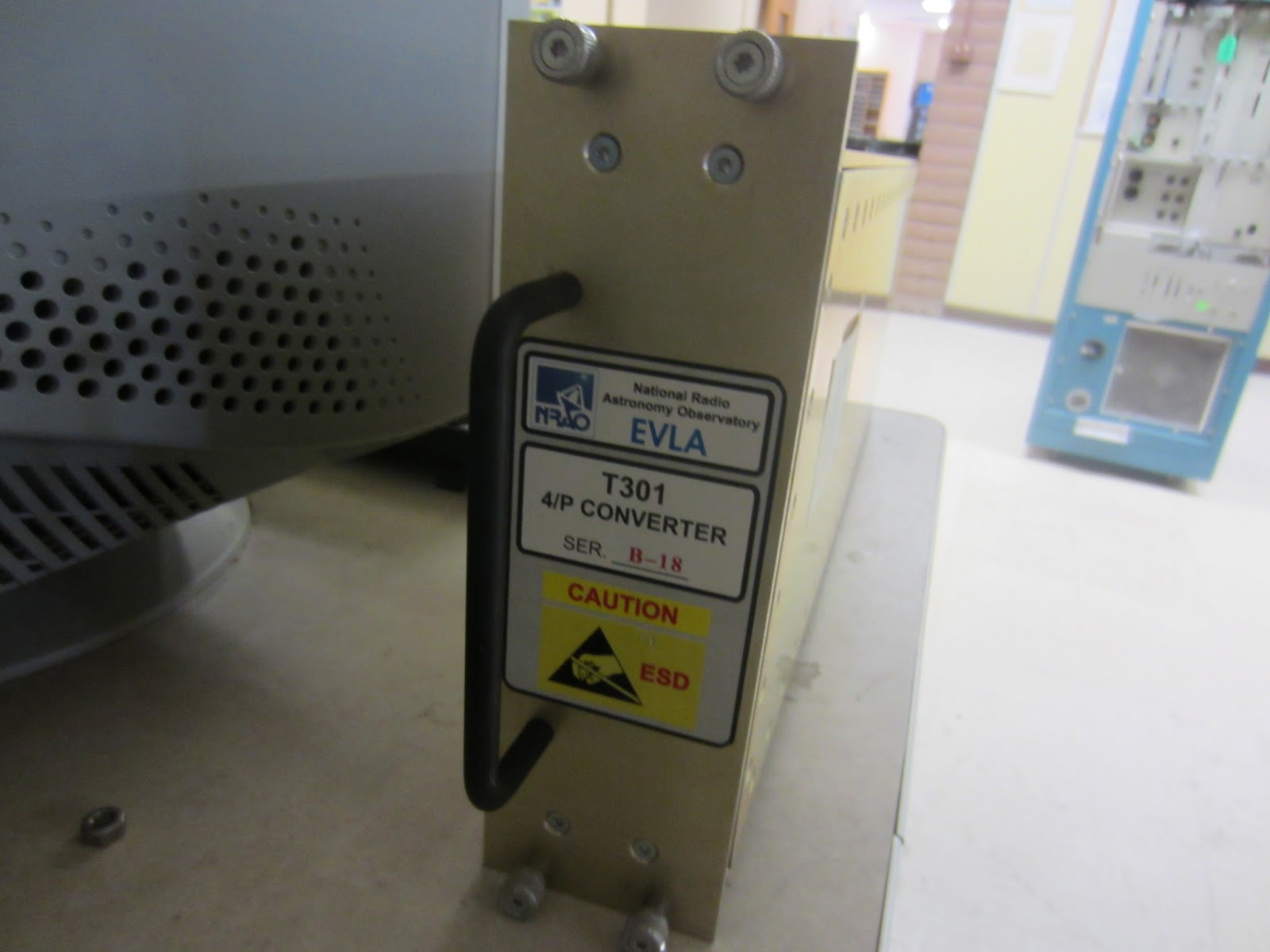
We get a new one, stick it in, turn it on and voila, it’s alive!
Sterling Coffey, NØSSC, is a regular contributor to AmateurRadio.com. He is ARRL Youth Editor and an electrical engineering student at Missouri S&T. Contact him at [email protected].
 Ham Radio Deluxe |
 W5SWL Electronics |
 Ham Radio Prep |
 KB3IFH QSL Cards  Hip Ham Shirts  HamRadioAuctions HamRadioAuctions Reliance Antennas Reliance Antennas Enigma Shop Enigma Shop |  morseDX  Ni4L Antennas  R&L Electronics R&L Electronics antennas.us antennas.us QRV QRV |
- Matt W1MST, Managing Editor
