 |
 QRP Success: 7Z and JT5
 17 June 2013 | by
 As I have written before there are several strategies for the QRP DX'er to employ, not the least of which is to call needed DX entities during a contest. The reason being that demand for any given station is diluted by the fact that there are so many stations on the air. Accordingly the pileups are smaller, generally speaking. As I look at my QRP needed list, many Asian countries are on the list simply because there is reduced activity from these entitites and the paths are tough. Normally, when openings occur, the pile-ups are huge and the operators are on for a limited time. I've learned to ignore spots for DX like HZ, JT, VU, etc.., at least from South Texas, as jumping into those pile-ups, with QRP power levels, on a normal day is not fruitful. Contests however are different.
Saturday afternoon I fired up my QRP log and logged into the cluster to look for needed countries. I switched my Log Periodic to be in-line with my KX3 and started looked for DX. The first to pop up was 7Z1HL. I had decent copy on him on 15 meteres with a little QSB. The pile-up was relatively small, but for 20 minutes or so, no joy. I had him in the open on several occasions and he wasn't hearing me well enough to answer. Then all of a sudden his signal went up a couple of S-units as the band improved very quickly. The second call after his signal built-up and I was in the log. Wow, I said to myself, 7Z on QRP.
I chased a couple of others after that, 9V and HS, but I couldn't get through the pile-up on 9V and I don't think the HS0 could hear me.
On Sunday morning, I fired up the KX3 again. There was a spot for JT5DX on 15m, honestly before I tuned to his frequency, I wasn't hopeful. When I tuned him in, wow, a solid 59. Maybe the best signal I 've ever heard from JT. First call, in the log. Wow!!
Again, I chased a few others, but suffice to say, I was happy with the weekend. Two relatively tough DXCC entities now safely in the QRP log. QRP IS!!
Mike Crownover, AD5A, is a regular contributor to AmateurRadio.com and writes from Texas, USA. Contact him at [email protected].
Young operators in All Asian contest
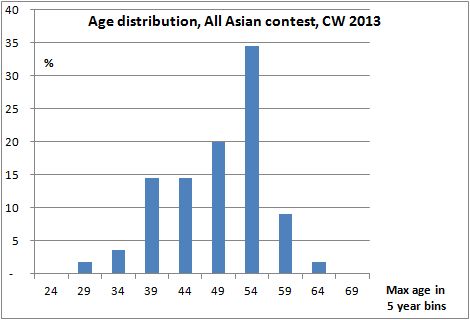
The All Asian DX Contest is one of the more fun ones to participate in. One thing is the DX aspect of it, but I like it also because of the exchange of the age of the operators. In other contests one exchanges boring stuff like serial number 1, 2, 3, … ; the CQ or IARU zone (14 and 18 for me); or the power output. But exchanging the age of the operators gives a little glimpse of the person behind the radio on the other side.
It also makes it possible to make a graph of the distribution of age. I had 62 contacts this weekend, of which 55 were unique. They were mainly in Asiatic Russia and Japan. The average age of the operators was 51.6 years – 7 years younger than me – and the graph shows the distribution. The bar for e.g. 54 is the percentage, 20 in this case, of operators in the bracket 50-54 years and so on.
The graph actually makes me quite optimistic concerning the future of ham radio. There are many young contest operators out there, at least in Asia. This resonates well with what others are saying also. Never before has there been so large activity on the bands as during contests these days.
Sverre Holm, LA3ZA, is a regular contributor to AmateurRadio.com and writes from Norway. Contact him at [email protected].
Fred Whitton
I’ve harped on enough about the Fred Whitton but I thought I’d share this. There were a few photographers around the course. catching you at your finest moment. I’d looked for one of me and there wasn’t one to be found in the original batches sent round. Apparently the camera’s weren’t happy with all the rain and they lost a few photo’s.
Luckily for me they recovered a few and I was in one of them, so here I am struggling up the 3rd pass out of 6. Newlands pass, near Buttermere. Its one of the easier passes and only hits about 25-30% at the very end. Not like Hardknott that is like that for most of it!

Anyway here I am in all my uphill-ness. 50 miles in and 60 to go! It ended up taking me 8 hours and 8 minutes and 50 seconds. If I’d been 8 minutes and 51 seconds quicker I would have got a 1st class time. Maybe next time
Alex Hill, G7KSE, is a regular contributor to AmateurRadio.com and writes from Cumbria, UK. Contact him at [email protected].
Father’s Day
I was able to get on the radio for a bit today. 15 Meters seemed to be alive jumping with “AA” contest stations. I didn’t have much interest in competing in the contest, but it’s always interesting to work Asian stations using QRP power. I managed to work several JA stations, cherry picking my way around, and trying the loudest ones. I also worked a few Asiatic Russian stations. Unfortunately, I did not hear or work anything more exotic.
I attempted to work Met TA3AX on 17 Meters, but this time QRP. Alas, Turkey was not to be had with 5 Watts – today. 😉
I finished the day by participating in the Run For The Bacon, the Flying Pigs monthly QRP sprint. Not a whole lot of activity, probably due to it being Father’s Day, but I did manage to work fellow blogger, Chris KQ2RP, and I also worked Jim W4QO and John K4BAI, twice. Earlier in the day we had another brief contact, so today was able to put John in the log three times today. I think that’s a record.
72 de Larry W2LJ
QRP – When you care to send the very least!
Larry Makoski, W2LJ, is a regular contributor to AmateurRadio.com and writes from New Jersey, USA. Contact him at [email protected].
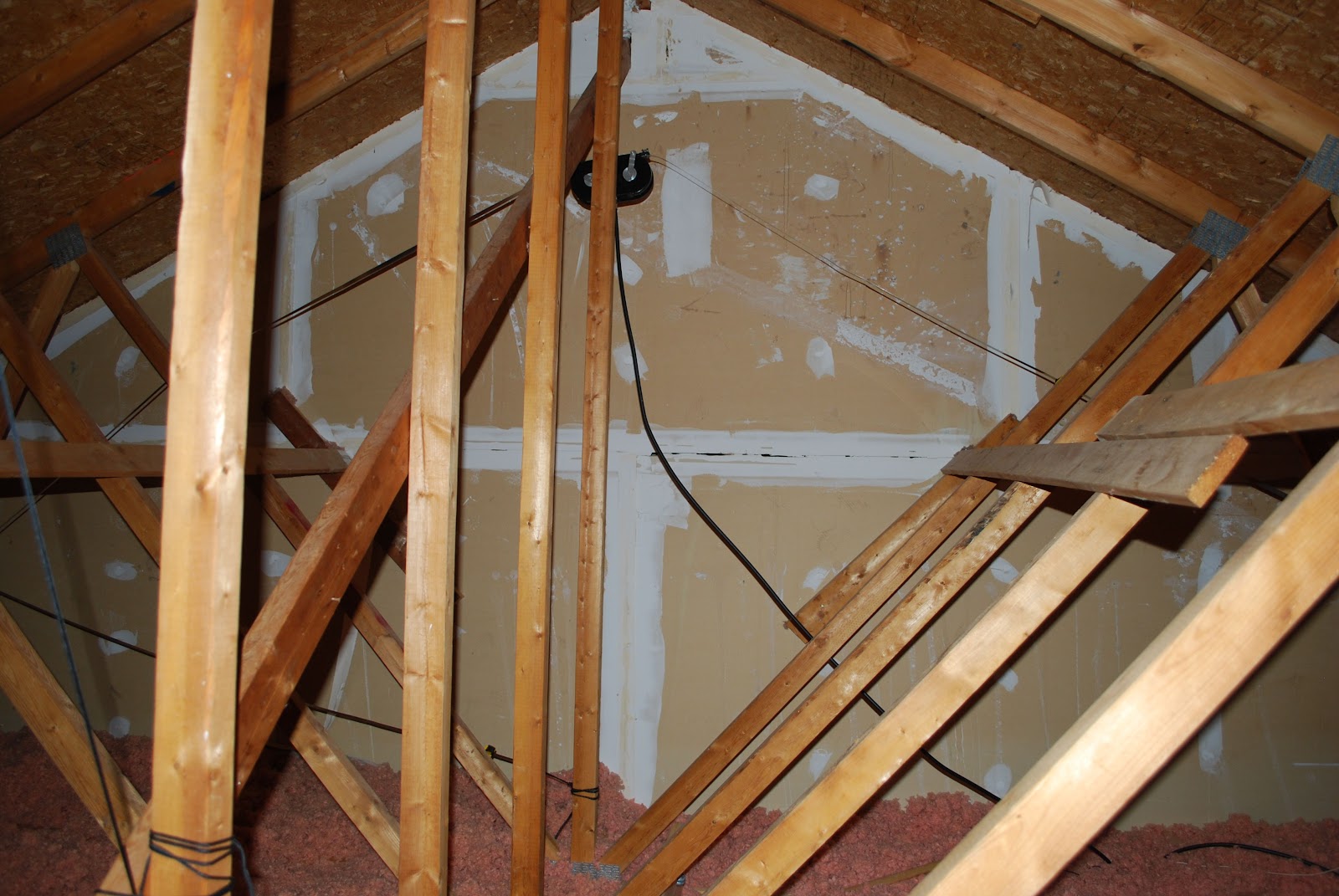
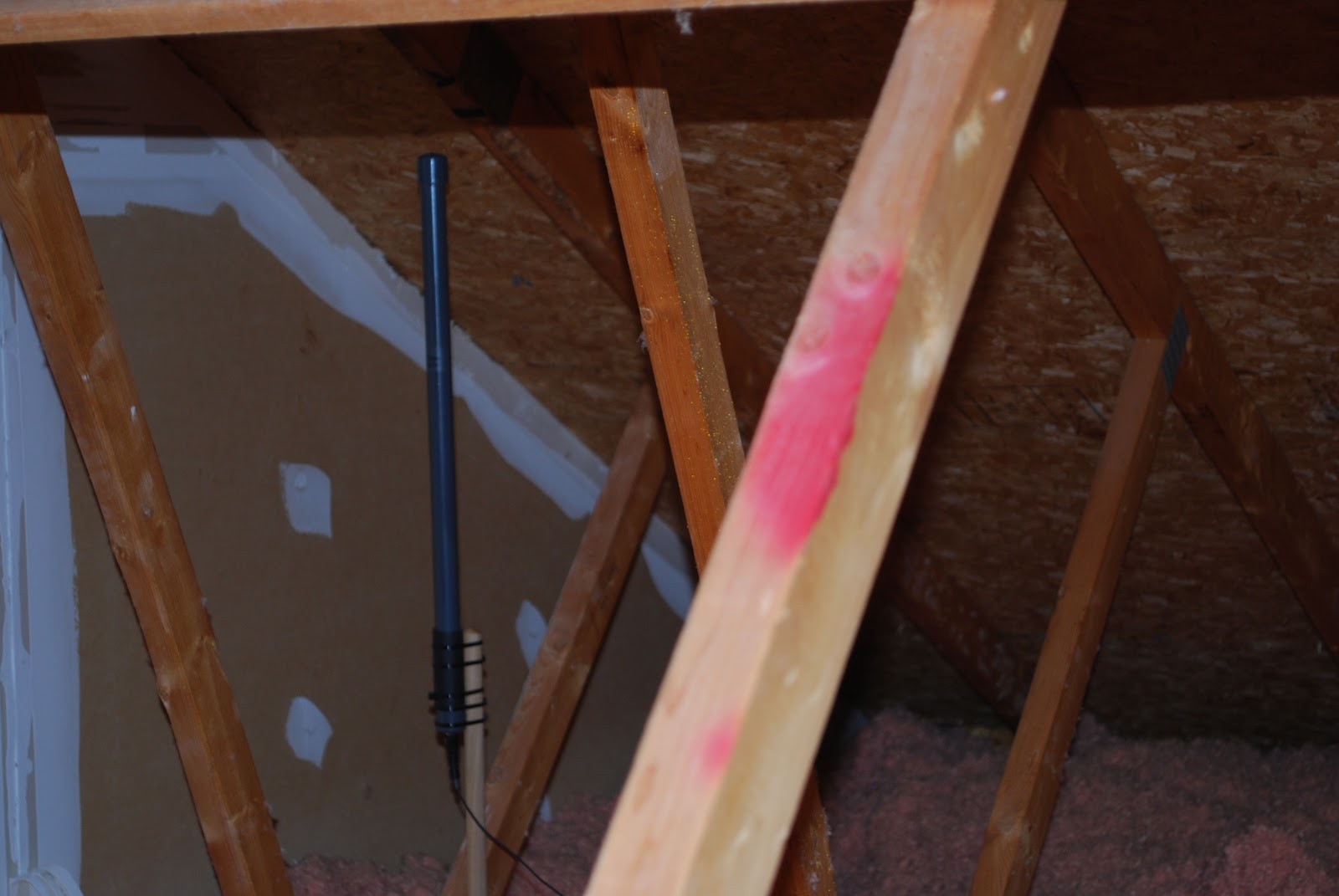
A trip into the attic.
 |
| Alpha Delta DX-EE with balun. |
 |
| Hy-gain noise antenna |
 |
| H-900 active antenna |
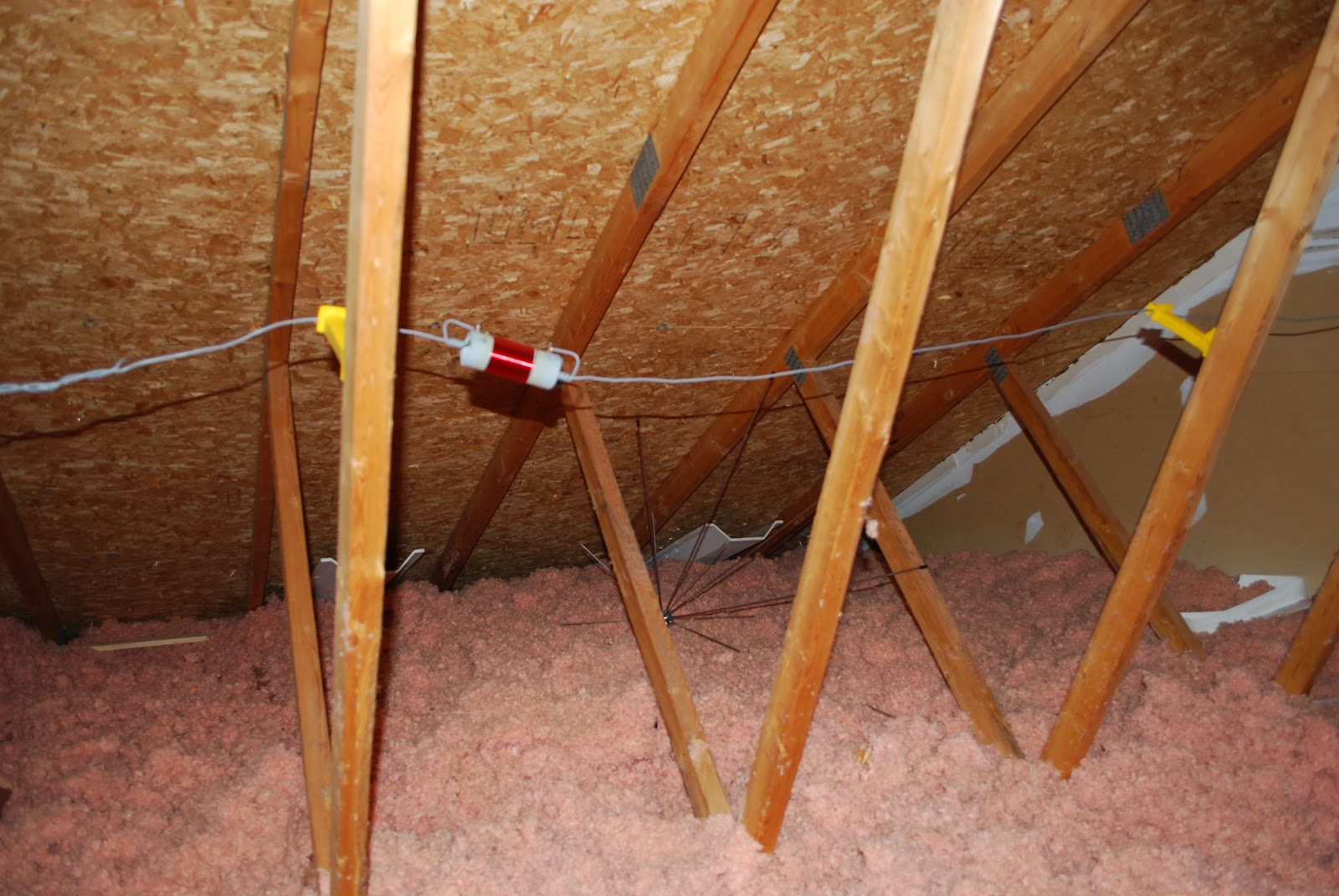 |
| Sagging 40m trap |
Mike Weir, VE9KK, is a regular contributor to AmateurRadio.com and writes from New Brunswick, Canada. Contact him at [email protected].
The New VHF Contest Categories
 The results are in from the 2013 ARRL January VHF Contest, which includes the new Single Operator 3 Band and Single Operator FM Only entry categories.
There were 77 entries in the SO3B category, with Rich KV2R having the high score: 6368 pts. Breaking his contacts out by band reveals 50MHz:92 QSOs/18 Grids; 144MHz:83 QSOs/12 Grids; 432MHz:12 QSOs/2 Grids. I operated in the same category but with a lower score: 1311, broken out by band this way: 50MHz:27/12; 144MHz:24/8; 432MHz:3/3. As I recall, 50 MHz propagation was not really that great, which is going to be the major swing factor for scores in the SO3B category. Scanning through the top SO3B entries reveals a relatively consistent pattern of 50 MHz having the highest number of QSOs, with 144 MHz in the same ballpark and 432 MHz significantly lower in count.
There were only 23 entries in the SOFM category, which is probably not a big surprise. While there are pockets of FM activity during VHF contests, historically the fun mode has not been used that much for contesting. The whole idea behind SOFM is to open up contesting to the FM operator. It remains to be seen how effective this will be but if it does catch on, it will take some time to build momentum. Ev W2EV had the high score of 1080 in the FM category, broken out by band here: 50MHz:19 QSOs/4 Grids; 144MHz:27 QSOs/4 Grids; 222MHz:5 QSOs/4 Grids; 432MHz:8 QSOs/3 Grids. W2EV’s score shows just a few grids per band, indicating shorter distance contacts overall. With only 4 grids on 50 MHz, he probably did not benefit from sporadic-e propagation on that band. The second place entry was from Erich KC9CUK who only worked the 2 Meter band, producing a score of 441 with 63 QSOs and 7 grids. The remaining entries had less than 30 QSOs. Almost everyone had contacts on 144 MHz but the usage of the other bands varied significantly.
I have always been most interested in operating 50 MHz and 144 MHz, sometimes adding in 222 MHz and 432 MHz, so I find SO3B a nice addition to the contest. In this category, I get to operate my favorite bands but my score does not get compared with the guys that have built stations that do 50 MHz through light. I suspect there are plenty of other VHF contesters in this same boat.
I find the FM category very interesting, as I have always tried to encourage FM operating during the contests. Clearly, FM is less effective than SSB and CW, particularly when the signals are weak. I don’t know whether this category will attract new operators or not to VHF contests. FM operation needs to hit critical mass because activity generates activity. That is, if you are the only FM contester in your area, its going to be frustrating. Of course, it will help if the established SSB stations make it a point to also work FM.
Oh, one more thing… we still need to get rid of the rule that says no contacts on 146.52 MHz. This rule is counterproductive. Every time I talk with an FM op about “getting on during the contest” they say “OK, so I should just call on five two, right?” I have to explain that calling on the calling frequency is not allowed during the contest (uh, that’s only for FM, you see) and their minds start to wander to topics that make more logical sense.
73, Bob K0NR
Bob Witte, KØNR, is a regular contributor to AmateurRadio.com and writes from Colorado, USA. Contact him at [email protected].
Under construction
Due to the problem with commenting I am reluctantly moving this blog to a new template. This will probably take a few days – especially as I will be going to hospital on Tuesday – because a lot of trial and error will be involved (more error than trial I dare say.)
Please bear with me while I make changes, try different graphics and so on. Normal service will be restored as soon as possible!
Julian Moss, G4ILO, is a regular contributor to AmateurRadio.com and writes from Cumbria, England. Contact him at [email protected].
 Ham Radio Deluxe |
 W5SWL Electronics |
 Ham Radio Prep |
 KB3IFH QSL Cards  Hip Ham Shirts  HamRadioAuctions HamRadioAuctions Reliance Antennas Reliance Antennas Enigma Shop Enigma Shop |  morseDX  Ni4L Antennas  R&L Electronics R&L Electronics antennas.us antennas.us QRV QRV |
- Matt W1MST, Managing Editor
