Archive for the ‘Uncategorized’ Category
 2m big-wheel – 3dBd gain without rotating
 September 16th, 2015 |
  Author:
 Since its erection yesterday in its proper home by David G0LRD all seems to be working well.
A quick check this morning and I am able to copy the Kent, Dutch and Belgium beacons on 2m and GB3LEU (NW of Leicester) beacon on 70cm with the FT817 and 2m big-wheel. This is a single 2m big-wheel (not a stack) from Wimo in Germany.
It has 3dBd horizontal gain and is omni-directional. It is an ideal SSB/CW/data antenna for casual operators like me. “Real” operators would use it and a beam: the big-wheel to watch all 360 degrees and a big gainy beam to pounce in the choice direction. Being one who does not take the hobby too seriously just the big-wheel suits me and my style of operating! I did not look for other beacons. It is nice not having to worry about a beam and rotator.
I have still to try this antenna (and feeder) as an HF vertical via my ATU. It should work on at least some HF bands.

K1 Sold
 |
| Elecraft K1 |
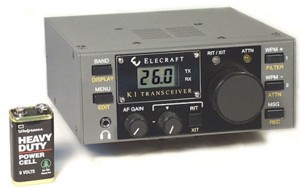
Today I will get my K1 off to its new owner in Holland. It worked well, but I have not used it since before my stroke. I prefer that someone has it who will use it.
There is one minor fault (which has just occurred) in that the menu button no longer seems to work as it did. I think this is a minor fault and I have declared this to the new owner, who still wants it.
In the past the rig has been used to work lots of DX including the USA on 40, 30, 20 and 15m. The rig is a 4-band version with internal auto-ATU. The K1 is a decent little radio.

Amateur Radio Weekly – Issue 77

How can we get more women involved in ham radio?
We are currently dealing with a hobby that is only 15% women that keeps fretting about getting more people involved in it, so why do we allow things that would drive half the population away?
amateurradio.com
How Radio Mala laid the groundwork for lifesaving communication
This is a story about a tool — amateur radio — that has helped, and will continue to help save lives. We call ourselves Radio Mala.
Make:
Arkansas Ham tops his own satellite contact distance record
Operating from an old US Forest Service fire tower atop Rich Mountain in western Arkansas, Swanson worked Manuel “Dom” Ruiz in Valencia, Spain via AO-7.
ARRL
FreeDV champion partners with Outernet
The modem will use QPSK, a LDPC code, and deliver payload data at around 2400 bit/s in a 5kHz RF bandwidth.
Rowetel
Morse code used to cheat during chess match
The 37-year-old player was also “batting his eyelids in the most unnatural way”, Mr Coqueraut said.
Southgate
Experimenting with the Ham Radio Wilderness Protocol
Just as Morse code was fading in the mid-1990s, the American Radio Relay League proposed the Wilderness Protocol as a way for hikers and campers to call for help in remote areas before mobile cell phone coverage became ubiquitous.
KC4LMD
D-STAR QSO Party 2015 September 18th
The goal of the D‐STAR QSO PARTY is to communicate through as many D‐STAR repeaters as possible throughout the world.
Icom
Using HD radio signals for navigation
In this article, we present the results of a study using AM HD Radio, digital radio in the 540–1700 kHz band of the frequency spectrum, with known transmitter locations, to locate and track receiver locations that are otherwise unknown.
GPS World
The Cold War nuke that fried satellites
The explosion – the world’s most powerful high altitude nuclear test – created an electromagnetic pulse (EMP) strong enough to disrupt global radio communications.
BBC
VHF-UHF Hams asked to observe Radio Quiet Zones
The National Radio Astronomy Observatory (NRAO) at Green Bank, West, Virginia, has asked that hams notify the facility if they plan to operate within 10 miles of either the Green Bank Telescope or the Sugar Grove Research Station.
ARRL
QSO logger for Android
QSO Secretary is a special logging program, optimized for mobile, portable, and field operations. It has been designed to allow quick entry of important information regarding QSOs.
Google Play
How to
See actual microwaves
In this post I will show you how to actually see microwaves by modifying a coffee can radar which you can build at home.
Hack A Day
Simple 28MHz WSPR (or PSK31) RX
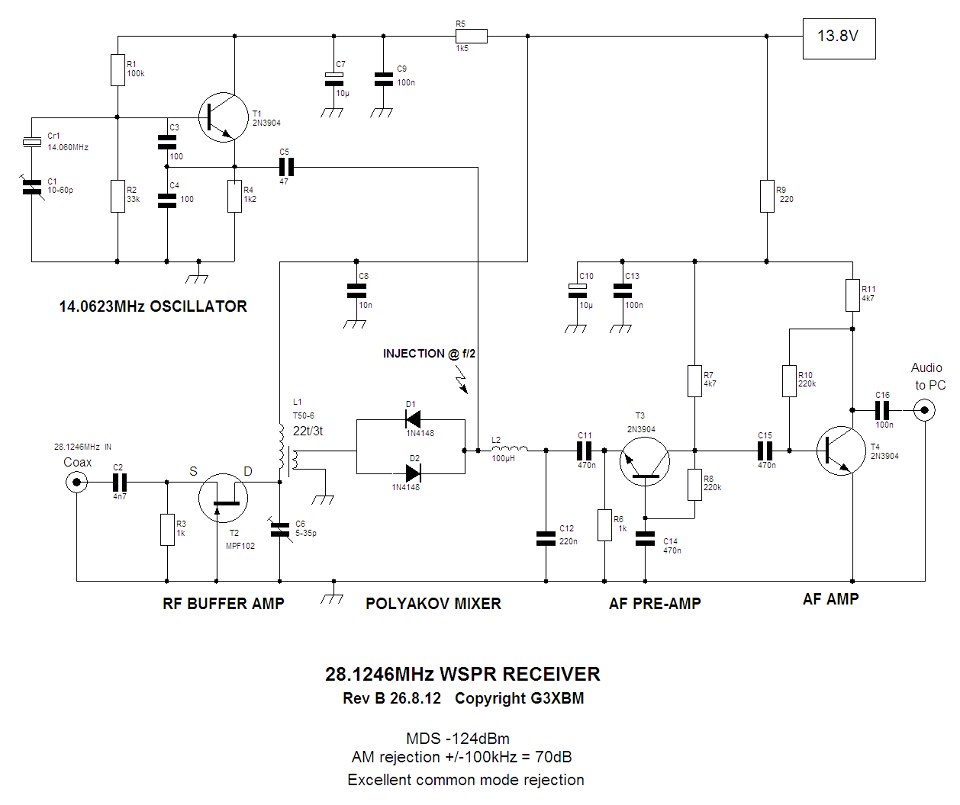
Facebook is throwing up memories from 3 years ago and one of these was a schematic for my WSPR RX for 10m, using low cost 14.060MHz crystals with a Polyakov mixer (injection at half signal frequency) The circuit worked well and could also be used for PSK31. Essentially this is a direct conversion receiver, but it mattered not. Even if you bought all parts new it is very inexpensive. 3 years later I would replace the 2 diodes by Schottky ones as these are now low cost and need less injection than the silicon ones shown.

How can we get more women involved in ham radio?
So, a couple of days ago there was a bit of a flap over on Reddit.
A club called FBOM International which specializes in digital modes created a ham radio promotional video (embedded above) and it was posted (and stickied) to the /r/AmateurRadio subreddit.
Then came a reply from Yvette Cendes, KB3HTS, a student at the University of Amsterdam working on a Ph.D in Astronomy. Here is a portion of her post:
…Let me explain why I find it offensive that this video is now being touted as the ad for our subreddit: it objectifies women and relies on gender stereotypes that would make no woman feel welcome here. We are currently dealing with a hobby that is only 15% women that keeps fretting about getting more people involved in it, so why do we allow things that would drive half the population away? I don’t pretend to have all the answers on a complex issue, but I do know this stickied post is far from what we should want to represent the community. And it goes to show that if we ever have a crack at attracting more women into this hobby we have a long way to go.
I believe the folks who made this video did so with good intentions and without any ill intent whatsoever. In fact, I’m glad they posted it — because it gave Yvette a chance to show that what seemed perfectly fine to some people can offend others looking at it from a different perspective.
Her reply gives us the opportunity to think about why we’re not attracting more women to ham radio and to STEM (science, technology, engineering and math) fields in general. This is a big deal and regardless of whether you agree with her position or feel she overreacted, it’s a discussion worth having.
I’m middle-aged and male. If we’re trying to attract more old guys like me to this hobby, then maybe we can just keep on doing what we’re doing. But if we hope to add more folks outside of this demographic, then we may need to rethink our promotional strategy a little bit.
What are your thoughts?
70cm contest using a 2m big wheel
 |
| Stations worked on 70cm tonight with 5W and a 2m big-wheel omni |
This evening was the September 70cm leg of the RSGB’s UKAC contest, so I decided to give it a go with my 2m big-wheel and 5W SSB. The match on 70cms was very good, but I had no idea how it would actually work. Well, the answer is “very well” as you can see by the stations worked. Best DX was 182km. To say I was pleased is an under-statement! I shall be able to use this antenna again in 70cm contests. I was also able to copy the new beacon NW of Leicester GB3LEU which was pretty good copy on 432.490MHz.

TX Factor Episode 9 is Ready to Watch
The popular UK TV show dedicated to amateur radio is back on the air with episode 9 featuring ham radio Essex-style!
We visit the south east of England to report on the work of Chelmsford ARS, Essex Repeater Group and Essex Ham.
And we’re giving away a CG-PK4 Pocket Memory Keyer in our free-to-enter draw.
Hope you enjoy the show!













