Archive for the ‘Uncategorized’ Category
 Our hobby – very diverse
 October 19th, 2015 |
  Author:
 There can be few hobbies that embrace so much as amateur radio. Some enjoy QRP, often making their own simple gear and each QSO is a thrill. Others spend a great deal of money on rigs, towers and antennas and enjoy just talking to others around the world. Some like the challenge of microwaves or optical. The list is endless.
We are lucky that our hobby can be enjoyed by all ages and abilities and in so many different ways. It is very easy to be critical of how others enjoy the hobby – I know as I am guilty of this! We should be thankful we are a “broad church” and allow each of us to enjoy the hobby in the way that suits us best. I used to enjoy building and field work, but because of my stroke I have had to adapt. Thankfully, I enjoy the hobby as much as ever.

Xiegu X108G Outdoor Version at JOTA 2015
Took the X108G Outdoor Version out to JOTA this weekend outdoors near Neys Provincial Park near Marathon, Ontario, temps during the day were 3c and at night was -4c first night and second night was -7c. We operated from a dining tent outside and was running battery power and a windom at about 15′.
We had light snow and rain during our outing and Saturday morning we did a hike to The Crack which is a large path through the rugged rock in the area.
http://superiorhiking.com/the-crack-in-the-rock/
Here are a few pictures of the weekend and a few links to YouTube videos of the X108G in action:


Was a great weekend out in the bush and having the 1st Thunder Scout Troop again take part in JOTA
Ionosondes, the “Fish Finders” of the Ionosphere, and How Ham Radio Can Help Advance Ionospheric Science
Part 1 of a 3 part Blog
Part 2 will cover the RBN – Reverse Beacon Network & DXMaps.com
Part 3 will describe the RBN Node @ WØLFA
An ionosonde is a portmanteau for “ionospheric sounder,” instruments managed by educational, government, military and scientific agencies around the world to monitor and measure the ionosphere. You can think of Ionosondes as “fish finders” that find, instead of schools of fish, regions of electrons and electrically charged atoms and molecules in the upper atmosphere.
The first ionosondes were invented in the 1920s, grew in sophistication during the 1930s, and were used by both sides during WWII to identify the best shortwave communication frequencies. A thorough history of ionosondes written in 1998 by Dr.Klaus Bibl is downloaded in PDF from the Annals of Geophysics Website here:
http://www.annalsofgeophysics.eu/index.php/annals/article/download/3810/3874
Ionosonde systems incorporate a transmitter tunable from as low as 500-kHz to as high at 40-MHz (1.6 to 12-MHz sweeps are a more typical range), antennas usually pointed straight up, and a receiver that tracks the transmitter listening for echoes reflected back to earth. It is, in other words, a radar system.
One of the four crossed-loop receive antennas used at the now-decommissioned ionosonde site in Lerwick, Shetland Islands (http://www.ukssdc.ac.uk/ionosondes/lersite.html)
Ionospheric weather, like tropospheric weather closer to earth, is in constant flux. The global ionosonde network is periodically mapping the ionosphere measuring the highest frequency reflected back to earth (this is Fc, the critical frequency) and at what height above earth that occurs (which reveals which ionospheric layer is in play). The critical frequency is proportional to charged particle density in each ionospheric layer. Signals at frequencies above Fc at the F2 layer (highest ionospheric layer) continue off into space instead of coming back to earth. Here is an example of an ionosonde ionogram (vertical axis is km above ground, horizontal axis is frequency in MHz):
Annotated ionogram from Wikipedia (en.wikipedia.org/wiki/Ionogram)
Knowing the critical frequency at various points around the world enables calculation of MUF (Maximum Usable Frequency) for shortwave radio broadcast and two-way radio communication in those regions. A useful rule of thumb is the MUF will be around three times the Fc. So, for a Fc of 6.2-MHz the MUF for signals transiting that region of the ionosphere would be around 18.7-MHz. In such conditions, the amateur 17-meter band, centered on 18.1-MHz, would be a great choice for long distance communication, as would the 20-meter band (14-MHz). The 15-meter band (21 MHz), on the other hand, would likely be ‘dead’ for paths across that region.
Q: why is the MUF so much higher than the Fc? A: radio waves propagated over long distances are refracted (bent) back to earth at acute angles, not ‘bounced’ back to earth like a handball off a wall. Less ionization is needed for refraction at low angles than for a return of a signal transmitted straight up.
(In addition to electron density profiles, ionosondes can measure Doppler shifts and polarization of ionospheric echoes. Why hams should care about ordinary and extraordinary waves and the polarization of ionospheric propagated signals will be the topic of a future WØLFA Blog post.)
How many ionosondes are in regular operation around the world and are reporting their data publicly? Best I can tell, it’s something around one hundred. The UK Solar System Data Centre has an interactive map (reproduced below) with data on each site, more info at www.ukssdc.ac.uk/wdcc1/ionosondes/world.html.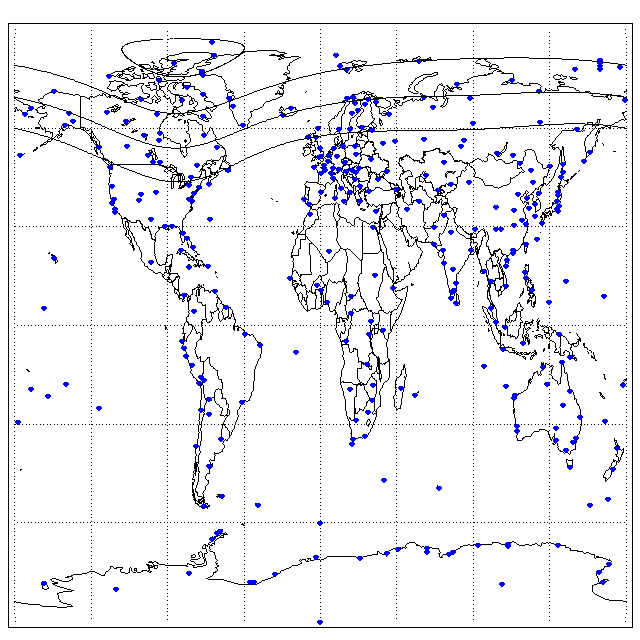
A hundred ionosondes (+/-) is ‘not nothing,’ however, the world’s a big place, and there are large ionospheric regions going unmapped by the ionosonde network. That’s where ham radio comes to the party.
The number of amateur radio operators communicating long distances over shortwave on any given day vastly outnumbers active ionosondes by orders of magnitude. Two of the most popular ham activities are contesting, making as many contacts with as many other hams in as many countries as possible in a given period, typically over a weekend, and DXing, contacting as many countries as possible in one’s lifetime during or outside of contests, the more obscure and hard-to-contact, the better.
“Contesters” and “DXers,” which are not mutually exclusive groups, tend to be very knowledgeable about radio propagation from their own extensive observations. Knowing what bands to operate on and at what times given the current state of the ionosphere can give a contester a winning edge or help a DXer snag an elusive country.
Hams have developed several innovative tools to collect, correlate and analyze the large number of ionospheric observations taking place on the ham bands every day. Every successful contact, a “QSO’ in ham-speak, is a data point. The American Radio Relay League’s Logbook of the World database is closing in on a billion QSO records from over 80,000 contributors! More data = better science.
Part 2 of this Blog will discuss two of the ways hams are collecting and analyzing ham radio-generated ionospheric propagation data in real-time: RBN, the Reverse Beacon Network, and DXmaps.com.
Part 3 will describe the RBN Node @ WØLFA.
Amateur Radio Weekly – Issue 81

DV4mini: All-in-one USB hotspot for D-STAR, DMR, Fusion
USB stick containing 70 cm data transceiver. Works with D-Star, DMR, Fusion, APCO25 and other digital modes which are based on GMSK, 2FSK or 4FSK.
YouTube
ARRL releases excellent Parity Act explanation video
ARRL President Kay Craigie, N3KN, said the video will be made available on Capitol Hill to make sure that Members of Congress have correct information, instead of misrepresentations.
ARRL
Kickstarter: Tiniest APRS tracking device
The Tracksoar APRS tracker is the smallest, lightest, ready to fly open source APRS tracker.
Kickstarter
Criticisms around ARES October SET
These groups rarely (if ever) properly train on the challenges of trying to use NVIS nets around the clock. Many don’t realize that 60 meters is not optional and they will likely need 160 meters in the mix too.
The Kentucky Packet Network
Field Day logging: A study in pain (PDF)
A local area network based logging system shared between stations, stored in a single database.
KK4SXX
AMSAT live OSCAR satellite status page
This page shows the most up-to-date status of all satellites reported in real time.
AMSAT
How a drug cartel took over Mexico with walkie-talkies
Inside the communications infrastructure of the ultra-violent syndicate.
Popular Science
OS X contest software overview 2015
Whether you are a serious contester, a casual contester, or someone who is just getting started, there is a contest logger that can meet your specific needs.
Mac Ham Radio
Curtain antenna for shortwave radio broadcasting
The curtain antenna is a dipole array, consisting of rows and columns of dipoles.
Broadcast Belgium
D Layer absorption
We learn in Technician Class and General Class studies that the ionosphere’s D layer is created in the daytime by ionizing solar rays and fades away completely at night, and we learn that the D layer absorbs HF frequencies below the 20-meter band.
Ham Radio School
How to
Dealing with urban radio interference on shortwave
The levels of urban radio frequency interference, or RFI, have increased dramatically in the last two decades and the proliferation of poorly engineered electronic gadgets is largely to blame.
The SWLing Post
Video
Amateur Radio: A 21st century hobby
Whether you enjoy writing software, getting hands-on with practical equipment, developing new technology or simply want to use what’s already there to communicate with others across the world, you’ll find all of this – and more – within amateur radio.
RSGB
Basic amplifiers: 1963 U.S. Army training film
An electronic amplifier is used for increasing the power of a signal.
U.S. Army
DX and Fall Colors
Judy and I took a walk near Hunkins Pond this afternoon. The fall colors were at their best! 20 meters was pretty good too. I worked Cuba, the UK and Rhode Island.

We hiked west and north on the old range road. When we got to David Swain’s north field, we turned in. The view was stunning. Even though the true temperature was 55F, in the sun it was almost 75F. I set up the Par 3-band end fed wire as an inverted vee over a maple branch and sat down in the sun. It was glorious.

I was running the KD1JV Mountain Topper at 3 watts. As I tuned down the band, I heard T47GDXC calling CQ. This is a special event station from Cuba. We exchanged quick 599’s and I was glad to have one contact under my belt. I had an ear to stations on the band and both eyes on the fantastic view.

Tom G3HGE from England was working one station after another. He and I are old friends and I was anxious to work him again. I called several times but other stations beat me to it. Finally, I got my chance and called him in the clear. “PID?” he sent and I returned with my call sign several times. At last he copied my call and we had a wonderful exchange. He was a solid 569, but I was only 339 to him. “UR signal is dropping to S1,” he sent as I told him I was operating portable in the beautiful outdoors. We signed after a couple of minutes, but I was thrilled to complete a QSO with him for the first time in a month or so. My little Mountain Topper sat in my lap with a notebook on my knee. You’ll see Tom’s call sign in the notebook.

I switched to 40 meters to see how that band was and heard Joe N1EFX in Rhode Island right away. He was calling CQ with a solid 589. He gave me a 449, but copied well, and we chatted for several minutes before signing.
I was satisfied with the contacts and wanted to hike down through the fields a bit before heading home. We headed east and south on the range road and came to Dearborn’s Farm. What a wonderful spot. Shimmering green grass, trees aflame in gold and corn over 8 feet high. We headed into a quiet glen and I took a quick snapshot.

These glorious days are so fleeting. Tomorrow and the next day it’s supposed to rain. We may lose much of the color.
Xiegu X108G Review Continued

Xiegu X108G Outdoor Version
Continued Review: October 14, 2015
Having played with the radio mostly doing some CW operations and some shortwave listening I have stumbled across a few little issues that I am hoping can alos be fixed by Xiegu by way of firmware issue.
I have to say once again that this little radio does pack quite a punch for what is in the box, and at the same time this radios performance is guaranteed inside the amateur radio bands, anything else like expecting a hard headed shortwave radio or am broadcast band radio for DXing might be just a bit naive.
Again I have operated this unit on cw and have still to test it on SSB. But in my cw tests I can tell you that the cw tone tested against other radios seems to be spot on. When up against the FT-857 the blue light flashes right along on the same frequency. The 500hz filter also works extremely well and takes all that noise out and allows working the intended station easy. I run the radio with the ATT off and signals are clearly heard without a problem on my windom. I used straight key for my operations but there appears to be an issue with the built in keyer, it wants to add extra characters so until this is fixed stay with a straight key.
So what have I found that needs to be addressed on this radio, let me start:
I was attempting to check into a voice net on 40 meters one evening as they were looking for checkins on phone or cw. So I figured I would test the split function out and set one VFO to cw and the other to SSB, well I was surprised to find that the radio will not transmit cross mode, I would have to have both VFO’s in the same mode to do anything which did not work obviously.
The second issue that brought me to this split mode was the fact that no CWR (CW Reverse) is present that will allow me to listen to the required SSB while in cw mode to check into the same net.
This has been addressed with Xiegu to see if there is a firmware fix for the issues stated, including the Iambic keyer problem. As the radio is now it would make a good SSB rig, but performance as a dedicated cw rig and not being able to check in using CWR kind of takes away the joy of portable use and using the radio as a go-kit emcomm rig. The 20 watts of power and its size is nice when you need that extra bit of punch.
The multikey microphone as well as the two programmable keys makes the mike a handy addition to this radio. HRD can be used and the IC7000 is the settings that are used in HRD to use the radio. We are still working on pin outs for the ACC jack to figure out if full PTT and audio in and audio out are present for digital operations and HRD.
Voltage Test: I did a voltage test to see what the minimum lowest power was to allow this rig to operate, this was asked of me by another portable radio operator. So I found 11 volts is the absolute minimum that the X108G will operate, once 11 volts is reached the radio will then start to motorboat and funny things happen to the radio, many of my battery packs I use for portable operations and teh other radios I use will cut off at 10.6 volts.
The other test that I want to do is to test the radio against an SDR radio like my KX3 or even by SDR dongle to see if any transmit spurs exist outside of the ham bands while in cw. This radio has attained FCC Certification so I know it has already gone through some hoops and hurdles.
So while I await a response from Xiegu I will continue to enjoy this little radio that has been designed as a minimalist radio with no extra bells and whistles attached to it.
Yaesu FT991 issues?
The price is certainly falling for this rig, but quite a few people have expressed disappointment. I cannot comment on these reports. Some are disappointed saying it is, “cheaply made”.
This is a trend of our age: I have noticed that M&S underpants are now thinner and not as good. My wife recently bought a coat (not M&S) and this was thinner than the one it replaced. No, making goods to fit a price seems to be the way things are today, rather than built to last. This says lots about our “consumer society”. Things are not made to last any more: they are designed to wear out or fail so we buy new items.
This is a state of affairs that ultimately cannot last.














