Archive for the ‘Uncategorized’ Category
 SDR, ham radio satellites, and antennas over amplifiers
 March 2nd, 2019 |
  Author:
  Stories you’ll find in our July, 2018 issue:
TSM Guide to Monitoring Air Shows
By Larry Van Horn N5FPW
Every year from March through November, millions of people hit the road to watch the excitement and thrills as military and civilian aero teams put their high-performance aircraft through their paces to entertain the crowds and perform at air shows all over the world.But you can add to the experience by monitoring the performing teams’ radio communications. With a radio scanner in hand, you will experience a whole new perspective of the show that few attendees will experience. Larry lets us all in on the frequencies used by all participants in these shows in VHF and UHF civilian and military bands.
A Look Back at the 2018 Air Shows
By Brian and Jo Marie Topolski
Air shows offer a variety of aerial action and every year is a little bit different. Veteran air show attendees, Brian and Jo Marie, give us a look ahead at the 2019 season and a look back at what happened last year. Among the new teams to look for this year are the Royal Air Force aerobatic jet team known as the Red Arrows and the US Department of Defense F-35A Lightning II demonstration team. Brian and Jo Marie tell you where you are likely to hear communications from these teams as well as all of the others. The duo also takes a look back at the losses that occurred during last year’s air show season.
Photos from 2018:
B-52 Stratofortress; Japanese Navy Type 97; Mitchell B-25
By Brian and Jo Marie Topolski
It’s hard not to be attracted to the impressive sight of a Blue Angels or Thunderbirds aerial demonstration. The number of planes in the air at once, the deafening sound of their pass across air show center are thrilling. But there are plenty of quality side shows as well. Brian looks closely at several examples of vintage aircraft and the role they played in aviation history.
In the Air for Sean D. Tucker’s Last Solo Season
By Kevin Burke
The dramatic photo on the front cover was taken by Kevin Burke, who has had the opportunity several times to fly in a chase plane following the daring aerial exploits of veteran air show pilot, Sean D. Tucker. It’s not an easy assignment and to get this kind of photo you need to have a good camera, plenty of experience using it and an ability to forget that you’re being held into the plane by a belt during a flight nearly as breathtaking as Sean’s.
Photographing USAF Thunderbirds’ Air Show Demonstration
By Kevin Burke
When you go to an air show, you’ll want to bring along your camera to try to freeze some of the drama for later viewing. But, there’s a trick to photographing moving objects, particularly when they’re moving at hundreds of miles per hour, at heights anywhere from 200 feet to 5,000 feet, under rapidly changing light conditions. Kevin has had a lot of experience doing so and has some tips for your next air show.
Scanning America
By Dan Veeneman
Scanning Jackson County, Mississippi
Federal Wavelengths
By Chris Parris
Atlanta Federal Mysteries and Super Bowl 53
MilCom
By Larry Van Horn N5FPW
Monitoring Venezuela’s Military
Utility Planet
By Hugh Stegman
Rejoice! WWV is Saved!
Shortwave Utility Logs
By Mike Chace-Ortiz and Hugh Stegman
VHF and Above
By Joe Lynch N6CL
ESA Astronaut Tim Peake KG5BVI and
UK Space Agency’s Principia Education Campaign
Digitally Speaking
By Cory GB Sickles WA3UVV
EMCOMM and DV Radio
Amateur Radio Insights
By Kirk Kleinschmidt NT0Z
Antennas before Amplifiers
Radio 101
By Ken Reitz KS4ZR
OTA-TV and the Mystery of HDMI
Radio Propagation
By Tomas Hood NW7US
It’s a Gray Area
The World of Shortwave Listening
By Ken Reitz KS4ZR
Shortwave Listening in the 21stCentury
The Shortwave Listener
By Fred Waterer
Shortwave Still Offers Exotic Listening
Amateur Radio Satellites
By Keith Baker KB1SF/VA3KSF
Amateur Radio Satellite Primer (Part III)
The Longwave Zone
By Kevin O’Hern Carey WB2QMY
Still Learning with SDRs!
Adventures in Radio Restoration
By Rich Post KB8TAD
James Millen and the Toy Company
Antenna Connections
Dan Farber AC0LW
Flying High Again: Aircraft Antennas
The Spectrum Monitor is available in PDF format which can be read on any desktop, laptop, iPad®, Kindle® Fire, or other device capable of opening a PDF file. Annual subscription is $24. Individual monthly issues are available for $3 each.
Amateur Radio Weekly – Issue 231

Reduce HF noise with Faraday Cage for switching power supplies
The results are very promising with the shielded supply eliminating the noise almost entirely.
rtl-sdr.com
“RF Seismograph” may be real seismograph
Alex Schwarz, VE7DXW, in British Columbia, Canada, is exploring the possibility that “RF signatures” detected by the RF Seismograph propagation tool could also be indicating earthquakes, and may even be able to predict them shortly before they occur.
ARRL
FreeDV QSO Party 2019
April 27th 0300z to April 28th 0300z 2019. This is a great chance to try out FreeDV and work Australia using open source HF digital voice.
Rowetel
Does WiFi kill houseplants?
Spoiler alert: No. To come to that conclusion, Andrew McNeil ran a pretty neat little experiment.
Hack A Day
Ultimate crimp guide with photos
Common wire-to-board, wire-to-wire connectors, and crimp tools.
Matt’s Tech Pages
In-depth: Ham Antarctic expedition
Between January 14 and February 18 I have been away from home on a research expedition to Antarctica. Several people have asked me for a post detailing my experiences.
Daniel Estévez
WiFi RF as art
The installation represents four open Wi-Fi Internet access points. By connecting to these points, visitors to the exhibition influence directly, through their network activity, a rhythmic sound generation process.
vtol
Ailunce HD1 Codeplug
If you are like me and just want to use your HD1 with a Jumbo Spot (or any hotspot) this is the easiest codeplug you’ll ever find.
K0PIR
LTE on Ham Bands in Austria
The goal is to use SDR and OpenLTE software to develop fast data transfer from 70cm upwards.
Southgate
Video
How to decode POCSAG & FLEX using an RTL-SDR Dongle
How to decode POCSAG & FLEX pager messages.
M6LME
Explained: The first geostationary satellite for Ham Radio
We take a look at the Ham Radio transponders of the new Es’Hail 2 Satellite.
Tech Minds
Get Amateur Radio Weekly in your inbox.
Sign-up here
The 2019 Novice Rig Roundup (NRR)
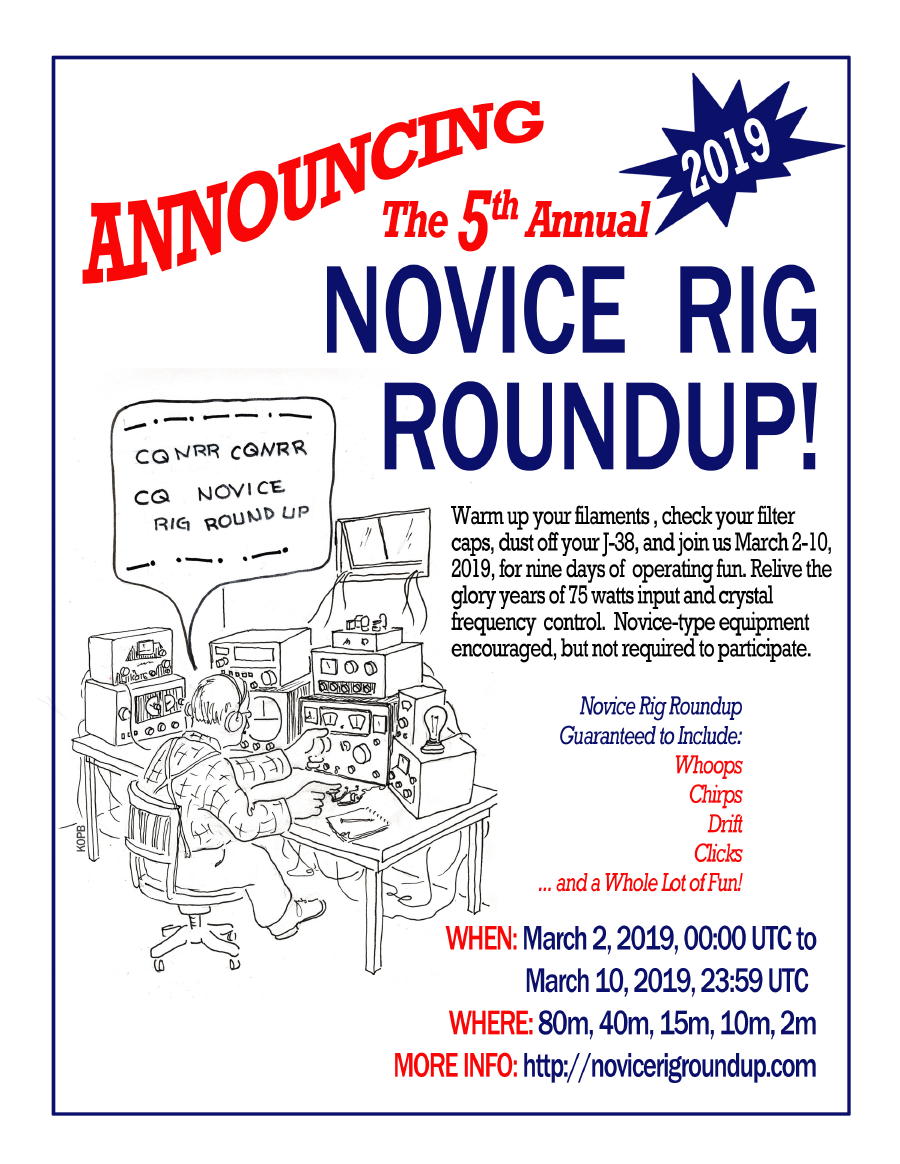
One of the most enjoyable operating events of the year is fast approaching — the Novice Rig Roundup or ‘NRR‘. Technically, it is a contest, but I have the feeling that most participants think of it as just a lot of fun and a nice opportunity to hear and work some of the great old ‘classics’ of the past — rigs that were used when they were teenage Novices or rigs that they could only drool about owning, back in those formative years when they each discovered the magic of radio.
Once again the bands will be alive with the sounds of Heath AT-1s, DX-20s, DX-35s, DX-40s and DX-60s, Johnson Adventurers, Eico 720s, Drake 2NTs, Knight T-50s and T-60s, Ameco AC-1s and of course, an endless variety of lovingly-constructed homebrew delights and … a full 9 days to celebrate the ‘good old radio days’ of their teen years, as many of us remember them.
The dates to remember are 0000 UTC March 2 to 2359 UTC March 10 and this multi-day opportunity is, for me, what makes the NRR so enjoyable. With a nice diversion from the usual ‘contest frenzy’ associated with standard weekend operating events, the NRR can be enjoyed throughout the week, whenever you choose to participate. If last year’s operating patterns continue, you should find activity at any time of the day … and even more as sunset arrives.
With the fast-approaching solar minimum, we will be hard-pressed to relive the glory days of worldwide 15m propagation, as even last year’s event proved to be tough on this band. With a little luck and, hopefully, a well-timed solar flare, we may get lucky! If you operate during the daylight hours, please get on 15m and give it a shot … and be sure to announce your activity on the NRR’s sked and chat page here, so that others will know where to find you, especially if you are rock bound in true Novice fashion. With our present spotty conditions, we need all the help we can get and the sked page proved a very valuable asset during last year’s affair.
Although technically not required, if you plan to participate it’s best to obtain your own NRR number, which is an easy 30-second process.
Additionally, there is an online logger where participants can post their daily log. The nifty logger also keeps track and figures out your score as it goes and no ‘after contest’ log needs to be submitted. If you plan on submitting a log, the logger is a requirement. The logger will also require you to set up a ‘log-in’ and once again, a simple 30-second process will take care of that from here. If you used the logger last year, you will have to set it up again for this year as the old system has been changed.
Stations may run either crystal-control or VFO or can switch between either method … the online logger will keep track and score things appropriately.
All of the rules and information can be found on the NRR’s excellent website. As well, the soapbox comments and station pictures from last year’s NRR may provide the inspiration that you need to spark-up your own activity in this year’s event … from what I can tell, this year will be bigger and busier than ever!
There is also a dedicated NRR Yahoo Group, often the source of much valuable discussion but there is a now HUGE group of great NRR chat and activity now on Facebook’s NRR Group here. I avoided Facebook for many years and have now discovered that it is an excellent forum for real time chat and information exchange … one can still choose to maintain a very low profile and avoid unwanted interaction if set up correctly.
In 2017 I ran my homebrew Longfeller in the (now eliminated) QRP category, and had a ton of fun. You can read about it here. Last year, I refurbished a nice Drake 2NT that had been gathering dust in the basement for over 25 years and ran it during the 2018 NRR. You can read about my activity and some of the rigs encountered during last year’s fun here.
If you have access to the web while operating, be sure to bookmark and check into the NRR’s realtime chat page. Many ops that are crystal controlled will announce their operating frequencies, making it easier for you to find them … sometimes way up or down from the normal NRR watering holes of ~ 3550 – 3650 kHz, 7100 -7125 kHz, 21.100 – 21.150 MHz and 28.114, 28.120 MHz … and don’t forget to check the colorburst crystal frequency of 3579!
‘CQ’ers should always remember to tune up and down the watering hole for replies from other NRR stations that may be crystal controlled and not able to answer you on your own frequency!! This is extremely important and a real reminder of what was common practice back in the Novice days.
 |
| courtesy: Harry – VE7AIJ |
Harry’s homebrew 6AQ5 crystal oscillator (Feb ’55 Popular Electronics) and Hallicrafters S-53, pictured above, allowed him to work the world back in the amazing radio days of Cycle 19. Let’s relive some of that excitement in the closing days of Cycle 24 … in the NRR!
You still have time to get that old clunker on the air but if that’s not possible, you can join the fun with your modern rig as well … all are welcome to jump in and have a great week of radio-fun. I think you will be surprised, just as I was last year, how good some of these old classics can sound … and you’ll hear some great bug-fists as well.
As indicated on the NRR website, this is “more of an EVENT than just a typical contest … once again taking our OLD ham radios off the shelf and putting them to use again! “
See you in the 2019 NRR!
Amateur Radio Weekly – Issue 230
US Amateur Radio Population Grows Slightly in 2018
The US Amateur Radio population once again grew by about 1%.
ARRL
The myth of VHF line-of-sight
I’ve come to realize the limitations of this model and how it causes radio hams to miss out on what’s possible on the VHF and higher bands.
K0NR
Ham radio and the condo life
I have been doing it for close to 7 years now and it does have it’s challenges.
VE3WDM
Random Acts of Kindness
The measure of a person is how they interact with someone who can do nothing for them in return.
AmateurRadio.com
Pi-Star hotspot getting started
The metal box is very solid, the board is good quality and the OLED display was already soldered in place. There was some soldering in that the pin headers for attaching to the Pi had to be soldered on to the Pi Zero board.
marxy.org
Receiving Es’Hail-2 GeoSat
Es’Hail-2 (QO-100) is a geostationary satellite at 25.5° East which carries transponders usable by radio amateurs.
M1GEO
Winlink on a Raspberry Pi
OH8STN
Repeater timeout project kit launched
A new project kit neatly solves the problem of alerting you before you hit the crucial timeout moment.
Essex Ham
Video
Ham Radio Deluxe Logbook 8 Things to Know
K0PIR
Dr. Tamitha Skov: Space Weather Woman
Space Weather News | Orbit Outlook and Meteors 02.21.2019
YouTube
Get Amateur Radio Weekly in your inbox.
Sign-up here
Directional antennas, multi-mode digital voice, and lousy propagation
 Stories you’ll find in our February, 2019 edition:
The Development of the Directional AM Broadcast Antenna
By John Schneider W9FGH
In the early years of AM radio broadcasting, all stations utilized non-directional antennas made of wire and suspended between towers or buildings. Interference, especially at night was severe—enough to disrupt reception of the desired station—and if the frequencies of the two stations were slightly separated, there would be a heterodyne beat note. As a result, only a few widely spaced stations could operate on each of the AM broadcast channels in the entire country at night—many of which shared time on a single frequency. As antenna technologies were developed and improved in the early 1930s, a few progressive stations began experimenting with multi-element directional arrays. John gets into the details of those early experiments that led the way to today’s AM antenna arrays.
TSM Reviews: Jumbo MMDVM Hotspot
By Mark Haverstock W8MSH
Over the last few years, several hotspot interfaces have appeared on the market such as DV Mega with Raspberry Pi, DVMega with Bluestack, Shark RF OpenSpot, and DV4Mini—all hovering around the $200+ range, making them a bit pricey for all but the most dedicated digital radio users. However, a new wave of digital hot spot, manufactured in China, are finding their way onto eBay, Amazon, and other online sites. These Multi Mode Digital Voice Modem (MMDVM) boards are not developed to replace repeaters, but rather to supplement them. In areas where there is no repeater, a hotspot lets a user connect directly to a digital network via the Internet. In areas of heavy repeater use, a hotspot allows the user to access the digital network without competing for an available time slot. Mark tells us how all of this works in actuality.
Piggy Bank Ham Radio: Part 3
By Cory GB Sickles
In the third installment of his Piggy Bank Ham Radio series, Cory explains the concept of literally saving pennies for cheap adventures on the ham bands that can have much bigger payoffs. His advice includes how to assemble the most useful tools at the best possible price; how to improve your soldering skills to repair older equipment that may need only a small amount of work to be useful again; making use of off-the-shelf technology you may already have to further your amateur radio activities. Cory provides good advice for new hams and veterans of the bands alike who want to spend more time on the air and less time looking through online catalogs and wishing they were.
The Discoveries of Hans Christian Ørsted
By Georg Wiessala
The Great Danish scientist, Hans Christian Ørsted, was a pioneer of electromagnetism who paved the way for Michael Faraday (1791-1867), Bohr and others. With his brother, Anders Sandøe Ørsted (1778-1860, who became a jurist and the third Prime Minister of Denmark), Hans Christian epitomized what has been termed the “Danish Golden Age,” from the turn of the 18th Century to the mid-19th Century. It was he who was said to have coined the word “electromagnetic.” The theoretical world in which Ørsted worked was packed with adherents of opposing philosophies but it was a chance observation that allowed Ørsted to claim an important contribution to the science of electricity.
Scanning America
By Dan Veeneman
First Look: Uniden Bearcat SDS200
Federal Wavelengths
By Chris Parris
Tucson Federal Update and DoE
Milcom
By Larry Van Horn N5FPW
Aircraft Spotting in the Digital Age
Utility Planet
By Hugh Stegman
It’s Time to Expand Aero Band SELCAL
Shortwave Utility Logs
By Mike Chace-Ortiz and Hugh Stegman
Digitally Speaking
By Cory GB Sickles WA3UVV
DV Miscellany
Amateur Radio Insights
By Kirk Kleinschmidt NT0Z
Audio Equalizers—Awesome, Overlooked and Gobbledegooked!
Radio 101
By Ken Reitz KS4ZR
Shortwave Listening in Your Car
Radio Propagation
By Tomas Hood NW7US
Lousy Propagation on 40, 80 and 160 Meters
The World of Shortwave Listening
By Andrew Yoder
Government Shutdown Spurs Pirate Shortwave Activity
The Shortwave Listener
By Fred Waterer
Shortwave Radio Yesterday and Today
Amateur Radio Astronomy
By Stan Nelson KB5VL
Tracking Meteor Activity
Adventures in Radio Restoration
By Rich Post KB8TAD
EICO HF-35: A Williamson-Mullard 520 Audio Amplifier
Antenna Connections
By Dan Farber AC0LW
Stealth: An Ongoing Philosophy
The Spectrum Monitor is available in PDF format which can be read on any desktop, laptop, iPad®, Kindle® Fire, or other device capable of opening a PDF file. Annual subscription is $24. Individual monthly issues are available for $3 each.
Ham radio and the condo life
Ham radio from a city condo…….I have been doing it for close to 7 years now and it does have it’s challenges. I have had great success with some cool world wide contacts. In Canada it’s tough to get into the housing market right out of the gate so many younger ham’s are getting their foot into the market with condo living. Then those ham’s who are retiring and want to downsize are considering condo life as well. I am here to say that in condo life there is also ham radio!!
Before we talk about the nuts and bolts of condo ham radio lets deal with some of the basics. I have always found it avoids condo board letters if you read and understand the rules and guidelines of your particular condo. Yes get used to it if you are going to move into a condo there are rules and expectations. What does this have to do with ham radio………well if you are seen as a respectful owner (or renter) of the condo board, residents and property it can go a long way.
For example most condo guidelines (nice condo word for RULES) do not allow “permanent antennas” on the balcony. This rule is yes for Amateur radio antennas but I believe the condo is concerned about the mini satellite dishes springing up or HD antennas. Just one of many challenges a condo radio op has to creatively deal with. In my case I have the MFJ 1788 mag loop and in my newest condo (6 months now) the antenna is portable and it not “permanently” mounted on the balcony. In my humble opinion having a low key antenna is important. Having whip antennas extending over the balcony or wires making their way down the side of the building just invites a letter from you know who from the office of your know where!! Like it or not we are all human and once this happens you have the microscope on you…..not a very nice situation to be in.
In a condo your fellow “condo-ites” are very close to you and that means RFI on your part but also on their part as well with all the unfiltered electronics on the market today. The positive outcome to this is you will become very knowledgeable on dealing with RFI. Oh and a word of advise…..I have read this in the past “go see your neighbor and suggest installing filters on their electronics” Up here in the land of snow and proverbial “thank you” we always say to apparently to everything……there is no thank you response from someone you are asking to tamper with their electronics. Rigs these days have excellent filtering and that are some accessories you can purchase to knock out the worst of offender.
Well that is enough for today….in posts to follow I am going to look at RFI, power output and no as a condo dweller you are not a QPRer for life………..nothing wrong with that either!! What antennas I have had that work, some of the better modes (not just digi either) to work and last but not least what happens if your in a situation were absolutely operating is possible, well I am here to say that you will still be able to get on the air in you condo on HF working DX!
Stay tuned.
Random Acts of Kindness
About 15 years ago, during a trip to Florida on an oppressively hot August day, I was dispatched to the local super market to get an ingredient for dinner. As I approached the entrance an older gentleman was heading toward his car. He was using his shopping cart more like a walker then a transporter of grocery items.
I noticed his car had a Purple Heart license plates I walked over to him and said, “Thank your for your sacrifice and service.” He literally started to cry, commenting that he had the plates for about 10 years and I was the first one ever to comment on them. In the ensuing conversation he disclosed he was wounded during the invasion of Guadalcanal and was also awarded the Bronze Star.
Starting on that eventful day I approached every veteran I could identify by sticking out my hand and saying, “Thanks for your service.” In the ensuing years everyone recipient would say, “thank you,” and frequently a nice conversation would follow.
When Viet Nam vets returned home they were treated with disdain. They didn’t dare wear their uniforms in public because people would curse at them and frequently they were spit upon.
I am of the opinion that irrespective of our personal opinions of the military and wars we owe a debt of thanks to those who severed, especially those who put their lives on the line. If I can identify a Viet Nam veteran I shake their hand and say, “Welcome home and thank you for your service.”
What is a Random Act of Kindness?
A random act of kindness is simply a deed we do to give pleasure to someone else with no expectation of anything in return. Thanking a vet is just one example, however, the kindness universe is infinite.
We humans tend to complain frequently and give accolades rarely. Have you ever complained to the manager of a restaurant that the meat was overcooked and the server was impolite? Thinking positively rather than negatively the comment could be, both your food and service was great.
The pervasiveness of a lack of positive feedback was driven home during my master’s graduation at Monmouth University. The then New Jersey Governor Thomas Kean was the keynote speaker. He started his presentation with the question, “How many of you know this is the year of the teacher?” Many people, especially students, raised there hand. He then asked, “For everyone, not just graduates, how many of you have had a teacher who made a meaningful impact or change in your life?” Almost everyone raised their hand. Next question from Governor Kean was, ‘How many of you ever took the time to thank teachers who had a meaningful impact on your life?” Almost no one raised their hand.
There is an important point here, just because someone is doing an outstanding job doesn’t mean they wouldn’t appreciate a pat on the back.
What Does This Have to do with Ham Radio?
Nothing and everything. Courtesy doesn’t have starting and ending boundaries. Have you ever thanked anyone who helped you with a difficult point when you were preparing for you license? How about a speaker of at a meeting? Almost everyone applauds the speaker but there is nothing like going up to the speaker and saying, “Great presentation, I learned a lot.” How about thanking the outgoing officers of your club, the publisher of your club’s newsletter or the person who makes the snacks at meetings?
My father’s mantra was, “The measure of a person is how they interact with someone who can do nothing for them in return. I think he was talking about random acts of kindness.
One last thought. Place a phone call to a couple of your ham radio friends and simply tell them, “Since I’ve met you I am enjoying ham radio much more which carries over to the quality of my life.”
Thanking or complementing someone will make you happy and possibly make the recipient’s day. It’s a win-win deal.













