Archive for the ‘Uncategorized’ Category
 Amateur Radio Weekly – Issue 264
 December 3rd, 2022 |
  Author:
Open-Source passive radar taken down for regulatory reasons
KrakenRF team has stumbled into an arms-trafficing legal roadblock for their KrakenSDR-based passive radar code.
Hack A Day
Turn a 20+ year old Yaesu FT-817 into a CW mean machine
It was quickly becoming clear to me that my humble FT-817 couldn’t cut the mustard in the world of serious CW operating.
Ham Radio Outside the Box
FCC OKs Ham-Military QSOs for Pearl Harbor Day
The FCC has approved an ARRL request to permit contacts to be made between amateur stations and military stations.
CQ Newsroom
Can you handle yet another ‘OTA?
Coming soon to a body of fresh water near you.
AE5X
40 MHz beacon in Denmark off air due to electricity costs
OZ7IGY has an annual electricity bill of more than 2,800 EUR.
EI7GL
FCC Commissioner advocates for preservation of AM Radio
FCC Commissioner Nathan Simington said AM radio is an “indispensable resource.”
Radio World
Turning a trailer wiring harness into ready-made ground radials
Now we have four 25 foot radials. Bonus was all were different colors. Easy to untangle.
QRPer
Raspberry NOAA V2 Edition 2023 image released
Raspberry Pi automated NOAA and Meteor weather satellite capture.
RTL-SDR.com
How to repair a broken solar panel
I learned that solar panels have bypass diodes and that if one fails, it will cause reduced output on a solar panel.
Mikes Tech Blog WB8ERJ
222 MHz: Is anybody there?
Amateur Radio on 222 MHz has endured several reallocations and other changes through the years.
On All Bands
Video
Building your own electric motor
Hannah Fry delves into the inner workings of electric motors.
BBC
Innovative use of screwdriver antenna
Would counterpoises work better if the radials where pointed down at a 45 degree angle?
David Casler
Get Amateur Radio Weekly in your inbox.
Sign-up here
CQ WW CW contest wrap up

Amateur Radio Weekly – Issue 263
SKYWARN Recognition Day set for December 3
The annual SKYWARN™ Recognition Day (SRD) on-the-air activity will take place Saturday.
ARRL
Digital Library of Amateur Radio & Communications surpasses 25,000 Items
DLARC has quickly grown to more than 25,000 items, including Ham Radio newsletters, podcasts, videos, books, and catalogs.
DLARC
Survey: How do you find new nets?
We’re researching how the Ham Radio community discovers nets. All information is anonymous.
Amateur Radio Weekly
HF & VHF Ocean Radars – 26 MHz to 43 MHz
Ocean radars measure ocean currents by emitting radio waves from shore-based transmitting antennas.
EI7GL
Decoding the Artemis I Orion vehicle
Seven hours after launch, I used two spare antennas from the Allen Telescope Array to record RF signals from Orion and some of the cubesats.
EA4GPZ / M0HXM
Lithium batteries in the cold: A guide
As a lithium battery cools, the chemical process that creates electricity slows down and the internal resistance of the battery goes up.
Off Grid Ham
The Luxemburg-Gorky effect
A phenomenon of cross modulation between two radio waves.
The SWLing Post
Stand alone SSTV camera
Despite the crude nature of SSTV it works surprisingly well.
Dzls Evil Genius Lair
FUNcube-1 (AO-73) now celebrating nine years in orbit
It has now transmitted more that 16 million data frames.
AMSAT-UK
Video
Exploring a 1 million Watt FM tower
Tour the super tower in Crestwood, MO, serving the entire St. Louis metro area.
Geerling Engineering
DIY sand battery
The theory, practice, and use
Robert Murray-Smith
Iowa Marine Mobile
Had a lot of fun experimenting RMOOTA (Random Metal Objects On The Air) with the boat today.
K0KLB
Get Amateur Radio Weekly in your inbox.
Sign-up here
Amateur Radio Weekly – Issue 262
Ever heard of the Heathkit SS-8000 Digital Transceiver?
The reason that very few Hams have heard of it is that it was never released.
VE7SL
CW Hotline
Think The Bat Phone for CW.
Ham Radio Solutions
DATV Trans-Atlantic experiments
Successful Digital Amateur TV tests on the 29 MHz band across the North Atlantic.
EI7GL
FediHams Digital Voice Network
This digital voice network is intended as a place to hang out for all the Fediverse Hams.
QRZ.is
Pride Radio Group
Pride Radio Group is a virtual radio club set up to demonstrate and promote acceptance within the hobby.
Pride Radio Group
Solar powered Meshtastic network
Austin Mesh is a community group working to build a mesh network of solar-powered Meshtastic radios.
Austin Mesh
Why do I want to buy so many Ham Radios?
What is it with this obsession of collecting radio gear?
WK4DS
The enduring Yaesu FT-817 and FT-818 series transceivers
Why choose a legacy design like the 817/818 when newer QRP transceivers have better overall field specs and features?
QRPer
Book: War Diaries – A Radio Amateur
What it’s been like for a radio listener and Ham Radio Operator living day-to-day in Kyiv since Russia invaded Ukraine earlier this year.
SWLing Post
Video
When secret government numbers stations go wrong
Automated stations are prone to errors.
Ringway Manchester
A.I. and Amateur Radio
Artificial Intelligence and Machine Learning and the future of Amateur Radio.
Open Research Institute
W6MRR balloon launch
High altitude balloon launch, Pasadena California. W6MRR, KN6KZF, and K6EAU.
SF HAB
RX888 MK2 16BIT Software Defined Radio
64 MHz real time bandwidth on HF.
Tech Minds
Get Amateur Radio Weekly in your inbox.
Sign-up here
For those Icom 7610 owners a different way to work split.
 |
| Fixed mode with 20kHz span |
I have had my Icom 7610 for several years now and am still very much enjoying it. From time to time I enjoy working DXpeditions and having Dual receivers and dual spectrum scopes with the Icom 7610 is very handy. The spectrum scope has 2 tuning options which are fixed and center modes. It could just be me but I find center mode hard to follow were as fixed mode seems very easy to follow. When you come across a station that is working split more often than not it’s because there is a large pileup and it’s more efficient to work split. For those readers who are not certain what split operation is this LINK explains it better than I can.
During split operation especially with a very rare DX station, there are LOTS of operators trying to contact the prized DX station. For this reason on the DX’s listening frequency, there are many ops trying to make contact. When you as an operator want to get involved and try to contact the DX station you have to drop yourself in the pool of stations calling the DX station.
The trick is where to set your VFO dial to have a chance to be heard by the DX station. In most cases, the DX station has a routine to move up or down his listening frequency which is your transmit frequency. One must listen and watch the waterfall to see who the DX station is answering call after call. You can then get the idea if he is moving up or down his listening frequency and by how much.
As I said there could be lots of callers and this translates to a very crowded waterfall display. To find out where to drop your call one must have a closer look at the waterfall. When this is done you can get some separation between the calling stations. Thus allowing you to better see who the DX station is answering. Then you have a good idea when and where to drop your call and hopefully be heard.
As I said the center mode I find very confusing and when I use it in split mode and spin the VFO I am just lost as to who is where and for this reason I use fixed mode.
As a side note: In center mode when you spin the VFO the signals on the waterfall move and the VFO marker remains stationary. In center mode when the VFO is changed the waterfall signals remain stationary and the VFO marker moves to the next signal.
As was said earlier it is best to have a closer look at the waterfall to see the action. In fixed mode, the smallest slice of the band you can have is 20khz. When operating CW as I do this for me is not enough for a very crowded calling group. In center mode, you can get a slice all the way down to +/- 2.5kHz or +/- 5kHz. For me, these are great options and with CW I generally would choose +/-2.5kHz but the rig has to be in center mode and that just does not work for me.
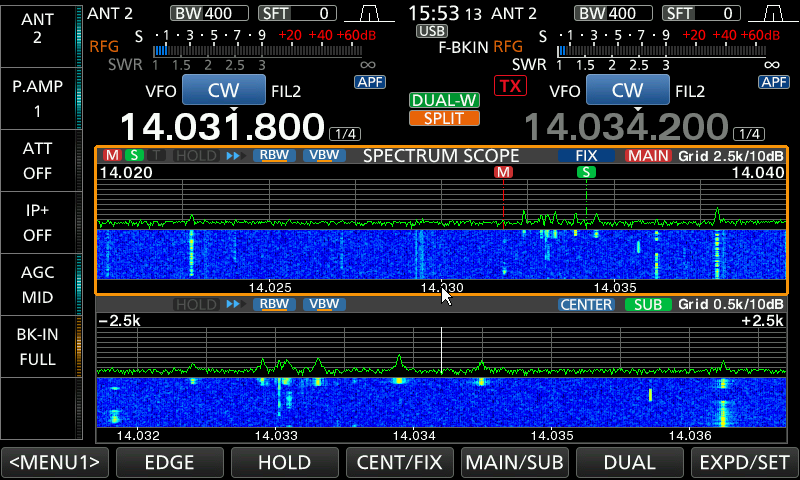
I have found a workaround so I can use the center mode, select +/-2.5kHz and still have the moving VFO B marker and not a moving waterfall! Below are the setup steps I take to make this happen.
In fixed mode, I find the DX station with VFO A
I then press the Dual-W button
Then press and hold Dual-W button to get the settings for VFO B the same as VFO A
I then press the split button
I press the Dual soft key my scope becomes over-under as this is how it is setup. You can see the dual scope view in the post pictures.
I change both scopes to center mode if not there already.
I now set the span to the same on each lower and upper scope in my case it is +/-2.5kHz I then touch VFO B frequency readout on the upper band scope (to activate VFO B)
Now in the upper band scope, VFO A remains stationary on the DX station. VFO B (in the upper band scope) now moves when the VFO dial is turned. The VFO marker moves (like fixed mode) and the band signals remain stationary.
The lower scope is still there but I don’t pay any attention to it. I found if I did not stay in dual scope mode I would lose the CENTER mode for VFO A and FIXED mode for VFO B.
 |
| 5+/-kHz in center mode but VFO acts like fixed mode |
Now with all this said I just know there is going to be a comment that informs me I can press 2 simple buttons on the rig and get the same results. I seem to always take the long way around with things. I have added some screen pics of how the waterfall looks when in 20kHz, +/-5kHz and +/-2.5kHz span during a DXpedition. As you can see when in +/-2.5kHz mode the calling station are easy to see compared to fix 20kHz and +/-5kHz selections. But best of all I have fixed mode operation of VFO B with these small spans.
 |
| +/-2.5kHz span view of pile up calling DX station |
Amateur Radio Weekly – Issue 261
DLARC comes online
Digital Library of Amateur Radio and Communications now available with first batch of collections.
Internet Archive
[Podcast] Deep dive into the M17 Project
M17 is developing a new digital radio protocol for data and voice that is open source.
Linux in the Ham Shack
The decline and fall of RaDAR
Participants set up a station, make 5 contacts, then tear down and move on.
Ham Radio Outside the Box
Simplifying antenna tuning with a manual tuner and a nano VNA on location
Something I have always hated doing is the whole tuning operation and transmitting while I did it.
WK4DS
QRZ Jumpstart Program gives away 2,000 radios
QRZ places a brand new radio into the hands of any person who has been licensed within the past 30 days.
QRZ.com
Measuring height with atmospheric pressure
We’re going to play around with the atmosphere around us, and do a little bit of math, to create a pressure sensor-based height measuring tool.
SparkFun
Radio manual archive
An archive of user manuals, service manuals, and schematics for hundreds of Amateur Radios.
QRZCQ.com
BBC broadcast tech: then and now
We look at the BBC’s pivotal role in making the broadcast and radio technology field what it is today.
Engineering and Technology
Special event station AU2JCB
A special event to commemorate the father of wireless communication, Sir Jagadish Chandra Bose.
AU2JCB
Time to make a choke balun
These devices are present to control common mode currents.
VE9KK
Video
10m FM QSO mobile: Florida <> Vermont
Conditions on 10m were fantastic this morning.
AE5X
The giant Collins HF discone antenna at the Titan Missile Museum
An amazing place and a unique and equally amazing antenna that you can use.
YouTube
Get Amateur Radio Weekly in your inbox.
Sign-up here
Amateur Radio Weekly – Issue 260
Richard Brunton, G4TUT, Silent Key
For countless years, Richard was editor of the popular Southgate Amateur Radio News website.
RSGB
Why I Quit QRP (and maybe shouldn’t have)
I placed the blame for my lack of portable QRP QSOs on poor propagation. In hindsight, there could have been another explanation.
Ham Radio Outside the Box
AMSAT Amateur Satellite Database
Radio frequencies for Amateur satellites orbiting Earth. Search and sort them by name, number and mode.
AMSAT
Build a passive radar with Software-Defined Radio
Spot stuff with the KrakenSDR and two TV antennas.
IEEE Spectrum
Drone to raise antenna using bait drop servo
This approach seems promising and I hope to try it out with a real antenna raising soon.
Marxys Musing On Technology
Making QO-100 contacts from North America–a new challenge
It is understandable that Amateur Radio operators in North America are disappointed that they cannot experience the fun of using QO-100.
AMSAT UK
Identify that antenna by sight
It’s a skill that Radio Amateurs pick up over years but which it sometimes comes as a surprise to find that is not shared by everyone.
Hack A Day
Radio silence grows in Venezuela as government shutters dozens of stations
At least 50 stations in Venezuela have been closed so far this year by the Conatel regulator because it says they lack valid licenses.
Reuters
Baluns and common-mode impedance: How much is enough?
This article starts by defining what a balun is (and is not) along with common-mode current and impedance.
On All Bands
Exploring the handy Prusik Knot
The Prusik knot is a simple, yet effective means to provide needed strain relief to wire antennas and coax.
QRPer
POTAXXIA may be right for you
Pursue your passion while remaining in control.
K0NR
Video
GNU Radio Conference 2022 talks
YouTube playlist of all talks from the 2022 GNU Radio Conference.
YouTube
Creating homemade tubes
Building a 1920s tube amplifier (and tubes!)
YouTube













