Archive for the ‘Uncategorized’ Category
 Not so super-regenerative
 March 30th, 2010 |
  Author:
 The success of my project to make an FM version of G3XBM’s Fredbox was always going to depend on the receiver. The Fredbox receiver is a simple three transistor super-regenerative design. This is the only practical way to make a receiver small enough to fit in a hand-held case. It is also the only cost-effective way to do it, because making a conventional double-conversion receiver with crystal control just wouldn’t be worth it for such a project.
What I didn’t know were a) would the super-regenerative receiver work with FM signals (the original Fredbox was designed for AM) and b) would it be sufficiently stable to stay on frequency without the benefit of crystal control? However, what I didn’t give too much thought to was the possibility that I wouldn’t be able to get it to work at all.
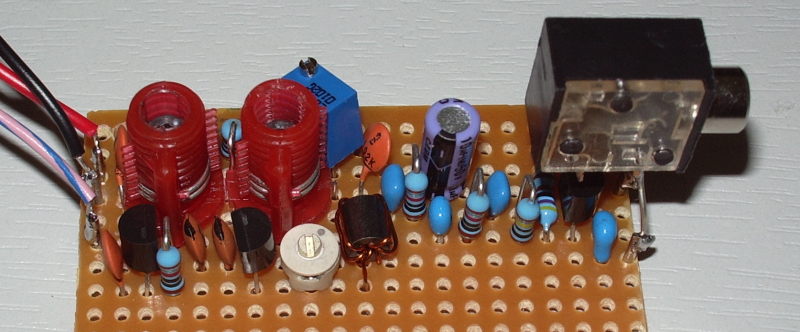 Because this is a VHF circuit I didn’t think I could try it out on the breadboard so I made it up directly on to Veroboard. The layout is pretty similar to Roger’s original layout from what I can tell from the pictures on his website, although I think he made an etched circuit board, something I’m not able to do.
 I drew up the layout using a bitmap editor. This shows the components from the top view. The large outline components are the Toko S18 inductors, and the red lines are wire links below the board connecting the ground traces. The schematic for the receiver part of the Fredbox is shown below. As with the Nano-40 I used an MPS13 in the audio stage in the hope of getting a bit more audio gain.
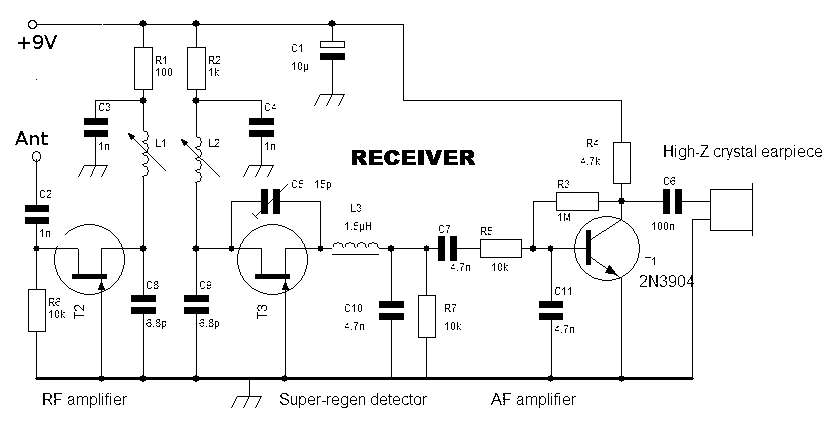 I applied power and expected to hear a hissing sound in the earpiece which stops when a signal is tuned in. However I heard nothing at all. The audio stage appears to be working, as I can hear a faint buzz if I touch something metal to the input.
Alan, VK2ZAY had a lot of trouble getting the receiver to work as well, and he is an experienced constructor who knows what he is doing. I suppose this should have warned me off trying this project. Alan replaced the axial choke for L3 with half a dozen turns of wire on a ferrite bead, and I did the same, but to no avail. I also substituted a variable trimpot for R2 which in many other super-regenerative receiver designs is a variable regeneration control. But no matter what the setting of the pot I could not get any regeneration to occur at all.
I think my FM Fredbox is about to become yet another abandoned project. 🙁

Once-Venerable Radio Shack For Sale?
 The New York Post is reporting that Radio Shack may be courting suitors, namely electronics retailer Best Buy. If you have the cash lying around, you can pick up your very own electronics...errrr cellphone store chain for a cool $3B.
 Could this be the next or perhaps last chapter of our once great electronic hobbyist mecca?

The NA-034 operation that almost wasn’t, Part II

It turns out that there was indeed a park at the southern end of the island named South Lido Park that was the perfect location to try again. There was a parking lot that bordered the park, and there were a few parking spots that were close enough to picnic tables that I could easily set up the radio and antenna on a table (or even on different tables) with the power cables connected to the car battery. This seemed like a good opportunity to get the antenna even farther away from the car and the radio, and hopefully away from the source of the RF interference. I set up the antenna, and was able to throw the counterpoise over a nearby low tree branch. (One of the recommendations for this particular antenna is to keep the counterpoise at least 2 feet off the ground.) I carefully checked the SWR with the antenna analyzer and found a good match.

I decided to try to eliminate the feedline that I’d brought with me as a possible issue, so I connected the antenna to the radio with a very short (about .5 meter) patch cable that I’d brought with me. Normally it’s not a very good idea to set up that close to the antenna, but I figured that for diagnostic purposes I could do it. It turns out that I wasn’t going to transmit very long that way anyway since I had the same problem. At this point, I decided to go back to the regular feedline, which is a 15m length of RG-8x that I’ve used for the past several years without issue. What I did was to create an RF choke by coiling some of the excess feedline at the feedpoint. The idea behind doing this is to help keep RF off the outside of the feedline, where it can radiate and cause issues. Unfortunately, that didn’t seem to help either.
During these tests, in addition to just hearing the odd noise in my headset, and on the radio speaker when I disconnected the headset, I was attempting to call some stations that I had been hearing all afternoon. The location that I had now moved
to was even better than my previous location, as there was water on 3 sides, which means I had an especially good path to Europe, South America, and the southwest US. Some of the stations that I’d tried to contact were extremely strong and should not have been difficult at all to contact. I was finally able to make a contact with S55OO so I knew that the radio was actually transmitting, though he was in the middle of working many other stations so I didn’t have a chance to ask him for a signal report. At that point, I was confused and frustrated at not being able to locate the source of the problem, and given that it was getting late in the afternoon, I decided to break down and shut down for the evening.
After heading back home (well, not to NJ, to where we were saying), I sent an email the Buddipole Users Group to see if anyone there had any ideas what the problem might be. I got back responses from a number of folks within a few hours, most of them suggesting that I try most of the things I’d already tried (which of course they didn’t know I’d done). A couple of folks suggested trying to use some ferrite beads in various places on power cable, microphone cable, and power cables. Unfortunately, I didn’t have any with me, and they aren’t the kind of thing that are stocked in a local hardware store or even Radio Shack. Budd, W3FF, and Scott, NE1RD pointed out that since I’d made one contact that the radio must be transmitting, but it did seem that there was still some problem.
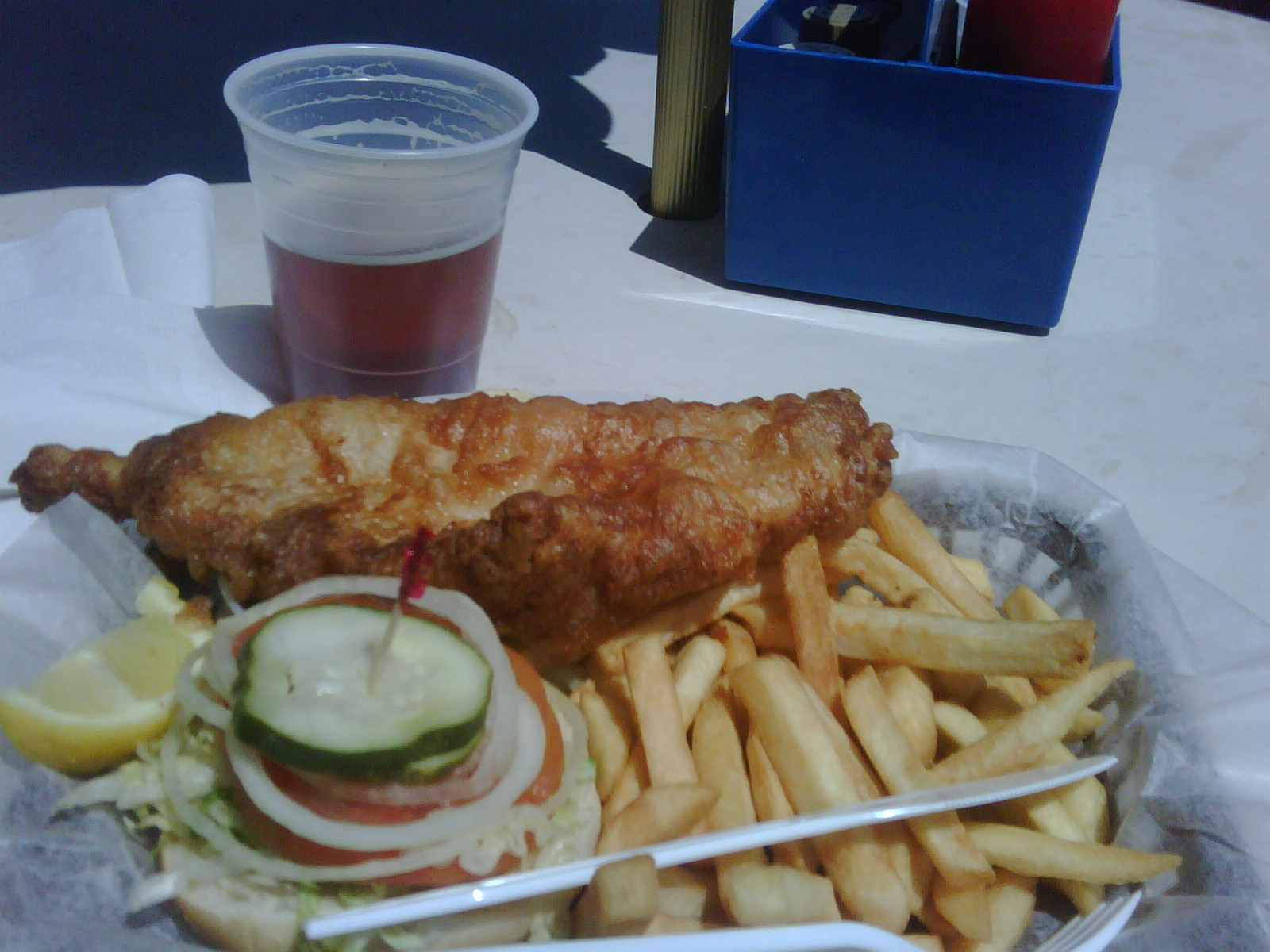
The next morning, I woke up, checked my email and found a few more things to try, packed up the car, and headed out for lunch at The Old Salty Dog on nearby Siesta Key. I was still frustrated that I hadn’t figured out what the problem was, but things always seem better after a beer and a fried Grouper sandwich. They probably would have seemed even better after two or three beers, but since I still had to drive back to the operating site I decided to stop after one.
When I arrived at South Lido Park, I found an even better location than on the previous day, where the operating position was under trees for shade and I was able to set up the antenna on a different table from the operating position, putting even more distance between the antenna, the radio, and the car. I made sure to have the RF choke in place as close as possible to the feedpoint, and wound up as much of the excess feedline into that choke to try to eliminate as much of the unwanted RF on the outside of the feedline as possible.
I was still hearing what I thought was RF in my headset (or from the radio speaker when I switched to the hand microphone), but I decided to call CQ anyway, hoping that perhaps someone would be able to hear me and perhaps let me know what my on-air signal sounded like. I finally got an answer back from Larry, KH6ITY who, as it turns out, was a technology teacher in Texas and was in the middle of demonstrating ham radio to his class. As it turned out, meeting Larry on the air was a wonderful stroke of luck.

Comedy in the woods
As someone who likes a walk in the great outdoors I enjoy reading accounts of people who take their radios out into the countryside for a bit of QRP fun. Today I thought I would try to emulate them. However although I did make a few contacts the attempt was a bit of a disappointment on several counts. Even the photos I took with my camera self-timer were disappointing as the operator completely obscured the radio and a picture of myself sitting on the ground at the foot of a tree apparently talking to my hand is not something I feel should be preserved for posterity on the internet.
As the CQ WW WPX SSB contest was on I thought this would be a good opportunity to make some QRP SSB contacts. The batteries in the FT-817ND seemed to be less than fully charged, and the battery endurance of that radio is poor enough already thanks to its power-hungry receiver. I decided to take my K2 instead, which would give me the benefit of 10W output and really punchy audio. So the local dog walkers witnessed the odd sight of someone setting off up the forestry track into the woods near Watch Hill wearing boots and rucksack and carrying a small Pelican case.
Fifteen minutes later they would have witnessed the even odder sight of the same person trying to throw a stick with a bit of wire attached over a tree branch. Now I know why the MP-1 was invented! After about ten minutes of persevering I managed to get the wire over a branch about 12ft high. The stick hung down the other side tantalizingly out of reach and I spent the next five minutes trying to hook it with the end of my walking stick so that I could pull the wire taut and secure the end of it.
I had previously prepared two lengths of wire for my portable antenna. One is about 22ft long, and has a few feet of nylon cord attached to the end for tying to sticks or rocks to hurl over branches and then secure in position as the radiating element. The other is about 16ft long and is laid out along the ground as a counterpoise. They are fixed to the red and black terminals respectively of a BNC to binding post adapter which is plugged in to one of the antenna sockets of the K2. The reason for the selection of these particular lengths is that I seem to recall them being suggested by Elecraft as good lengths to use with the T1 portable auto-tuner.
There are no picnic benches or tables in the forest so I just sat down on the ground and used the Pelican case as a table. The K2 sat on that, and the antenna ran off directly behind it at about a 45 degree angle, over the tree branch and down a few feet at the other side. The counterpoise ran off at right angles.
I switched on the K2 which was still on 15m from my last mobile outing and immediately heard many strong signals. However signals didn’t seem as loud or as plentiful as I would have expected during a major contest. I pressed the Tune button and the K2 ATU whirred away and finally delivered its verdict: 9.9:1! It couldn’t match it!
I didn’t hear anything on 10m so that wasn’t worth trying. I got a usable SWR on 17m but there was hardly any activity on that band. On 20m the best SWR was between 2:1 and 2.5:1, and on 40m I managed to get 1.5:1. Unfortunately the K2 is a bit SWR-sensitive – something I never noticed during the years I used it as my main home station when I could always get a 1.2:1 or better – and it flashed up Hi Cur (high current) when I tried to use 10W on 40m. So I had to back my power down to use that band, which didn’t help matters.
I made nine contacts in less than an hour’s operating, which included a break to eat my sandwiches:
1130   7.113  ON5SY   59  609  59  001
1131   7.123  PI4Q    59  801  59  002
1133   7.167  PA6Z    59 1022  59  003
1138   7.123  SP4TKR  59 1130  59  004
1143  14.286  YL6W    59 2416  59  005
1212  14.292  HG1S    59 1821  59  006
1215  14.315  OG6N    59 1450  59  007
1217  14.321  SN2B    59 2772  59  008
1218  14.335  SP9LJD  59 1876  59  009
But these were not nice easy contacts like I made using the same radio and the same power from the car using the MP-1 antenna. My thanks, as well as my apologies to the stations that wasted valuable minutes trying to pull my call and serial number out of the ether.
It was getting a bit cold and I felt a few spots of drizzle so I decided to call it a day. I think I’ll stick to taking VHF on hikes in future.

Antenna Party
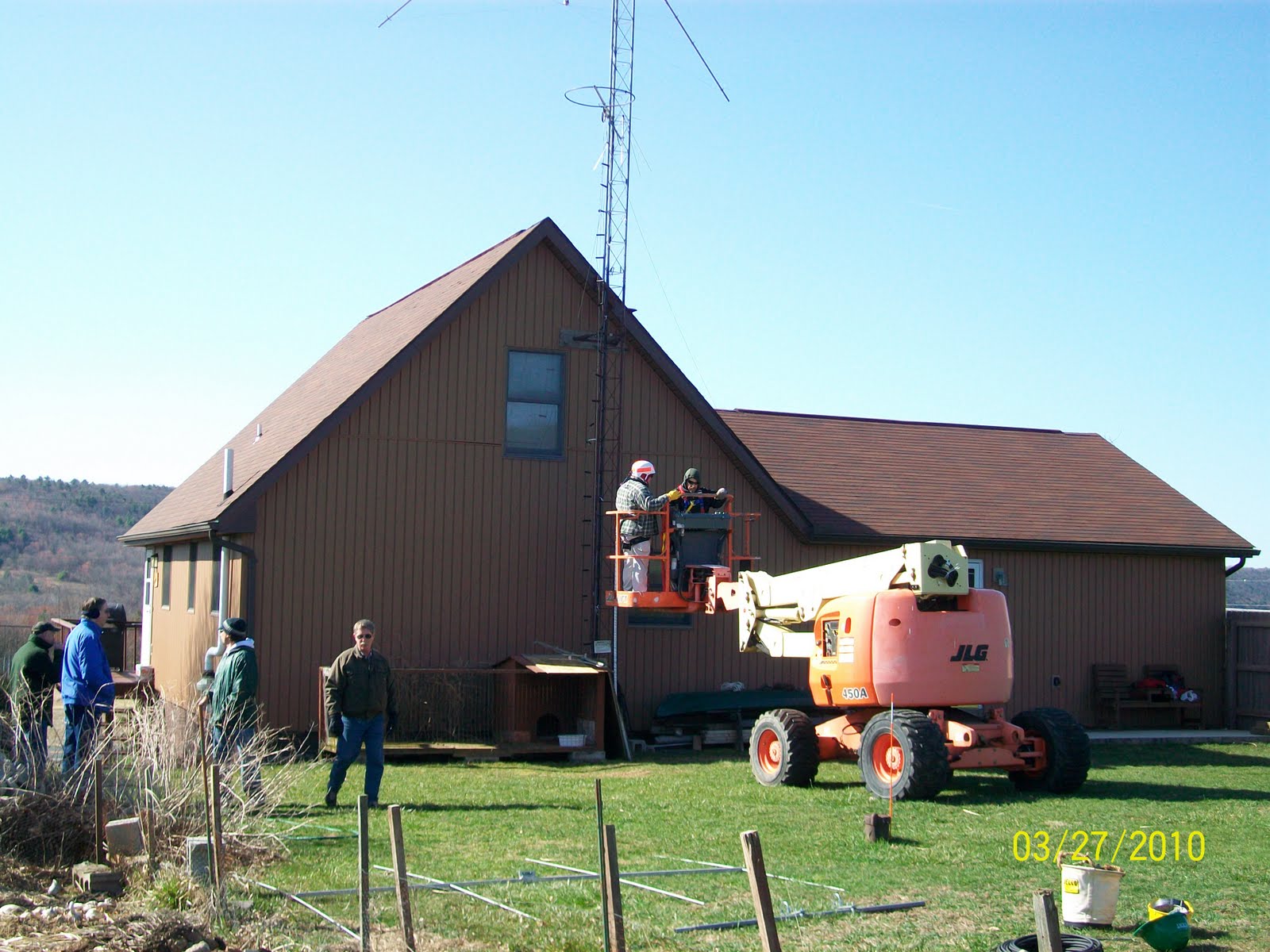
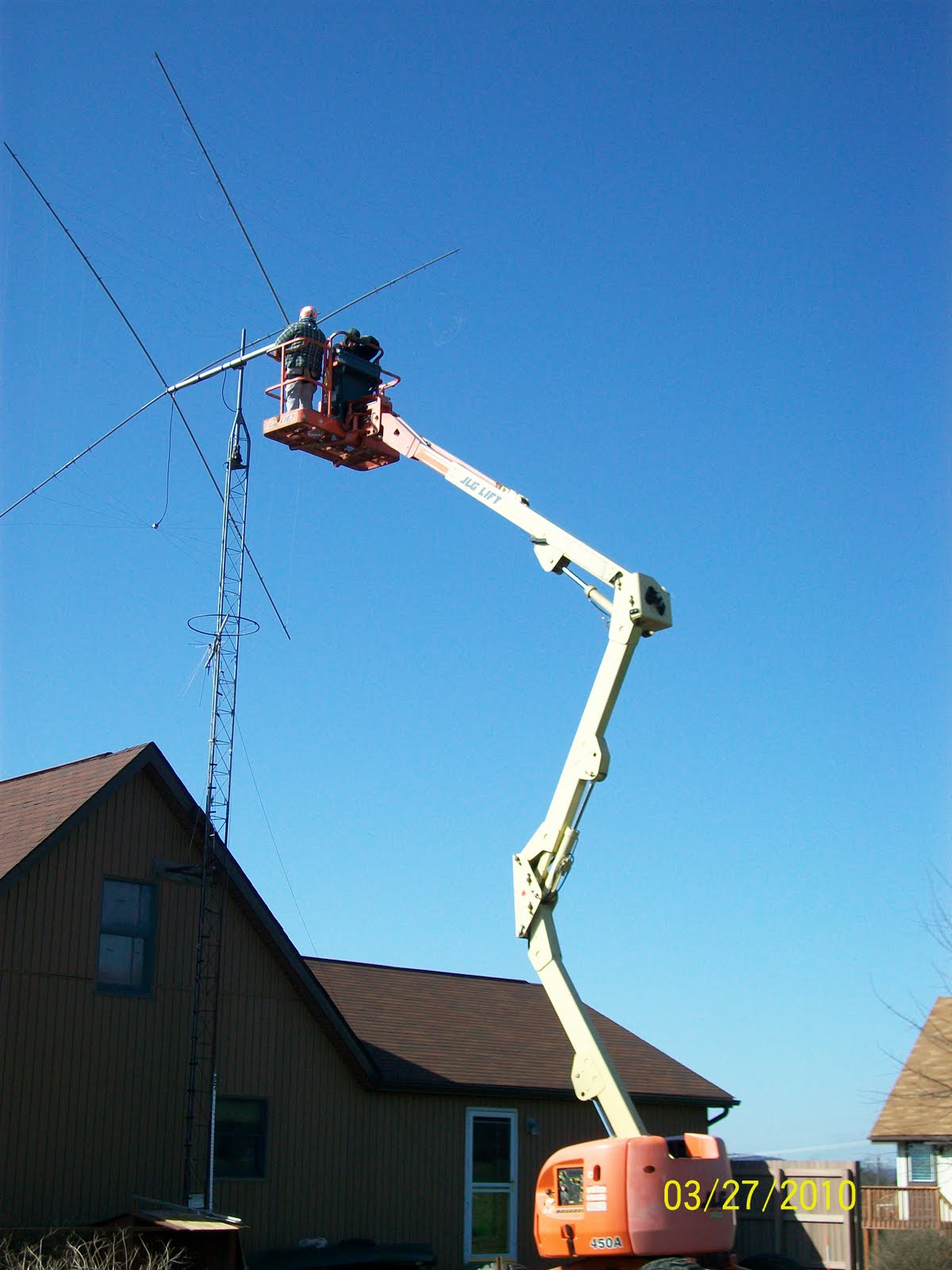
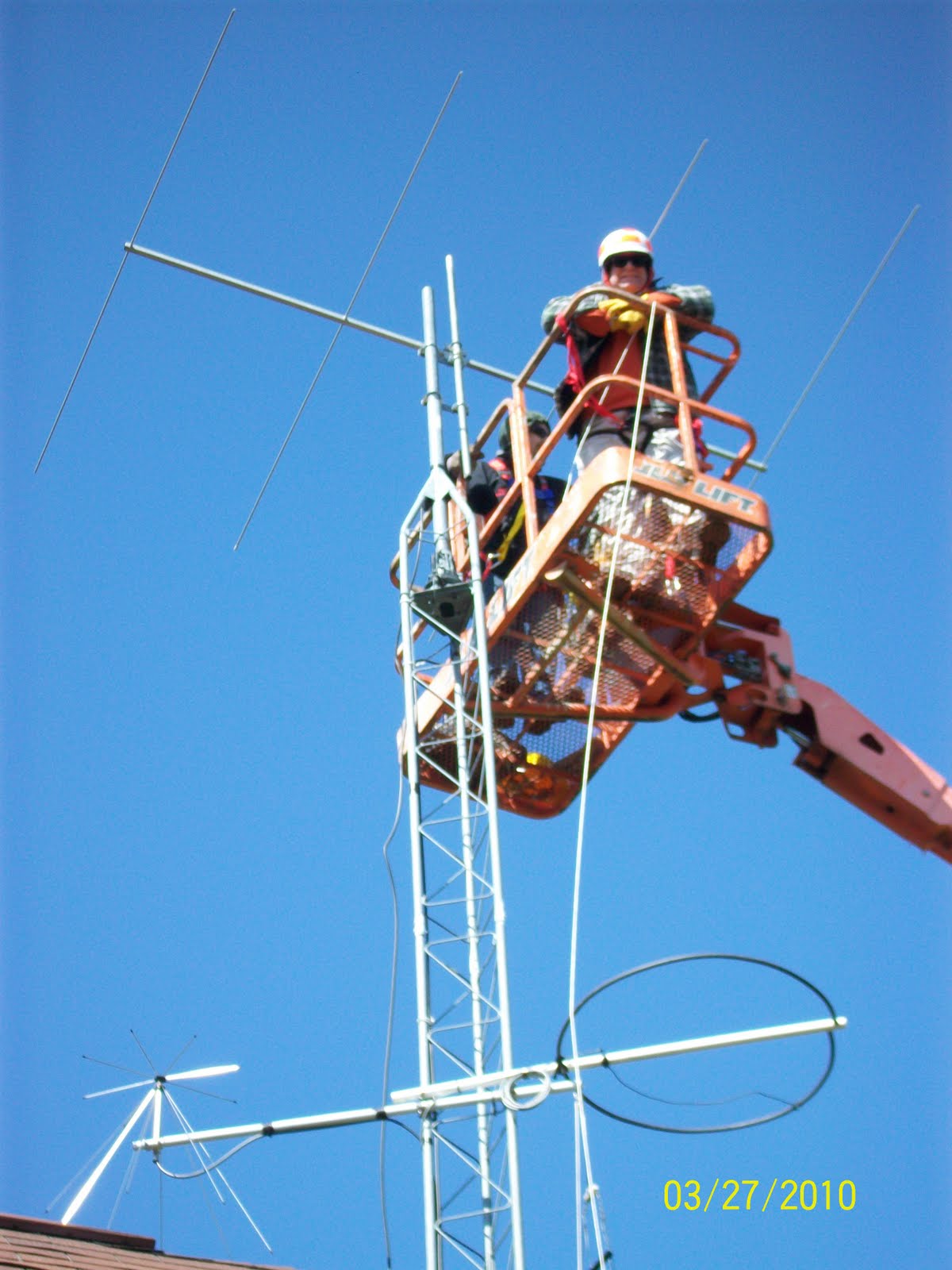
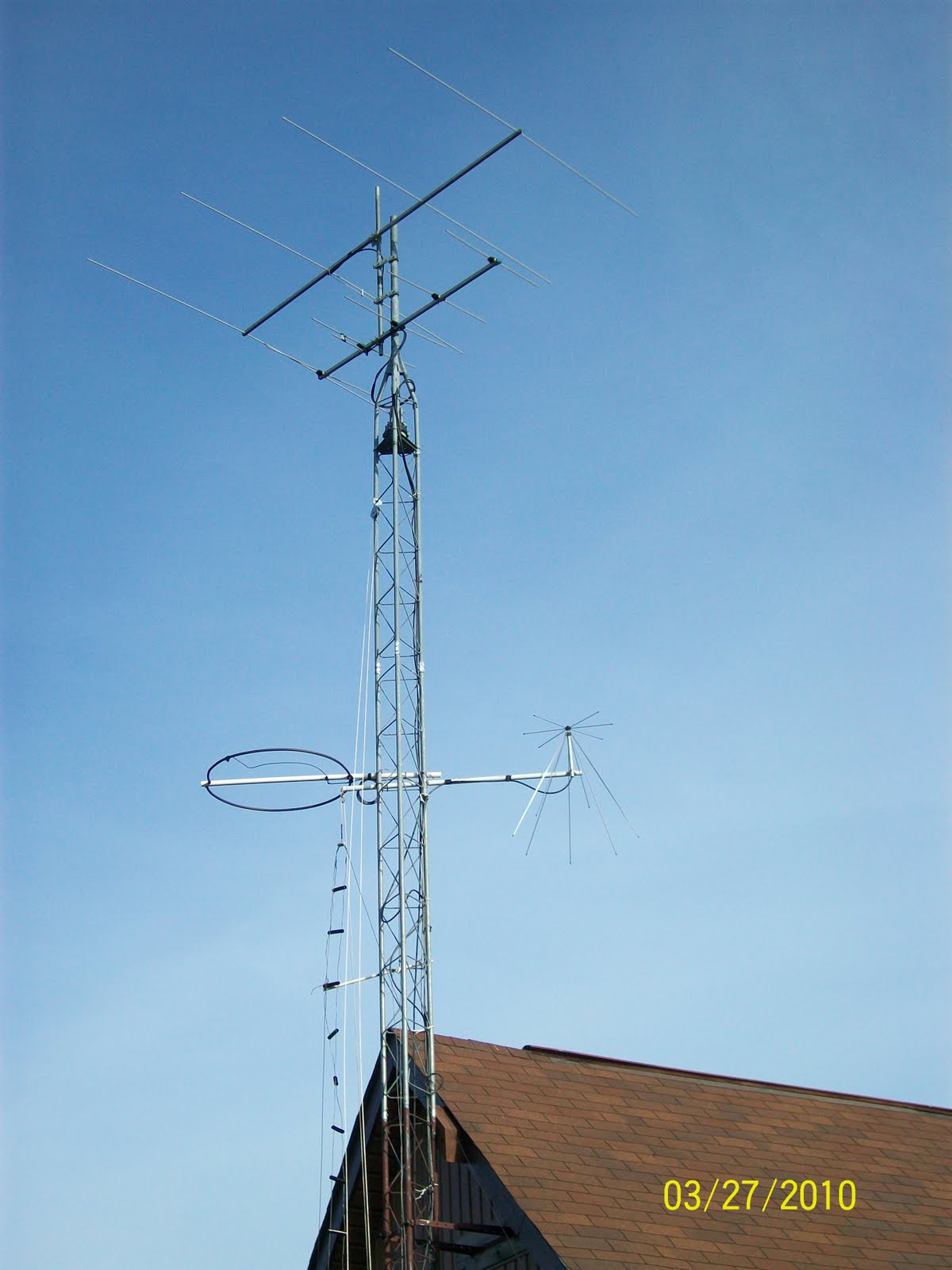
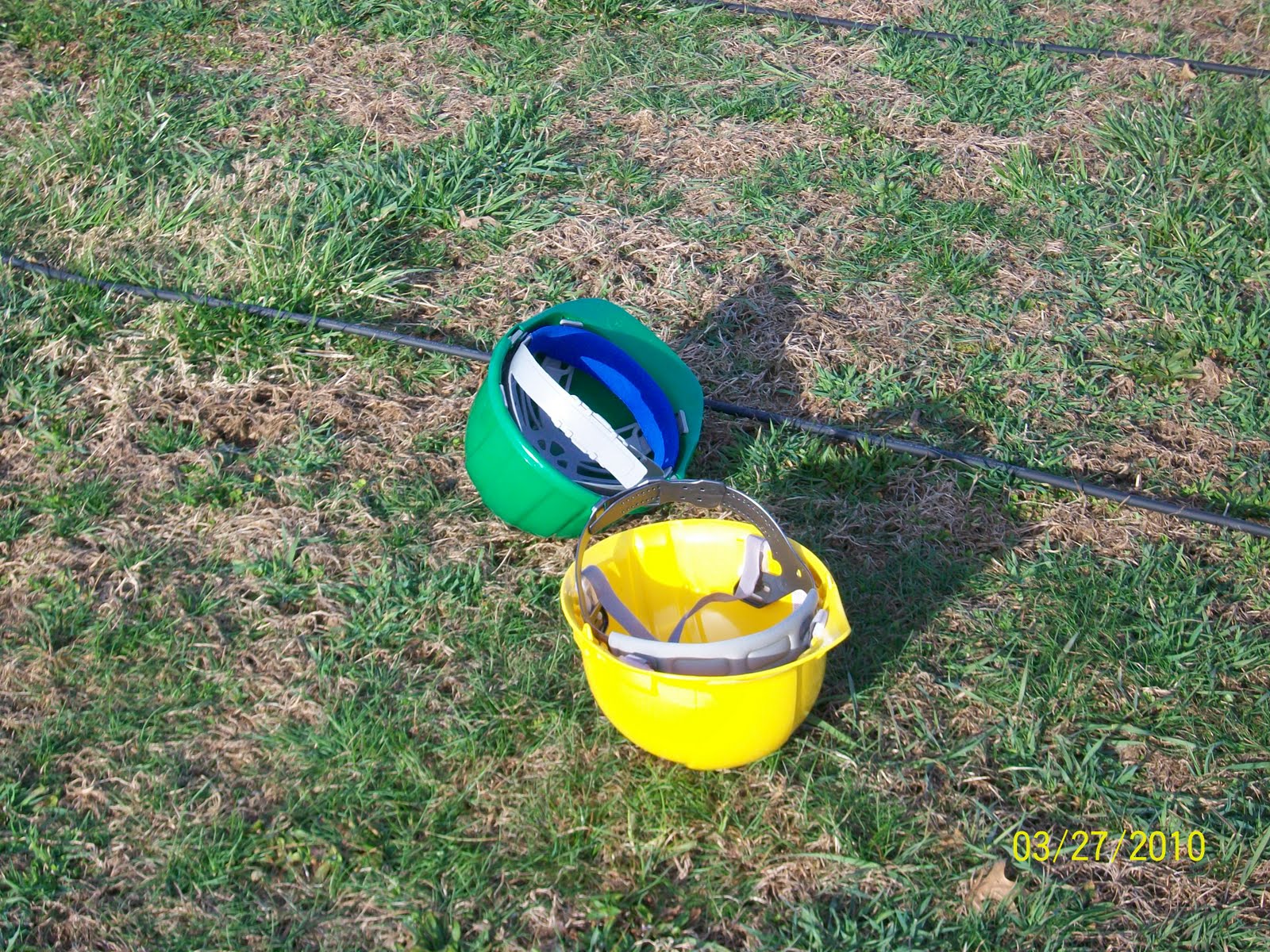
Rather than hinging down the 40' (12 m) Rohn tower as usual I rented a 45' (14 m) manlift locally. This was a good decision. This model had a 500 pound (227 kg) platform capacity, so two people plus gear could fit in it. Once I figured out how to operate the controls, it was a very nimble piece of equipment. We wore harnesses and clipped into the platform railing with lanyards for safety.

The NA-034 operation that almost wasn’t, Part I
As I mentioned in my posting from last week, I spent a few days in Florida recently. I was down there visiting family, but had free time in the afternoons and had planned on operating for a few hours each day from Lido Key, which is IOTA designator NA-034. Briefly, IOTA (Islands On The Air) is a program where hams operate from various islands all over the world and make contacts with other hams. There’s an awards program for contacting various numbers of islands. The rules (link goes to a PDF file) for what qualifies as an island for IOTA purposes are a bit complex, but Lido Key, just west of Sarasota, Florida, qualifies. I’ve made a couple of trips down there in the past and had a lot of fun operating from that location.
My plan was to head out to the parking lot of Lido Beach and set up there, as I’ve done in the past.This location is very easy to get to, and the parking lot has never been full when I’ve been there, so I can take up as much space as I need. For this portable operation, instead of using hamsticks (which are very straightforward to use but since they are nearly 2 meters long, are hard to ship), I decided to use my Buddistick vertical antenna. I’ve written about the Buddistick quite a bit here before, you can do a search from the search box on the right of the blog home page for “buddistick” to see all the references. Because Sharon and I didn’t want to have to check baggage, I shipped the radio (my trusty Icom 706MkIIG), feedline, power cables, and Buddistick down to a relative a couple of days before we left NJ.
I set up the radio and initially mounted the antenna on the rear of the rental car, a Mazda 5, which seemed to be a good way to get it up fairly high and also allowed me to toss the counterpoise wire over a low tree branch.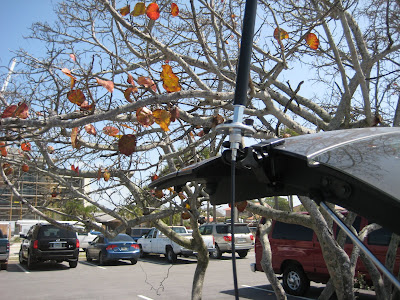 (It’s a bit difficult to see, but you can view the counterpose wire just above the bottom of the picture, it’s the very thin wire.) I set up the antenna, configured it for 20m, and checked it with the antenna analyzer, where I found that I had excellent SWR at my intended operating frequency of 14.260Mhz (one of the standard IOTA frequencies). I connected the antenna to the feedline, and used the built-in SWR testing in the radio to ensure that the SWR was still good (it was), found that my intended frequency was unoccupied, and started to call CQ. That’s when I discovered that I had a pretty serious problem.
The problem was that when I keyed the radio and called CQ, I could hear a lot of what sounded like RF feedback in the headset. My assumption was that for some reason, the transmitted signal from the transmitted signal from the radio was being fed back into the radio, and causing the noise that I was hearing in my headset. As it turned out, I was wrong about the source of the problem, but I didn’t find that out for another 24 hours. Working on that initial assumption, I tried to move the antenna to a slightly different location on the car, and even tried to use the very small Buddistick tripod to place the antenna on the ground much farther away from the car, but had no success. (By the way, that’s a wonderful little tripod, but it’s really not designed to work on a concrete parking lot surface where you can neither dig the legs in nor secure it to anything. All it took was a tiny breeze to knock over the antenna. Fortunately, no damage was done to the whip antenna, but I’ll be a bit more careful about trying that again.)
At that point, I had to take a break from troubleshooting to join a conference call at work. (Yes, even though I was on vacation.) After the call and a follow-up call, about 90 minutes had passed. I tried a few more attempts to play with the radial height, move the location of the radio, and to create an RF choke by coiling some feedline at the feedpoint of the antenna, but was still having no success. I decided to try to find another operating location, hoping to find a park where I could mount the antenna on a picnic table much farther away from the radio, hoping that any RF problems coming from the antenna would be significantly reduced by the distance. I looked at the GPS I’d brought with me and it appear to show a park farther south on the island, so I put all the gear in the car, and headed south.
The saga continues in Part II.

This Weekend In RadioSport | Aggro Prefix Time
 Who owns the single operator all band low power record? Is 60 million points possible for a multi-multi station? Who will log 1,528 prefixes or more this weekend?
It’s aggro prefix time for high frequency airwaves and operators are transmitting unusual prefixes from their callsign quivers. Everyone is a multiplier. It is important to listen first after clicking that flash spot before pushing to talk.
No one likes a busted call when log adjudication rolls around. One pays a penalty in points, ouch, especially when operators are chasing records or looking to establish a personal best.
Rules (link).
Have fun, double check receiver filter settings, check audio, and listen first. Everyone likes a clean log.
Contest on!














