Archive for the ‘Uncategorized’ Category
 Ham Radio Odyssey | XR0Y’s 21st Century Journal | Part Six
 April 10th, 2010 |
  Author:
 XR0Y – part 6 – we are at Rapa Nui! from SQ8X on Vimeo.
Stan, SQ8X’s positive attitude reflects an ability to bring together like minded team members. A successful team, in most cases, will mirror the attitude of its leadership.
Leadership is exemplified by one’s ability to connect with zeitgeist or the spirit of the times. SQ8X demonstrates essential qualities like empathy in addition to persevering against adversity. Perseverance is a quality of leadership that I admire. Life is not always a silver spoon and how one deals with adversity is a good measure of character.
73 from the shack relaxation zone.

Snag
The diode I ordered yesterday to do the mod on the TH-205E came this morning, but it is a bit big.
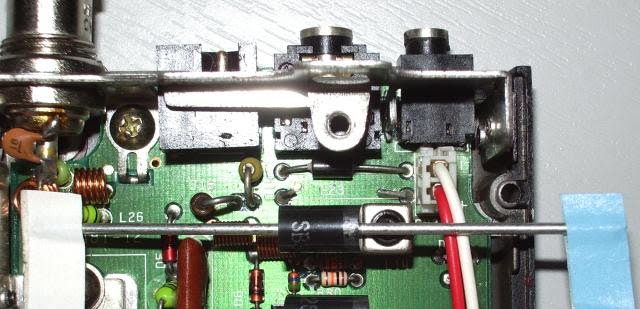 It looks as if I might have to use a thin wire link after all.
The diodes I ordered have a rating of 3A whereas the one specified by Kenwood – part number ERB83-004 – is rated at 2A. You can see an ERB83-004 which is used as a reverse polarity protection diode mounted vertically just to the left of where I hoped to put this one in. It is much smaller.
There is room for the big diode but it will not be easy to get a soldering iron bit in and trying to solder such heavy leads to the thin leftovers of the old one could result in more problems.
Back to the drawing board.

This Weekend In RadioSport | Cosmic Fun
 RadioSport Russia | Yuri Gagarin International DX.
Building a successful franchise is a patient endeavor and RadioSport Russia is on the way toward that goal. There is an interesting twist to this event — satellite contacts are permissible. Additionally, there are few locations on the globe actually launching space vehicles and one can log the following…
- RT3F — Cosmonaut Training Center.
- RS3A — Laboratory of Space Engineering.
- R3K — Russian Space Flight Control Center.
- UP7Z — Expedition of Kazakhstan amateur radio operators to Soyuz 17 landing site.
Rules (link).
 RadioSport Asia | Japan International DX.
Fun for the west coast of the United States and an opportunity to pass out needed -Qs to those supporting our RadioSport results.
Rules (link).
 RadioSport USA | Georgia QSO Party.
Splitting an event into two time periods is an excellent idea and the Georgia QSO Party provides such an opportunity. One can relax in the shack and have time enough for family through the weekend.
Rules (link).
SFI = 76 | A-index = 11 | K-index = 2 | Sunspot Count is 23 @ 1211UTC.

Ham Radio Odyssey | XR0Y’s 21st Century Journal | Part Five
XR0Y Videoblog – Part 5 from SQ8X on Vimeo.
Imagine first. Create vision. Develop plan. Build team. Delegate objectives. Lead with positive attitude. Fulfill dream. Repeat process.
Departure day arrives and one observes Stan’s anticipation after months of planning, sleepless nights, and countless hours of coordination. His reaction to this moment is priceless.
73 from the shack relaxation zone.

Blown fuse
My hopes that the TH-205E I bought on eBay would be fully operational after connecting the fully-charged new battery were dashed last night when I attached the battery, switched the radio on and got … precisely nothing. However I already had a suspicion as to what was wrong. Whilst searching for information about the radio I had found information about a design fault in early models of the TH-205 that was corrected by a modification in later versions.
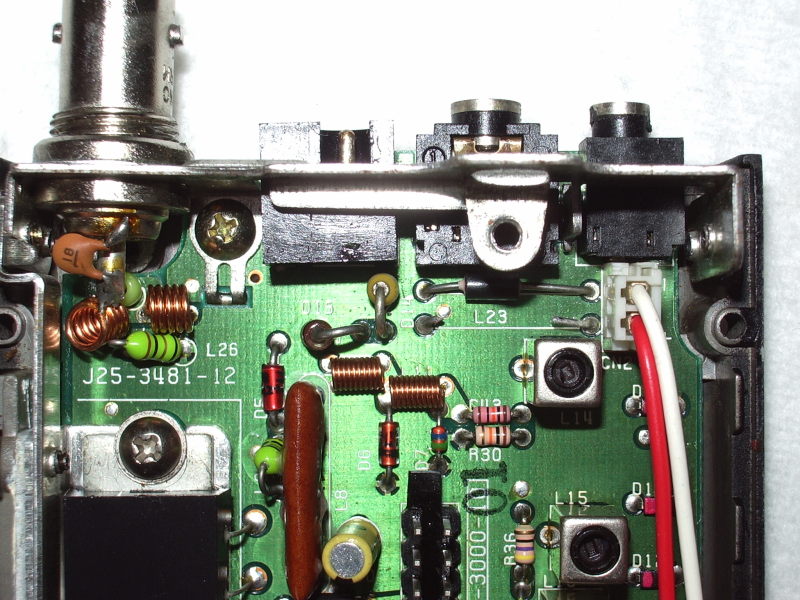 The original TH-205s had a miniature 4A fuse in line between the battery and the power switch. However if external power was applied using an incorrect type of DC plug, the battery was not disconnected from the supply line. The external power could overheat the battery and blow the 4A fuse. I suspected that the fuse had blown.
In fact, I’m afraid it was probably me that blew the fuse. When I first plugged in external power from my shack GSV3000 power supply I noticed the current meter quickly blip as contact was made before the power jack disconnected the battery from the circuit. I didn’t know at that time about the fault, or that the original battery was a dead short. It probably isn’t a good idea to plug in DC power leads while the power is on, but I expect I had other radios on at the time and didn’t want to turn the power off.
I opened the TH-205E up again. I could see the wires from the battery went to a jack on the RF board which is underneath the IF board, so I had to remove the IF board to get to it. This really is a nicely made radio and it is easy to take apart. The fuse, with a ferrite bead on one of the leads, was in the obvious position next to the red wire from the battery. In the picture you can see its position marked L23 after I had snipped the fuse out (I didn’t want to remove the RF board from the chassis to unsolder it completely, so I will solder the replacement to the lead ends that are left.)
I didn’t have a miniature 4A fuse to replace it with. The official Kenwood modification is to replace the fuse with a blocking diode to prevent DC power reaching the battery pack. But they use not just any old diode, but a Schottky barrier rectifier diode which has a low voltage drop of about 0.4V. (A regular silicon diode would cause a voltage drop of about 0.9V.) Of course, I didn’t have a 2A Schottky barrier rectifier diode in my parts drawer either.
I did consider simply replacing the fuse with a thin strand of wire. Since I only have the low voltage 7.2V battery pack I don’t really want any additional voltage drop. I know about the problem so I could simply avoid it by not hot-plugging external power into the power jack. But there is always the risk I might forget and I don’t want to do the repair again, so I decided to do the proper modification.
I ordered the diode from eBay supplier PIC-Projects. I have to say that eBay has become my main source of electronic components and is a major salvation when you need an odd part like this. There is no minimum order charge or handling fee that makes it uneconomic to order less than £30 worth of stuff, and the prices of both parts and postage are very reasonable. Sometimes you have to order cheaper parts in quantities of 10 or 50, just like the “professional” suppliers like Farnell, but the prices make it worth while and it helps to build up a stock of parts for future projects. I ordered 5 of these Schottky diodes because they were only 35p each, and I’m sure I’ll find a use for the other 4 eventually.
Hopefully the diodes will arrive in tomorrow’s post and I’ll finally be able to put the TH-205E on the air with its new battery!

A stroke of luck
 Sometimes you just get lucky. After I repaired the TH-205E I recently won on eBay, I was looking around for ideas on what to do about the dead battery pack and I found someone selling brand new Kenwood KNB-4 battery packs for £2.40. Well, not brand new, but never used, in the manufacturer’s box, though they would have been manufactured some time around 1993. The seller claimed that, although stored for a long time, after three full charge / discharge cycles they should be capable of holding a reasonable charge.
The KNB-4 was not actually made for the TH-205E. However due to Kenwood keeping the same form factor for its hand-held transceivers for several years the newer battery pack is able to be used in the older radio, as I was able to confirm from the W&W Manufacturing website, which claims it is equivalent to the PB-4 accessory battery for the TH-205. This is the large “high capacity” battery, with 1500mAH capacity as compared to the 500mAH of the one that came with the radio. Unfortunately it is only 7.2V which gives a power out of 1.5W according to the manual. It would have been nice to have had the 12V 1200mAH one which gives 5W out but you can’t have everything.
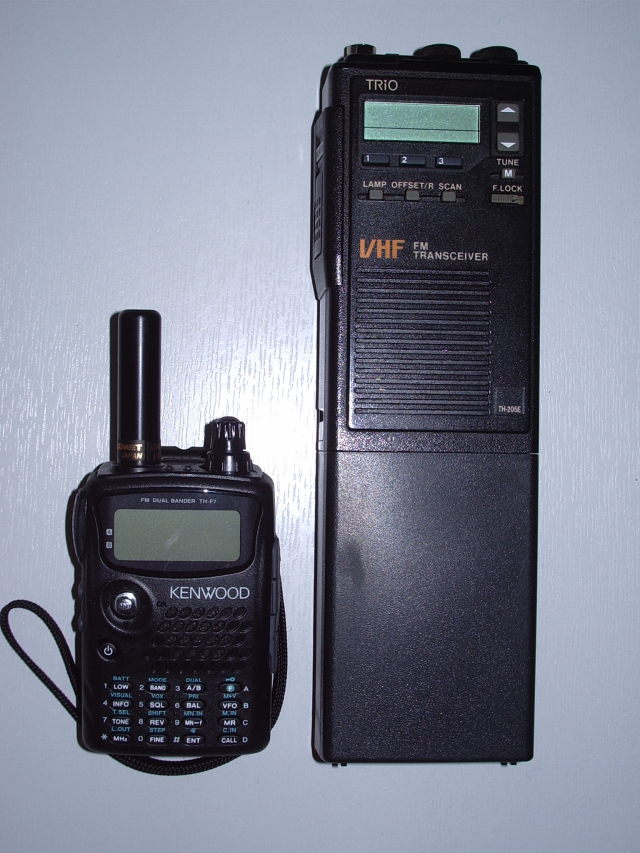 This is a big battery pack and it turns the already large TH-205E into a veritable giant, as the picture of it next to the TH-F7E shows. This is more than just a radio! You give your biceps a workout every time you use it. The radio will hold down your log sheets on a windy hilltop where lesser rigs would blow away and it also makes a handy weapon to beat off any assailants who might try to mug you whilst you are on the air.
Unlike the supplied battery, the KNB-4 doesn’t have its own charging socket, just contacts for a drop-in charger. So I will need to make a drop-in charger for it. I have already made a start using a piece of Veroboard with contacts made from a paperclip. The battery is charging at 240mA from the shack power supply, so after 10 hours I’ll know if it can hold a charge. If it does then I’ll make up a proper constant current charging circuit and put it in a nice box. Then I’ll have a great little, err, I mean great big 2m radio that will certainly attract a lot of attention wherever it goes!

Ham Radio Odyssey | XR0Y’s 21st Century Journal | Part Three and Four
XR0Y – Rapa Nui Videoblog – Part 3 from SQ8X on Vimeo.
XR0Y – Videoblog – part 4 from SQ8X on Vimeo.
Rising Cost.
What is the future of DXpeditions given the rising cost of logistics? Is air transportation of equipment sustainable and, or, even economical? I imagine lightweight, flexible expeditions may incur a cost that is par with or exceeds that of the airline ticket, when including premium baggage pricing.
I’m wondering if shipping through Federal Express would actually reduce logistically cost? I have homework given high frequency airwave conditions. The ionosphere is blown out at the moment.
The cost of reaching remote, rarified locations will as ham radio moves toward 2020, require sharing cost from printing analog QSL cards too sponsoring a day worth of meals. Or, team leaders may consider, looking at the menus of alpine expeditions and how they prepare meals at high altitude.
Non-Profits.
The cost of DXpeditions, at least from perspective, continues arcing sharply upwards and one might begin thinking about supporting non-profit organizations like the Northern California DX Foundation (NCDXF) whose mission is, “[A]ssist worthwhile amateur radio and scientific projects with funding and equipment.”
Frankly, the days of privately funding an expedition to rarified locales, is probably peaking.
Conclusion.
Will siege like DXpeditions survive? Will operators around the world need to work a little more on skill and improve antenna systems a little more because big gun DXpedition signals will just cost too much?
Help those helping others and consider making a donation to the Northern California DX Foundation sometime in the near future.
73 from the shack relaxation zone.














