Archive for the ‘Uncategorized’ Category
 Our Social Media Revolution
 May 8th, 2010 |
  Author:
The message is clear and it is social media. A cluster of ham radio operators understood a few years ago that a wave, no more like a tsunami, would crash against the shores of culture and it is here. It is not a fad. Social media is transforming our daily lives from inter-personal relationships to business-to-business transactions.
Perhaps, one might say as Alvin Toffler did, this is a power shift.
Failure to realize this transformation, most likely, will leave institutions, organizations, and individuals on the boondocks of the 20th Century.
73 from the shack relaxation zone and thank you FRRL for the content.

FCC Proposes 60 Meter Band Changes

The proposed changes in a nutshell are:
- Swap one channel with another frequency due to federal licensee digital traffic which often on this channel
- Increase the power limit from 50 watts PEP to 100 watts PEP
- Allow CW, PSK31, and PACTOR-III modes

Daft contest exchanges
I just got round to checking the Sport Radio page of the May RadCom so as to transfer to my wall calendar the dates and details of any contests I might be interested in making some contacts in this month. I happened to notice that the exchange for the 144MHz Contest on 15/16 May is RS(T), serial number, grid locator and post code.
Post Code??? What’s the point of that? And what if you are operating portable from a hill somewhere and don’t have a post code? Daft idea if ever I saw one.

More eBay purchase woes
I’m not paranoid, but I think everyone is out to get me!
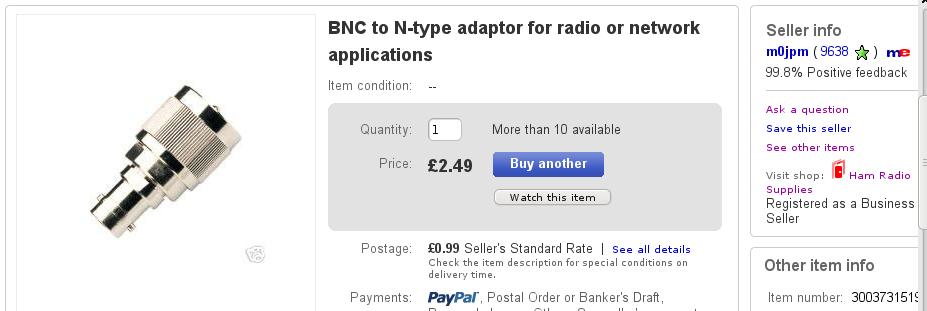
I ordered some connectors from eBay seller m0jpm and, because I have been thinking about getting a radio that has N type connectors on it, I decided to order a couple of BNC to N-type adapters so I could use the much easier to obtain BNC plugs on my antenna cables. The listing I ordered from is shown below.
 The package arrived this morning and when I opened it, to my dismay I found that the adapters were the reverse of what I wanted. As you can see, they are for attaching N-type plugs to BNC sockets.
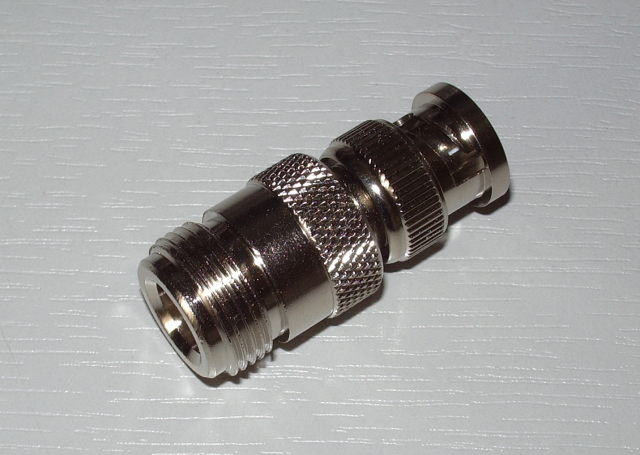 It has sometimes happened that I ordered the wrong thing by mistake, so I was relieved when I checked the eBay listing and saw that this time it was the seller’s mistake not mine. But my relief turned to anger when I emailed the seller to inform him of the error and received the reply: Dear g4ilo, Hi we have send you what you have ordered, as this is the only n-type to bnc we have listed. but if you not happy send it back for a refund.
Is it really necessary to insult my intelligence by telling me “we have send (sic) you what you have ordered”? I will send the adapters back for a refund (and no doubt be out of pocket for the postage) because they are no use to me. But I shan’t be buying anything from m0jpm again.
In a comment to my previous post Ricardo CT2GQV said that I should give up buying on the Internet. I wish I could, but if I did I would have to give up the hobby because it is not possible to buy radio stuff round here.

Ham Radio Youth Net Every Saturday at 21:00 GMT
Ryan, K3SFG, asked us to pass this along to our readers:
CQ young hams…CQ young hams…
The Youth Net takes place every Saturday @ 2 pm (CA Time, PDST)
It is on the N6NFI Repeater, 145.230 -100. Young hams, 18 or younger, can also check-in through Echolink, using KR6DD-R (271122) or N6WN-R (477737).
Please help us get the word out, and if you have any questions, suggestion, etc., please contact K3SFG at [email protected].
Note: Only hams 18 and younger can check-in to this net. Unlicensed youth can check-in under the supervision of a control operator.
Please visit http://www.sbara.org/index.html and click on Youth Group in the left side bar.
Thanks and 73!
– Ryan, K3SFG
3830 Claimed Scores | 2010 7th Call Area QSO Party (7QP) | Low Power
 In State County Expedition Multi/Multi.
- KE7DX | 87 CW | 25 SSB | 25 Mults | 10.5hrs | 7,775 Points [Arizona Outlaws Contest Club].
n = 1 score submitted in this category.
In State Multi/Multi.
- KB7QND | 281 SSB | 54 Mults | 17hrs | 30,348 Points [Arizona Outlaws Contest Club].
n = 1 score submitted in this category.
In State Multi-Single.
- K7LED | 286 CW | 120 SSB | 52 Mults | 12hrs | 56,940 Points.
n = 1 score submitted in this category.
In State Single Operator CW.
- KK7S | 595 | 62 Mults | 18hrs 110,670 Points.
- AB7R | 640 | 53 Mults | 11hrs | 101,760 Points [WWDXC].
- W7Z (W7ZR) | 500 | 53 Mults | 12hrs | 79,500 Points [Arizona Outlaws Contest Club].
n = 11 scores submitted in this category.
Out of State Single Operator CW.
- N6MU | 191 | 98 Mults | 56,154 Points [SCCC].
- K0IO | 134 | 59 Mults | 23,718 Points [Newton ARA].
- K1TN | 99 | 49 Mults | 6hrs | 14,553 Points.
n = 14 scores submitted in this category.
A tough weekend inside the cans given changing ionospheric conditions although KK7S captured a 3830 top slot position prior to log adjudication. Out of state participant, N6MU, battled tough conditions on 20m leading the Southern California Contest Club to its banner position in the low power category.
It was not easy with near flat conditions however KK7S and N6MU get the honors! Well done.
Contest on.

Quiet day
 Not much happening today. I have been WSPRing on 10m with 5W but heard nothing and have been spotted just once – by OY1OF on the Faroe Islands.
Yesterday evening I was receiving EA4SG in Spain but he was running 20W. I upped my power to a similar level, and was spotted by G0HNW and M1AVV in the early evening. I left the system running all evening but after it was dark I noticed my neighbour’s security lights were coming on at the start of my WSPR transmissions. Not good when you are trying to maintain a “stealth” station!
Before I started with WSPR today I got out the old DOS laptop and the Motorola programming software to make a few changes to my GP300 configuration. I reduced the squelch threshold slightly, reduced the power from 6W to 5W which should help the battery endurance more than it will affect reception of my signals, and I programmed the radio for 16 channels.
Now there are 16 channels it’s difficult to remember what they all are so I made a paper scale to go under the tuning knob which shows the 2m channel numbers or repeater calls. I had to use the magnifying headset to do the very small lettering and I can only read the scale with my reading glasses on – which I don’t when I’m out and about. But I couldn’t read the channel numbers on the original dial scale either so I’m not actually any worse off. I used to have great eyesight – this is what happens after spending most of your life in front of a computer!














