Archive for the ‘Uncategorized’ Category
 10m open to the north
 May 22nd, 2010 |
  Author:
 Once again, WSPR is revealing the existence of consistent propagation paths every day on 10m between Iceland (TF), the Faroes (OY) and northern Norway (LA/LB) and the UK and north-west Europe when there is no Sporadic-E and no other propagation except over very short distances between closely located stations. This has occurred even during periods of zero sunspots.
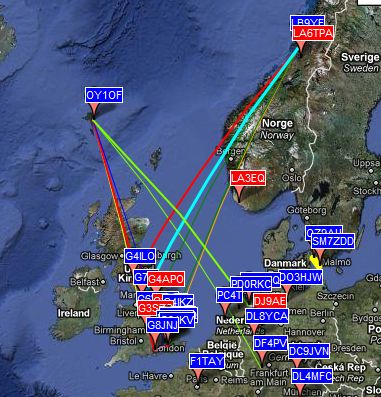 I’m guessing that because we have only in the last few weeks had a large number of WSPR monitors on 10m because of the Sporadic-E season, no-one has previously observed it. But I’m surprised at the lack of comment about it. Perhaps this is a phenomena known to everyone but me, in which case I’d welcome some enlightenment.

Ten Tec HB-1A
From John Harper AE5X’s blog I have discovered that Ten Tec will be re-branding the Chinese HB-1A QRP CW transceiver. The Ten Tec versions aren’t exactly the same – they will be selling two versions, one covering 40 and 30 metres and one covering 30 and 20 metres whereas the original covers 40, 30 and 20. This may have something to do with meeting FCC spurious emissions specifications.
 As it happens, my HB-1A is on eBay at this very moment. Not that there is anything wrong with it, just that it doesn’t do anything that my FT-817 can’t do and I’ve spent quite a lot on new radios recently so it seems right to dispose of some of the ones that aren’t being used.
But its performance wasn’t exactly spectacular. It’s a bit sad to see the company that made and discontinued the Argonaut 516 HF QRP rig and matching 526 6’n’2 metre rig offering such a basic radio as its only QRP product.
I’d love a Ten Tec 516 / 526 pair, so if anyone has one in mint condition that they’d like to sell or trade for an Elecraft K3/100 drop me an email.

WebProp update update
I received a response from the web host support desk about the problem that is causing the WebProp update scripts to fail to access the WWV solar data. The reply was:
There is nothing we can do to fix this it’s a configuration error on their end with their dns. This is occurring because of invalid dnssec configurations at noaa.gov. We will not bypass the dnssec configurations implemented within .gov. The only way to have this corrected is by the dns administrators at noaa.gov signing their zones.
20-May-2010 15:26:00.099 validating @0x827fff000: swpc.noaa.gov SOA: got insecure response; parent indicates it should be secure
20-May-2010 15:26:00.116 validating @0x80284f000: swpc.noaa.gov SOA: got insecure response; parent indicates it should be secure
20-May-2010 15:26:00.159 validating @0xadb055000: swpc.noaa.gov SOA: got insecure response; parent indicates it should be secure
20-May-2010 15:26:00.204 validating @0xad9af8000: www.swpc.noaa.gov A: bad cache hit (www.swpc.noaa.gov/DS)
This is way over my head, but I think they are saying this is due to a problem at NOAA’s end not mine.
I will give it a couple more days, but if the problem doesn’t go away then I will have to remove WebProp. I know this will be a pain for those who have included it in their websites but there is nothing I can do about it.

WebProp not updating
The WebProp HF propagation indicator has not been updated since midday today. Since that time the update script has failed with an error saying that it is unable to resolve the host www.swpc.noaa.gov where the WWV solar weather reports come from. Since it can’t get the data, it can’t update WebProp.
I have opened a support ticket with the web host which has replied that there is a “problem with the server DNS.” Hopefully the problem will be resolved shortly.

A simple HF receiver
Before this blog I had a web site with some amateur radio information. It is still out there, but I should close it down or update it totally. Here is one of the projects from those pages which I had great fun with and which is worth adding to this blog. I was quite impressed with the quality of the audio from this receiver which has just seven components (three capacitors, two transistors, a resistor and a transformer). Below is an edit of what was originally written a few years ago.
I constructed this simple receiver having seen the circuit at WB4LFH’s web site which he calls the ‘audion’. This circuit is almost identical to the last circuit on that page, except I changed the inductor connection to the variable capacitor from being a tapped connection to being a transformer coupling.
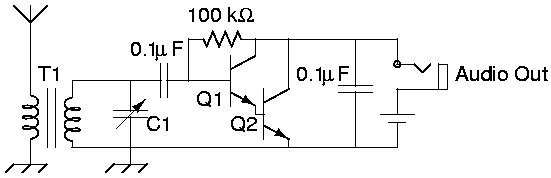
The inductor was a T50-2 toroid with secondary being 28 turns of enameled copper wire and the primary (connected to the antenna) being two turns. (Remember a ‘turn’ on a toroid is the passing of the wire through the hole). The transistors were 2N3904 types, but you can try any general npn transistor. The tuning capacitor was a air plate type taken from an old radio receiver, likely about 300pF. The circuit was constructed ‘ugly style’ on a small piece of unetched circuit board. Use what you have in your junk box and experiment.
The performance is very good considering the simplicity of this receiver. Below are a set of sound recordings from this receiver. The recordings show how the volume can change (no AGC here!) and that the selectivity is not too good.
If you consider building this receiver please note that these recordings were done with the receiver connected to my external antenna at that time, a G5RV. I tried using a long whip antenna, which I had in the junk box, and there was no discernable reception of a signal with it. So you will likely need to use a good length of wire to act as an antenna. Post a comment if you have any success with this circuit.


Weather station
After I removed my Ascot weather station due to the interference it caused on the 70cm band, I didn’t have a clock in the shack. I searched for a long time to find a radio controlled digital clock with a nice 24 hour LED display capable of showing UTC but couldn’t find anything suitable. Whilst browsing I found something interesting. It was a Meteotronic WM5100 weather station made by La Crosse, reduced from £49.99 to £17.49. As I still liked the idea of having a weather display in the shack, I decided to get one.
 The Meteotronic is interesting as it is not, in itself, a weather station. It is a radio, tuned to receive transmissions from the German time and frequency standard station DCF77 on 77.5kHz. Besides an accurate time signal, DCF77 transmits weather forecast data for 90 different regions of Europe for up to 4 days ahead. This information is received by the device and displayed on its LCD, as you can see in the picture.
Some of the weather regions are quite large. I am in the region “northern England” which covers the whole area north of Birmingham to the Scottish border. But the forecasts are probably still better than predictions based simply on atmospheric pressure trends, like most home weather stations.
I’m coming to realize that this is a pretty poor location for reception of radio signals of any type. The unit had difficulty receiving the DCF77 transmission, although I am well within the maximum distance at which reception is possible. You need to experiment with different locations to get the best reception.
Although the unit doesn’t have a UTC time option, you can set a time zone offset, so I can set this to -1 during the summer to compensate for the effect of daylight savings time.

Out on the fells with Murphy
This morning there was a lot of Sporadic-E about. I spotted – and was spotted by – several stations on 10 metres. I didn’t hear any normal activity on 10, but there was some on 6m and I made a couple of contacts. However the weather was gorgeous, too good to be indoors whatever the propagation, so I took some coffee, a sandwich, the Motorola GP300 and the Intek H-520 Plus and set off to do a couple of Wainwrights.
 I parked in a lane between Mockerkin and Lamplugh and walked along the track above Hudson Place. You are high above Loweswater here and can enjoy some wonderful views for no climbing effort at all. Then it was up over the grassy fellside to Blake Fell (WOTA LDW-140.)
There was a strong, cold south westerly wind so I hunkered down in the stone wind break on the summit to have my lunch. A retired couple over from Newcastle joined me and wanted to chat, so it was not until they had gone that I was able to get the radios out. I put the telescopic 5/8 antenna on the GP300 but the wind was so strong it was blowing it almost horizontal so I switched to the helical. I was using the speaker mic, but no-one replied to my calls and I realized that the rig was not going to transmit. That was the first of my troubles.
Dispensing with the speaker mic I called CQ and made contact with Keith G0EMM in Workington. After we moved down to 145.450MHz we were joined by Colin 2E0XSD and Derek 2E0MIX.
The guys knew I had recently acquired a 10m FM H-520 hand held and anticipated that I would want to try using it. I decided it was too windy to try the 4 foot antenna so I used instead the short one that came with the rig. As soon as I pressed the PTT the rig shut down and re-started. Keith suggested there might be something wrong with the batteries, and that seemed to be the case as when I reduced power to 1 watt the rig didn’t shut down but the battery state indicator went from all bars to no bars. So that was the second of my troubles.
As per usual, I had my digital camera with me to try to take a picture, using the self timer, of me at the summit. But either I got only my legs, or only my head, or the wind moved the camera so the picture was blurred. After that, every picture I took with the timer was grossly over-exposed (although if I took a picture manually it was alright.) That was the third of my troubles, as a consequence of which you are spared a picture of G4ILO this post.
After that I set off for what I thought was Burnbank Fell (WOTA LDW-183). My target was a prominent summit with a large stone summit cairn, about 100m lower than Blake Fell. I reached it in about 20 minutes, put out another CQ call and was contacted by Keith and Colin. They had been tracking my position using APRS and informed me that it looked as if I was on Carling Knott. I was sure I wasn’t, as there is no other Wainwright summit in the area. Carling Knott isn’t a Wainwright, and the one I was on looked like a pretty important top that I’m sure Wainwright would have given a page in his Guide to the Western Fells.
I had hoped to descend from there down to the lake but I couldn’t find the path – the fourth of my troubles – so I ended up re-tracing my steps, though avoiding the actual summits to save a bit of climbing. As I walked back over the grassy hill over which I had walked a couple of hours earlier I put out another call on 2m and was answered by Keith and Colin again, who both confirmed that my APRS position now put me on Burnbank Fell! So this featureless grassy hillock that I had barely noticed on the way up is actually a Wainwright, while the higher Carling Knott with its impressive summit cairn isn’t. I’m sure AW had his reasons…
Back at the shack I found there was nothing wrong with the H-520’s batteries, but it doesn’t seem to like the short whip antenna, which of course I never tested it with before I went out. If I had been able to use the four footer it would probably have been fine. The GP300 worked perfectly with the speaker mic, and I couldn’t reproduce the problem with the camera self-timer either. As for activating the wrong fell – I guess I should look at the map a bit more closely.
But it was still a gorgeous day and a wonderful walk, even if it was a bit windy and Murphy was my invisible companion.














