Archive for the ‘Uncategorized’ Category
 Great Cockup
 June 1st, 2010 |
  Author:
 In British English, a “cockup” is rude slang for a mistake, usually implying carelessness. Great Cockup is the name of a rather undistinguished grassy Wainwright summit near the northern edge of the English Lake District. I don’t think there is any connection between the slang meaning and the name of the hill. But whilst my decision to go for a walk up Great Cockup on Bank Holiday Monday wasn’t a mistake, from a radio point of view it wasn’t a success either.
 I parked the car near Overwater and set off on quiet lanes and then a grassy track on the western side of the fell with great views over Bassenthwaite Lake.
 The summit was reached after about an hour of walking. Despite being the end of May a cold north westerly breeze was very much in evidence on the summit. By descending a few feet it was possible to get away from the breeze, but as soon as it dropped clouds of black insects appeared and covered everything. It was necessary to brave the full force of the wind in order to eat the lunch Olga had prepared without an accompaniment of fresh insects. Despite this one managed to find its way inside the Intek H-520 – it was still walking around the inside of the display window this morning!
Lunch over, I got the radios out. I had taken the Intek H-520 hoping to make some DX contacts on 10 metres, but despite making numerous calls on the 10m FM calling frequency, 29.600MHz, I had no takers. There was obviously some enhanced propagation as I heard a French station and also some activity on a repeater on 29.660MHz.
I heard a French station call CQ on 29.600 and when I replied to him he said “UK stations, please QSY to 29.205MHz.” I was unable to oblige because a) my radio only tunes exact 10kHz multiples and b) when I did try to transmit anywhere near there the radio cut out due to the SWR being too high on that frequency. I’m afraid the H-520’s intolerance to even moderate SWR renders it almost unfit for purpose and if I hadn’t modified it to work on the 10m band I would probably consider returning it under warranty. As it is, probably the only option is to reset the power control to limit the power to 2W on the “4.0W” setting. As noted previously, when received the radio delivered less than 3.0W even on the UK CB band and I now suspect this was done deliberately by the manufacturer to try to mitigate this problem, knowing that the majority of CB users would be none the wiser.
While listening for the French station I heard what sounded like an APRS packet on 29.210MHz. I don’t know if that is a recognized APRS frequency but it would be interesting to monitor that frequency with a decoder to see what is being transmitted.
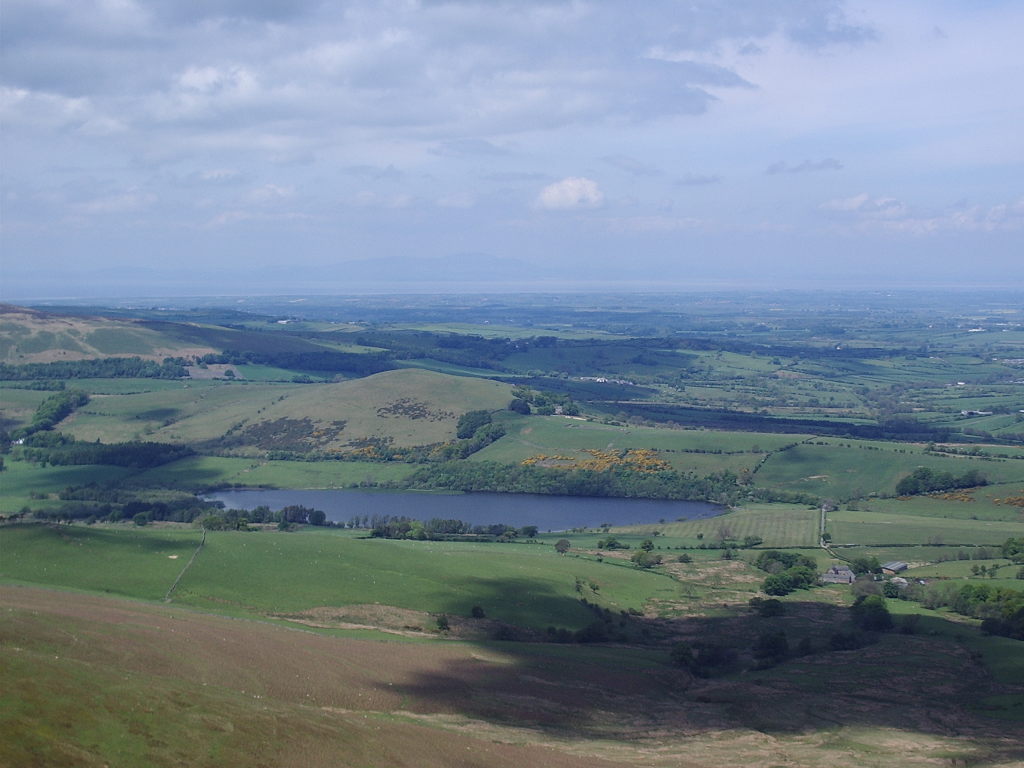 I tried the Motorola GP300 on 2m with the 5/8 telescopic antenna but was unable to raise any contacts on that band either. I did hear some activity on the channel set up for GB3EV but which I suspect may be the GB3BT repeater on the north east coast which is on the same frequency.
Back home I heard and worked Colin 2E0XSD/P who was on Ling Fell (behind the ‘hump’ on the left of the middle photograph) using the H-520 inside the shack with the 4ft. whip antenna. On 2m I worked Derek 2E0MIX/P who was up on Scafell Pike, England’s highest mountain. So had I gone out a bit later I would probably have made not just a couple of contacts, but a couple of summit to summits. Never mind. It was a pleasant walk and now I have the excuse to go again another time.

Interview With Bryce, KB1LQC And Brent, KB1LQD Of RITARC | Part 2 Of 2
Their vision is bold and their commentary on the state of ham radio is noteworthy. We are, in their words, at a crossroad; one that is deciding the direction of our hobby into the middle of this century and beyond.
Who else but KB1LQC and KB1LQD, young men at the beginning of their careers, could deliver a message to those capable of creating required change?
What kind of ham radio related activities is RITARC involved in these days?
The RIT Amateur Radio Club is one of those clubs I feel is taking a different approach to the hobby. As I stated earlier, there is a difference between the traditional outlook on the hobby and the demands of the current generation of students in high school and college. K2GXT is very much into utilizing amateur radio for various technical aspects, not just operating.
The club has been promoting various uses to advance technology rather than simply operating HF or other bands. As a group we are also very good at promoting amateur radio along with our club to the student body as well as RIT administration. For the last two years straight we’ve won the RIT Clubs Showcase “Best in Show” award which pitches 10 clubs against each other to present themselves to RIT administrators who then vote for their favorite and most innovative club.
We know how to make our presence, effectively get our point across, and deliver a memorable presentation.
For example, we recently redesigned and constructed a 12 foot long RC blimp from scratch which utilizes ATV video on-board. Just search YouTube for some of the videos uploaded this past May! Brent is designing an optical communications system for long distance light transmission. So far he has obtained about 1/4 mile from his efforts. This may not be amateur radio but many techniques learned from the hobby have been utilized.
We just obtained the ability to design, etch, and construct our on PC boards right in our clubroom. Finally, this summer I hope to design a simple Software Defined Radio much like the softrock kit while here at RIT. Both the light receiver and SDR have the potential to become a K2GXT kit for promotional purposes.
We may be veering off from most college clubs but we are seeing a huge amount of interest from the student body. Next year may be a defining moment for the clubs’ membership. Today’s students just don’t seem to be impressed with long distance QSO’s or repeater contacts, at least initially.
Many of my peers might not truly realize that a cell phone is simply a radio. We are becoming quite an abstract society with the technology granted to us. Brent and I have found that by introducing the hobby through alternative methods such as projects and other technological advancements with amateur radio, we are able to grab the interest of younger people.
Tradition will never die, once in the hobby they are exposed to the numerous traditions of DXing, QSL cards, etc. I am excited to see where the RIT Amateur Radio Club is able to go with this next year.
What mode of operation is trending within the club?
RIT keeps most of us busy enough with its academic rigor combined with the quarter system (10 week courses, very fast paced) that we don’t get to operate nearly as much as Brent or I would enjoy seeing. The club did do a lot of operating during this past Fall (2009) and focused mainly on 20 meter SSB and PSK31. Many new club members did a fine job and were interested but unfortunately everyone got hit pretty hard winter quarter with school commitments, it’s a problem many organizations at RIT deal with, the quarter system has obtained a love-hate relationship.
This summer Brent and I are redesigning the clubroom which is located underground in the academic tunnel system to be much more operation friendly. It was setup a few years ago bye people with great intentions but not too much HF operating experience. We hope to make it really inviting to sit down and grab some DX!
What about third year varsity oarsmen for the NCAA Division 3 crew team?
First off, Brent and I no longer row for RIT. Brent obtained a rather bad injury in the beginning of his Varsity year (2nd year) and I had to leave this past year about halfway through my third year rowing due to academics. Rowing is one of those sports that few truly understand. It’s an intense commitment and being proactive, I decided it was better to leave the team than to let my grades suffer; I was going to bed at 4:00am and getting up at 5:30am several nights a week.
Very few people knew that the rowing season goes six days a week and from four to six hours a day from early September through late May. Rowing has been “grandfathered” into the NCAA so it follows the US Rowing regulations as opposed to NCAA regulations; simply meaning that we practice full speed all year.
I have learned a lot about pushing myself both mentally and physically from being on the team as well as how to manage my time. I thought I was busy in high school!
To put it in perspective, I’m not where near the normal height of a rower, most mistook Brent and I for coxswains! Perseverance, mental toughness, and having the ability to deal with a large amount of self-induced lactic acid pain allowed me to row for RIT. Since I am shorter than most rowers I had to push harder just to obtain the same speed as my peers who had more leverage on the oars.
A good analogy for what it’s like to row a 2 Km race would be to put 90 or so pounds on a leg press machine and do 225 leg presses in six or seven minutes without stopping. Crew will be one of those adventures in college that I will miss!
What are your goals after graduation?
Both of us are toying with the idea of Graduate school. Ironically or not, both of us are deeply interested in analog electrical engineering. We both have an interest in further studies involving the analog/mixed signal design field. If not, both of us are obviously RF geeks and want to do something with radio communications.
I have also found an interest in UAV’s (unmanned aerial vehicles) and similar areas so maybe I’ll be able to find a job that blends the two together! Too bad NASA cancelled the constellation program… HIHI.
Where do you see ham radio in the year 2020?
This is a big one. I honestly can’t say for sure but I will say that the hobby is at a crossroads. I feel that many radio amateurs are committed to keeping traditional views of amateur radio the main course of the hobby. This includes things such as DXing, QSL cards, SSB, CW, etc.
Honestly, I don’t see the hobby grabbing the attention of a large majority of the coming generations if it stays on that course. Yes, we have small niches involved in building satellites, software defined radios, and other very technical areas but overall the hobby is very much focused on the same goals it was in the 1950’s and 1960’s.
I’d like to see the hobby as a whole take a step back, look at what the 15-25 year old generation is more responsive to, and go from there.
It is apparent now that mobile communications has been integrated with personal computers which have been further integrated with the Internet. The key word for today’s generations is “integration”, building a 40 meter CW rig may be neat but in the overall picture we have more people who could potentially be involved in amateur radio who are interested in much larger integrations of technology. As radio amateurs we have a critical advantage, spectrum. Use it or loose it as they say.
The engineering field itself is seeing declining interest, why can’t we become the “De-facto” hobby for students interested in engineering? Not just electrical engineers either. Aerospace, mechanical, software, and other engineering disciplines all have the ability to integrate one form or another of amateur radio into their projects. So what if it’s not DXing. Maybe they will become interested in that too!
When amateur radio first started in the early 1900’s think about what it was then. Radio technology was still in its infancy. A brunt of the hobby was involved in experimenting with technology for almost half a century; if you wanted to be on the forefront of communications technology then you got your amateur radio license.
Studying the early years of amateur radio has shown me that around the time-frame following World War II our current traditions were created. Think about it, radio technology allowed for easier communications around the world with surplus equipment. We must move on!
I personally feel we need to look back into our roots of experimenting and try to use the radio spectrum available to us for more technologically advanced applications. This should grab the interest of many high school and college aged people with an interest in technology.
I’ll end this with an analogy. Don’t try to sell a car to someone who isn’t interested in purchasing a car, it’s much more effective to sell a car to someone who is interested in buying one in the first place. Now tell me where amateur radio can improve its promotional campaigns?
73 from shack relaxation zone.

Interview With Bryce, KB1LQC & Brent, KB1LQD Of RITARC | Part 1 Of 2
I met Bryce, KB1LQC through Twitter and immediately connected with his CollegeARC project. There are visionaries and leaders, when the attributes of both combine, the result is innovation in addition to a map into our future.
Bryce and Brent, KB1LQD who are twin brothers, are on the adventure of a lifetime while chartering unknown territory toward the middle of our century.
Share with us how you got your start in ham radio?
We both became involved in amateur radio during our Sophomore year of high school in the Fall of 2004. Prior to that Brent and I were constantly tinkering with things and fascinated by mechanical and electrical systems.
Brent obtained a Gordon West study guide for the technician class exam around 2003 however we never got around to using it to obtain our license. My dad who was licensed a year or so after we were with the call sign KB1MGI is a firefighter/EMT. Consequently, throughout our whole lives we have always been around fire/police scanners which instilled an interest in radio communications to some degree.
Then in the summer of 2004 we met our neighbor, W1XH, who gave us a few QST’s and some inspiration. After that my dad bought us the ARRL Technician study guide and a CW key with a practice oscillator. That Fall I had my Technician class license with a CSCE for code credit and Brent had his Technician license (CSCE for code credit came a month later for him). Both of us upgraded to Generals the following December and one year to the day of my call sign being issued, I was awarded an Extra class radio amateur licensed in the Fall of 2005.
So yes, I managed to do all three in exactly one year!
Tell us about your high school amateur radio club experience?
Amateur radio is not our only hobby. In fact, Brent and I are avid mountain cyclist and pretty active members of the New England Mountain Bike Association, NEMBA, when we are home in Massachusetts. Brent and I resurrected the Chelmsford High School Mountain Bike Club during our Sophomore year of high school, just as we were getting into amateur radio. One of the advisers for that club was David Steeves who teaches physics at CHS. Long story short, after riding with him he also became interested in the hobby and he too got his license around 2005 obtaining the call sign KB1MKW.
Starting fresh in the Fall of 2006 Brent and I were working with Dave as our advisor to start the Chelmsford High School Amateur Radio Club (CHSARC). Shortly thereafter the club was awarded the call sign KB1NAY and operated with our own personal equipment for several months. We obtained and won the ARRL “Big Project” grant in 2006 which gave our club several thousand dollars worth of equipment including a Yeasu FT-897, Cushcraft R-6000 vertical antenna, and some other odds and ends to make the station work.
The least I can say is that the ARRL “Big Project” was an amazing opportunity for the club.
Brent and I ran the club until we graduated in 2007 and headed for the Rochester Institute of Technology (RIT). KB1NAY is still operating to this day but with the vanity call sign N1CHS which I helped them obtain in the Fall of 2009. I am proud to say that after visiting the school during breaks from RIT, N1CHS had about 10 members in the 2009-2010 academic year.
One of the most important aspects of starting the high school club was being able to adjust from the traditional outlook on ham radio to a point of view of the hobby from a perspective more in line with today’s high school mentality. We adjusted to catch the interest of the students and it worked. We’ve since taken those ideas to RIT and they also seem to be working quite well.
One of the reasons N1CHS is still going strong, besides being managed by Dave KB1MKW, is that neither Brent nor I lost communications with the club. We attend meetings when we are home and always check in to see if they need something.
Who influenced your zeal for home brewing equipment?
Home brewing equipment was the main interest in obtaining our amateur radio licenses. Both of us would constantly be taking things apart though we had no idea how to put them back together at the time but that didn’t matter. I vividly remember having an old rototiller where the engine had died when I was really young. My parents let me take it apart. My dad literally gave me some tools and I just took the one piston four stroke engine apart. It may not have been electrical but I was absolutely fascinated by seeing the parts move and understanding that all those parts made up a much larger system which propelled the machine.
My first contact in amateur radio was made on a home brewed CW transmitter for 40 meters. It was a design called the “Michigan Mighty Mite” and was simply a Pierce oscillator attached to an antenna. It operated in the Tech-Plus CW band and put out about 500 mW.
I used a borrowed Icom receiver from one of my dads fire/EMT radio friends. I laugh at it today but at the time we didn’t even have coaxial cable. I used a CAT5 LAN cable with all eight wires soldered together as transmission line to the antenna. Oh’ the novel days of being inexperienced! Furthermore, Brent and I always joke that we didn’t obtain access to a VHF rig or any repeaters until after we had our General licenses. We just couldn’t afford it at the time.
What factor(s) propelled your decision to obtain a degree in electrical engineering?
Hands down it was amateur radio for both of us. Without being given the opportunity to build a radio or related electronics and then using it to make a contact I doubt the field of electrical engineering would have caught my attention. Being able to tinker with electronics in the hobby was a defining experience for both Brent and I. We also met numerous engineers in the hobby where we were able to obtain a better understanding of technical fields.
I must joke that neither of us will claim to be good at math, neither of us are one of those students where the guidance counselor in high school suggested to go into engineering! Quite honestly every time we walk into the cooperative education office here at RIT and show them our resume they always ask us why we are not Electrical Engineering Technology majors.
The difference being that both of us have an incredible amount of experience with hands on aspects of electronics. Amateur radio even helped us obtain an internship in the microwave engineering field during high school. We may struggle at the math but no matter how tough it can get, both of us are passionate enough to never give up.
Electrical engineering is what we want to do.
Tell us about your role as Vice President of the Rochester Institute of Technology Amateur Radio Club?
As Vice President of K2GXT I am responsible for odds and ends that they President (Brent) needs to get done as well as serving as the projects manager. Honestly, Brent and I work closely together so the lines between President and Vice President are often blurred between us since we both operate on the same wavelength (pun intended!).
During the 2009-2010 academic year I decided that the club should put a huge effort into the Imagine RIT Innovation and Creativity Festival which was held on May 1st 2010, it was a huge success for K2GXT; we had an incredible amount of interest in amateur radio from a large number of the 32,000 visitors to the event.
Mind you, 32,000 people attended the festival at RIT from just 10AM until 5PM. It is safe to say that we were busy!
73 from the shack relaxation zone.
P.S. Part two will follow sometime tomorrow afternoon.

Project Future Of Ham Radio | Rochester Institute Of Technology Amateur Radio Club
They are the Rochester Institute of Technology Amateur Radio Club and from small beginnings a future is shaped.
73 from the shack relaxation zone.
P.S. Surfing the ionosphere this weekend and post-storm conditions continue challenging my low-power, low-profile station. It feels like paddling into double overhead while the waves are breaking top-to-bottom.

This Weekend In RadioSport | 2010 CQ WPX CW

Finally, the weekend is here, and time to enjoy RadioSport in the shack relaxation zone. It is all about ham radio fun.
Contest on!

Report on my QRSS signal from Michigan

QRSS report from AJ8T
Thad, AJ8T, sent me a nice report on my 30m 160mW QRSS signal. A screenshot of what he received is above and clearly shows the ‘a3stl’ part of my signal. In his e-mail he reported
It was received about 20:40Z on May 26,2010 using Spectran, a Signalink interface, a Yaesu FT-897d and an 80m horizontal loop up about 10m fed by ladder line. I’m located in Sturgis, Michigan (grid EN71hs) half way between Chicago and Detroit.
My transmitter has been running continuously now for a few weeks and it is good to see how stable it is. For those readers unfamiliar with QRSS those frequency changes that give the CW are about 5 or 6 Hz steps. Which gives an idea of the stability, as well as the challenge to detect these signals (the 30m QRSS ‘band’ is just 100Hz wide).
He also reported that he too will be putting a QRSS transmitter on the air soon. I look forward to seeing AJ8T’s signal on the grabbers.
Thanks for the report Thad!


Morse USB keyboard
This is a really cool little project.
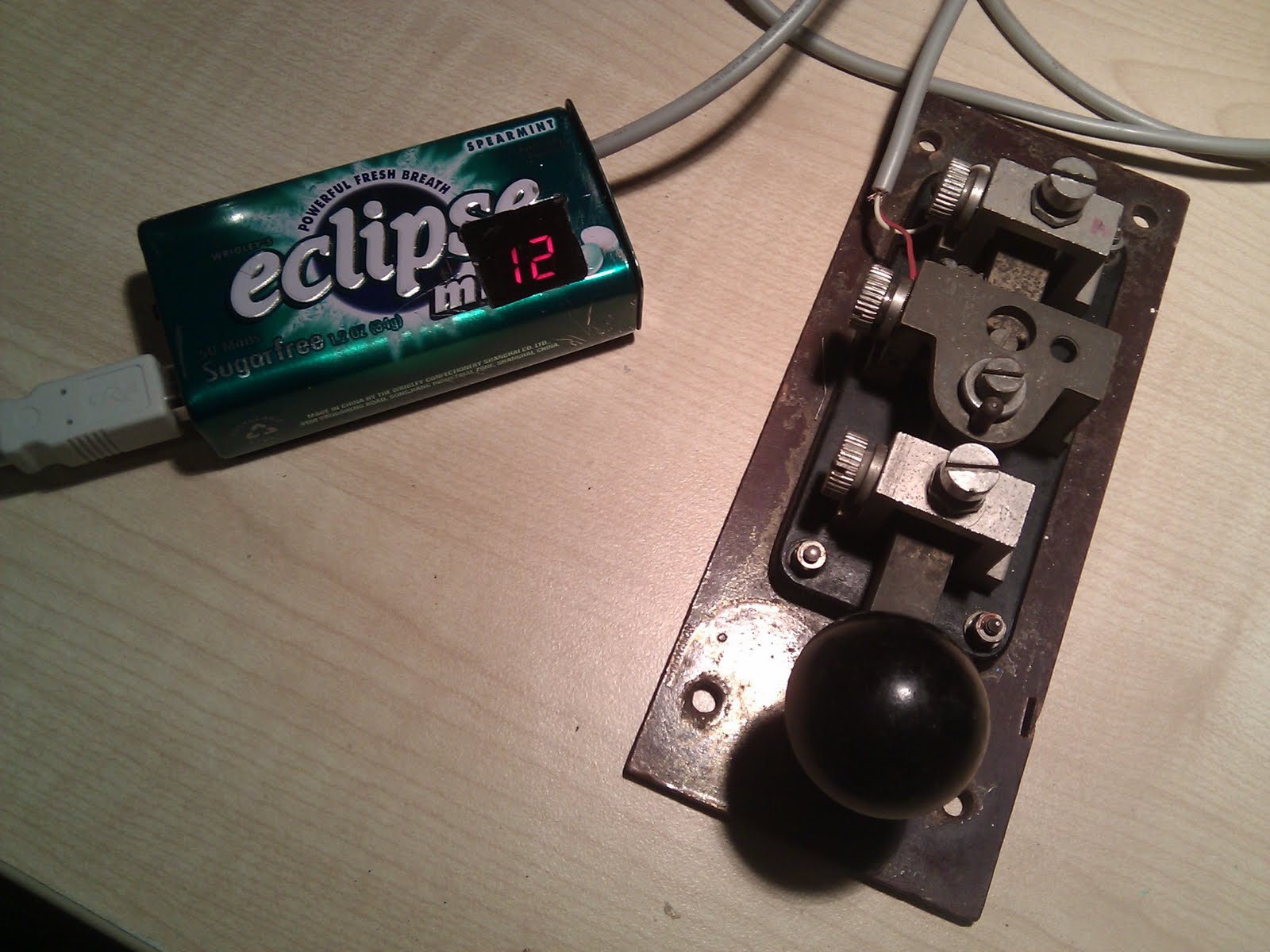 It isn’t clear what it does from the picture, but it’s a device that makes a Morse key look to a computer like a standard USB keyboard. So you can type into your word processor, blog or whatever by sending Morse.
I want one of these. If I had to type all my blog posts using Morse I’m sure I would really get my speed up! Shame it isn’t available as a kit.














