Archive for the ‘Uncategorized’ Category
 RadioSport History | Chatting Up With N6AA
 June 19th, 2010 |
  Author:
  I enjoyed our hamfest in Santa Maria, California this morning and my opportunity to chat up with Richard Norton, N6AA.
We talked about what it takes to move to the next level and he shared a few stories about his 9Y4VT operation as well. The key to successful RadioSport, according to N6AA, is operate as much as possible, guest operate where possible, and call CQ alot even if one is low power, low profile.
Richard mentioned both the art and science of the game will surely follow as one pursues a Box score. I wanted to listen for hours however his duties were first given the hamfest, perhaps, next time N6AA will continue recounting his adventures to 40 zones stretching across the globe.
73 from the shack relaxation zone.
P.S. I purchased a Palomar R-X Noise Bridge and a 2009 ARRL Periodicals CD-ROM with QST, QEX, and the National Contest Journal.

Making a mistake, rapidly
Someone commented in the eHam ratings for my blog that I spent too much time complaining about retailers. I’m sorry about that, I only tell it how it is, but it appears that no-one in this country is capable of doing their job properly. Perhaps the government’s policy of sending 50% of people to university means that most people are over-qualified for the job they do and are too bored by it to actually think about what they were doing.
Phase 2 of my shack renovation was completed earlier this week. It should have been finished a couple of weeks ago. Olga designed and ordered a system of wall units including shelves, cupboards and a bureau with a door that drops down to form a working surface. This bureau is to be my workbench – now I can start something and when I have done enough for one day I can just close the door on it so everything stays looking tidy.
The consignment arrived consisting of all 11 boxes as marked on the shipping labels. However as we started to assemble it we found that a few bits, including the entire bureau, were missing. On contacting the retailer they were sure that 12 boxes had been sent, but the bureau was never discovered and they had to order a new one from Sweden – hence the delay.
My workbench is now separate from my operating area so I can no longer use the Diamond power supply that powers my radios to power my projects. So I needed a variable power supply for the workbench. Yesterday I was pleased to win in an eBay auction a refurbished variable power supply from Rapid Electronics for about half what a new one would have cost. The courier delivered a large parcel this morning which was labelled with my address, but when I opened it I found four retractable mains cable extensions that had been ordered by Workington Sixth Form College, together with their invoice. So now I have to wait in while Rapid arranges for its courier to collect the mains extensions. Whether I will ever see the power supply, or whether it will just vanish like our original bureau, remains to be seen.
I’m sure some readers must be thinking “take a chill pill, mistakes happen.” But mistakes seem to happen rather too often, if you ask me. If you were in the mail order business, wouldn’t you put systems in place to ensure mistakes like this don’t happen, because they annoy your customers and cost money to rectify? Rapid Electronics “operates a Quality Management System to BS EN ISO 9001:2008.” What a load of spherical objects that is.
While on the subject of retailers, last week I sent an email to a company that advertises notebook PCs with Linux installed, asking for a quote for a system for my business. I have not received a reply. Why does that not surprise me?

The Montreal Doppler
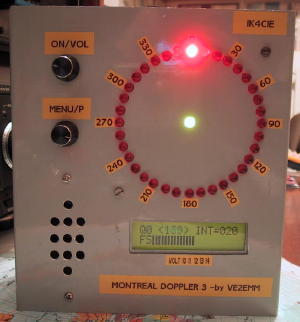 So, here I was at Dayton a few weeks ago and decided to check out the fox hunting/amateur radio direction finding (ARDF) forum. I forgot who did the forum, but it was actually very well done. One of the projects I learned about was “The Montreal Doppler”. This is a really neat project designed by Jacques Brodeur, VE2EMM.
I saw many neat attenuators, offset attenuators….. but this….. well…. it has LEDS! Pretty lights…. OK, I digress. Working with a bunch of these LED’s is pretty kewl and looks sweet. This is a project that is well documented on the web and I’ll provide links below.
The biggest question I had was, where do I get the microcontrollers and firmware. Not only was I able to acquire the PICS (microcontrollers), but I was able to get PC boards and the LCD for a very reasonable price from FAR Circuits! I know I picked up the last one he had at Dayton, but he may be able to do more (they cost $45.00). Check out the FAR circuits website at http://www.farcircuits.net/
A little about this project from VE2EMM’s website, list of features:
– 36 LEDs display; center LED when green = good signal, when red = no signal , the direction is frozen to the last good signal.
– Uses 3 PICs; a PIC16F628A for the display, a PIC18F4520 as the main processor and a PIC12F675 as a frequency divider.
– Filters; a Max 267, the best bandpass filter that I have ever seen, followed by the Roanoke switch cap filter for very narrow band width (+/- 0.5Hz).
– My DopplerII integrating and phase detection software in the main PIC.
– LM386 for monitoring the audio independently from the doppler.
– Simpler menu selection, turning a selection pot and a pushing a DO switch.
– It will switch 4 antennas with a + or – going signal, 4 antennas differential, 8 antennas with a + or – going signal.
– Pushing the DO PB sends the direction to APRS. The protocol is: <cr><lf>%359/Q<cr><lf>. The Q (0<8) is the quality of the signal just before the
extraction of the phase information.
– GPS information goes through the doppler, it will be instantly interrupted when the doppler sends a DF to APRS on a PC.
– Faster main processor, PIC18F4520. **** NEW **** June 06
The model I saw really intrigued me and there are a few really well done websites devoted to this project (it has quite the cult following).
The original site is at:
http://www.qsl.net/ve2emm/pic-projects/doppler3/doppler3-e.html
Here is another page on Jacques site that has some examples from other builders:
http://www.qsl.net/ve2emm/pic-projects/doppler3/md3_photos/dopler%203%20pictures.html
KA7OEI has a neat page with a bunch of information on this project:
He has a lot of information about an alternate firmware that looks like the image below:
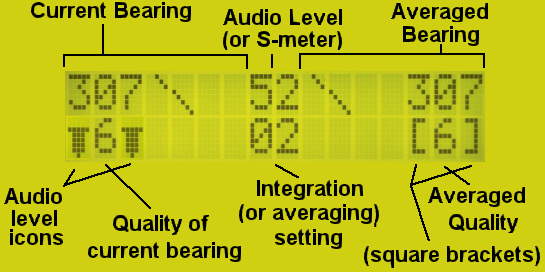
The alternate firmware page is at:
http://ka7oei.com/emm2_mont2a.html
If you have any more information on this project, resources or anything of the sort, please comment below.
Uranus to blame for poor propagation
 A recently published paper suggests that the peaks of the next two solar cycles are likely to have greatly reduced sunspot activity similar to solar cycles 5 & 6 during the Dalton Minimum of 1790 to 1830. Solar records going back over 11,000 years have been correlated with planetary ephemeris and the results appear to show that solar cycles are affected by the position of the solar system’s outer gas giants Uranus and Neptune.
However I’m not sure what is more depressing: the thought that I’m unlikely to see a solar maximum in which ten metres is wide open for worldwide propagation during my lifetime, or the reaction of some of our fellow amateurs to the news on QRZ.com. “WHY CRY about it? Buy a BIGGER antenna & amp for the bands you enjoy & have FUN!” read one comment. “All the whiners about hams using kilowatt amps will be crying constantly. Life is too short for QRP.” went another.
QRPers have been having fun throughout the extended solar minimum of the last few years and will no doubt continue to do so despite the dearth of sunspots. What is sadder, in my opinion, is the passing of an era when radio amateurs were all thoughtful, intelligent, articulate, considerate and gentlemanly individuals who treated their fellow enthusiasts, whatever their interests, with respect.

IARU HF World Championship
 The IARU HF World Championship is one of my favorite summer RadioSport events. The game is well positioned for phenomenal success given new media tools and its global reach perhaps might I say, this is the World Cup for RadioSport?
However, has leadership recognized its potential for publicizing ham radio while creating a venue for the world to watch? Instead, a world wide network of headquarter stations, cannot compete. What good is competition without results?
Meet A Challenge With Vision.
I do not agree with the elimination of headquarter scores. RadioSport at the international level has a problem in need of a reasonable solution. Elimination is a one-sided, arbitrary decision and the consequences reach far into the future. Perhaps, it is time for our international RadioSport community, to see this as an opportunity and meet the challenge with all its resources?
My favorite comment and one that is most reasonable was written by John Crovelli, W2GD/P40W who stated, “Eliminating national cheerleading and bring the HQ stations back into the competition, can be accomplished easily. Assign ZERO points to in-country QSOs made by HQ stations. The potential for abuse is eliminated.”
New Media Shaping Our World.
Toby, DH1TW examines the problem while demonstrating the reach of today’s new media and its capacity to shape our conversation. His campaign started with his blog, a tweet, then a survey…
If, the game is moving to the next level of elite competition, one for the elite competitor then meet this challenge with resources and bold vision. I’m looking forward to participating in the IARU HF World Championship this summer.
73 from the shack relaxation zone.

Noises off
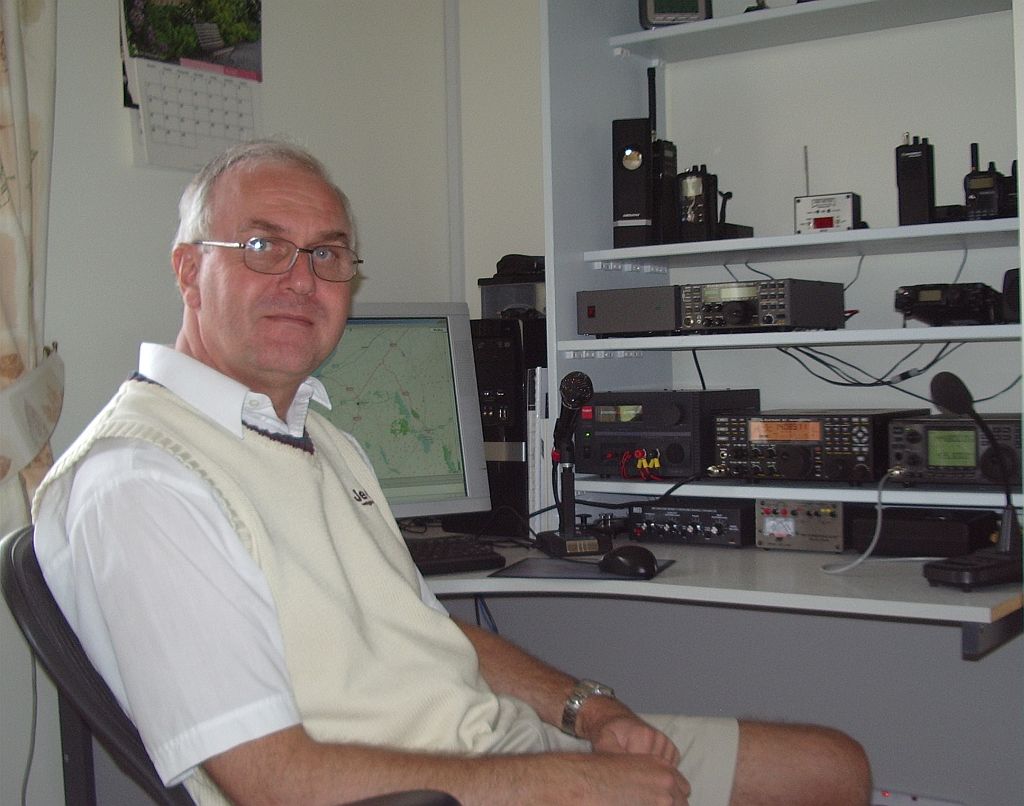
Show me a tidy shack and I’ll show you the shack of someone who doesn’t spend much time tinkering with equipment, or someone who has been nagged by his XYL to make the shack tidy and curses every time he needs to connect or disconnect something – which at G4ILO seems to be several times a week.
 When I switched on the computer this morning there appeared to be a Sporadic-E opening building on 2m to the south east so I switched on the IC-910H and turned the SuperMoxon in that direction. Nothing was heard, so I switched to the vertical instead and was puzzled as to why the band noise was so much greater on the beam than the Slim Jim.
The opening passed, as all such openings have this year with nothing heard or worked, and I decided to investigate. I switched the computer off and the noise fell to the same level as on the vertical. Eventually, after much trial and error and cursing because the cables can only be reached by groping blind (with the aid of a shaving mirror or a picture of the back of the rig) behind the equipment I established that the problem was the serial cable providing PTT control to the interface connecting the 910H to the computer. Even when it was disconnected from the radio, plugging it in to the serial port on the computer caused the noise level to jump up.
This was a cheap interface I’d bought some time ago for the FT-817. The serial cable supplied wasn’t screened, but I’d shortened it to use with a USB to serial adapter without a lot of spare cable lying around. This had resulted in it being too short to use with a real serial port, so I had replaced the cable. I had used screened cable for the replacement, but although I had connected the copper shield to the GND pin of the RS-232 port, it wasn’t connected to the body or shell of the plug, which in any case was plastic.
I managed to solder to the metal flange of the plug, the bit that pushes on to the socket on the PC, and connect a short wire from that to the GND pin and the shield. That seemed to do the trick, and the noise level is now the same when the beam is pointing towards the shack as it is on the vertical. Problem solved, for once! Nevertheless I do sometimes wonder if computers are worth all the trouble they cause to us radio enthusiasts.

Back to front
 Last night for the first time in a very long time I operated RTTY. I made ten contacts in the BARTG RTTY 75 contest. The reason was that Elecraft had released a beta version of firmware for the K3 that enhances the built-in DSP modems to support the 75baud RTTY mode that was being used in the contest. Now that the K3 also supports a way to get decoded text into a computer program I thought it would be fun to give it a try.
For those unfamiliar with the K3, the transceiver boasts a built-in Morse decoder plus DSP based modems (encoders and decoders) for PSK31, standard 45.5baud RTTY and now 75baud RTTY. As the K3 doesn’t allow direct input from a keyboard, the usual way to use this facility is to send text using a Morse paddle and read received text on a scrolling 7-character window of the K3 display. However, using a program like KComm it is possible to send and receive text using software commands over the CAT interface as well. Since, like most things that require good motor skills, I’m hopeless with a paddle (or key) at anything much above 12wpm, that’s what I did.
I installed the new firmware and it decoded 75baud RTTY signals perfectly, so I waited for the contest to begin. After it did, I soon found that although people were hearing me they weren’t decoding me. I got lots of QRZ?, ??????? and SRI NO PRINT. I started to get frustrated and began thinking that RTTY is an obsolete mode that has no place in the 21st century because I know I could have made contact with these stations easily using PSK31 and a fraction of the power.
I decided to switch to soundcard mode and use Fldigi to try to make some contest contacts, and then found that people were replying to me on the first call! So clearly there was something wrong with the RTTY being generated by my K3.
This morning I tried receiving some of my transmitted RTTY using the FT-817 and Fldigi on my NC-10 netbook. When the RTTY was generated by Fldigi it was received perfectly. However when it was generated by the K3 I received gibberish unless I switched the K3 to REV DATA mode (i.e. reverse sideband.) Since I was receiving the RTTY perfectly OK using the normal sideband I presume that the K3’s transmitted RTTY was reversed. I have reported it to Wayne and await comments.
Unfortunately I did have some problems with KComm as well. After a while, it started aborting the transmission of any macro after the first few diddles. Like many programs, it has grown to the point where it is hard to understand what is going on any more and my interest in programming has fallen off a cliff in the last few months. I don’t know if I will ever get around to fixing the problems and releasing the final version. I do like using it, and KComm is the only program that really supports the K2 and K3 properly because it doesn’t treat them like a Kenwood TS2000 (whose command set it nominally shares) but was written to take account of the way these radios actually work.














