Archive for the ‘Uncategorized’ Category
 R is for Readability
 August 9th, 2010 |
  Author:
 A couple of times I have been told by a station I was in contact with that my signal was “Radio Five”. I was a bit offended. As a classical music lover I would have preferred to have been “Radio 3”, or at least “Radio 4” which is the BBC’s highbrow channel with news, arts and current affairs programming. But joking apart, what were they trying to tell me?
I don’t want to sound like one of those curmudgeonly old farts who believe that it would have been better if newly licensed hams had never been born in the first place. I’m well aware of how such an attitude can, and has, put off newcomers to the hobby, and don’t wish to discourage someone who might just have plucked up the courage to make their first QSOs by telling them they are doing it wrong. At the same time, I’m afraid that if one does nothing, says nothing, these nonsensical phrases will slip into common usage like a virus as others hear them on the air and think that’s what they are supposed to say too.
So let’s set things straight. The only “Radio” you need to mention during a contact is the make and model of the box you are talking to me with. If you are giving me a report on how well you are receiving my signal then the term is READABILITY.

The Perseids meteor shower and Meteorwatch
Radio amateurs have long enjoyed the Perseids meteor shower as being a good one for making VHF Meteor Scatter (MS) contacts. Back in the 1980s, I was part of the Square Bashers Dxpedition group which made many MS QSOs on 144MHz from ‘rare’ locator squares. My first MS expedition was GB2XJ from the Lizard in Cornwall (IN89 these days).
Primarily, we used high speed CW, around 600-800 lpm (120-160wpm) generated by memory keyers and tape recorders to slow the morse down. By todays standards this probably seems agricultural and it worked well. We made contacts over 2000 kms.
These days, meteor scatter contacts on VHF very often use the WSJT software which is very effective. But you don’t need specialised equipment to make QSOs. At the peak of the shower, you will easily be able to make contacts on SSB – as reflections are quite long. Listen to 144.300, 50.150 or 70.200 and see what you hear.
The shower should peak on the 12th August, but you should be able to hear decent reflections for a day or two before the peak.
On Twitter, there’s been a great deal of interest generated in the whole subject of observing meteors. People all over the would are being encouraged to ‘tweet’ when they see a meteor and use the #meteorwatch hashtag. Adrian West (@virtualastro) has put together a brilliant website devoted to Meteorwarch which will run from Wednesday 11th August to Saturday 14th August. There’s a page devoted to detecting meteors by radio which provides plenty of information to get started.
Whether your a radio observer or a visual observer – enjoy the Perseids!

Where DID you get that DVAP
Someone – ‘G7 in Northampton’ – just posted a comment to an old post asking where I got my DVAP. I can’t see where your comment has gone! Anyway…
I got my DVAP through HRO in Atlanta in the US. However, they are now available in the UK and I have heard that Waters and Stanton, Martin Lynch and RadioWorld have all had stocks – quite likely other stockists too.
Hope that helps…

Pileup on the fells
The hills are alive with the sound of “CQ SOTA” and “CQ WOTA”. These two adventure radio programmes are becoming so popular that anyone trying to make contacts from a hilltop this last weekend on 2m FM had trouble finding a clear frequency. The sight of radio amateurs on mountain summits is becoming so commonplace that soon it will be the ones without radios getting the funny looks.
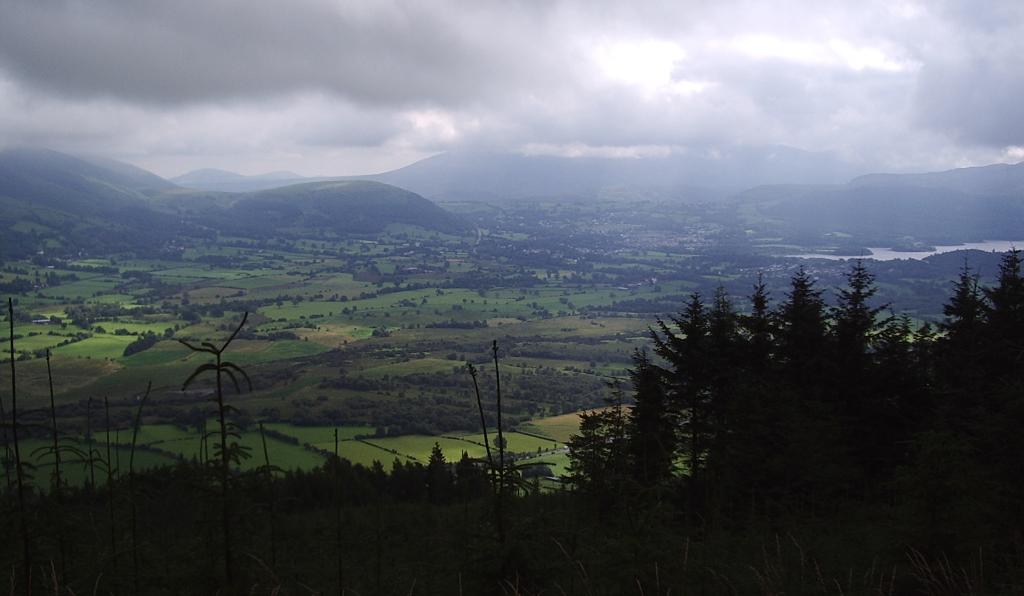
On Sunday morning Olga said to me “You should go for a walk”. Needing no further encouragement, I tossed the VX-8GR and a few bits and pieces into my rucksack and off I went. I parked at Thornthwaite near the old Swan Hotel and made my way up through the forestry roads to the minor summit of Barf. I didn’t go up by the direct path from opposite the Swan as it is very steep and slippery – I came down that way once a few years ago and it was enough for me.
On the way up I had a contact with top Wainwrights activator Phil, G4OBK/P on the summit of Brandreth. Phil is well on his way to completing the challenge of activating all 214 Wainwright summits in the English Lake District within two years and reached the half way mark this weekend. Visit Phil’s Wainwrights blog if you get a chance.
Shortly after contacting Phil I saw two ospreys circling over Bassenthwaite Lake and calling to each other with their high-pitched cry. I stopped and took the picture shown above of the view towards Keswick. About ten minutes later a small red deer came out of the forest about 100m ahead of me and trotted into the distance. Perfect!
It was cool but humid, but the misty weather creates a special atmosphere in the forest that is very pleasant. However once on the top of Barf a drying breeze was experienced. I made another contact with Phil, who was now en route for Great Gable, so he could tick Barf off on his “worked” list, and made another contact with Geoff GM4WHA. I also received an APRS message from Colin 2E0XSD, who unfortunately couldn’t hear me direct due to the amount of rock between us.
I then set off for the higher summit of Lords Seat, which I reached in about half an hour, where I stopped and had my lunch. By then Phil had reached Great Gable so we had a summit-to-summit contact. I made numerous other contacts, including Geoff and Colin and a couple people on SOTA summits outside the Lake District. I received a lot of comments about wind noise in the microphone, despite trying to shield the radio with both hands. The VX-8GR is the only one of my 2m hand-helds not to have a speaker mic, due to the fact that the only option is the expensive original Yaesu version. I should probably carry the VX-8GR just for the APRS and take the Motorola GP300 for voice contacts.
Simon, M3IWN/P called CQ from the top of Scafell Pike in the Lake District, which is England’s highest mountain. He was doing a SOTA activation and had a beam antenna with him. On a clear day I could probably see his summit from where I was, but he had so many callers that after 10 minutes of trying he still hadn’t heard me. I decided to move to another frequency and make some contacts of my own, checking back on Simon’s frequency now and again until eventually he got my call and we had a contact. At the time I worked him Simon had filled two and a half log pages with contacts including several summit to summits.
The QRM up there had to be heard to be believed. I was only using a 2m helical. The VX-8GR receiver tends to die in the presence of strong signals and I have heard strange things when using anything better than the stock antenna. Another reason for taking the Motorola, which has a better receiver. First, though, I will need to reprogram it to cover 145.300MHz, the frequency Phil likes to use on his activations.
Over the weekend I think something like 20 Wainwright summits were activated by around half a dozen different operators. Scafell Pike was actually activated twice on Sunday! Later in the afternoon after Simon had left I saw a spot had been posted for another station on the same summit.
I returned to the car via the forestry roads for a very pleasant walk with a lot of radio fun as well. If you want to join in, come to the English Lake District on a summer weekend – you won’t regret it!

The Next Level Part II
My weekend is wrapping itself up and NAQP CW delivered a lot of ham
radio fun. I’m also grateful for the friendships that follow our
hobby. Whatever one’s passion there is another who shares the same
albeit RadioSport or chasing DX or logging grid squares on 2 meters
when the ‘e’ goes plasmic on very high frequency.
I had fun this weekend sitting in front of a high frequency
transceiver pumping radio frequency toward destinations unknown. A
local ham opened his station for guest operation and my cans jumped to
the next level when monoband antennas surfed some serious radio waves.
It felt tubular and hang ten like while Q after Q went into N1MM
Logger.
Sometimes I wonder if ham radio forgets to emphasize friendship from
across the miles. I enjoyed making new friends this weekend especially
when a QRP operator in Texas mentions in his e-QSL, “Good ears. I
enjoy reading your blog.”
I want to say you are welcome and it is my pleasure sharing a personal
journal about ham radio. Our hobby is not for everyone that is okay. I
would like one Texan QRP operator committed to their passion instead
of ten Paris Hilton types committed to nothing other than nothing.
What will those new numbers translate into over the next five years?

Meeting up with Dave, G4BUO
It was great to meet with Dave, G4BUO last night. Though we have pretty regular QSOs in various contests, it was ages since we had met up for a beer and a chat, and very enjoyable it was.
Dave had been part of the UK team, with Andy, G4PIQ who’d achieved a brilliant 9th place in the recent World Radiosport Team Championship (WRTC) held in Moscow. It was interesting to hear how they’d achieved such a high QSO total in the contest, by using two radios on one aerial, with some fancy switchgear, allowing them to ‘interleave’ QSOs, ie one person transmitting whilst the other one was listening. Clever stuff.
As always, propagation varies from the different part of the world and the Great Circle paths took a bit of getting used to; UK is west, France and Germany is southwest and so on.
Temperature at their field day site was extremely hot, rising to around 38C at time, but the winds got high as well, with the tent almost blowing overnight; it being held down by the support team and referee whilst Dave and Andy kept on operating.

The Next Level
The heart of ham radio beats strong and the next level awaits. The
North American QSO Party CW is less than 24 hours away when operators
will compete for Box positions. Our high frequency spectrum will
ignite with signals juiced by the awesome power of solar Cycle Twenty
Four. The competive spirit of RadioSport underpinned by good
sportsmanship will certainly drive the beginning of our fall and
winter season.
There is something to be said about being in the right place at the right time.
I logged a station in Mexico this afternoon on 10m and it is a first
since my re-entry into ham radio. The numbers are steadily improving
with glimpses of epic high frequency conditions. I’d like at least one
of those memorable events worthy of three cups of Starbucks and better
than the best fish story. Perhaps?
Strategy is straightforward that is be in the right place at the right
time. I’m looking forward to moving to the next level and having a lot
of ham radio fun through Saturday evening. Also, the biggest secret in
RadioSport that does not require a non-disclosure statement is, call
CQ a lot.
73 from the anywhere, anytime shack.














