Archive for the ‘Uncategorized’ Category
 I am great!
 October 16th, 2011 |
  Author:
  Do you see those numbers on the display? Cool, isn’t it? That means I’m smart. Very smart. Bright and clever too. I admit I’m not too good looking, but I do have something of a genius in me. Come on guys, give me a round of applause. I did it! Finally fixed my Kenwood TS-440S. I feel like a million…..whatever currency is worth something nowadays. So, how did this sharp and brainy fellow do it? Simple: follow the 8 Volts.
After I rebuild VFO#5 last week I measured 8 Volts where I should measure 5. This bugged me for a week: where did those 8 Volts come from? So on Sunday morning I fed the family, kissed them good-bye and locked the door of my shack. With schematics, PCB layout and a DVM in hand I started out on my journey following the 8 Volts. It was a difficult track with many resistors on its path, a conductor or two and inductors to counter them. And then I arrived at a three-way junction called FET. Junction FET is known for regulating those obstinate Volts. But what do you know? Junction FET was tired beyond repair and those 8 Volts were going all three ways, where they clearly shouldn’t be. Now those of you who have travelled similar paths before (or should I just call you “old geezers”) know that you should handle junction FET with care. But until now I got away with rough-handling them. Not this time, so I quickly made amends and put in another junction with loads of TLC and some solder. And my journey ended there and then.
My thanks goes out to my family, the Yahoo TS-440S group, Mr. Liu for the components and to you, my dear readers, for putting up with me. SEE YOU ON AIR!!!
P.S. Your turn. I think I deserve at least 10 comments telling me how great I am, don’t you think?
New project– BATC DigiLite DVB-S Modulator
Note: a longer and more technically detailed version of this is at my other 'blog, which I've decided not to syndicate.
Why was I up to 3 AM last night, making me miss the Iowa QSO party today? I received a care package via “Royal Mail” on Friday from the British Amateur Television Club. It is something that was designed almost the same way (actually more clever in many respects) that I had been thinking of doing for close to 10 years.
The DigiLite is based on the “Poor Man’s DATV” by F4DAY. The project has been updated for modern computers by using a 2 channel FTDI USB serial port chip (which is the “why didn’t I think of it?” part of the design) and a closed-source (unfortunately) DSPic33 and Windows PC software to capture data from a “e-bay special” several year old Hauppage PVR-150, 250, 350 (and probably PVR-USB2) analog capture card from e-bay. (What is special about them for this project is an Conexant MPEG-2 encoder hardware chip and they are cheap!)

BATC Digilite card 3/4 way assembled at W0FMS -- topside

BATC DigiLite card 3/4 assembled at W0FMS -- bottom
The BATC’s solution of using an inexpensive PIC and the FTDI serial interface is a maybe slightly kludgy but awfully clever solution of inexpensively and simply pumping data to the QPSK modulator chip. Although there are some disadvantages to this simple interface, it is an awesome start!
The modulation used is DVB-S, which is the older digital standard used by most of the world for satellite transmissions.
I’ve been playing with LEGAL Free-To-Air satellite for many years. The majority of what is left unencrypted on C-band and Ku-band FSS satellite is receivable on an inexpensive set type box and/or PC receiver card. These receivers take in 950-2150 MHz signals as an IF (with a converter and/or a LNA in front of the IF) in Amateur use.
The main disadvantage to DVB-S for ham radio is that the modulation is pretty weak when it comes to handling multipath. Existing Yagi beams other directional antennas will mitigate this greatly in Amateur Use. See the other ‘blog for details.
THE great advantage to DVB-S for ham use– in my opinion– is that the bandwidth and data rates, even the video and audio coding the the MPEG-2 Transport streams are pretty much completely up to the link user. DVB-T in Europe and ATSC in the US is only setup for 6/8 MHz channels and IMHO there is no reason for hams to use this much bandwidth in 2011 for ATV. Neither are a good choice for low bandwidths as we NEED to have in amateur television.
Experiments by the BATC and others show that the digital signal is much more usable and stable than equivalent bandwidth analog ATV and it just gets better with reduced bit rates.
Ho, Hum? ATV? who cares? Well.. see.. it’s not really just that, is it? Data such as DVB-IP can be used for data instead. There are $20 e-bay DVB-S cards capable of receiving data as a native computer network interface via this protocol. Maybe we can restart a packet radio network up again?
So this is the start of an interesting project for me that I’ve wanted to do forever. Hopefully it will turn out well and can be revolutionary.
Signal Graphic TI2/NA7U PE4BAS

With the help of PC4T’s tutorial I made this graphic in excel. The blue line represents my signal at Casey TI2/NA7U and the green line represents Casey’s signal at my QTH. The strange thing is that I did not receive Casey after around 01:52 UTC. But of course it could be he only listened after that time. Peak on 30m was around 02:50 UTC after that you see propagation is going up and down slowly sloping downwards. Sunset greyline at Costa Rica is at 23:20 UTC if I’m not mistaking. You see a small rise of my signal being received by Casey at that time. Casey’s signal peaked also at that time, but is difficult to see as the graphic is 3D. So I quickly made another graphic showing this. Besides WSPR on 30m I did some 10m too for 2 days, I’ve been heard in 23 DXCC now and even logged a all time new one Kazakhstan bringing me at 64 DXCC on WSPR all band.

Learning Morse code with a smartphone app?
 Does anyone out there have any suggestions for an Android or iOS smartphone app to help learn Morse code and improve speed and accuracy? I’ve been poking around the App Store and Android Market. There are MANY choices and I’m hoping someone will be able to save me a little time and frustration.
Something’s come over me lately. I’ve had this renewed interest in learning Morse code. Well, not really “learning” — more like “re-learning.” I had to learn the code when I became licensed twenty years ago, but like most things I studied at the time, I promptly forgot it after the test was over. What a shame, really. I honestly viewed it as an antiquated, useless requirement. I never imagined that I’d ever want to use it.
I’m looking for a new challenge. For me, I think that challenge is QRP CW. I love this hobby. There are so many aspects that it literally can take a lifetime to explore them all.
Inspiration!!
Never Quite Good Enough, Yet!
A few days ago I had a CW chat with a guy in Illinois; nothing note worthy about this, yet! W9XS, Ron is a VFB CW operator as evidenced by his perfect code even though he was mobile at the time of our QSO. I complimented him on his fist and he replied that he has been doing code ever since his novice days, so fast code was no problem for him. I said I was not that good a code operator to be able to drive a car and do CW at the same time, to which he replied, “I’m on a bicycle, not in a car”!
My mouth literally dropped open. /M on a bicycle and churning out perfect code. He uses an Icom 706M2G for his bicycle/m work and there is a photo of him on his bike at his QRZ web site. Look him up. I greatly admire this man! We ended our chat just as he pulled into his drive way, he said over the air.
I have been trying to become a good code operator ever since I became a ham. I’m better than I was, but no at good as I want to be. My problem is that I get distracted with other things, modes, ham radio building projects and CW takes a back seat. Once again, I determine to reach my goal of becoming a good code operator. I’ve done this before, only to become distracted yet again.
This time for sure!
de AA1IK
Geezer on the porch in Steinhatchee, Florida
Confidence
 |
| Combined result RTX Saturday |
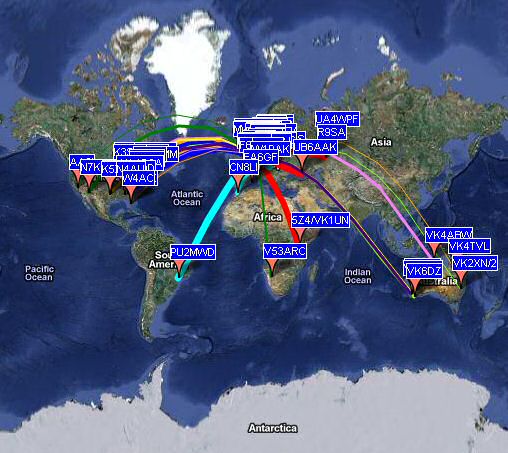
I left WSPR running at 10m this weekend. Although there was a huge difference between propagation at Saturday and Sunday. Since my computer chrashed a couple of months ago this was the first time that I installed WSPR again and Saturday around 10:00 UTC I was finally on air with my usual 1W. A little late as I already heard several Japanese stations with big signals on both 10m and 12m. Anyway, my WSPR signal was heard from Australia to Africa and North and South America. I could note several new DXCC and I count 18 till now on 10m WSPR that received met 1W signal. As always I received a lot more, and there was something that was conspicuous. There were stations that transmit with 50W and stations that transmit with only 0,1W. I did remember what Paul PC4T wrote about the QRO stations that appear on JT65A as well. Then I thought why? Why is someone using that much power on QRP modes like WSPR and JT65 or even PSK? I think it is a matter of confidence. Confidence in your station and in your antenna system or even the propagation. Probabely someone that has no confidence in it will use more power so he is certain to be heard. It could also be something else, like a wall of QRM/QRN in very populated or industrial areas. Imagine you always have to struggle with S7-9 QRM on all bands and you occasionally spot something on WSPR or JT65? Using QRO could be a scream for others to do the same so it’s finally possible to QSO or spot a WSPR signal. I don’t know, I hope someone that use more then 5W on WSPR or JT65 can tell his story why? Most confident station this weekend on 10m was N4AU with 0,1W over 7337km (4559mls) my report -6dB. No confidence at all had DF4PV who was transmitting 50W and had a signal of +2dB. Later he switched to 10-1 and 5W, probabely gained some confidence after all.
Lucky 10
I understand the reason for split operation when you run a DXpedition. Without split operation you probably wouldn’t be able to hear a thing apart from the big guns shouting for attention. Unfortunately for a little fish like me the split is too wide, most of the time. My classic TS-130V has a RIT of only 2 kHz. Nowadays many operations choose splits of 5 or even 10 kHz, even for CW! Never mind, I’m already glad to be able to hear them.
Today, however, 10 meters was open again and after tuning around I found a 53 signal from T32C. Nice, but I heard them before, so no big deal. But it became nicer when I noted he was working a split of 0 kHz and he was calling out CQ because there were few takers. Out came my mike and with the 12 Watts I am putting out on 10 meters he gave me a 59 report. Yeah, right! I gave him the honest 53, but I don’t think he noticed.
Of course, when my TS-440S is fixed I have a 1oo Watts and wide RIT/XIT again, but unfortunately that hasn’t happened yet. I got the missing parts yesterday and spent tonight putting the VFO#5 back together again. No luck, still lots of dots on the display saying that the PLL won’t lock and I’m measuring 8 Volts where I should be measuring 5 Volts. The search for the fault continues……unfortunately.













