Archive for the ‘Uncategorized’ Category
 Interesting opening on 10 meters
 September 3rd, 2012 |
  Author:
Magnum 257 (Radio Shack HTX-10)
I was sitting in the living room Saturday morning, turned my Magnum-257 10 meter rig on, and spun the dial to see if there was any activity. To my surprise, there was. Now, this is the older version of the 257, which makes it basically a RS HTX-10. 25 Watts on USB, and minimal features. Connected to the Magnum is a very simple wire antenna, thrown into a tree close to the apartment, and a counterpoise out on the roof. I heard IK6CWQ calling from Italy. I picked up the mic, and responded, not expecting to be heard, and was surprised when he acknowledged. Not bad for this meatball setup I have. I tried another Italian station I heard calling, but at that point news of the opening caused a bit of a pileup, which I just couldn’t dig my way through with the Magnum. Still, I was pleased with the one contact. The opening dropped out pretty soon after that.
My first HF contact ever was on that radio. Back in January, when I first bought it, I drove to the South Shore here on Long Island and parked near the ocean. Using the Magnum with a modified 11 meter whip, my first contact was with France, followed by a 10 minute rag-chew with a ham in New Mexico. I wish every other new ham such good luck! Since that day, I have made 30 additional contacts on that rig. Usually from near the highest point on Long Island (a whopping 400 feet AMSL!), or near the ocean. I’m definitely keeping the Magnum. No matter what else I invest in, it has sentimental value now.
Afternoon Hike to Knox Mountain
This afternoon my family and I hiked up to the cabin at Knox Mountain. I worked Jamaica, a container ship in the Atlantic Ocean, the Czech Republic and England. It was a perfect, crisp late summer day.

Sunlight filtered through a canopy of green. The air was filled with the sound of crickets mingled with the song of the brook that flows alongside the trail. Mushrooms of every variety and color lined the trail.
The cabin and the pond are about a mile and a half from the trail-head. The place is dazzling at first sight.

While my wife and daughter lay down on the grass to sun and read, I set up a rig under the cherry tree alongside the pond. I used the Chinese HB-1B on 20 meters with a half-wave vertical wire over a branch. The band was active with lots of strong stations.
Right away I called Josh 6Y5WJ in Jamaica after he finished a QSO. We have worked many times before and exchanged greetings and quick 599 reports. Then I went up the band to the QRP frequency and heard Oleg UR5FA/MM calling CQ. He works on a huge container ship and gave his current position in the Atlantic Ocean. He was a 569 and I was only 449. Oleg was running 5 watts to a small loop. He was clearly happy to have made a 2-way QRP contact. So was I!

The little HB-1B is a fine rig. I think it runs about 4 watts with the lithium pack. Dropping down below 14.025 again, I worked two Czech stations in a row. First, Vasek OK1DN gave me a 559 and sent, “UR QRP 4W doing a nice job.” Then I worked OK3AA just a few kHz away. Milan also gave me a 559. I’d been sweeping past 14.021 for quite a while trying to catch Tom G3HGE in England. He was working lots of DX and I was hoping for the chance to call him. Finally, the opportunity came and we chatted for more than 10 minutes. Tom and I have had many QSOs in the past and recognize each other’s call without any logbook lookups. Tom gave me a 579 before signing off.
We headed back down the trail after a bit more than an hour. It’s hard to find a nicer way to spend an afternoon than a hike to Knox Mountain.
Bike Ride to the Winnipesaukee River
This afternoon I took a quick bike ride to the Winnipesaukee River that runs between Tilton and Franklin, New Hampshire. I worked Italy, Lithuania and Hungary. It was a wonderful outing with perfect weather. I headed straight for the river, but several boys were fishing in my favorite spot. So I set up in a field alongside the river.

I set up on 20 meters under a large white birch tree. This photo shows the view from my operating position. I was using the HB-1B at 4W with a half wave wire over a tree branch.
The first contact was with Daniele IK2SND. He gave me a 559 and he was a 599. Then I tuned up the band a bit and answered LY2J who was calling CQ. Pranas had a very hard time copying my call. I repeated my call but Pranas still missed a letter. My antenna was off about 5 degrees from vertical, so I decided to move the backpack and make the antenna perfectly vertical. As soon as I did that, Pranas copied my call and gave me a 519. He was 599. Once again it proves the importance of angle of radiation. I moved up to 14.062 and called CQ. I wasn’t expecting a call from Hungary! HA6OD answered right away and gave me a 599. Jozsef was also 599. When I told him I was QRP, he sent “FB UR QRP.” After operating for fifteen minutes, I packed up and walked about 30 yards to get a quick photo of the river.

These warm summer days are numbered. The crickets are talking about it. Some of the maples have already started to drop their leaves. This week we’ve had a few nights in the 50s. I want to get out as often as possible.
Planning My New QTH: Taking Inventory Of My Evolving Interests – Part 1 of 3
We moved to Glade Park, Colorado last November and, unusual for me, I’ve been planning my new QTH before commencing construction (QTH = ham radio ‘Q code’ for ‘location’ which hams use to as a catch all term for their home and ham station). I’ve had pretty big ‘antenna farms’ over the years in Malibu, California, Tiffany, Colorado and East Topsham, Vermont. Each time my enthusiasm to get back on air led me to ‘plan’ as I built. Although each of these stations performed very well on the air, I eventually realized that each station could have been better. So this time, it’s different…
My inspiration to be patient and plan has been the detailed and thoughtful strategic planning that my friend Tom Taormina, K5RC, is employing in the updating of his potent ‘contest station’ (a ham radio station optimized for radio contesting a/k/a ‘radio sport’) near Reno NV. Tom has a club callsign that he uses in contests, W7RN. If you’re a radio contester you no doubt recognize this callsign.
Tom was a NASA executive during the Project Apollo glory days and today is an author and ‘Forensic Business Pathologist’ using his NASA expertise to advise corporations on employing rocket science – literally – to operate their businesses better. Tom’s contest station planning is extraordinary in scope and detail. (Tom’s business Website is www.itwasrocketscience.com and you can learn more about his contest station at www.w7rn.com.)
Since re-entering the amateur radio hobby in 1989 I have spent most of my ‘on air’ time operating radio contests on the HF bands (HF is technically ‘High Frequency’ 3 to 30-Mhz, but most hams consider the Medium Frequency 1.8-MHz ham band to also be part of the HF spectrum) and in between contests making contact with as many countries as I could on each different amateur radio band between 1-MHz (’16o meters’) and 50-Mhz (’6 meters’).
By 2003 I passed 2,800 total ‘band-countries’ (total number of countries contacted on each band added together). 2003 was the year my daughter was born and also when my professional responsibilities – then in the music business – multiplied. Fatherhood and career conspired to soak up my ham radio time and my station, we were living in Vermont at the time, gathered dust for 8 years by which time I had changed careers and moved the family back west.
Most mornings I wake up and gaze at the sun rising east of our 35 high desert acres in Glade Park CO, where we moved late last year. Glade Park is a small community perched on a high plateau west of Grand Junction. Its rural, scenic, private, dry, sunny and as far as I can tell, a great place to ‘grow some aluminum’ and ‘work the world.’ Sipping my morning coffee I frequently wonder what signals are being refracted down all around me from the solar energized ionosphere and ponder what antennas I should build to find out. I’ve also been taking careful of the moon as it traverses the sky above our property, especially moonrises (more on that later). Gradually, day by day as the sun and moon rise and fall, a station plan has come into focus.
The first step in the planning process was taking inventory of my evolving ham radio interests. This hobby is a big tent with close to a million licensees in the U.S.A. alone. Some hams enjoy providing communications as a public service during natural (and man made) disasters – ‘when all else fails amateur radio gets through,’ others enjoy long, ‘rag chew’ conversations with friends old and new around the world, some enjoy building and tinkering with gear, some ‘chase DX’ (make contact with odd bits of geography, the further away and more obscure the better), and some focus their energy on radio contesting.
In the past radio contests and DXing motivated me to get on the air. My years away from operating my station have given me time and space to meditate on exactly why I love this hobby. I eventually realized that it wasn’t so much the contest scores or the growing list of countries contacted, although there was pleasure in these accomplishments, my core interest is my fascination with the physics of what makes a radio signal propagate around the world. Take the energy used by a common household lightbulb, push it down a coax cable connected to a bit of aluminum and, voila! electromagnetic waves are launched into the ether coming back to earth thousands of miles away. This has intrigued me since I was a teen age ham radio operator in the 1960s.
DXing and contesting activities tend to reveal the most extraordinary radiowave propagation; this I have come to realize is why I enjoy DXing and contesting and why I will continue to contest and chase DX but with changed focus – some of the most extraordinary propagation modes and paths are revealed during radio contests and while chasing DX.
My passion for antennas is direct by product of my passion for propagation. Better antennas allow you to explore more exotic propagation modes and paths. At this point perhaps you shouldn’t be surprised to learn that I became a partner in an antenna company last year – InnovAntennas, Ltd. of Canvey Island, England – after becoming enthralled by the groundbreaking antenna designs company founder Justin Johnson (also a ham, callsign G0KSC) was creating. My passion now = my career. (More info: www.InnovAntennas.us for North America and www.InnovAntennas.com for Europe and ROW.)
I’ll now steer this blog entry back to my station planning. The ham radio band with the most exotic propagation is the 50-MHz (6 meter) band. This is adjacent in the electromagnetic spectrum to TV Ch. 2. Can you imagine tuning into 100+ countries and all continents on your living TV set via its rooftop antenna? Well, that’s the challenge of 50-MHz. Most of the time radio waves on this band propagate ground wave, maybe 100 miles, and not much further. Whereas other ham allocations such at the 14-MHz (’20 meter’) band routinely offer up global contacts, long distance contacts on 50-MHz are always special and much of the propagation at this part of the spectrum is not well understood.
There have been midsummer 50-MHz contacts between Japan and the southern USA – nearly half-way around the globe – in recent years and the propagation mechanism for these contacts is not well explained by the known physics of the ionosphere, yet these contacts are real and happening. My friend Dr. Lew Sayre, W7EW, made over a hundred contracts all across Europe on 50-Mhz from Oregon late last June. This is a long, long way and traverses the northern polar regions – usually death for such high frequency radiowaves – how did those radiowaves take that trip? Incredible! Dr. Jim Kennedy, KH6/K6MIO, a physicist and a ham, has been presenting papers on ‘extreme’ 50-MHz propagation at ham radio conventions in recent years which are utterly fascinating due to both what is explained and what remains mysterious.
Thus, my new station will be well-equipped with antennas for 50-MHz. I want to have the capability to access exotic propagation modes that a pedestrian system would never detect. My friend Dennis Motschenbacher, K7BV is building a MASSIVE 50-MHz antenna system at his Turkey, NC home: a stack of six ’11 element LFA Yagi’ antennas (InnovAntennas models, thanks Dennis!) nearly 70-feet long apiece spread across a nearly 200-foot tall radio tower. Dennis and I, it should be obvious, are lucky to married to women who in addition to being beautiful are tolerant of our hobbies. I am thinking about building something similar.
I’m splitting this blog entry into three parts. This first missive shows how I put a big 50-MHz antenna system on the top of my priority list. The next two parts will cover (a) why the new Flex-Radio 6700 transceiver (a device that transmits and receives radio signals) has caused me to put all of my other ham radio transcievers – except for my beloved Elecrafts – for sale and motivated my business partner Justin Johnson to develop a new antenna design which will find a home at my station, and (b) why I have become so interested in the moon and why I will be building at least four antennas systems which will be aimed at our planet’s lone natural satellite.
73
Bill AA7XT
Antenna Restrictions on Mt. Evans? The Conclusion
I finally received a letter from the Clark Creek Ranger District regarding my encounter on Mt. Evans (read the first part of the story if you are not familiar with it). It took me almost six weeks and several e-mails to get an official statement from the Ranger District. I guess an underfunded federal agency has more pressing issues to deal with.
The good news is that it was an over-eager FS employee who kicked me off the mountain.
The bad news is that, according to the letter, the Federal Code of Regulation [36 CFR 261.10(a)], which applies to communication equipment, is written with some built-in ambiguity and might be interpreted differently in other Forest Service units.
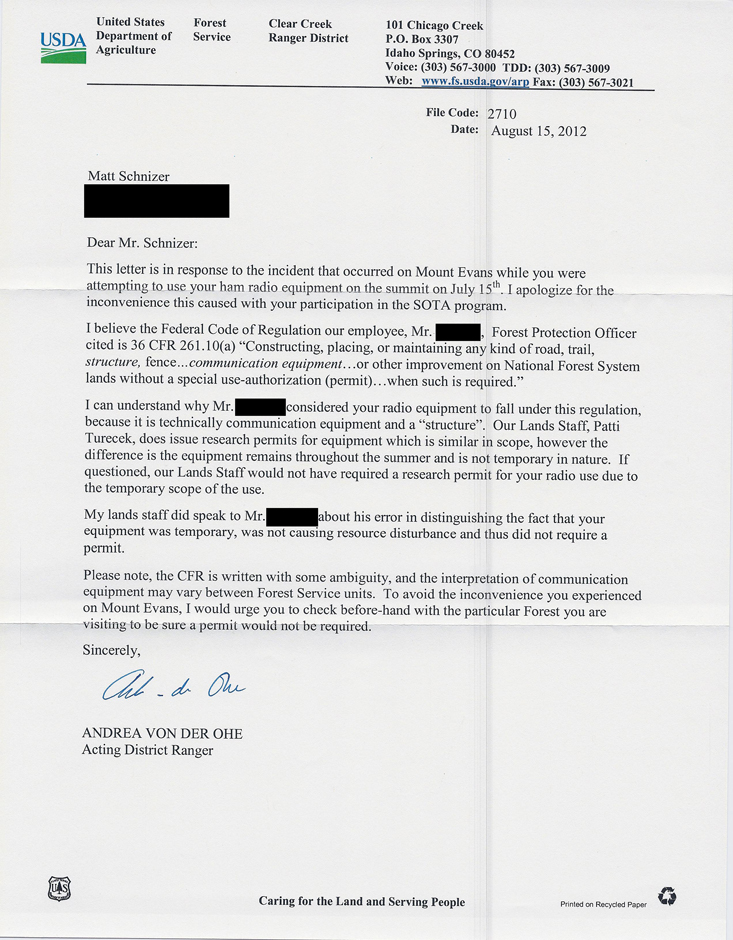
Official Response
Well, I will deal with another interpretation if and when I run into another issue. The Clear Creek Ranger District interpretation however makes sense to me – chapter closed!
I really appreciate the clarification.
Read the entire letter by clicking on the thumbnail to the right.
That’s my last post from Mt Evans but there are two more pictures I wanted to share. The first one was shot at the Summit Lake trail-head early in the morning. The trail starts on the right side of the picture, goes up the ridge to Mt. Spalding and over to Mt. Evans.
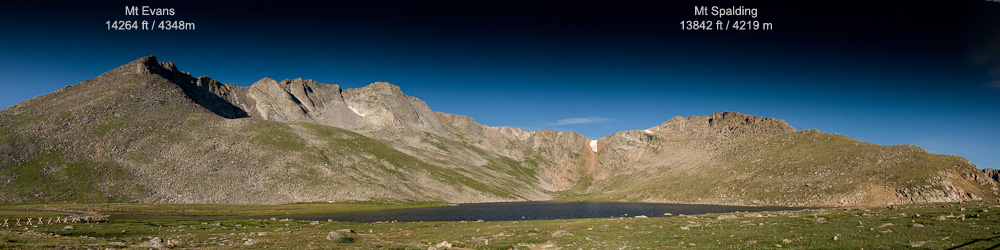
Panorama of the Mt. Evans Area
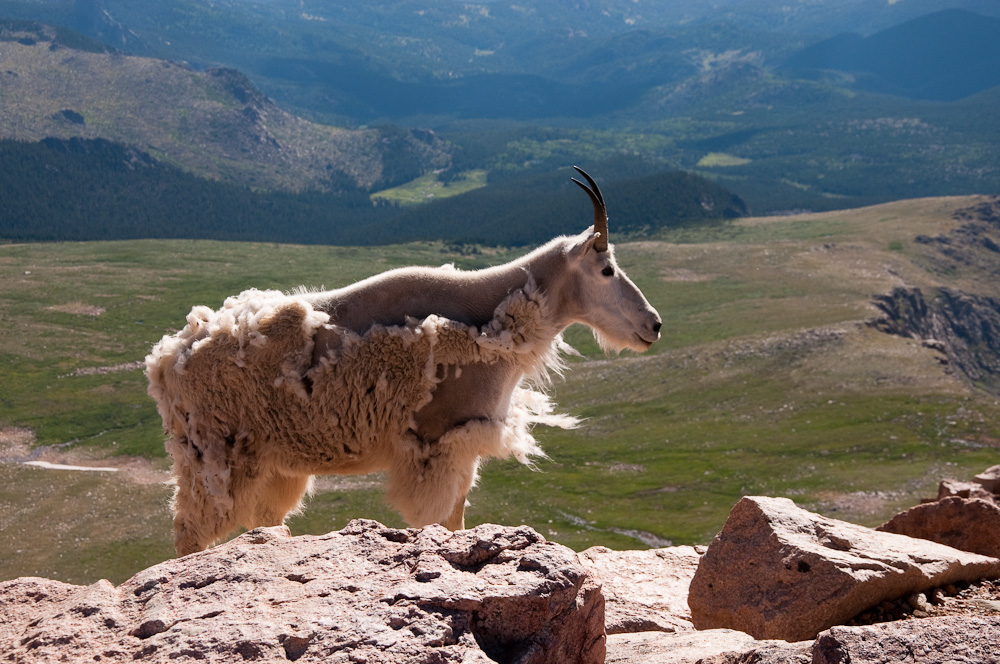
Mountain goat on Mt. Evans
The second picture is from a close encounter of the third kind… well, not quite but is was remarkable. This unflinching mountain goat approached me. The picture is shot with a 52mm lens, not a tele-photo lens. He came up to me at arms lengh… too close for my taste. I normally try to keep a save distance between wild animals and myself, but this guy was not shy at all. Since I had never heard about occurrences of rabies in mountain goats and since I received some goat combat lessons earlier in the year (courtesy of Rooster) on my trip to Mt. Herman, I took the chance to take some real close-up shots instead of retreating.
73, Matt/KØMOS
No can do.
On Tuesday, when Mr. Liu from the NCC asked me for my opinion on matters regarding radio amateurs in Taiwan, I gave him my two wishes:
- 1 – an English version of the exam, to get more foreigners licensed.
- 2 – being able to choose your own call sign.
Both requests were torpedoed right away. First off, when the NCC would make an English version of the exam then they would also have make a Japanese version to accommodate them. And then an Indonesian version. And a …….. well, you get the drift.
Assigning call signs was a more sensitive matter. Even though the R.O.C. on Taiwan has been independent since 1949, it has not been recognised by many. Hence, over here we depend on the generosity of our next door big brother – the P.R.C. of China – to be able to use some prefixes from the ITU assigned block for China (Taiwan uses BM, BN, BO, BQ, BU, BV and BX, China the rest of the B-block). Amateur radio call signs are kept back for 20 years after expiry, so the resulting pool is small. So, unfortunately, once you get your call sign you are stuck with it, because the NCC doesn’t want to hand our new ones at your will. And even though changing areas would be a good reason, they still refuse. I am now living in area 3, but I still have to use my area 2 call because the NCC doesn’t want to assign a new BX3 call to me.
Luckily I am happy with my call. After all, ABT stands for “Any Bloody Thing” and that is how I enjoy the hobby: any bloody thing goes! Have a nice weekend.
Whisper it!
I was at home but too busy to play radio, so I did the WSPR thing on 10 MHz all day. Here is a screenshot of the local morning session. As you can see I am right in the middle between JA2GRC, DU1MGA and W8TOD in Beijing. W8TOD in Beijing??? There must be something wrong with his set up of WSPR! But there isn’t. On the QRZ.com page of Warren you can read the following:
I live in Beijing, China currently and am operating under the “less than one watt” and the “it’s legal if you don’t get caught” rules.
There you go! Stay under the radar, mingle in the crowd and you can get your radio fix, even if it is not allowed. The radio situation in Asia is messy, so turn it into your advantage.
Mind you, I wouldn’t do what Warren does and as I wrote yesterday, I am very careful in my actions, because I want to enjoy my hobby for a long time. So I do my best to play by the rules, but I will bend them if necessary.













