Archive for the ‘Uncategorized’ Category
 Ham Radio Product Survey
 February 27th, 2014 |
  Author:
  Jameco recently reached out to me to ask if I’d be willing to ask you about the type of amateur radio products you’d like to see them carry.
Like DigiKey and Mouser, Jameco is one of the larger electronics component distributors in the United States. They’ve taken notice that amateur radio is a growing hobby and that their current inventory selection may not be serving us as well as it could.
So, what type of items do you have trouble sourcing?
Antennas? Batteries? RF connectors? A wide selection of QRP and other types of inexpensive kits? Other components you’ve had to source overseas?
No idea is too crazy — they want to know what’s on your mind and what frustrations you have when trying to get the items you need.
Finished the Shack-in-a-Box
Normally my projects take a long time to finish because I can’t find the right materials (I’ll dedicate a post on that later). But my “Shack-in-a-Box” project was done fairly quickly: only six weeks.
The box is an old German army issue box that my Junker straight key came in. Very sturdy and not too heavy.

I padded it with foam I got from a shop selling notebook batteries; the plexiglass dividers were left-overs from old cosmetic product displays. The little basket was a dollar from the local hardware store and the only thing bought new.

Everything but the antenna is in there: the KX3, LiPo battery (old laptop battery cells from a friend), the touch paddle and various cables. There are ear plugs and an old computer microphone with which I get very good audio reports. With this setup it takes me less than a minute to be operational and packing up is equally fast. This weekend is a long one in Taiwan because of Peace Memorial Day and I’ll be out on the coast doing my first serious stint of portable operation. If you hear me on air don’t hesitate to call me. 73.
Air mobile over Colorado
http://www.youtube.com/watch?v=5Vdpsg_ZLwE
John W1LNX worked Scott W9AFB aeronautical mobile over Colorado recently. Not a bad signal for just over 100 miles away. I am curious about his distance record.
According to John’s description, Scott was operating aboard a Boeing C-135 (or one of the many variations thereof) at about 33,000 feet.
Although Scott’s transceiver in the airplane is limited to 2M and 6M, I think his enviable operating position gives new meaning to the term “air superiority”!

And the winner is……
As I wrote in a previous post, being used to rigs from over 20 years ago it was quite a culture shock operating both the KX3 and the IC-7200. Knobs all have dual functions and there are menus abound with almost infinite options. RTFM is not an option, it is a must. In the beginning I found that I would often put my KX3 aside and go back to my tried, trusted and familiar TS130V to have my radio fix.
After I got the IC-7200 that changed, because to me the lay-out and functions came a bit more natural. I did have a “duh” moment when I connected a microphone to the set. I didn’t get the stock HM-36 mike but bought a HM-118TN instead, which is supposed to be wired identically. The mike would key the radio but no sound was being transmitted in SSB. Turned out there is a menu option where you can choose what input to use for SSB: the front connector, the USB connector or the rear aux connector. Maybe obvious to most, but it took me the entire evening to find out, resulting in a brand new microphone being completely disassembled and reassembled.
But after that everything was fine and dandy and now after some two months of operating both I can more or less say which of the two sets has my preference. And the winner is…….none at all! Both are fine rigs in their own right, but neither one will become my favourite rig. Here is why (and remember, these are my opinions based on my experience)….
First the KX3, the pros of this rig:
- an excellent receiver for CW and SSB
- very sharp filters
- excellent internal tuner
- easy CW operation and internal decoder
- energy efficient
- config menu system is very clear and arranged alphabetically
and the cons:
- volume is much too low and distorted when turned up
- lousy AGC
- lousy AM reception
- sub par reception below 1800 kHz
- no separate audio out
- no adaptive tuning speed
- clumsy operation for some functions
- inadequate cooling of the finals
- output power only 12 Watts
My biggest gripe with the KX3 is the audio output. I realize that the rig is designed for use with headphones, but I am not keen on using headphones inside the shack. When receiving weak signals I have to turn up the volume high (up to 50) to hear it comfortably (with NR off, because that reduces audio volume even further). If you then encounter a strong signal the AGC doesn’t kick in enough so you get distortion. I tried playing with the AGC settings, but to no avail. I also tried to further isolate the small speaker from the case, but also no improvement. I could use an external speaker, but that defeats the purpose of the KX3 as being a complete package in a small footprint.
Apart from the audio gripe the KX3 is a dream for CW operators. The spot function is so convenient I already miss it when not using the KX3. Even under noisy conditions the 50 Hz filter still produces clear signals. I compared both rigs during the CQ160 contest in January. On the IC-7200 I heard stations, but could not decode them. With the KX3 they came in clear and decodable. If the Elecraft K3 is as good at receiving as the KX3 it might well become my next rig.
Then the IC-7200. The pros here:
- easy to operate
- excellent audio for such a small speaker
- adaptive tuning speed
- one USB connection for audio and rig control
- filters are excellent for digital modes
- excellent reception on medium wave
- 100 Watts output power
and the cons:
- no band up/down buttons
- no PTT button
- narrow filters settings give a lot of ringing under noisy conditions
- lousy internal keyer
- some often used functions are not easy accessible
- sub par reception below 500 kHz
Operating CW with the IC-7200 is not as pleasurable as the KX3. With little noise the narrow filters work fine and give clear audio. But with the noise level going up, so does the ringing and that makes signals unintelligible. The USB cable connection for both rig control and audio is a great feature, but it has its disadvantages: below 10 MHz the noise from my laptop is noticeable and below 3.5 MHz it obliterates most signals, except the strongest ones. Unplugging helps, but that defeats the purpose of the USB connection, of course.
But you have to live with the cons and enjoy the pros, so I will. Need I make a choice I would keep the IC-7200, because it delivers more bang for the buck and the set just “feels” right to me. The KX3 doesn’t give me that comfy feeling when I operate it, but man, it sure can receive well. I don’t need to make a choice, though. I will keep both rigs because the KX3 will be used in my portable shack-in-a-box and the IC-7200 will remain on my desk for daily operations. It’s almost a bit like with cars: a station wagon for daily commutes and grocery shopping, and a sports car for those short drives in the weekend.
Doing the MFJ loop happy dance!!
1. Tuning the loop for max noise (as low SWR was not happening) did happen but as soon as the rig was tuned in any way the noise dropped to nil.
2. Once max noise was achieved and I transmitted the max noise was gone again.
3. There was no spots on the Reverse Beacon Network while giving the tuned match a go.
4. When transmitting power levels were all over the place from 1 watt to 5 watts.
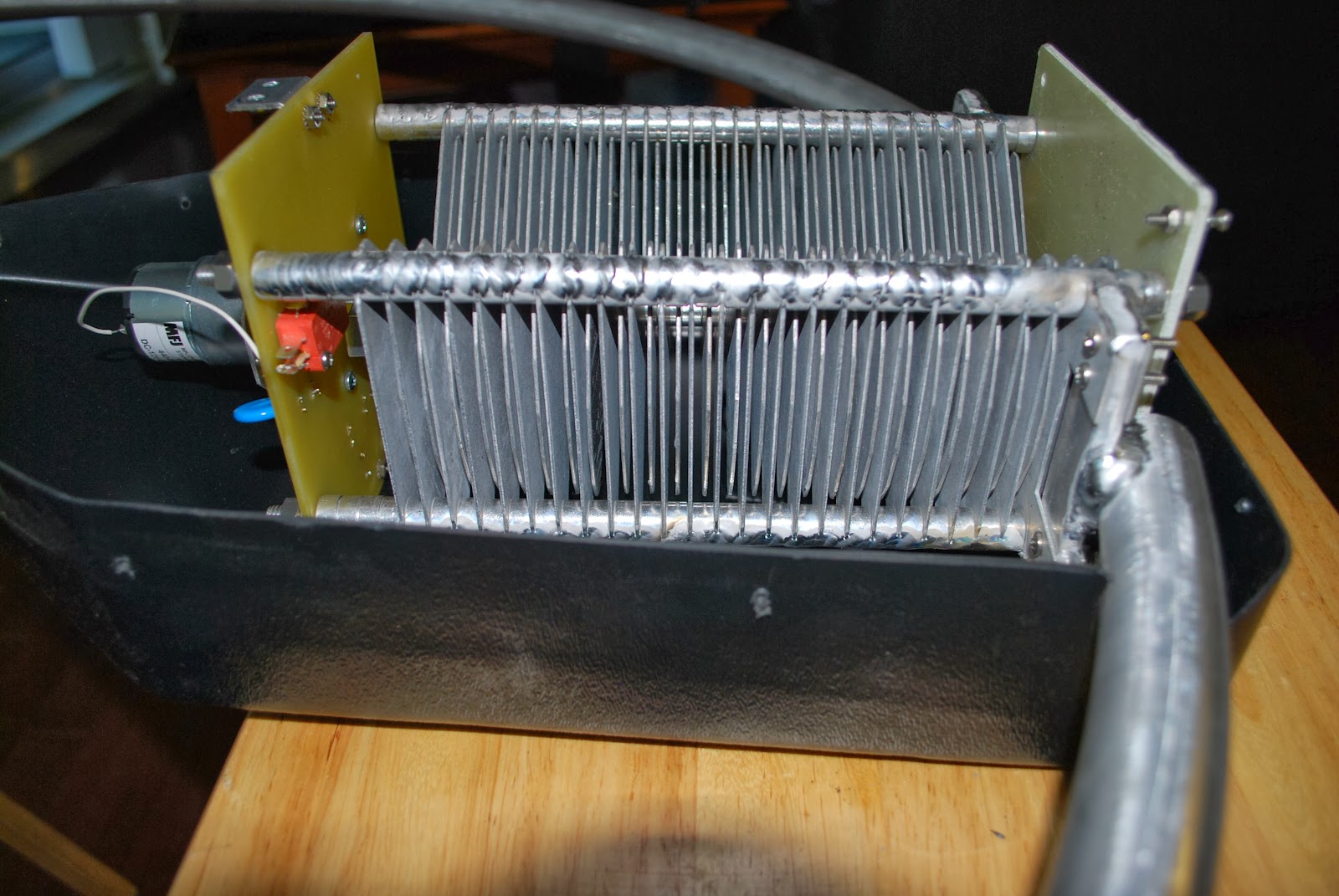
I had posted my 20m tuning problem on 2 loop user groups and had some great advice but nothing seemed to even come close to solving the problem. I then emailed MFJ who very promptly emailed me back and advised me to change the shape of a 12 gauge copper loop that was located inside the loop. Easier said than done this involved removing half the plastic cover on the loop and changing the shape of this loop then
 |
| Adjusting the loop |
 |
| Some plates to close |
Raspberry Pi repeater controller
http://www.youtube.com/watch?v=FrtHzsZMfm8
Aaron Crawford, N3MBH, is in the process of designing a repeater controller using his Raspberry Pi. He’s moved into testing on the RPi and toward designing and refining the circuitry for the radio interface.
What makes this different than other projects I’ve seen is the polish of his web interface. You can tell he’s a web developer — it’s definitely slick!
Aaron describes the project here:
In setting out to develop this project my primary goals and features are to develop a low-cost, low-power, but feature rich duplex repeater controller suitable for setting up a temporary / emergency repeater systems with radios that can be run on portable power. However with a more complete feature set and a modular design, it could also be used as a primary or a backup controller for a permanent installation repeater. With the low cost, modular design, it would make it easy to keep backup hardware (Raspberry Pi, repeater control board, and a cloned SD card) on site for easy service swap-outs.
This is definitely a project to keep an eye on. Kickstarter, anyone?
Two new states.
Birthday parties for 8 year old daughters are fun, but soooooo tiring. My plan was to get up early on Sunday morning and take full advantage of the daylight path to north America for the ARRL DX Contest. But Saturday was the day of the long awaited party and we outdid ourselves entertaining all the little guests, until we drove them home in the evening. So when I opened my eyes on Sunday it was already 10 local time and when I crept behind the set already after 11. Most of NA in the dark, so I didn’t expect much from 15 and 10 meters.
But boy, was I wrong! The 15 meter band was wide open and I logged two new states: Louisiana and Iowa. Georgia also yielded two new stations, despite it being after dusk there for a while already. Strangely though, the 10 meter band didn’t show any sign from NA, but 20 meters did and in the middle of the day I was able to log two stations from the west coast with excellent signals. And the last thing that really surprised me was the discipline in this contest. I didn’t encounter any rude behaviour and stations didn’t spill over into other portions of the bands. Kudos to all the operators who took part. It sure was fun!













