Archive for the ‘Uncategorized’ Category
 TX Factor – Episode 3 is Now Available!
 May 16th, 2014 |
  Author:
 Yes, it’s ready to view over on www.txfactor.co.uk
Bob and Mike assist Roger G4ROJ with his amazing kite aerials. Nick pays a visit to Ben Nock G4BXD at his Military Wireless Museum in Kidderminster and discovers Ben’s impressive collection of war sets and spy sets. Mike reports from the Exeter Radio and Electronics Rally to find out what people expect from a rally in the 21st century. We also review a new quad-band mobile radio from Wouxun.
We hope you enjoy this bumper edition!
73
Nick 2E0FGQ
TXFactor Team
Two year anniversary
Today, sadly, marks the two year anniversary of the passing of my Mom. Some days, it seems like her passing happened so long ago. Other days, the pain is as raw as if it had just happened. I know they say that time heals all wounds, but there are some things you never get over. And to be honest, I would rather feel the occasional pang of grief than become complacent about her death. There are indeed moments when the emptiness and sadness still rear their ugly head. Fortunately, those sad times are farther and fewer between, and there are many times when the memories invoke moments of joy and laughter or a smile.

In a related matter, the friend of a friend passed away in early April. I mention this, because some of you may have known him – some well, others just in passing. The person I am referring to is Bill Stevenson G4KKI. Sadly, Bill passed away from cancer in early April. Bill was one of the “QRP family”, a FISTS member, an antenna experimenter and he loved going on portable QRP operations. Bill contributed a lot to the various QRP lists with posts about his successes with homebrewing rigs, magloops, and his various portable QRP ops expeditions to various places in his beloved home of England.
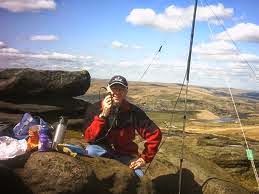
His webpage is still up, if you care to have a look: http://homepage.ntlworld.com/g4kki.william/
And Bill also liked to post videos of his projects and exploits on YouTube: https://www.youtube.com/user/g4kki
A person once said that, “Everybody wants to go to Heaven, but nobody wants to do what they have to do to in order to get there – die.” I suppose that’s true, but sometimes I think the heavier burden is left with those of us who stay behind.
72 de Larry W2LJ
QRP – When you care to send the very least!
Kayaking /MM from Hermit Lake
I took the kayak out on Hermit Lake today. It was beautiful. I worked Missouri, Rhode Island, Florida, South Carolina, Alabama and Georgia… all with a d-star handie talkie.

It was 70F and sunny, and I was ready for my first outing to Hermit Lake. I brought a d-star setup packed in a bright yellow Pelican case. It contains a Raspberry Pi computer, a battery, a DVAP (digital voice access point) and a MiFi card. I also had the Icom ID-51 handie. This setup gives me access to the world-wide d-star network.

As soon as I left the shore I started working stations all over the country. I was connected to reflector 30C which is in Atlanta. A reflector is a collection of repeaters. Today 30C may have had 60 users. Making contacts is easy. When I started out, KB6RRX in Georgia was talking with WJ4X in South Carolina. I joined in and explained that I was out in Hermit Lake in a Kayak. Adam, WJ4X looked me up on http://www.aprs.fi. He could see my GPS track on the lake. Unfortunately, I forgot to change the hiking icon to a boat.

The lake was wonderful! As I was paddling along, a large loon popped up barely 20 feet from me. He didn’t seem worried about my paddling by. I floated past islands and coves where turtles basked in the sun on half sunken logs.

Not far away a large Canada goose veered away to the south of me. As I floated through the quiet water, I chatted with Jamie, K4OEY in Alabama. Then I had a call from Mike W4MPL in Orlando. Turns out we both went to the same college. A few minutes later I was chatting with Tony AD0DQ out in Missouri.

As I neared the shore I heard Barry N1TOQ in Rhode Island send his ID. I returned the call and we chatted for a few minutes. He also operates d-star while /MM and wanted to know the details of my setup.
Within the next 10 days our club is putting up a d-star repeater in the area. Next time I go kayaking, I won’t need the pelican case full of equipment. I’ll just use the repeater.
Mental gyrations
Yesterday, the bands seemed a little on the “light side” when I headed out for lunch. Both 15 Meters and 17 Meters had some signals, but it seemed like most of the DX stations were ones I have already worked before. So I decided to go to the 20 Meter QRP watering hole and put out a CQ.
I was answered by Bob AK4JA in Georgia. He was a solid 589 at peaks and he gave me a similar signal report. Here’s the thing – while I was using my normal 5 Watts, Bob was running 500 mW! And his signal was fantastic! While I am fully aware how QRP signals don’t necessarily equate to “weak signals” – even I stand up and take notice when a QRPp signal almost pins my meter. I kind of felt like this guy – remember him from TV commercials a few years back?

For those readers not from the US, the Department of Energy ran a series of public service announcements a few years back asking people not to be “Energy Hogs”. Normally, running 5 Watts can make you feel smug with that regard. Yesterday, using even 5 Watts made me feel piggish.
For the record, Bob was using a Yaseu FT817 to a dipole – and it was doing a fantastic job for him. His 1/2 Watt signal almost sounded like he was transmitting from a location just down the street.
When I got home a “new” computer was waiting for me. I purchased a refurbished Dell Optiplex 320 from the Blair Group via eBay. This was the same place from which I had purchased a Compaq to replace the family computer which died a few weeks back. For a very good price (under $150), I got a Windows 7 box to replace my shack laptop, which is not only an XP machine, but is physically on its last legs after suffering through years of “kid abuse”. I figured that it’s better to replace it now, while the laptop is still barely kicking, so I can access all the data that is still there before it totally dies. As it was, I was already using an auxiliary keyboard and monitor, so I only had to purchase the box.
So I ran through the Windows 7 setup with nary a hitch. But then, of course, comes the fun part. Getting all the important Amateur Radio programs up and running. I downloaded Log4OM and got that running. I followed the directions for transferring all my log data and configurations from the XP machine to the Windows 7 machine. Everything seemed to be OK – except the program wasn’t displaying any of my previous QSOs! Log4OM said they were all there, but it just wasn’t showing them in a visible way. It turns out that the W2LJ.sql database file needed to be in a different sub-directory than where it was located on the XP machine. Once I got that figured out, things were good. But for a while there, the little beads of sweat started popping out on my forehead while I started muttering to myself, “Where are all my QSOs?”
The next problem to tackle was downloading the KX3 and KXPA100 utility programs from Elecraft in order to get them running, as well as OmniRig for CAT control for Log4OM. Downloading and installing the programs was easy enough – the computer did all the work while I tuned around 20 Meters. The hard part was figuring out why the computer didn’t want to talk to the KX3 or the KXPA100.
For whatever reason, it didn’t turn out to be as “plug and play” as it sometimes is. Every time I tried to get the KX3 utility to talk to the KX3 – nada, zip, zilch. The radio and computer were acting like a husband and wife after a marital spat – not talking to each other. It appears that the KX3 was looking to talk via Com1 – but that was being used by another device. And when I hit the “Scan for Ports” button on the utility, that was all that I was getting.
That caused me to make a sharp right turn and head off to the dreaded Control Panel and even more dreaded Device Manager. For those of us who don’t consider ourselves to be all that computer savvy, this is dreaded territory. Kind of like walking through the Valley of the Shadow of Death.
But it was there that I was able to scan for hardware changes, open another port (Com 3) and load the drivers for the Elecraft KXUSB cable. After that, the KX3 and Log4OM and the utility programs and the Dell were all smoochy-smoochy like a newlywed couple.
Satisfied that I got the very basics covered, I looked up at the clock to discover that it was after Midnight. Holy cow! When you get up before 6:00 AM, post Midnight is late – very late! I still have to download and install Avast (one of the first things I did was to uninstall and trash Microsoft Security Essentials, which IMHO is useless). After that, there are a few more remaining Amateur Radio programs that I have to re-download and get running – like DX Atlas for instance. Then I need to transfer accumulated documents and photos from the laptop and then I can finally say “Good-Bye” to Windows XP.
And that, in itself is kind of sad, as I consider XP to be the most stable and useful platforms that Microsoft has ever come up with. If it wasn’t for the fact that my laptop looks like Rocky Balboa after a tussle in the ring with Apollo Creed, I probably would have kept it going for a while longer. However, time marches on and I suppose it’s appropriate to modify that well known saying – “Time and Microsoft wait for no man”.
72 de Larry W2LJ
QRP – When you care to send the very least!
Warm!
The weather has taken a decidedly summer-like turn in central NJ. At lunch time today, the outside temperature is a June/July like 84F (29C). You will not hear a word of complaint out of me, that this is too hot, considering how long and extended our winter was. I’ll take this any day of the week!
As the situation at work returned to somewhat normal, I was able to head out to the Jeep this afternoon, for my hour long break. I was able to work out of the back, with the rear tailgate open, providing a bit of shade from the Noon sun.
15 Meters and 17 Meters seemed to be the active bands. On 15 Meters, I worked SN777AG – Jurek SP2GUB who was commemorating the 777th Anniversary of the City of Elblag, which is not far from Gdansk.

After SN777AG, I worked Jose EA1MX in Spain. QSB got the better of that QSO. We were able to exchange rudimentary RST information, and that was about it. I’ll count it as complete QSO, but I hate when QSB kills an opportunity for more.
I then hopped on over to 17 Meters, where I worked EM90WF in the Ukraine, another Special Event Station. This one was to commemorate the 90th birthday of Vladimir Goncharsky U5WF (SK). Vladimir was not only a very successful Ham who had won many awards, but was also a WWII veteran. The station was loud into NJ – very loud. This is not the first time I have heard them, or have tried to work them, as I’m always attracted to very loud signals from DX stations. Attempts to work EM90WF in the past were unsuccessful. In fact, a few weeks ago, I spent one or two lunchtime sessions trying to break the pileup, fruitlessly. Today? First call – go figure.
72 de Larry W2LJ
QRP – When you care to send the very least!
Hike to Sky Pond
What a beautiful day in New Hampshire! Tim W3ATB and I hiked to Bald Ledges, a little past Sky Pond. We had a fantastic time. We worked the Netherlands, Belgium, England and WA8REI in Michigan.

Sky Pond is a tiny lake in the wilderness of New Hampton. It’s about 12 miles from home. We had a picnic lunch on the shore and then hiked about 20 minutes to the ledges. The view there is stunning.

Toward the northeast, we can see Lake Winona in the foreground and both the White Mountains and Ossipee Mountains in the distance.
I set up the KX3 with a 33 foot sloper to a pine tree. Band conditions weren’t very good, and I worked 17 meters, because that’s where I could hear the most activity. I worked PI4DX in the Netherlands, OS11M, a Morse Heritage special event in Belgium, and then my old friend Tom G3HGE in England. As I was working Tom, a large hawk flew back and forth at eye level out several hundred feet from the ledges. I described it to Tom but I called it an eagle by mistake. He was impressed with the description and wanted me to send a photo!
I packed up my gear and walked up the ledge to see how Tim was doing. He was running the HB-1B on 20 meters and there wasn’t much going on. We went up to the QRP frequency and there was Ken WA8REI just finishing up a QSO. What a thrill to receive a 579 from Ken in Michigan and chat with him for a few minutes. We first met at Lobstercon in Maine. I handed the key to Tim and he and Ken chatted for a minutes before signing. It was a perfect ending to a perfect outing.
The black flies are just coming into their own in New Hampshire. Soon they’ll pretty much control all the outdoor activity. We might not get out much for the next couple of weeks until they die back. Then we’ll have mosquitoes to contend with. All better than snow!
This amazes me
While talking with my bud, Bob W3BBO today, we discussed an instance that we had both heard, of a Ham who was selling all his equipment. It appears this operator feels that he has reached the pinnacle of the hobby by working all the DX that there is to work, “So there’s nothing else to do”, and he’s packing it in.
Bob and I were both incredulous. He’s been in the hobby for over 50 years and I have been in the hobby for 36 years now. I do understand that with any undertaking, there are ebbs and flows of enthusiasm and interest. You might be super active for a period and then lose steam for a while. It might even reach the point of becoming temporarily inactive. And as John Lennon famously said, “Life is what happens when you’re busy making other plans”. Life circumstances change, as do priorities.
But to chuck everything and get out of the hobby because you have “done it all?” I don’t think that’s even possible!
So let’s say you’ve been fortunate enough to work 9 band Honor Roll ……. there’s nothing left? How about (wait for the plug) trying to do it again using QRP? Or how about getting into satellites, or digital modes, or perhaps taking a shot at working all counties? I have a friend, Dr. Paul Scipione AA2AV, who has worked all counties three separate times – SSB, CW and CW QRP. That’s an accomplishment!
Build something, go hilltopping or become active in SOTA or IOTA, go on a DXepdition! Bounce your signals off the ionized trail of a meteor, or the moon.
My point is, Amateur Radio is actually a hobby built up of sub-hobbies. There’s always something new to try and undertake. The day someone actually does end up “doing it all” will be a very special day, and I’d like to meet and shake that person’s hand. For indeed, that person will definitely be very special, and I think I would love to read whatever book they choose to write about their adventures.
Scrolling through QRP-L today, I came across a link to a cool article written by Gerry Lynch, a Ham in the UK. If you’re contemplating learning CW and are not sure it’s worth your time and effort, you might want to read this: http://www.gerrylynch.co.uk/WhyCW.html
72 de Larry W2LJ
QRP – When you care to send the very least!













