Archive for the ‘Uncategorized’ Category
 August 8th, 2014 |
  Author:
  472kHz – improvements?

Using the strapped feeder to my Par 10/20/40m as my 472kHz antenna rather than my 2m/70cm feeder, the antenna current has nearly doubled with the antenna current meter now showing 30-33uA whereas it was 18uA before. This suggests ERP has increased by around 4-5dB (ERP proportional to I^^2), but we’ll see later. The Par antenna itself is lower than the 2m/70cm antenna and runs horizontally to a tree. Average height is around 3-4m AGL. The losses may be greater.
The picture shows the 472kHz coil used (a ferrite rod would be fine but since moving it is “lost”), the 472kHz homebrew transverter (left) and the 3C90 matching coil between transverter and antenna (towards centre, LHS of coil). The small meter measures antenna current and registered 18uA last night and 30-33uA now with the Par antenna with strapped feeders.
UPDATE 1420z: G8HUH (250km) is copying in daylight a full 8dB S/N better than last night. Encouraging.
UPDATE 1448z: M0PPP (182km) seems to be coming in stronger than last night too and in broad daylight.
UPDATE 1700z: M0PPP is now spotting me at 1456z, 1538z and 1620z i.e. in daylight. He was not copying me at all last night, so I think my signal IS stronger.

Early close again tonight on 10m WSPR
Tonight is the last night my shack is being used as a bedroom. Hopefully I shall be able to operate beyond 1745z tomorrow if I want to. I am also unable to come on for the UKAC session on 2m this evening for the same reason: my shack is a bedroom for the third night.
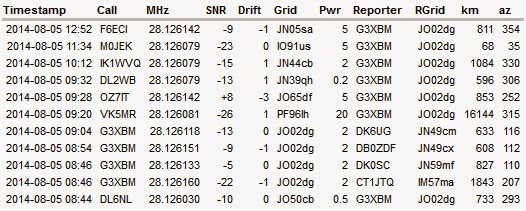 |
| 10m WSPR unique spots until QRT at teatime |
These last few days have been exceedingly fatiguing (stroke). Not sure if this just a bad week or whether it is extra tiring having the little ones around: although I enjoy having them it is at least twice as tiring for me: I worry about them but am too feeble to sort out things. This makes me feel SO tired. We’ll see if I feel less tired when they go home.

MRI scan results
A week ago I had another MRI scan to see how my brain bleed is repairing. Today I had to go back to get the results. I was extremely relieved to hear all is repaired, my boys will not inherit the problem and all is well.
My relief was visible. This had been a real worry to my wife and I. I dreaded further brain surgery, fearing some long-term damage might be done. I have now been “signed off” by the neurosurgeons and should not need to see them in their clinic again.
My main problems remaining are swallow of some liquids, giddiness when walking, some stomach discomfort and profound fatigue: most days the least physical exertion totally exhausts me. I find it hard to describe just how tired I feel most of my waking day. All these remaining issues should improve, but this could be a long time. Apparently the neurosurgeon told the DLVA in June that I am fit to drive, although their OK could take months to reach me. A few months ago there was no way I could have driven, but now I feel ready to do so. It will be good to drive the car again.
Today has been an emotional day. I am profoundly grateful it is drawing to a close.

Hughes PRC-104 Manpack Radio
I finally picked up a Hughes PRC-104 military manpack radio in excellent working condition with a bunch of extras. I have searched for a military unit for a long time now. Having been with the Naval Reserves and 736th Communication Squadron in Thunder Bay, and being a communicator in both, along with my passion for old gear and portable operations I could not pass this one up.
I have searched for a long time for a rig like this. There are many in the UK being sold but the exchange rate and shipping, plus all the extras needed to buy to get portable just made it not worth it for me. As you have read in past posts portable operation for me are a pleasure. With all my travels up North I find I am always taking my YouKits HB1B MKII with me now and setting up at my locations.
The PRC-104 came with battery pack and charger for the LiPo batteries, loud speaker, speaker/microphone combination, handset, PRC-271 antenna and full Alice Pack with frame and belts. It also came with extra mounting hardware for the pack frame if you wish to take the pack off. I ordered an empty battery case ($16.00) and will make a second 28v pack for the radio. I have also ordered a spare U-229 pigtail connector which will work for my cw/digital connector.
This radio goes back to 1976 and runs about 20 watts on a fresh new battery pack. The receiver is quite good as I was hearing things on the whip antenna outside that I could hear inside on the windom in terrible band conditions this past weekend. I was able to check into our local 80 meter Northwestern Ontario ARES Net on 3.750 Sunday night with my NVIS antenna and got a great audio report and was told I was over the noise level as well. The tuner in this radio seems to tune quite well and is very quick.
I have collected numerous amounts of military gear in the past and old shortwave gear, but portable rigs for me are still what I enjoy, I like being outside in operating conditions versus sitting in the shack. I am awaiting the arrival of the X108 and the TJ5A as well to test these units out for portability. I do not think they come close to the HB1B MKII for a self contained unit. The battery pack in that rig last a very long time when I am up North on my trips and makes contacts quite well on the cw bands. CW is my niche, and the mode I enjoy operating, so once I get the cable I will operate the PRC-104 on cw and hopefully shoot a small video of it in action.

Cheers
Fred
VE3FAL/P
That happened only once before.
I was in the pileup to work W1AW/0 in South Dakota today. I already have them in the log, but I can’t seem to resist a good pileup these days. Anyway, after I worked them, instead of the normal “TU 73”, I got “W2LJ QRP?”
I answered “YES QRP 73 DE W2LJ” and I got a dit dit in reply.
I guess it was somebody who knows of me. The only other time that happened was when I worked W1AW/1 in New Hampshire, but I knew going in that Dave N1IX was the operator. Dave is a superb op and fellow Fox hunter.
It would be interesting to know who was behind the key. It sure makes you do a double take when you work a station and the operator is familiar with you, but yet you have no idea as to whom you may have worked.
72 de Larry W2LJ
QRP – When you care to send the very least.
Current set-up for WSPR, JT65 and JT9-1
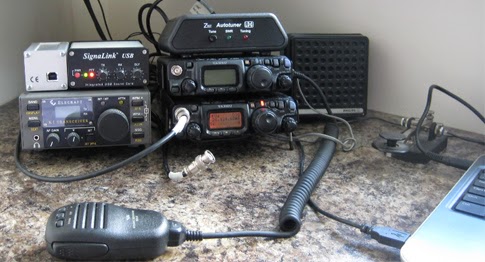
This is a photo of the kit currently used. The top FT817ND is used mainly for 2m and 70cms (local FM net, SSB and CW, beacon hunting) and the lower FT817 for WSPR, JT65 and JT9-1 mainly on 6m and 10m. The lower rig is set at 2.5W, but the cable run to the V2000 vertical is lossy on 6m. I use a SignaLink USB audio interface to the PC. This works well. For all digital modes I use the FT817 on DIG setting via the rear connector. Sometimes I use the Z817 ATU, which I find very good. With this, I can get onto 5MHz and some other bands.
Best DX (on WSPR) is Australia at 1W out on 40, 20 and 10m and Israel on 6m WSPR (1W ERP).
Not shown (on shelf above) is the 472kHz homebrew transverter, the 15m MFJ Cub and the Mizuho 200mW 2m SSB rig. Also out of sight are a 136kHz beacon, the 2m Fredbox, the 6m Sixbox, the VLF 8-9kHz beacon, and optical rigs. I am waiting for better health to be able to use these again. Currently my operating is all from home and mainly modes not requiring me to talk, although I have ventured onto our Monday night FM net and the odd 2m and 70cm contest.














