Archive for the ‘Uncategorized’ Category
 Radical, but I kinda like it!
 August 13th, 2014 |
  Author:
 Posted by Bobby AK4JA (who I’ve worked – fantastic op!) on QRP-L today. Provocative? Yes. Controversial? Yes. True? No, but I kinda like it anyway:
“QRP – a real man’s mode , not for sissies and certainly not for selfish, impatient , ego-maniacs – Man up, grow a set and go QRP if you dare!”
Not trying to start a QRO vs QRP war, but I enjoyed the humor. And it makes for a good battle cry. Definitely better than “Life is too short for $200 finals” or whatever some guys like to bandy about. And no, I won’t be changing my tag line.
Hey, Bobby! I think this would make a good T-shirt! Something on the order of this:

Hee hee! Is that a challenge, or what ?
72 de Larry W2LJ
QRP – When you care to send the very least!
Special Event Alert
This coming weekend is International Lighthouse/Lightship Weekend. Here’s an article I caught online:
http://www.thedailynewsonline.com/news/article_4b4d8e82-21ea-11e4-9326-001a4bcf887a.html
I’ve had the opportunity to work various lighthouses and lightships the world over throughout the years and it’s always been fun. Back when the Piscataway Amateur Radio Club was in its hey-day, we activated the Twin Lights Lighthouse in Atlantic Highlands, NJ.
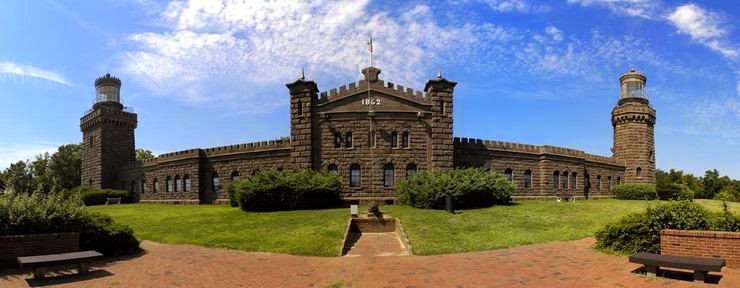
- Cape May Lighthouse
- Barnegat Lighthouse
- Twin Lights
- Sandy Hook Lighthouse
- Sea Girt Lighthouse
- Tucker’s Island Light
- Absecon Lighthouse
- Hereford Inlet Lighthouse
- East Point Lighthouse
- Finn’s Point Rear Range Light
- Tinicum Rear Range Lighthouse
I’m not sure how many, if any, will be activated for ILLW Weekend. Even though the Skeeter Hunt falls the weekend before ILLW Weekend, maybe next year we can make lighthouses part of the theme and do some “pre-activations”. What say?
Here’s a little video “advertising” a Spanish lighthouse that will be activated this coming weekend. The link was provided by fellow ETS clubmember, Don K2DSV. This definitely gets the juices flowing, thinking about all the exotic lighthouses that will be on the air this coming weekend.
72 de Larry W2LJ
QRP – When you care to send the very least!
What a difference a day makes!
Yesterday, at this time, the bands were humming (relatively) with Skeeters, WES’ers, and WAE’ers, just to name a few. 24 hours later, during a later lunch break ……. not much of anything. This is where I was picked up by RBN:
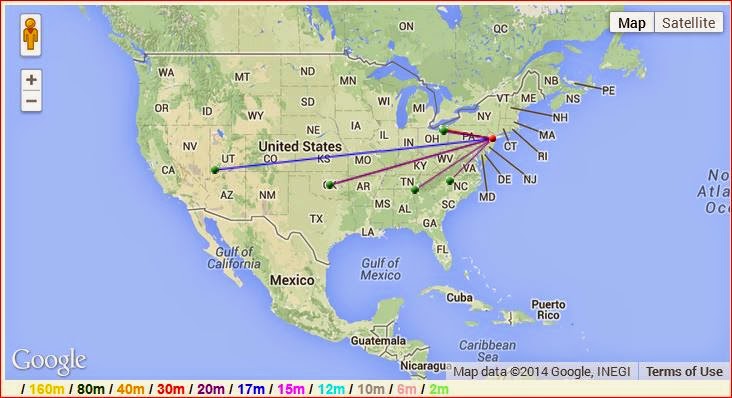
DX from the Blueberry Patch
Judy went blueberry picking this afternoon in Ashland, New Hampshire. I went along. She picked blueberries; I worked Russia, Germany, Greece, Denmark and Arizona!

I tossed a 30 foot wire over a maple branch and sat down on the grass with the KX3. What a perfect way to spend an hour. Here’s my log:
11 Aug-14 1954 14.020 RA/UY6IM CW 599 599 Russia
11 Aug-14 1957 14.032 DM200TSV CW 579 599 Germany
11 Aug-14 2002 18.071 SV2CQB CW 569 599 Greece
11 Aug-14 2008 18.075 OZ2TF CW 559 599 Denmark
11 Aug-14 2012 14.009 NN6T CW 569 599 AZ

All the DX contacts were quick exchanges, but the last QSO with Glen NN6T in Kingman, Arizona was the most fun. Glen and I actually had a QSO, and I promised to send him a photo of my operating position. He sent, “UR QRP is doing very good.” That was a relief because the bands seemed a bit shaky today.
Judy picked nine quarts of the most luscious blueberries I ever tasted. I had a great time making a few QSOs. Nice combination.
Fire rekindled
When I first heard about the ARRL’s centennial operation, I was mildly curious but hardly enthused. As most know, the League is sponsoring a year-long operating event in which ops in all 50 states will be on the air a week at a time, signing W1AW/X, where “X” is the call district.
Well, it has been 52 years since I earned WAS, I thought. So I decided to see if I could work each W1AW/X state for a new certificate.
Then I decided to work each state several times each just to be sure I was “in the log.”
And as the first round neared the end (each state will be on the air for a full week at least twice during 2014, usually two states each week), I thought to myself, “Self, why don’t you see if you can work them on all modes?” I need practice in pile-up and contest operating on the digital modes and especially RTTY.

Suddenly, this little centennial thing has become a lot of fun and a thrilling challenge! I’ve heard other guys say the same thing. I’m way down the list on total QSOs (3000-ish somewhere) and just cracked the top 15 in my state, mostly due to my late and lackadaisical start. But now I spend far more time than I should chasing W1AW.
I have a new book due at the publisher’s, have just started a new ham radio book, have a 10-month grandson I want to teach the Morse code, I need to be getting ready for the Huntsville, Alabama, Hamfest this weekend, college football season is about to start, and…Wait!…W1AW/1 in Vermont was just spotted on 12-meter PSK31.
Excuse me. I gotta run…
73,
Don N4KC
www.n4kc.com
www.donkeith.com
(Author of the new book RIDING THE SHORTWAVES:
EXPLORING THE MAGIC OF AMATEUR RADIO)
A face to a call
It’s not often that I meet hams whom I only met on air. So today I was delighted to put a face to the call HL5KY, Joe from Korea.

HL5BTF, HL5KY and BX2ABT
2014 NJQRP Skeeter Hunt
First off, I don’t know who was hunting who. I thought I was hunting Skeeters, but I think they had other ideas – and I was the hunted:

And that was nothing compared to my legs! I didn’t think the little buggers would be so active during the day, so I didn’t bring my OFF wipes with me. I’ll remember this for next year!
I set up in my favorite park here in South Plainfield – Cotton Street Park. There are plenty of 50 – 60 foot trees which just beg to have wire strung through them. It’s a quiet park and there’s not the overwhelming amount of traffic that Spring Lake Park (our Field Day site) gets. There were people walking through and playing, but no one came over to investigate what I was doing. I guess I’ve become a fixture – “Hey, it’s that crazy guy with the radio again!”

Off to the right, you can see the coax going up , up , up. Here’s a better shot:

Today, I ended up using the PAR END FEDZ. I stayed on 20 and 40 Meters only, so it turned out to be the ideal antenna for the event. The antenna launcher worked flawlessly again, and I would dare say that the end of the wire was up at the 60-65 foot level. I don’t know if it was just me, but there was bad QSB and it seemed like one second, a station would be 599 and ESP the next second. As far as stations worked per band, I ended up with almost a 50/50 split between 20 and 40 Meters. I listened briefly on 15 Meters, but it seemed like it was dead.

The equipment was the usual, but you might take notice of the new paddles. That’s a set of Pico Palm paddles that I recently bought from Rick K7MW. The magnets hold the paddles securely to the Velamints tin that I use to store my earbuds. They worked flawlessly! If there were any CW mistakes (and there were) it was my fault, not the paddles. They feel and work just as nicely as any full sized set of paddles.
I ended up working 41 different stations. 35 Skeeters, 6 Non- Skeeters, no DX, 19 different S/P/Cs, and I did work enough stations to spell out “SKEETER” for the 100 point bonus. I ended up with 5,876 points. The loudest stations I heard were K3LRR, KX9X, N0SS and WA0ITP. I worked my bud, Bob W3BBO and he was about 569. Later in the day, I heard him again on the same band, this time working WB3T. Bob’s signal had increased to an honest 589/599. Tha bands seemed a little crazy today.
I’d like to thank not only the stations I worked, but ALL of you who participated. This is so much fun for me – not only the event itself, but the planning and the corresponding back and forth with all of you. You guys really make this event worthwhile. My mailbox is already filling up with log summaries and I will work on those during the coming evenings.
There WILL be a Skeeter Hunt in 2015! Hey, what better way is there to spend a beautiful Summer day than by being outside with your radio, making contacts with all your friends?
72 de Larry W2LJ
QRP – When you care to send the very least!













