Archive for the ‘Uncategorized’ Category
 Pixie kit from China
 February 13th, 2015 |
  Author:
 My low cost 40m Pixie kit – although G1KQH only paid about 60% of what I paid – is on its way from China but has not yet arrived here. I assume, with free shipping, this comes by sea. I am in no great hurry. As I mentioned before, I very much hope to build this unit as I have not built much in ages because of my brain bleed.
UPDATE 1600z: My kit arrived in the post today. Still to open the package, but judging by the speed this must have come by air. It looks well packed.

Digital experiments
In all my time in amateur radio I have never once experimented with microprocessor programming and I have done very little “digital” design. This seems to be a gap in my knowledge, although I am still not really interested, preferring RF design, especially QRP. I must say I remain very impressed with Wolf’s (W5OLF) tiny WSPR-AXE-CW beacon: this goes to show just how much can be achieved with so little physically. Maybe this is a whole area I should embrace? The trouble is it is impossible to be an expert at lots of things, unless you are very bright. Certainly I do not consider myself a polymath!

Speaking of FYBO
Falling sunspots?
Sunspot number today has fallen to 50, the lowest for quite a while and 10m propagation is forecast to be “fair” again.
Yesterday, 10m did open for me to the USA and plenty of stateside stations copied my 500mW beacon in the end after a late start. I suspect today it may be harder going as we seem, on average, to now be on the downward slope towards the next minimum, although this is years away. If predictions of the next maximum are to be believed, a SN of 50 would be considered a decent figure for the next sunspot peak! Of course, the predictions could be wrong, although the predictions have improved a lot and most got cycle 24 pretty accurately.
I have not yet turned on the 10m beacon this morning as we have visitors. It will probably be turned on just before lunch. I am still on MF but there are few active stations in range.

TX Factor Episode 7 Is Live
The long-awaited next edition of the UK-based HD TV show dedicated to amateur radio is now available at www.txfactor.co.uk
In this episode the team investigates the issues of recruiting young people to the hobby and visits a veteran amateur who’s an inspiration to us all! We discover what the IOTA programme has to celebrate and test an innovative 2 metre antenna which can be won in our next draw.
We hope you enjoy the show!
TX Factor Team
Here are 9 Great Ham Radio Podcasts
Over the last decade, I’ve listened to many ham radio podcasts and found them to be a great way to pass the time while driving or working in my home office.
Some of the best podcasts have come and gone, and some wax and wane on a regular basis as the host’s time permits (Jerry, we miss PARP!).
I put a list together of the eight podcasts that I listen to on a regular basis. Hopefully you’ll see one or two that you haven’t added to your list. Do you also enjoy listening to any of these great podcasts?
(And if I’ve missed a good one, please let me know in the comments!)

#1: ARRL Audio News


#7: Fo Time

#8: QSO Today

Building the M328 component tester (1)
This could prove to be a very useful piece of component test kit, for the constructor and repair bench, including the novice. It does, R, L, C including ESR, Diodes and Transistors, giving the pin configuration detail of the Semiconductor device undertest as well as the useful gain figures.
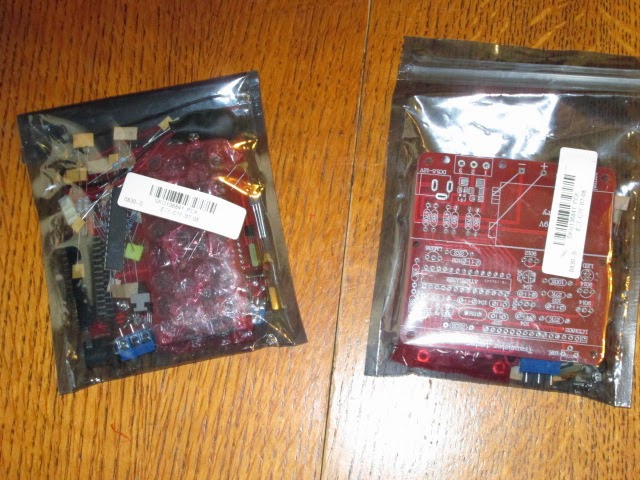
It is basically a copy of the Karl-Heinz Kubbeler design, centred around a programmable ATMEGA328 microcontroller which is very well documented. The kit took about 2 weeks to arrive from China, which contains a well made PCB, display module and all the components, including the blown main chip all for around £8.00 ($12 US). It comes with no instructions on how to put it together, but a Chinese manual is downloadable from the purchase site, which I will make a link available at the bottom of this Blog. Infact, really you don't need the manual for construction, as the component values are printed on the PCB, it just helps a little to get one or two things installed the right way around like the switch, and the circuit diagram can be useful for component reference and maybe fault finding later? Of course the Chinese manual is written in Chinglish, we are refered to welding not soldering! I don't think my old arc welder would prove very suitable for this project somehow? Hi!
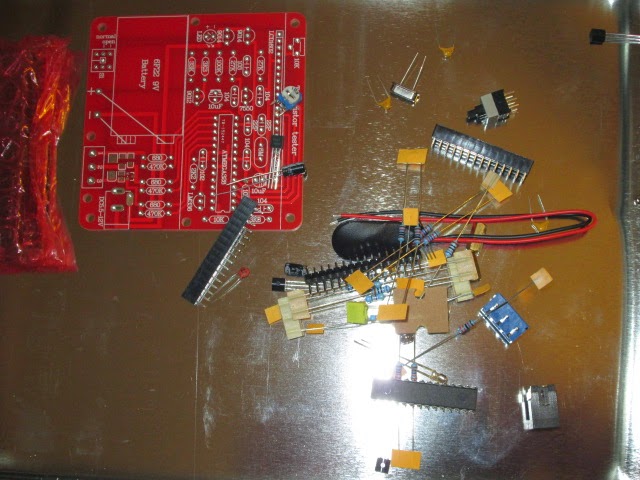
I emptied all the components out of their anti-static packet into an empty biscuit tin, so I didn't lose any of them. I was away, it took around 2 hours of soldering, and sorting out the correct values, a DMM can help with the resistors values, as I found an orange band can look like a red, so its best to measure them to avoid confusion and getting one soldered in the wrong position. Transistors are marked to board values, and the marking of the outline makes sure you cannot put the devices in the wrong way around.
At this stage it is time to check the board over for shorts, man made solder links etc, and snip off component ends. All looked ok, time to connect the 9V battery, before inserting the main ATMEGA IC, at this point a DMM is required to check for regulated 5V at the IC socket pins 7 & 22, all confirmed correct and the regulator was doing its job!
All in all it was quite a relaxing project to put together, I didn't find anything too difficult, although a bit of care is needed aligning up the pins of the main chip before pushing firmly home into its socket.
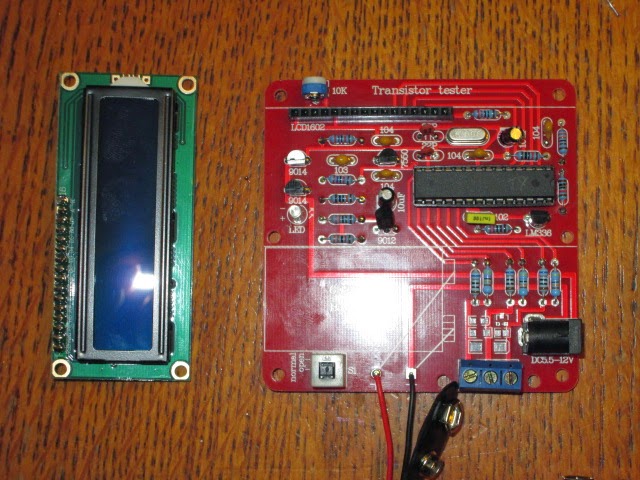
There is not much work to do with the display board as most of this is already constructed, just a strip of header pins that carefully require soldering in across the top of its PCB. This then mates up with the socket strip on the main board when it is pushed home and bolted together.
All looked good time to switch on! If it fires up correctly one push of the On button should turn on the display. In my case it did, and didn't? When I released the Push To Make switch, it went out ? Some folk have had problems putting the switch in the wrong way around, I knew I hadn't done this and a quick check confirmed the switch had been inserted correctly, time to investigate further? The clue was the LED under the display board wasn't on, a quick check with the DMM around the circuit in this area confirmed my thoughts, I had put the LED in the wrong way, huh! Oh dear! I had to pull it all apart, split the two boards desolder and turn the LED around, and then put it all back together.
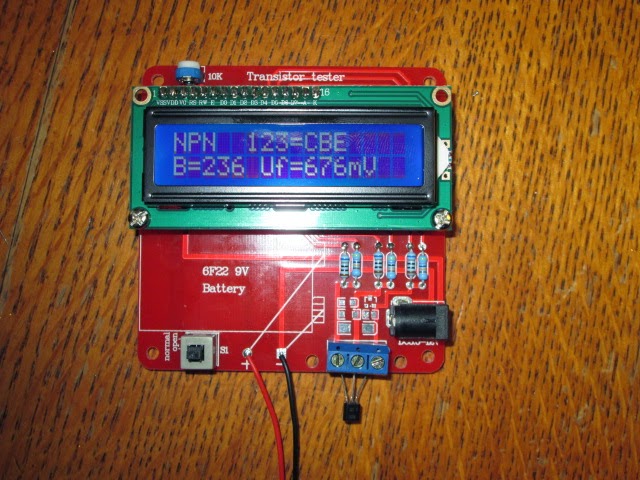
Great it then fired up correctly, and held in its On state after pushing and releasing the button, a quick adjustment of the contrast pot to get the display correct and all was looking well, time to calibrate..
To be continued in part 2.
References:
This is where I purchased the kit from, although they are available from ebay too:
http://www.banggood.com/DIY-Meter-Tester-Kit-For-Capacitance-ESR-Inductance-Resistor-NPN-PNP-p-929603.html
Construction manual:
https://www.dropbox.com/s/zpjwo3vfv9yfr5b/SKU136841%20M8install.pdf
Design manual helps with Calibration and other stuff:
www.mikrocontroller.net/attachment/143813/TTester_096k.pdf
Newer version of manual:
www.mikrocontroller.net/attachment/164956/ttester_eng104k.pdf













