Archive for the ‘Uncategorized’ Category
 The Spectrum Monitor — March, 2015
 February 27th, 2015 |
  Author:
Stories you’ll find in our March, 2015 issue:
Catch the Action in the Air and On the Air
By Brian and Jo Marie Topolski
Once again, Brian and Jo Marie Topolski take us all to the air show with some dazzling photos and the inside scoop about what and where to listen when you take your scanner with you. Brian also has a salute to woman aviation pioneer, Julie Clark, a regular fixture at many air shows, and a look inside his own air show command post.
The Air Show Experience
By Kevin Burke
TSM air show regular contributor, Kevin Burke, shows us his own (and his son’s) photographic touch along with his own experiences at air shows. He also offers a photographic “Study in Blues” as well as a review of the Bearcat BC-125AT at an air show.
Now Try ‘Scanner-less’ Aviation Monitoring!
By Richard Fisher KI6SN
Want to catch all the aviation action but don’t have a scanner or live near an airport? Not to worry, says Richard Fisher, you can enjoy aviation monitoring to the fullest extent possible, and at no cost. Richard shows us how.
TSM Reviews: Teak Publishing’s 2015 Air Show Guide
By Ken Reitz KS4ZR
For many years, readers of Monitoring Times magazine came to rely on the expertise of its military communications columnist and MT assistant editor, Larry Van Horn N5FPW, to provide the very latest in frequencies used by all the top aviation demonstration teams at air shows across North America. And, even though MT closed its doors in December 2013, Larry has since continued to provide these frequencies in the form of an annual Air Show Guide in Kindle format. Here’s a review of his latest Air Show Guide.
TSM Air Show Schedule
US Navy Blue Angels; USAF Thunderbirds; Canadian Snowbirds; Breitling Jet Team; Raiders Flight Demo Team; GEICO Skytypers; Team Oracle’s Sean D. Tucker; John Klatt Air Shows, and Air Combat Command F-16 North American air show schedules.
Scanning America By Dan Veenaman
Hard-Learned Radio Civics Lesson in D.C.
Federal Wavelengths By Chris Parris
Flying with Federal Aviation
Utility Planet By Hugh Stegman NV6H
How to Hear HF Civil Aviation
Digital HF: Intercept and Analyze By Mike Chace-Ortiz AB1TZ/G6DHU
US Coast Guard, Customs & Border Patrol COTHEN Network
HF Utility Logs By Mike Chace-Ortiz and Hugh Stegman
Amateur Radio Insights By Kirk Kleinschmidt NT0Z
RFI Part 2: Finding, Fixing or Fleeing
Radio 101 By Ken Reitz KS4ZR
Intro to FTA Satellite and Advanced Cord-Cutting
Radio Propagation By Tomas Hood NW7US
Space Weather Terms
The World of Shortwave Listening By Keith Perron
Armed Forces Network Taiwan (AFNT)
The Shortwave Listener By Fred Waterer
World Languages via SW Radio Web Sites
Amateur Radio Satellites By Keith Baker KB1SF/VA3KSF
AMSATs: From OSCAR-1 to FOX-1A
The Longwave Zone By Kevin O’Hern Carey WB2QMY
Longwave: A Cradle for High-Tech
Adventures in Radio Restoration By Rich Post KB8TAD
The Admiral Bean-Counter Special: Part II
The Broadcast Tower By Doug Smith W9WI
What Happens to a Dead Radio Station?
Antenna Connections By Dan Farber AC0LW
Got a Match: Methods of Matching Coaxial Cable to Antennas
The Spectrum Monitor is available in PDF format which can be read on any desktop, laptop, iPad®, Kindle® Fire, or other device capable of opening a PDF file. Annual subscription (12 issues, beginning with the January 2015 issue) is $24. Individual monthly issues are available for $3 each.
Duemilanove
Yes, I did it again. Needed a 25 cent Molex connector and while browsing the electronics supply store I bumped into a rack with Arduino stuff. Maybe it was the Buddhist music playing in the background (the owner of the store is a devout Buddhist and only meditative music is played in the background), but I suddenly felt the urge to buy one. Now remember, I have a love-hate relationship with computers. I prefer having nothing to do with them, but since I cannot avoid them I just go with the flow. Apart from that, I never really got the coding bug.
 But for some reason the urge was too strong this time. And so I spent 15 bucks on a Arduino Duemilanove and 3 bucks on two add on boards: a 3 color LED and an analogue temperature sensor. Not much money to try it out and if I don’t like it then no big loss. Because of the name alone you should buy one, too. Can you name me an electronics product with a sexier name than Duemilanove??? And it just means 2009!!! Sometimes I wish I married an Italian girl, then I would be living in Italy now and be immersed in that wonderful language every day.
Back home I found out that installing the IDE was a simple “sudo apt-get install arduino” and I was connected. It took me all of 15 minutes to get the 3 color LED blinking and I was hooked. This is not difficult at all and a lot of FUN! Now it’s not that I have all the time in the world to start learning to write sketches now. Far from it, I’m as busy as ever. But after introducing the Arduino to my 11 year old son he started playing with it and it took him an hour to make the LEDs blink his name in Morse code (because that’s the only Morse code he knows). This might turn into a nice father-son play-thing and who knows, maybe I finally start to get the coding bug.
A.M. radio, those were the days
As a young boy I recall listening to long distant A.M. radio stations in the evening on my transistor radio. As a young boy I had two hobbies that thrilled me, that was rock collecting and electronics. At a very early age my parents would buy me Radio Shack perfboard kits, 101 in 1 project kits and then an AM radio kit to build and then I was fortunate enough to get a Radio Shack Globe Patrol SWR to put together and listen to the world.
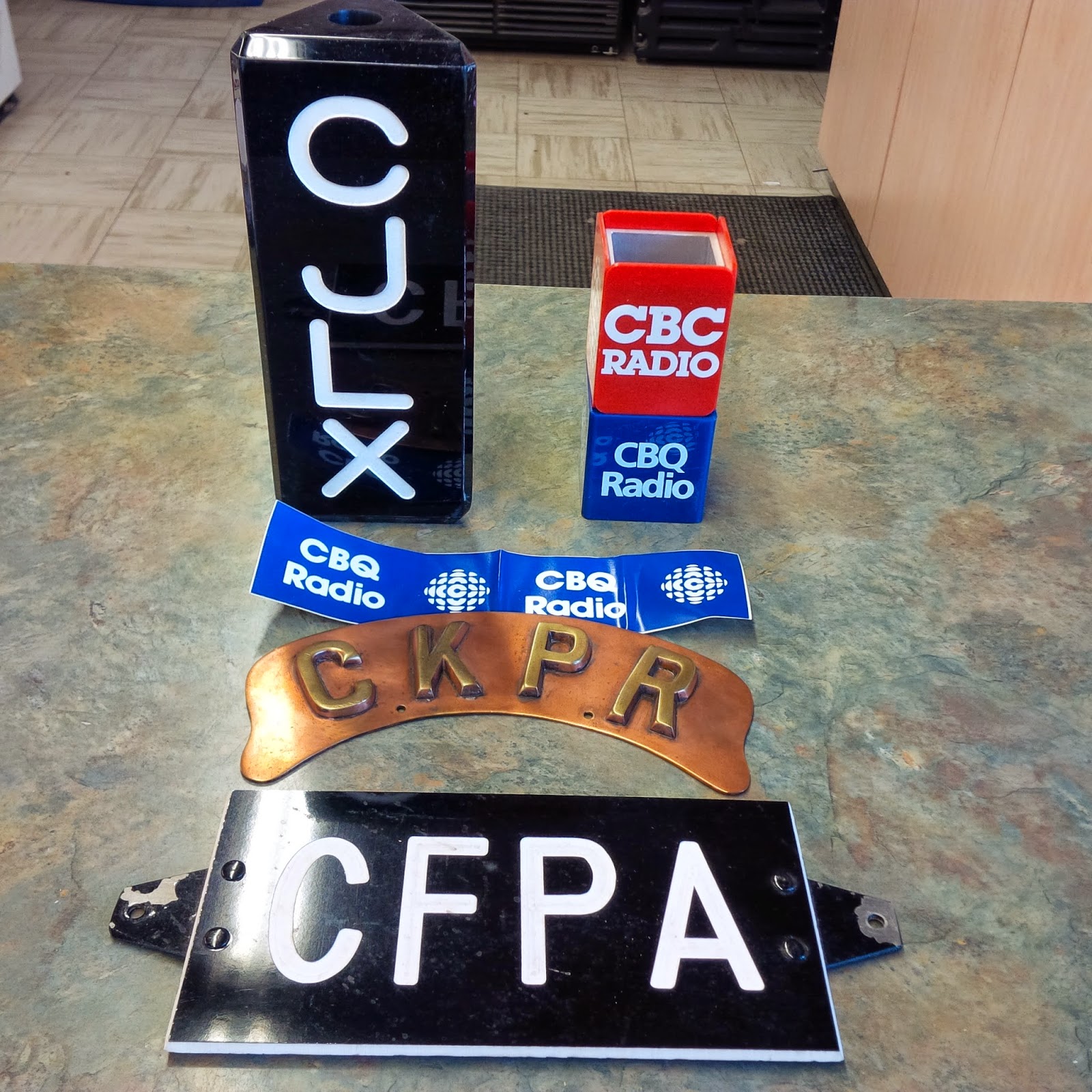
But what I recall most of all was having a tie to many of the local AM stations as I had an Uncle who was a DJ on many of them and then he eventually became Chief News Editor in Thunder Bay for CBC (CBQ). In the day we had 3 A.M. stations that ran full time, 580 CKPR , 800 CBQ and then 1230 (CJLX, CFPA), and then not being too far from Duluth MN where we are located I could usually hear at least 2 stations from there both day and night, one in particular was around 560.
I best recall listening to many programs at night, everything from Grand Old Opry, CBS Mystery Theater, The Great Gildersleeve and The Life of Riley, Dragnet and others. Of course WLS 890 was always loud here in Thunder Bay, ON (Formerly The Twin Cities of Fort William and Port Arthur)
There are no more A.M. stations in Thunder Bay, all have migrated to F.M., however as you drive along the North Shore of Lake Superior you will find many low power A.M. stations that rebroadcast some of the larger stations.
Here is a look at a few of the reminders of those once powerful and notable stations that once took on the air waves.
Pixie (40m) build completed this evening
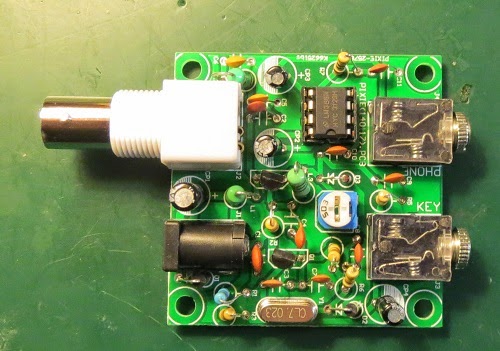 |
| Completed 40m Pixie assembly |
This evening, I completed the build of the 40m Pixie PCB assembly. It will get checked over for dry joints or shorts in the morning and air-tested shortly.
A very half-hearted attempt at the 6m UKAC this evening was aborted because of my poor voice but I only worked 3 locals in the short time I was on with my V2000 vertical.
I really wanted to crack on with the Pixie build, although I was not expecting to finish the built today. The small PCB based kit does represent very good value.

Android smartphone with built-in UHF transceiver
-

- Otium Android smartphone
-

- Screw-on SMA antenna
Over on Reddit, there’s a discussion going on about an Android smartphone with some sort of built-in UHF radio (FRS/GMRS). It appears to be a Chinese-made Android phone from Otium called the Otium V8. It’s for sale on Amazon for about $300.
Below is a screenshot from someone asking how it works. The frequency is a shared FRS/GMRS channel (in the U.S). I would expect a radio like this to be “channelized” and not show a frequency directly on the screen — which makes me wonder what other frequencies one might be able to enter…?

Courtesy of /u/rgansaldi
Are GSM phones with built-in radios common? Has anyone ever used one of these?
From the screenshot of the built-in PTT app, it looks like it has an adjustable power level, does frequency splits, PL/CTCSS, and even has a narrow/wide bandwidth selection.
What chip are they using to do this? Can it be tweaked with software to transmit/receive “out of range” in the 70cm ham band? I’m curious!
ISS SSTV reception in Thunder Bay, ON EN58hh
Been a long while since I played with satellites or even the ISS for that matter. In fact 2 meters has taken a total backseat for me as it no longer thrills me as far as APRS or even repeaters. IRLP nodes as well just don’t do it like they used to, combine that with only one telephone provider (Thunder Bay Telephone) and major dropouts etc on the IRLP it makes it no fun on nodes.
So turned the FT857 on today after reading about the ISS sending SSTV pictures down to earth. Using a dual band vertical at 25′ and using MMSSTV I was able to copy these pictures this afternoon. (Monday afternoon in Ontario)


 So kinda made my day to see the pictures up on the screen when I got back into the shack.
Cheers
Fred
VE3FAL
Testing time – 40m Pixie
Tomorrow I am going to try to build my little 40m Pixie kit that I bought for just over £7 from China. This build is an attempt to see if I am “up to the job”. I know the limited performance the Pixie is capable of and on 40m BC breakthrough may be a major issue here in the UK.
I really really miss doing real building and truly experimental amateur radio. This is a step on a long road. My health has been so poor in the last 16 months or so that there was no way I could have attempted this before. People have been very kind and offered me building help and help with antenna erection. These offers have come from all over the world – the world is filled with good and very kind people. There are far more good and kind people than evil ones.
By normal standards a little Pixie build would be trivial. For me it is a major step and test of my current abilities. I do so hope I can manage this! Please don’t laugh – to me it is a major step.














