Archive for the ‘Uncategorized’ Category
 10m BitX transceiver
 May 26th, 2015 |
  Author:
 I notice that someone has created a 10m (28MHz) version of the BitX transceiver. Yes, all would like more details but we don’t know who you are!
Anonymous said: “I have successfully designed and built a 28MHz version of the BITX transceiver. The main reason for this project was to drive homebrew transverters for 6, 4 and 2Metres. Contact me if you would like details.”

Fourbox transceiver
 |
| G7CKF’s Fourbox |
Jenny, G7CKF has now taken the 2m Fredbox design and created a 4m version called the “Fourbox”.
Hi Roger,
I feel I should drop you a line with my thanks and the link below, I’ve used your QRP AM transceivers as the basis for a 4M transceiver and published it on my blog. I’ve come back to amateur radio after a 20 year absence and since construction was always my main interest in the hobby I reached for the soldering iron.
http://thekeywordgeek.blogspot.co.uk/2015/05/a- transceiver-for-not-lot.html
There is no sparkling new insight to be had from it as it’s pretty much your fredbox with slightly bigger coils. There is no crystal because I am cheating and using a Raspberry Pi clock generator to make my 70.260MHz.
My QTH is IO91lw, between Bicester and Buckingham and rather low lying. Very little 4M activity hereabouts, sadly, so the chances of my actually working anyone with it are slim. But that’s not really the point of building, is it.
Anyway, hope you find it of interest, and thanks again for sharing your designs.Jenny, G7CKF

Amateur Radio Weekly – Issue 61

FCC eliminates Amateur Radio vanity call sign fee
“The Commission spends more resources on processing the regulatory fees and issuing refunds than the amount of the regulatory fee payment.”
ARRL
Dayton 2015
The Hara Arena we all know and love continues to be, well, Hara Arena. The good news is renovations are in the works. A Hamvention official told me it’s for real and probably a three to four year project.
Radio Artisan
Pirate SSTV over US Navy satellites
Radio pirates often make use of the Fleetsatcom satellites to send and receive slow scan television (SSTV) pictures over a wide distance.
RTL-SDR.COM
Liquid metal antenna
Boffins have made a liquid metal device which can alter its shape through voltage alone, removing the need for clunky external pumps previously used to arrange such material.
The Register
Wireless door bell adventure [PDF]
433 MHz ASK signal analysis.
Paul Rascagnères
Fox-1 Operating Guide
Fox-1 Operating Guide released at the 2015 Dayton Hamvention. FM transmitter capability on 435 MHz and FM receiver capability on 145 MHz. A full-duplex radio (capable of receiving and transmitting simultaneously) is recommended.
AMSAT
Can I use my Ham Radio on public safety frequencies?
It is widely known that many amateur radios can be modified to transmit outside the ham bands. The answer to this question used to be that amateur radio equipment cannot be used legally on public safety channels because it is not approved for use under Part 90 of the FCC Rules.
K0NR
Enough already!
It’s yet another rant about how most hams nowadays dress like slobs and need to take a bath. I don’t know about you, but I’m getting really sick of this kind of talk.
KB6NU
How to
How to replace a noisy wall power supply
When you purchase a replacement power supply, you must make sure that several properties match that of the device it will power, else you could cause damage.
The SWLing Post
Video
First look at the Flexradio Maestro at Dayton
An early look at the new Flexradio Maestro interface for flex radios. All in one over Wi-Fi touch screen with two waterfalls and physical control interfaces.
YouTube
Pixie kit prices – truly incredible prices
Since my post earlier on this blog about low cost 40m Pixie kits from the Far East, I have been told that Bangood was selling these kits today for a staggeringly low price! This information is thanks to Spence M0STO. Earlier they were for sale at an incredible £2.67.
At this price you might just buy the crystal here in the UK! The kit comes with ALL parts (apart from battery, key and headphones) and a very nice silk-screened PCB. Don’t forget this is with FREE shipping. Unbelievable.
My kit from them worked first time. It was the first time I’d built anything in a LONG time because of my stroke. At this price it is an offer too good to turn down. AM breakthrough was perfectly usable (i.e. low) and RX sensitivity fine. I got over 400mW out too. Don’t forget, this is a complete 40m CW transceiver.
Sorry for the double post but the kits are here and the Customer Service is second to none. Beware the prices change daily inline with currency. http://www.banggood.com/DIY-
Radio-40M-CW-Shortwave- Transmitter-Kit-Receiver-7_ 023-7_026MHz-p-973111.html

DST 100 receiver
 My very first communications receiver weighed a ton (it took 2 people to move it!) and was a DST100. I believe it was made by Murphy during WW2. This receiver, I have since learnt, was designed for intercept listening. It was built like a tank with a huge rotary turret tuning unit. The radio cost £7 from a local garage and it was overhauled (new valves?) by (the now late) G3CHN. It covered from around 50kHz to over 30MHz and heard some impressive DX. I was always puzzled why signals were so broad on the lowest range, not realising at the time that it covered 50 to about 150 kilohertz! This was in 1962.
At that time there was little amateur band gear available (none from Japan) and lots of us used WW2 surplus gear which was available at low cost from many suppliers. Popular receivers were the AR88 and CR100. Transmitter-receivers included the WS19, WS38 and 52 sets.
Amateur radio in the 1950s and 1960s was quite different with lots of HF AM still and most people building their own transmitters. SSB was in its infancy. In many ways it was the high point of the hobby, although today we are blessed with low cost gear, free software, more modes and more bands. The hobby means different things to different people. Long may it continue.

2 Meter Portable Ground Plane Gizmo Antenna
Portable, Ground Plane for 2 Meters made with BNC antennas
that you can ‘take down’
Its a compact ground plane antenna for portable use!

2 Meter Ground Plane Portable Gizmo Antenna in Operation 2
This antenna is built on a 2 inch washer. Holes were drilled in the washer to accommodate 4 radials. The center hole for the BNC to BNC connector was already there, but had to be reamed out. This (male to male) connector is where the coax from the radio is attached on the bottom of the washer. It also serves to hold (the center radiator element)!
(Note: The radiator, in the center, needs to attach to a BNC MALE connector, the cable from the radio also needs a BNC MALE connector. I used a male to male adapter for this purpose. It didn’t fit tightly so I used an old bike inner tube to cut a small spacer for taking up the slack. I’d have used a metal washer for ‘fitting’ the adapter, but I had already make 3 trips to the hardware store, so I used what I had)
Gizmo Portable Antenna
without the cover

Center Post of BNC Connector for the Radials are Shorted to the Shell Side
I used BNC female connectors from, Digikey, a good source for components! The center post of this connector is shorted to the ‘shell side’ to provide a ground plane with all the radials!
The 24 inch antennas from China were purchased on Ebay! CHEAP! The 2 inch washer is from the local hardware store. Everything fits on this washer, a 2 inch space, but the center coax is tedious to attach with all the radials in place, especially if you have big fingers.
The Cap is from a spice bottle!
I live alone so it was not a problem! LOL

Spice Bottle Cover
I love to use things for which they were never intended! This spice bottle cap is a good example of this. At this point, I’m not sure if I’ll seal it to the top BNC antenna radiator element or not? If I seal it (with hot glue, maybe) , the cap becomes permanently attached to the radiator element, and would be difficult if not impossible to remove. The whole idea here is to use this antenna as an impromptu portable antenna!

2 Meter Ground Plane Portable Gizmo Antenna Hanging from a Taped Tie Wrap
A tie wrap is used to ‘hang’ the antenna. Its hanging from a hook on my porch at the condo. I put 50 watts into it to get a repeater 10 miles away. SWR was 1:1 This is a portable antenna! Its not meant to be a permanent one. If you have ever needed a 2 meter antenna that you can pull up into a tree with a string or rope, this is it! Hauling it up 40 or 50 feet on a rope will get you better results than at ground level.
There is a joke that says, have you ever seen a golfer with only 1 club? Ham radio antennas are in the same category as golf clubs. You just can’t have too many!
All the elements can be removed for easy storage and transport, (radials as well as the vertical element)! I’m sure some clever ham will come up with a suitable case for this entire assembly. If I had one of those nifty clear plastic shipping tubes, I’d store in that! I’ll be on the lookout for one!
Miracle Whips and derivatives/copies
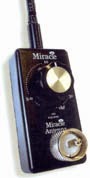
A 56 inch long whip can only behave like a 56 inch whip. This is a basic law of physics. What the Miracle Whip (MW) and its derivatives do is match this whip on the HF and VHF bands. With a decent ground or counterpoise wire the MW may be only a couple of S-points down on a “decent” antenna on the higher HF bands. They work reasonably well and, in the past, I used my MW quite a bit, even from indoors. They are definitely NOT a miracle antenna, although they are not too bad. Since the owner, a Canadian called Robert, died there have been a few newcomers in the market.
Would I buy one today? Probably not. I have had better results with small loops. As a simply deployed mainly RX antenna they make an ideal companion for an FT817 or similar. Their beauty is their simplicity. If you want optimum performance in a small antenna there are better solutions. Small loops seem to work better, but then bandwidth becomes very narrow although loops don’t need grounds or counterpoises to work well. Personally, at QRP levels I’d use a loop every time.
As Wheeler showed years ago, efficient small antennas are reactive and unless losses are minimised, efficiency suffers. This is a fundamental limitation. Although high permeability ferrites and high permittivity ceramics can help to alter the size of space near an antenna and “magnify” the effective size of small antennas, the effect is small unless there is a lot of ferrite with high permeability or a lot of ceramic with a high permittivity. In theory, a tiny antenna can be very efficient but you’d need superconductors and lossless capacitors! At the moment, sadly, neither are practical to mortals!
See https://sites.google.com/site/g3xbmqrp3/antennas/mwhip .














