Archive for the ‘Uncategorized’ Category
 Amateur Radio Weekly – Issue 68
 July 11th, 2015 |
  Author:
Ham donates Andy Warhol print to the ARRL
“Myths: Superman 1981” — will be sold at auction and the proceeds used to create “The Dave Bell, W6AQ, Endowment Fund” to benefit the League.
ARRL
Seen any hams on ‘new media’ lately?
What I never hear is any mention of ham radio.
amateurradio.com
HF mobile antenna installs
The single biggest factor with respect to efficiency for any mobile is ground loss, so maximizing this half of the antenna system is essential.
VE6AB
Amateur Radio becomes Primary on 1900-2000 kHz
The FCC action with respect to 1900-2000 kHz reduces the possibility that we might suffer in the future from new radiolocation deployments.
ARRL
Tracksoar: The open source APRS tracker
It has a UBLOX MAX-M8Q GPS receiver for precise high speed location data, with a compact and lightweight chip antenna.
Tracksoar
CQ World Wide VHF Contest
1800 UTC Saturday, July 18 through 2100 UTC Sunday, July 19.
CQ Communications
A “clean sweep” of the 13 Colonies
I guess a few years makes a difference. Back in 2012, as a complete ham radio newbie, I worked about 2-3 of these 13 Colonies stations.
KK4DSD
Fldigi configuration backup generator
Restoring your settings for a new or recovery installation is simple.
Mac Ham Radio
Use SSB for better VHF range on SOTA peaks
For serious VHF work, 75 miles is not that great of a distance but we were running QRP power levels with small yagi antennas.
K0NR
Hacking computers: Using an SDR receiver and a piece of pita bread
Security researchers at Tel Aviv University have demonstrated how to extract secret decryption keys from computers by capturing radio emissions of laptop computers.
Southgate
Lessons from a 10 mile hike
Unfortunately, things don’t always go as planned. This hike taught me a few lessons that I will carry forward on future hikes.
KC4LMD
Video
How to operate FO-29 using a single Yaesu FT-817
How-to video demonstrating the basic concept of working amateur radio satellite FO-29 semi-duplex using a single Yaesu FT-817 2m and 70cm all mode transceiver.
YouTube
Seen any hams on ‘new media’ lately?
If you’re into podcasts, you know that among the half-billion or so out there – everyone on the planet has one, and most of us have two, kind of like repeaters – there are dozens or more that are part of networks devoted more or less to technology and “geek culture” (computers, phones, Internet, games). TWiT, Revison3, Frogpants, Geek’s Life, GFQ, TechCrunch, the Verge are a few names that come to mind quickly, but the list goes on and on. I only consume a few, though I hear the hosts and guests talk about many more that I haven’t made time for.
What I never hear is any mention of ham radio.
The only references I ever hear outside of our own shows are a few by Leo Laporte outside of Ham Nation, and Adam Curry and John C. Dvorak on No Agenda (both are hams). Otherwise, at least in the shows I listen to, we don’t exist.
We hams are geeks too, and proud of it, no?
Ah, but we’re mostly old geeks. The people – hosts, guests and audience – on these shows are the 20 and 30-somethings we keep saying we need in ham radio (and that’s why you’ve never heard of these shows!). They are interested in technology. Some of them would be interested in some aspects of ham radio, if they knew we existed. I think many others would at least be interested in hearing about us, the way we’re interested in hearing about other things even if we’ll probably never do them ourselves.
So would it help to get some ham visibility on these shows? I know we’ve got lots of our own shows, but they barely touch the general ‘tech’ audience.
And if we got some hams on those shows, what would they talk about? DX on 20? Mesh? And who would they be? Me? I’m 65. Bob Heil? He’s in his 70’s. We’re cool and all, and they’d be polite to us, but would they relate? I don’t think so.
And while you think about that, here’s HamRadioNow Episode 211: Adventures of a Hacker Turned Ham. (The video is at the bottom of this story. The link will take you to the HamRadioNow web page – same video, more links.)
It’s Michael Ossmann’s story, as he told it at the TAPR/AMSAT banquet last may in conjunction with the Dayton Hamvention®. Michael invented the HackRF SDR board, which got him noticed by TAPR, which reintroduced him to ham radio, and he’s now ADØNR. Embedded in Mike’s story is the theme where is the next generation of hams coming from, which kind of ties into my topic above.
Also at the banquet, AMSAT slipped in a short presentation about an upcoming geosynchronous satellite with an amateur radio transponder. Big news… for the Middle East, Europe, Africa and western Asia, as the satellite is owned by the Qatar Satellite Company, and it’s main mission is TV and communications for the Middle East. The ham transponder will have as wide a footprint as possible, but it can’t see North America, Japan, coastal China, Australia, and all but a little peek at South America. OK, so American hams can’t play, but we’re excited for hams on the other side of the globe, and it’s a foot in the door of the geosync satellite community. Oh, and it’s going to be 2.4 GHz up, 10 GHz down, so expect that to spur some radio development.
And I lead off with a pitch for the KICKSTARTER I’m running to fund me making video of the ARRL/TAPR DCC in Chicago this October. It was successful in 2013 and 2014, and it’s chugging along, with a deadline of July 31, and a goal of $10,000. That makes about 20 programs covering all the main sessions of the conference. I’m especially looking for support from small ham businesses that can afford a $500 ‘corporate underwriter’ pledge to get their name and product or service before the TAPR audience. Details in the KICKSTARTER.
And if you don’t have time to sit and watch (hey, this is already TLDR), you can subscribe to the HamRadioNow audio podcast (just an audio rip from our videos, but many of them make good ‘radio’ shows). You’ll have to manually enter the RSS address in your podcast app:
http://HamRadioNow.tv/hrnrss.xml
Once you’ve done that, you can subscribe and get the new shows as they’re produced, usually before they’re on YouTube or announced anywhere else (audio is so easy… why do I do video?).
73, Gary KN4AQ
Pipit 15m transceiver
This rig was designed and built many years ago. It spanned some impressive distances and worked well. The receiver was a direct conversion and the gain adjustment was before the mixer, so RF gain could be reduced easily which helped strong signal handling. No RX-TX offset was needed as this was just about right anyway. For quite a time it was the main rig used and every QSO felt like a million dollars! It was written up in GQRP SPRAT a very long time ago (30 years ago?). It is hard to get much more fun than using something this simple and working a long way regularly with it.
Before I had crystals for the CW part of the band my very first QSO was a USA SSB station that I called that was located near Chicago some 4000 miles away. I nearly fell off the chair when he replied. After than I knew anything was possible. I really should rebuild it someday.
It crossed the Atlantic many times. I even used a 10/15m trap dipole (very low) occasionally and never used anything bigger than a low wire dipole. Output power was 800mW, quite enough I found for solid CW QSOs.

Leaving Dragon Lake

This is the current look of my shack and my antenna farm. Everything packed up and ready to leave Longtan (a.k.a. Dragon Lake). Four years after we moved back to Taiwan we had saved enough money to buy a house and we found one to our liking in neighbouring Daxi (a.k.a. Big Creek). Because the lease of our Longtan house was due we decided to move in even though nothing is finished. Really, we don’t have doors yet and not even one wall is plastered and painted. The best parts of the house are the bathrooms and the kitchen which are 80% done. Radio activity is limited to monitoring local radio, especially the nearby airfield, and the medium wave band with a small loop antenna. Yes, even indoors this is possible now! My summer will be spend plastering and painting, but it will be worth it: my new shack will be 6 by 2.4 meters big. I’ll be back in the fall. Cheerio!
Elecraft K1
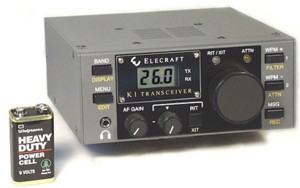
One of my least used rigs (it has still to be used at this QTH!) is my 4-band Elecraft K1 CW transceiver. This covers 40m, 30m, 20m and 15m CW at up to about 7W. It has the auto-ATU built in so just needs a 12-13.8V supply, CW key and end-fed antenna to be on the air.
At my old QTH it has worked lots including the USA on all bands with a simple end-fed wire antenna down the garden. I really should consider selling it or trading it in as it is not being used.

Nifty I Phone Morse Code Decoder
HOT PAW
MORSE CODE DECODER FOR I PHONE

Screen Snap of Hot Paw Morse Code Decoder
I recently installed a ham radio station in my truck. Since then I’ve been having a lot of fun with it, using SSB mostly, since that is a novelty for me. Most of my operating has been using CW, but taking a side trip into PSK occasionally. Logging is somewhat cumbersome in a truck. I used big elastic bands to attach a small clip board to my leg so I could quickly write down a call sign and very basic information. This information would be then transferred to a computer log at home. I tried using the computer in the truck also, and that proved even more cumbersome, having the laptop jammed into the steering wheel.
I like to use a keyboard to send code but no matter what I used, it was a bit awkward in the truck. At the very least, the laptop stays put when its jammed into the steering wheel. Using the passenger seat would require my changing the radio head orientation, the antenna control and paddles which are all set up for easy use from the drivers seat.
Occasionally I’d switch to CW and fumbled for a pen to write down a call sign, time, and band. The guy I was chatting with on 40 meter CW was running just a tad too fast for me to copy ‘everything he sent’, so I missed some of it. It seems that the ‘buffer in my brain’ is smaller than I’d like it to be and with FIFO being the rule, the beginning of a word vanishes as I copy the ending.
(FIFO, First In, First Out’) Some folks may complain that using a ‘decoder’ is cheating somehow. Yes, for a contest, but for every day QSO’s its not cheating at all. If you don’t like it, don’t use it!
I discovered this app and tried it last night for the first time. Wowzah, can it copy code! Just lean it up against your radio, or just near it, and it copies CW. This is a really great help when someone is sending just a ‘tad faster’ than my ability to copy ‘everything’! Its also handy to ‘get the entire call sign’, while I was fumbling with other things in the truck! It works pretty well even in poor band conditions, and has Farnsworth Method as well as regular copy. It has ultra high speed copy, but I have not tried it. 1oo WPM code is hard to come by on the air.
This proves very useful in the truck, but my guess is that other hams will find it handy in other ways.













