Archive for the ‘Uncategorized’ Category
 Our Amazing Sun and HF Radio Signal Propagation
 August 7th, 2015 |
  Author:
 Space Weather. The Sun-Earth Connection. Ionospheric radio propagation. Solar storms. Coronal Mass Ejections (CMEs). Solar flares and radio blackouts. All of these topics are interrelated for the amateur radio operator, especially when the activity involves the shortwave, or high-frequency, radiowave spectrum.
Learning about space weather and radio signal propagation via the ionosphere aids you in gaining a competitive edge in radio DX contests. Want to forecast the radio propagation for the next weekend so you know whether or not you should attend to the Honey-do list, or declare a radio day?
In the last ten years, amazing technological advances have been made in heliophysics research and solar observation. These advances have catapulted the amateur radio hobbyist into a new era in which computer power and easy access to huge amounts of data assist in learning about, observing, and forecasting space weather and to gain an understanding of how space weather impacts shortwave radio propagation, aurora propagation, and so on.
I hope to start “blogging” here about space weather and the propagation of radio waves, as time allows. I hope this finds a place in your journey of exploring the Sun-Earth connection and the science of radio communication.
With that in mind, I’d like to share some pretty cool science. Even though the video material in this article are from 2010, they provide a view of our Sun with the stunning solar tsunami event:
On August 1, 2010, the entire Earth-facing side of the sun erupted in a tumult of activity. There was a C3-class solar flare, a solar tsunami, multiple plasma-filled filaments of magnetism lifting off the stellar surface, large-scale shaking of the solar corona, radio bursts, a coronal mass ejection and more!
At approximately 0855 UTC on August 1, 2010, a C3.2 magnitude soft X-ray flare erupted from NOAA Active Sunspot Region 11092 (we typically shorten this by dropping the first digit: NOAA AR 1092).
At nearly the same time, a massive filament eruption occurred. Prior to the filament’s eruption, NASA’s Solar Dynamics Observatory (SDO) AIA instruments revealed an enormous plasma filament stretching across the sun’s northern hemisphere. When the solar shock wave triggered by the C3.2-class X-ray explosion plowed through this filament, it caused the filament to erupt, sending out a huge plasma cloud.
In this movie, taken by SDO AIA at several different Extreme Ultra Violet (EUV) wavelengths such as the 304- and 171-Angstrom wavelengths, a cooler shock wave can be seen emerging from the origin of the X-ray flare and sweeping across the Sun’s northern hemisphere into the filament field. The impact of this shock wave may propelled the filament into space.
This movie seems to support this analysis: Despite the approximately 400,000 kilometer distance between the flare and the filament eruption, they appear to erupt together. How can this be? Most likely they’re connected by long-range magnetic fields (remember: we cannot see these magnetic field lines unless there is plasma riding these fields).
In the following video clip, taken by SDO AIA at the 304-Angstrom wavelength, a cooler shock wave can be seen emerging from the origin of the X-ray flare and sweeping across the sun’s northern hemisphere into the filament field. The impact of this shock wave propelled the filament into space. This is in black and white because we’re capturing the EUV at the 304-Angstrom wavelength, which we cannot see. SDO does add artificial color to these images, but the raw footage is in this non-colorized view.
The followling video shows this event in the 171-Angstrom wavelength, and highlights more of the flare event:
The following related video shows the “resulting” shock wave several days later. Note that this did NOT result in anything more than a bit of aurora seen by folks living in high-latitude areas (like Norway, for instance).
This fourth video sequence (of the five in the first video shown in this article) shows a simulation model of real-time passage of the solar wind. In this segment, the plasma cloud that was ejected from this solar tsunami event is seen in the data and simulation, passing by Earth and impacting the magnetosphere. This results in the disturbance of the geomagnetic field, triggering aurora and ionospheric depressions that degrade shortwave radio wave propagation.
At about 2/3rd of the way through, UTC time stamp 1651 UTC, the shock wave hits the magnetosphere.
This is a simulation derived from satellite data of the interaction between the solar wind, the earth’s magnetosphere, and earth’s ionosphere. This triggered aurora on August 4, 2010, as the geomagnetic field became stormy (Kp was at or above 5).
While this is an amazing event, a complex series of eruptions involving most of the visible surface of the sun occurred, ejecting plasma toward the Earth, the energy that was transferred by the plasma mass that was ejected by the two eruptions (first, the slower-moving coronal mass ejection originating in the C-class X-ray flare at sunspot region 1092, and, second, the faster-moving plasma ejection originating in the filament eruption) was “moderate.” This event, especially in relationship with the Earth through the Sun-Earth connection, was rather low in energy. It did not result in any news-worthy events on Earth–no laptops were fried, no power grids failed, and the geomagnetic activity level was only moderate, with limited degradation observed on the shortwave radio spectrum.
This “Solar Tsunami” is actually categorized as a “Moreton wave”, the chromospheric signature of a large-scale solar coronal shock wave. As can be seen in this video, they are generated by solar flares. They are named for American astronomer, Gail Moreton, an observer at the Lockheed Solar Observatory in Burbank who spotted them in 1959. He discovered them in time-lapse photography of the chromosphere in the light of the Balmer alpha transition.
Moreton waves propagate at a speed of 250 to 1500 km/s (kilometers per second). A solar scientist, Yutaka Uchida, has interpreted Moreton waves as MHD fast-mode shock waves propagating in the corona. He links them to type II radio bursts, which are radio-wave discharges created when coronal mass ejections accelerate shocks.
I will be posting more of these kinds of posts, some of them explaining the interaction between space weather and the propagation of radio signals.
For live space weather and radio propagation, visit http://SunSpotWatch.com/. Be sure to subscribe to my YouTube channel: https://YouTube.com/NW7US.
The fourth video segment is used by written permission, granted to NW7US by NICT. The movie is copyright@NICT, Japan. The rest of the video is courtesy of SDO/AIA and NASA. Music is courtesy of YouTube, from their free-to-use music library. Video copyright, 2015, by Tomas Hood / NW7US. All rights reserved.
Ham Radio 2.0 video program launching Kickstarter campaign
Jason Johnston, KC5HWB, announced today that he’s launching a new video series called Ham Radio 2.0. To help fund the project, he’s also launching a Kickstarter campaign to raise $5,000 in a little less than two months.
Johnston’s video podcast joins several other popular shows for hams including Ham Radio Now, AmateurLogic and Ham Nation.
This isn’t Johnston’s first radio-related venture. He sells radio equipment on his Grapevine Amateur Radio website and is a long-time blogger at Grapevine Ham Radio.
He says that his goal is to provide a wide variety of episodes including featuring new radio debuts and hands-on, how-to instructional videos.
Some of the topics he plans to cover include:
- New radio reviews
- Featured dealer profiles
- Hamfest reviews
- Coverage of DXpeditions and SOTA activations
- Tech talks
- Featured homebrew gear
Johnston hopes to leverage success he’s had with other ham-related videos. “With promotions, I see potential for getting tens of thousands of views on every video,” he says. “Promotion is the key, and will be my main focus with kicking the project off initially.”
DX from Bald Ledge
Judy and I hiked to Bald Ledge in New Hampton today. We had a view to die for, and I worked some nice DX too… Spain, Bulgaria and the Czech Republic.

We started hiking at Sky Pond. It’s a crystal clear remote pond in the wilderness. It’s a favorite of local fishermen, but not known by many. From the pond we hiked a half mile up an old range road and then north on a woods trail for about a mile.
Bald Ledge is about 600 feet above the west shore of Lake Winona.

I tossed a 28 foot wire over a pine tree and sat down on the ledge facing northeast with the KX3. 20 meters had a few light signals. 15 meters was completely dead, so I started out on 17 meters where there were some strong signals.
EA5GX Sergio in Spain was calling CQ and we made a quick contact. There was some QSB, but he gave me a 579. It was nearly 15 minutes before I made a second contact. There were a couple of pileups, but I stayed away from them. Finally I heard LZ1GU in Bulgaria calling CQ. Harry was strong and he gave me a 569. “Are you happy?” Judy asked. “No….” I answered. “I need another QSO.”

Two nice QSOs and a perfect spot to spend an hour or so? Who wouldn’t be happy?
I like to get at least three contacts, so I scanned 20 meters again. There was Jiri… OK2RRR, the same station I had worked yesterday from Old Hill Village. He was booming in and I called him. Again he gave me 589. NOW I was happy! He told me he had received my email with the photos I sent him from yesterday, and he was pleased I was out hiking on a beautiful hill top. “Enjoy the hike,” he sent as he said 73 and wished me well.

Judy and I shared some fruit and I packed up for the walk back. When we reached Sky Pond, we both took our shoes off and waded in the water. Fantastic!
Project "on hold" – AM Tenbox
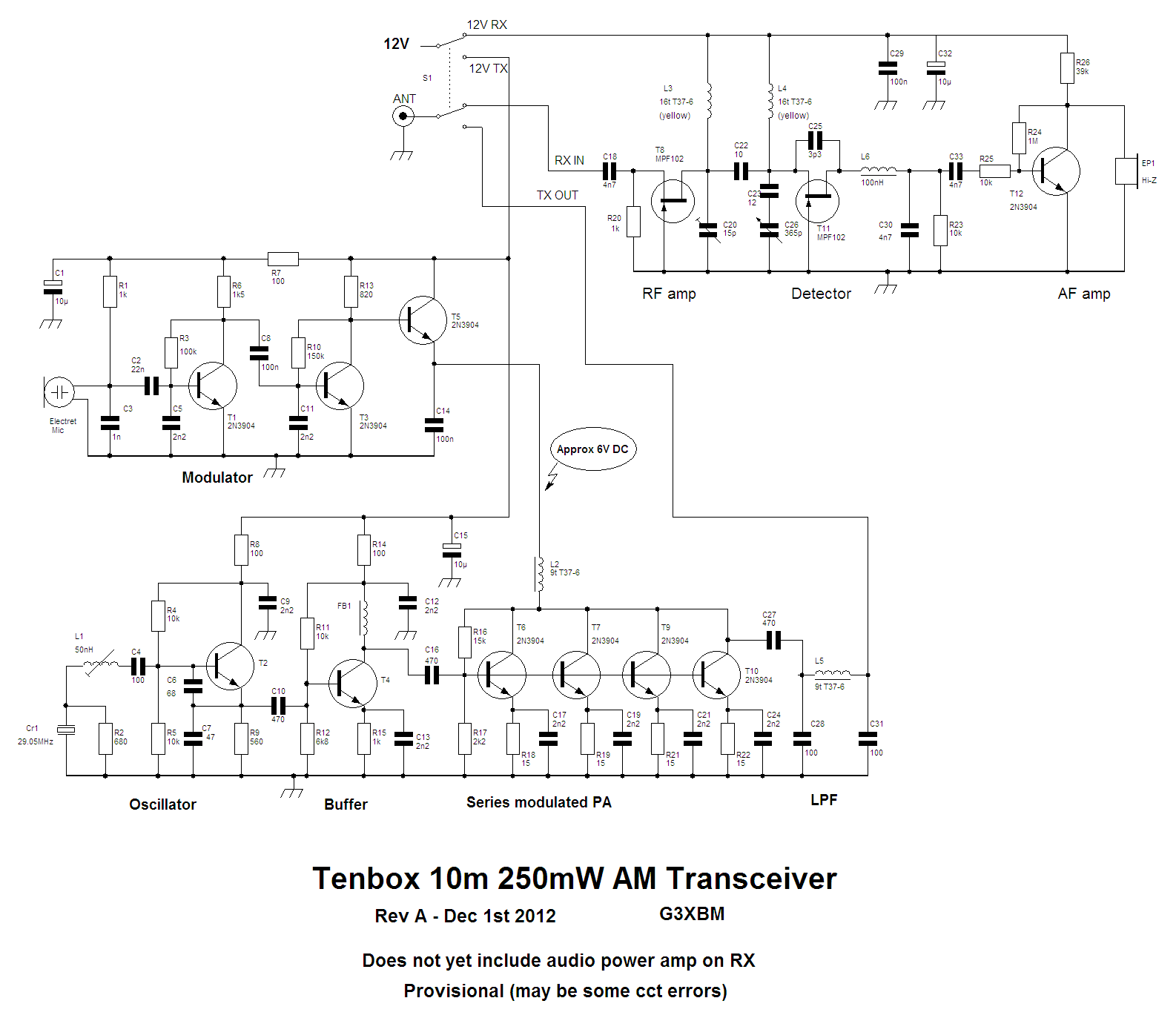
Like many of my projects, this transceiver is “on hold” due to my stroke. I am still too unwell to do much in the way of designing and building. One day, not too far away, I hope to complete this project. If anyone else wants to do this, please use my schematic as a starting point. With a small PCB it would make a nice club project.
It will make an ideal simple rig for nattering across town, especially as 10m loses its fizz and starts to act more like a vhf band again. Such conditions may be with us for years. I fancy putting this in a box like the old Heathkit Lunchboxes with a proper LS amp and LS.

Prices of Japanese radios?
I wonder when the next round of price drops will come on Japanese gear? The big Japanese players such as Yaesu, Icom and Kenwood have had an easy ride of late and been able to dictate prices. Now the competition is waking up, I expect they will be facing tougher times.
The latest exchange rates (UK pound to Japanese Yen) is £1 is worth about 193 Yen. Not many years ago it was less than 130 Yen to the pound. In real terms, Japanese goods should be much less expensive. At the moment both the UK dealers and Japanese are doing very well thank you from a customer base prepared to pay high prices. Expect big falls between now and the year end. This will be partly due exchange rates becoming much better (for those in the UK) and partly due to the increasing threat from the non-Japanese suppliers. Don’t you find it amazing how low cost some Chinese hand portables are compared with similar products from Japan? Rip-off come to mind – charge high prices for Japanese goods as long as the suckers pay.
No, the age of UK amateur radio consumers being taken for a ride is ending. The next time you discuss prices with UK dealers remind them of competition and exchange rates! At the moment their margins must be very high. Japanese goods are priced too high in the UK – fact. A few years ago I was more sympathetic, but not any more. UK consumers should pay a fair price with the dealers getting a fair margin, but please don’t take us all for mugs. I shall buy when the prices are fair and not before.
If I have this wrong, I shall be interested to hear the dealers viewpoint. Exchange rates have got vastly better and I do not see this reflected in end user prices here in the UK. Someone is making very handsome profits.
Consumers – vote with your wallets and do not buy overpriced radios. I have said before, the FT817 is classic example: all development costs were recovered years ago, so the price should be considerably lower than it is. Dealers have dropped the price somewhat, but it is nowhere near what it should be for a very mature design.

QRP from the Ashland Railroad Station
Judy and I stopped by the Ashland Railroad Station today after visiting a blueberry field. I worked eight stations in the NA QSO Party and a station in Bulgaria. It was a gorgeous afternoon.

The station is one of the stops along the Plymouth and Lincoln Railroad that runs between Northfield and Lincoln, New Hampshire. The old depot is a museum now. The train makes regular stops there during the foliage season in the fall when the passengers disembark to tour the museum.
I tossed a 28 foot wire into a maple tree on the other side of the tracks and sat down on the platform with the KX3. I work part-time on the railroad as a conductor and know the train schedules.

The caboose in the background belongs to Brian, KA1JOZ who also works on the railroad. I started out on 20 meters. There were plenty of signals and the propagation was pretty good for a change. The North America QSO Party was in full swing and it was easy to make contacts. I seemed to have a pipeline to Minnesota. Here’s my log:
1 Aug-15 2011 14.019 NA0N CW 599 599 MN
1 Aug-15 2014 14.030 N0AT CW 599 599 MN
1 Aug-15 2016 14.033 N2UT CW 599 599 NM
1 Aug-15 2017 14.027 WO4O CW 599 599 Fl
1 Aug-15 2019 14.024 W9IU CW 599 599 IN
1 Aug-15 2020 14.019 K0MPS CW 599 599 MN
1 Aug-15 2021 14.018 K0AD CW 599 599 MN
1 Aug-15 2024 18.076 LZ73TRC CW 599 599 Bulgaria
1 Aug-15 2027 14.027 WA4PHC CW 599 599 NC

At one point I switched to 17 meters to see how the activity was. I heard LZ73TRC calling CQ. He was strong, and we had no trouble making a nice QSO. I operated for about 20 minutes and packed up.

Amateur Radio Weekly – Issue 71

Amateur Radio Parity Act has 93 cosponsors
ARRL Headquarters has forwarded 3,433 letters to 402 individual US House members, seeking their cosponsorship of H.R. 1301.
ARRL
Coming soon: 146.52 MHz in ARRL VHF contests
Brian Mileshosky N5ZGT, ARRL Director of the Rocky Mountain Division, reported that the ARRL has decided to remove the prohibition of 146.52 MHz in VHF contests.
K0NR
Why 30 Meter APRS?
A case study on 30m APRS vs the 2m APRS network.
The Kentucky Packet Network
Comparing RTTY, PSK and MFSK
Using the ARRL field day test message to compare RTTY, PSK and MFSK digital modes.
HamRadio.me
FUNcube Certificate of Achievement and QSL Card
Those who have successfully received telemetry from FUNcube-1 and uploaded it to the Data Warehouse are able to download these documents.
AMSAT UK
Understanding LF and HF Propagation (PDF)
This PDF is a series of features that formed a good introduction to the topic.
G0KYA, G3NYK
Raspberry Pi packet/digital mode open hardware
Ham Radio sound card interface for the Raspberry Pi or other microcontrollers.
Reddit
Android balloon tracker and modem app
Ground tracking app for high altitude balloons, complete with RTTY modem, offline mapping, online distributed listener integration, chase car location reporting and more.
Google Play
Arduino CW decoder
This is arguably the simplest part of the project. I simply downloaded the sketch and uploaded it to the Arduino.
Amateurradio.com
Icom America club station revealed
I’m pleased to report that a number of our employees are regularly getting on the air and we’re looking forward to activating a few contests as well.
Icom
How to
Google Earth with NWS and APRS using KML
I wanted to find an easy way to integrate mapping, radar data, and APRS tracking data for SkyWARN events.
Robert Andrews
Simple one-chip regenerative receiver
You might be surprised that you can convert an audio amplifier to a receiver using just a handful of components.
Hackaday













