Archive for the ‘radio’ Category
 50-MHz Progress
 June 14th, 2010 |
  Author: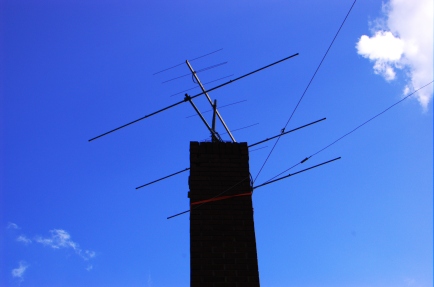
As I mentioned in the previous post, I’ve made some strides toward getting on 6 meters over the weekend. I assembled the 3-element Yagi last weekend. It was leaning against a post in our back yard pointing skyward for a few days. I told Sarah that I was thinking of adding 18,431 more of these antennas so I could compete with the 50-MHz radar at Jicamarca. She was not amused. I hadn’t even mentioned anything about megawatts. Yes, Virginia, the mast in the photo is not square. The top portion of the mast is a little skewed in the rotor and it’s attached with rusty U-bolts that I’ve never loosened. I’m still turning the antenna with the TR-2, even though I have a T2X out here now. I will do that swap eventually. But, for right now, the TR-2 is doing fine.
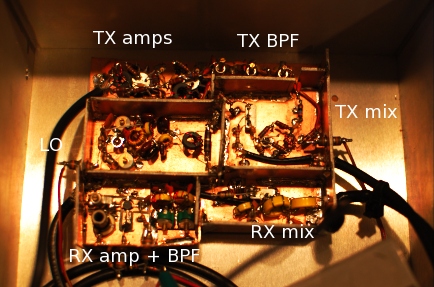
In order to start moving the transverter toward its new home in a beautiful rack-mount enclosure that previously housed a 900-MHz digital repeater (not included when I obtained the box, unfortunately), I had to “re-arrange its internal organs”, as a menacing extraterrestrial used to say in Space Quest. Sarah wonders why I schlep all of this crap from place to place with us. I’ve had that rack-mount box longer than we’ve been married! It was just waiting for a chance to serve in my shack. Anyhow. You can see the layout above. Sarah says it looks like a doll house. Pretty sweet house, if I say so myself.
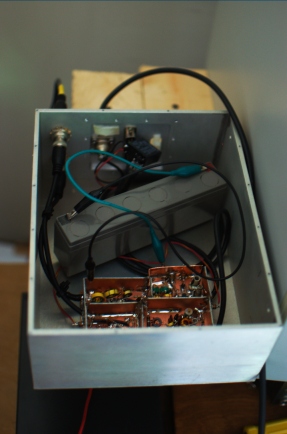
Here’s another view of the partially-integrated box. I’m running it off a battery because I don’t have the power supply subsystem installed in the box, yet. It’s really just a PA and some control circuitry away from operational. Although, I would like to align the TX side with a spectrum analyzer at some point.
I heard quite a few signals in the ARRL contest over the weekend. W5ZN comes to mind, as well as a couple of locals like N4QQ, who lives just a stone’s throw away on the other side of the Beltway (aka the wrong side of the tracks). I suspect that the locals would move the S-meter a little more (like past S9) if I put an IF amplifier in after the RX mixer. But, I’m not really keen to do that unless I have to.
Schematics will come once I’m finished. But, nothing about this so far has been rocket science (or brain surgery, as the rocket scientists say). I’ve just been following the Handbook.
Magic: right place, right time
I put the 3-element 50-MHz Yagi (Cushcraft A50-3S) up yesterday morning with the 6-element 144-MHz Yagi (WA5VJB design) above it—just in time for the ARRL June VHF contest! The 50-MHz transverter is not yet complete, although I have the RX side done and the TX side makes about 250 mW. It’s not integrated and I haven’t started building the PA. Bummer because yesterday was a pretty good Es day from what N3OX told me last night.
With 10 watts from a TS-700S to a 6-element Yagi at 30 feet, there’s not a whole lot you can work on 144 MHz. Plus, everybody was on 50 MHz, so I could only hear the multi-operator and serious single-operator stations on 144 MHz locally. Around 21:00 local time, Sarah and I had just returned from a walk. I had pointed the beams WSW (my best shot from here is SW) and was slowly tuning up and down the band hoping for some tropo enhancement or something…and after a few passes, I heard on 144.210 MHz…
“CQ contest, CQ contest, looking for sporadic-E on two meters, CQ contest, Kilo Five Quebec Echo…”
That’s something alright! I figured the beam was in approximately the right place and gave him a call. He came right back and we exchanged grids. He was there for a few minutes and then disappeared as suddenly as he had appeared. I know he made at least one other QSO, but he was starting to fade by that point and I couldn’t hear the other side. Cool!
My logging software calculated the great circle distance as 1037 miles (1669 km) between FM19 (me) and EM31 (him). Either it was one heck of big meteor or (more likely) one heck of a sporadic-E opening. Either way, I’m pleased. Want more of that!
Odds and Ends
Yesterday, I revisited this post listing on-going projects from December 2009. Some things have changed, some remain the same.
The computer stuff has all been crossed-off the list, except that the home server is off-line with a dead power supply (or motherboard). I’m somewhat loathe to spend any money on it, but I should be able to pick something up.
While it would probably have been cheaper to buy one of the HF/VHF/UHF combo radios, I’ve set off stupidly down the trail of building (and interfacing) transverters. I am just three amplifier stages away from having 3-5 watts on 50 MHz! …plus the interfacing. I’ve decided that interfacing transverters to radios is more difficult than actually designing and building the transverters themselves. I built the 903-MHz W1GHZ transverter during the Winter, but haven’t tried it on the air just yet. W8ISS announced recently that he had some leftovers from the group buy of W1GHZ transverter parts, including boards for 2304 and 3456 as well as some G6Y relay kits. I bought the lot. I have enough MMICs and chip caps in the shop to build these and since I’ll need to order a couple of mixers for the other transverters, I can hit the Mini-Circuits minimum order. Sometime. Microwaves may all get pushed off to Fall and Winter.
Through a strange coincidence, my wife and I independently decided that it would be a good idea to move my ham shack. The new location is closer to the center of activity in the house, which means I’ll operate more radio and be more accessible to her while I’m doing it. But, the feedline and rotator cable no longer reach my 144-MHz Yagi. Fortunately, I’ll be able to raid the K8GU coax stash shortly. In the mean time, I’ve been missing what appear from the Hepburn maps to be epic tropo conditions. Stuff happens.
QSLing, notably my favorite QSL topic—bureau cards. All bureau requests for KP4/K8GU have been processed. I ran out of CE/K8GU cards with 10 to go. I will run some more of these from a photo printer in the next couple of days. Piles of PJ2/K8GU, K8GU, and (go figure) AA8UP cards remain. I will get the PJ2 cards done this weekend since I have a box of cards on-hand. K8GU and AA8UP cards are awaiting a redesign.
Although it sounds like a lot, relatively little is getting done on any of these things thanks to an outdoor project at home. More on this in the future.
TS-930S PA mod — first try
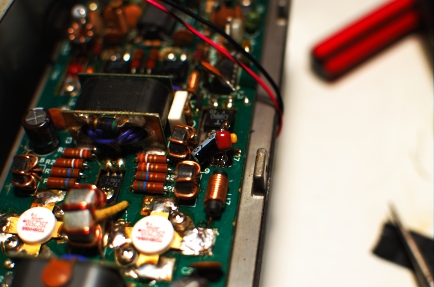
As I wrote recently, I have been tackling the low-frequency instability problem in the TS-930S PA unit. My first attempt was to add several bypass capacitors to from the supply side of L7 to ground (through a lug on the Q7 mounting screw a short distance away). This should tame the drivers, although the problem is not there.
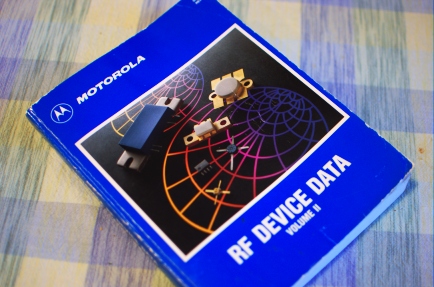
The hum came back when I pushed the power beyond about 50 watts. The push-pull MRF-422 final amplifier circuit in the TS-930 comes from Motorola EB27, with a few small modifications. However, it is not clear to my untrained eye where additional precautions could be taken. I have a hunch that my next target will be this portion followed by the 2SC2075 pre-driver stage if I come up empty on the finals.
More on the TS-930S PA
I’m not sure that I’ve shared this on the blog, but I’ve long known that the reason that my “troublesome” 930 burns up PA drivers is a low-frequency oscillation. This mechanism was also mentioned by Leeson in his comprehensive list of 930 upgrades and repairs. At first, I thought that the 28-volt power supply’s filter capacitors might be the culprit—insufficient ripple-suppression. After all, the oscillation sounds like it has a 60-Hz component (I’ve never tried to measure this because I’m concerned about blowing up more transistors). I finally completed the capacitor replacement last night, realigned the power supply voltage and PA bias levels…and the oscillation is still there, just as I increase the drive past the point where I get 50 watts out.
There is a good Helge Granberg article in the September/October 1980 issue of RF Design titled “Good RF Construction Practices and Techniques.” I would like to get a copy of the original article because Motorola, in their infinite wisdom, reprinted the article as AR164 but neglected to include the list of references. Granberg devotes an entire section of the article to instabilities, a full of half of that section to low-frequency instabilities. This is the area I will focus on first:
Causes for the low frequency instability are usually inadequate collector DC feed bypassing or an extremely poor ground in that area. Two or three RF chokes together with various values of bypass capacitors from 1000 pF to several uF may be required in the DC line to stabilize the circuit. (See examples in Reference 1.)
Ah, Reference 1, where (who) art thou?
If I ever get to the bottom of this problem, there should be a useful body of work and notes to prevent this from happening repeatedly to others.
A License to …
Jeff, KE9V, posted a note today about all of the bellyaching that goes on over the Hamvention venue at Hara Arena in Dayton, Ohio, also occasional home to Bill Goodman’s North American Gun and Knife Show (“Tell a buddy, bring a friend…Don’t you dare miss it!” the jingle goes). In fact, according to the Hara calendar, it appears to host almost monthly gun and knife shows. But, I digress. I’m delighted that Hara is near my in-laws’ home should I ever wish to make a last-minute appearance—yes, it’s tempting to get in the car tonight. And, I digress farther. The point of this post is to explain the pervasive grumbling, finger-pointing, and misinformation, that spews forth from a vocal minority of the amateur community.
I was sitting in 8th grade math class adrift in daydreams as the teacher reviewed yet another topic from a prior grade. Clearly, this was a widely-perceived problem, because one of my classmates persisted in talking to several others around her. Finally, the teacher became so exasperated that he asked, “Young lady, do you have a license to talk?” Of course she did not, but I chuckled noting that, as a newly-minted General class amateur radio operator, I had a license to talk. I tucked that away for future use and went back to whatever it was I was daydreaming about. And today, some 16 years later, the thought sprung into my mind as I read Jeff’s blog.
Another curious coincidence contributed to this confluence of cogitation. As I was eating my lunch, I happened across an old KK7B paper from the Proceedings of Microwave Update ‘94 entitled “Simply Getting on the Air from DC to Daylight.” It’s not a particularly technical paper. It is about the art of doing radio and it was fun to read. In the first three paragraphs, he writes,
In the not-so-distant past, the primary emphasis in amateur radio was putting a station on the air…Sometime in the ’70s the ARRL stopped calling amateur radio a technical hobby and started referring to it as a communications hobby.
Brilliant. I’d like to update that for the present,
In the not-so-distant past, the primary emphasis in amateur radio was communication via radio…Sometime in the ’00s, realizing that it had lost the communications game to telecom deregulation, mobile phones, and the Internet, the ARRL stopped calling amateur radio a communications hobby and started referring to it as an emergency service.
So, where does that leave us? Well, we have a technical license exam structure impressed upon a group of people who are enthralled with communication but use the Internet because it’s easier. No wonder anybody who reads about ham radio on the Internet thinks we’re up a creek!
I’m going to go make a CW contact or melt some solder to cheer myself up. In the end, we have a license to communicate via radio. Let’s use it.
LHS Episode #035: Soylent Green is Bad Apples
 Last week in the Linux in the HAM Shack chat room, we had a lot of participation from our listeners. It was so great to see everyone there. We hope that in the future, more people will get a chance to check out the live show. Check back here on the web site for the schedule of live recordings.
This episode of Linux in the Ham Shack is jam-packed with content. We have a special guest from around the Interwebs that you will likely know if you listen to other podcasts about Linux. The show did run a bit longer than usual, but there is just so much in it I couldn't begin to tell you everything you're going to hear. I do hope that you'll stick around for the entire episode because there are some goodies near the end that you will not want to miss out on, including how you can win significant cold, hard cash.
Thanks to our special guest, our live participants and to everyone who listens to the show. PLEASE, tell everyone you know about us, and that we're not just for amateur radio enthusiasts. Technofiles, geeks, Linux and FOSS addicts and just about everyone will gain something from the podcast. Oh, and due to a couple of technical problems, the audio quality in this episode is poor in a few places. I did the best I could. Next time it'll be better. Have a great week!
73 de Russ and Richard













