Archive for the ‘radio’ Category
 Now I understand – Phase Locked Loops
 February 15th, 2012 |
  Author:
 Every now and then I come across great books or videos that explain a concept in such a way that it becomes immediately obvious what is going on. I’m a great believer in learning by demonstration or even better, learning by doing.
I came across another explanatory video recently that I thought was too good to keep to myself. It covers a topic that was a complete mystery to me: Phase Locked Loops. We utilize them in almost every modern transmitter and receiver yet most people I have talked to view them as a black box that, fortunately, does its job well and usually without interruption.
The video below does a good job on opening the black box and showing just what makes phase locked loops … well, lock.
K1MAN
On 14.275MHz I have been listening to a ‘news’ broadcast by K1MAN. This may not be news to many of you but it’s the first time I’ve heard what seems like a pre-recorder loop of ‘news’ going on and on and on. Surely this isn’t legal?
I quick Google later I found out that this is an on going issue with the FCC, ARRL and just about every governing body in the US. So not really legal but loop holes are loop holes. Time to close them.
Oh dear
A Winter Trip to Greenland
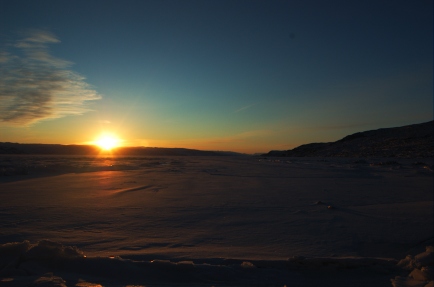
Last year, I managed to scrape together some equipment funds at work to buy a small spectrograph system for studying atmospheric light emissions (airglow and aurora). A co-worker secured the funds and contacts for us to install it at an observatory in Greenland. Because we need to make the measurements at night, and because the instrument was delivered in early December, we made immediate plans to go to Greenland as soon as possible. (Sarah is certainly laughing at this point because the plans were actually far from immediate and we bought our passage just over one week before departure.)
Greenland is only a short (4- to 6-hour) flight from the NE U.S., however the only route that operates in winter (and indeed the only commercial route) is on Air Greenland via Copenhagen, which operates four round-trip flights per week in winter. This turned getting there into a two-day affair of perverse travel arrangements totaling over 12,000 air miles to go about 4200 miles round-trip on the great circle. I met my co-worker, a United Airlines devotee (myself an American Airlines devotee), in Copenhagen and we flew to Kangerlussuaq (Sondrestrom) on Air Greenland.
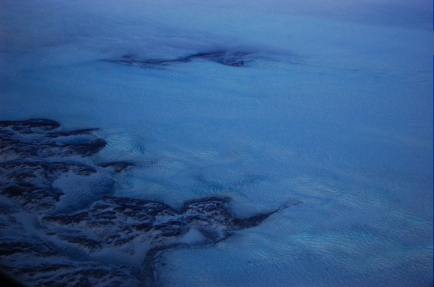
One of the things that strikes you about Greenland as you approach Kangerlussuaq is how otherworldly and remote it is. Kangerlussuaq is the site of the former U.S. Sondrestrom Air Force Base, and one of two runways (the other is at Thule) on the island large enough to accommodate aircraft capable of flying to Greenland from abroad (this is a mild, although amusing exaggeration). Air Greenland has its hub there, shuttling passengers off to towns around Greenland on twin-engine turboprops like the Dash-8. It is, as our host explained, “…not your typical Greenland town. It is far inland at the end of the fjord and not on the coast. The only reason it exists is because of the airport.” Fuel and supplies are all brought in from outside. Like most current and former U.S. military installations worldwide, it is reliant on diesel fuel for its on-going existence. It’s sobering to be someplace that is totally unsustainable, although one might argue similarly of many U.S. cities, but I digress.
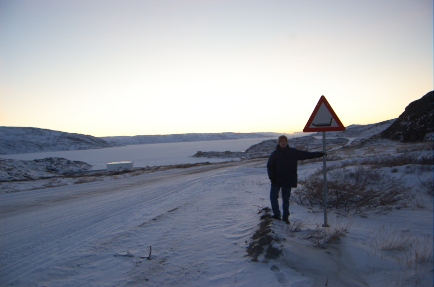
Kangerlussuaq is also near “the dog line,” north of which sled dogs are very common. Here is one of the two road hazard signs we saw while driving around…dogsled crossing:
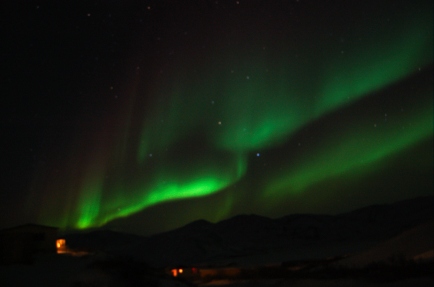
The instrument set up easily the first afternoon and we were able to collect some data with it that night. As we were setting the instrument up, we heard reports of an Earth-directed CME from the Sun and hoped for aurora over the next few days. We were not disappointed…
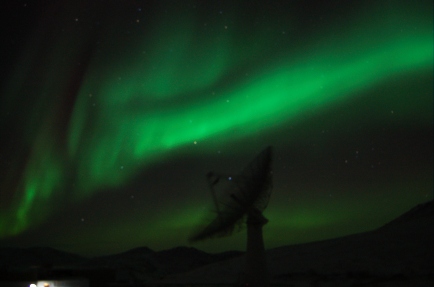
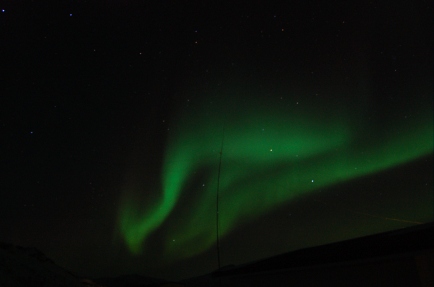
The second night, I stood “aurora watch” in the cold while my warm-blooded co-worker processed the previous night’s data. Soon, I saw some faint cloudy white sheets way down on the horizon and I ran back in to alert him and retrieve the camera tripod. This photograph was taken facing toward the east southeast.
And, the 3.5-MW peak L-band incoherent scatter radar was running. The dish is blurred because it is moving.
And, here is a shot of my fan dipole strung up on the DK9SQ mast.
Speaking of radio, I did manage to make a few QSOs as OX/K8GU on 17 meters, but not as many as I would have liked. The combination of high absorption in the auroral oval (mostly to our south during our stay), little sunlight, a poor low-angle shot (required to avoid the auroral zone) to North America, short openings, and the fact that we were well-occupied with work for the four days we were there conspired to keep my contact count low. QSOs will go into LoTW soon—the certificate was issued yesterday. I have not yet designed a card, but there will be a special card. Thanks to those who did contact me.
Hermes a step closer
Southgate ARC News ran a short piece on TAPR and appointing PCB manufacturers the other day. Reading onto this could be catastrophic but I can see that Hermes is getting closer. I’ve been following this for a little while know and bump into Kevin Wheatly, M0KHZ, the project leader every once in a while. I am really looking forward to this innovative piece of kit coming to the open market. Having seen a very early prototype a few years ago I would love to get one of my greasy paws on one of these. A high performance (HF) shack in a very small box! Hold onto your hats for Dayton then!
Thats the operating over now for the hard work
GB4LBC has now shut down, we’ve amassed quite a few contacts over this weekend to add to our haul from last weekend as well. The loan of the old shop from St Bees lifeboat was very much appreciated by all of us that got involved. I managed to get a couple of 2m FM contacts from the top of the headland before the battery died on me and fired up the Monday night intercontinental special (loosely based on just about every other vertical but with one exception – It wasn’t resonant on the band it should have been). I’ll check it with the analyser shortly to see what I’ve managed to do with it but even when it was tuned by the autotuner and at an awful efficiency no doubt I managed a couple of DX contacts to add into the book.
Over the next few days I’ll be collating all the log sheets we have and totting up all the contacts. I’ve got quite a few to do. We seemed to be more popular than we bargained, so it’ll take a bit of effort to sort out the QSL cards and awards.
Norman, G7MRL, Noel, G4PEW, Liz M6EPW and myself will undoubtedly be back next year and hopefully colin, M0XSD can do better with his lurgy timing with our muddy antenna installation and modest transceivers to do battle with high winds and rain as well as frozen soil so thanks to everyone who answered our calls, forgave our ability to forget your callsign, call you by someone else’s name or listened without switching off to us repeating ourselves with the same facts and figures that we’d handed out in the previous over. You’ve all made our 2 weekends of SOS Radio week enjoyable and most of all memorable.
GB4LBC going QRT
Another nice day as GB5LBC
Well, that has to be the longest day I’ve ever spent at the mic. Both Norman, G7MRL and myself have been at the coalface from about 8am. The morning sun was just starting to peep through the fells and made for a lovely sight. The bonus was that the ground that had been boggy and muddy last week was stiff with the hard morning frost and it made setting up the mast much easier.

Lovely morning for radio
The St Bees lifeboat station manager has been so helpful and not at all concerned by our muddy footprints that have given away our movements on his clean floor. We’ll need to clean it up properly tomorrow afternoon.
Conditions weren’t as good as last weekend. The band seemed to have a lot of static in the morning and QRM at lunchtime followed by bedlam in the afternoon with stations on top of each other on 40m. 20m was contest town and we only managed 1 contact before be gave it up as a bad idea. 17m, 12m and 10m gave a few contacts including Greece on 10m FM, which was nice.
Both Norman and myself had a tiring day and at 3pm headed back to 40m for a few more QSO’s. We’re back on the air tomorrow although I’m on home duties in the morning but Noel and Norman will be on in the morning. Perhaps I’ll get a chance to use my 6m 5/8 vertical.
Anyway, although it was a tiring day we couldn’t have filled 5 pages in the log without everyone coming back to our CQ call. Without those patient people who helped us when the conditions were against us. The number of stations that wanted our little extra award certainly helped get the numbers up. I’ve a sneaking suspicion that GB1LBC will be in big demand tomorrow after Bill had to call it a day with feeder troubles today.
Pop’s Shed and the Kingsley Radio AR7
After my grandfather passed away I spent a lot of time recalling the good times I had spent scrounging around his CB shack and hanging out with Pop “down the shed”. If you’ve spent time around old motorbikes, retired lawn mower engines, vacuum tube electronics and inches of dust you know what the shed smelt like and probably have a pretty good idea what it looked like as well. I used to be able to send Mum into fits by embedding a combination of oil, grease, dust and grinding compound into the knees and sleeves of my good clothes after spending the day “over south” (South Geelong)
Even now I can still walk into any old auto mechanics and the smell brings back dozens of memories as clear as day … but one memory in particular had been bugging me for a while now. On several occasions I had used a magnificent rack mounted shortwave receiver that had been hooked to a long-wire antenna between the shed and the house. It had several plug in coils housed in bright metal boxes, one for each band as well as a unique tuning dial that had windows around the circumference with numbers that updated as the dial was turned.
 |
| National HRO right? … Nope, its an Australian clone! |
For the longest time I was thinking what you are probably thinking now, I had been using a National HRO receiver right? Well, you’d be wrong … just as I had been for years! When I eventually asked my uncle about the receiver (I waited a long time as I feared it had been thrown out & honestly didn’t want to know if it had) he said, “The AR7?” … “Yes, its here in the garage covered in dust”. He went on to say that I could have the receiver if I could figure out some way to ship it … not a slight problem given the receiver, power supply and speaker are over 120 lbs!
Knowing now that I had been using a completely different receiver I set to work and found out what I could about this National HRO clone …
From : http://www.vk2bv.org/
The AR7 was produced during WW2 by Kingsley Radio of Melbourne for the R.A.A.F. These receivers were used in ground stations for long range communication over fixed circuits as well as for receiving signals from aircraft.
The AR7 was based largely on the National (USA) HRO model, a fact that did not go unnoticed by National. This was the subject of litigation during the war years. Over 3000 of these receivers were produced and for their time, produced excellent performance.
These sets were very popular with radio amateurs after the war and unfortunately subject to many modifications. The Wireless Institute of Australia station, VK2WI at Dural New South Wales was equipped with modifed AR7’s for many years. I seem to remember that very local operators could block the receivers completely, resulting in hurried phone calls!
An unmodified AR7 is a rare beast. The Department of Civil Aviation used these sets for many years in a highly modified form, requiring a new front panel. Refinements included squelch and crystal locked coil boxes.
From : http://www.shlrc.mq.edu.au/~robinson/museum/AR7/
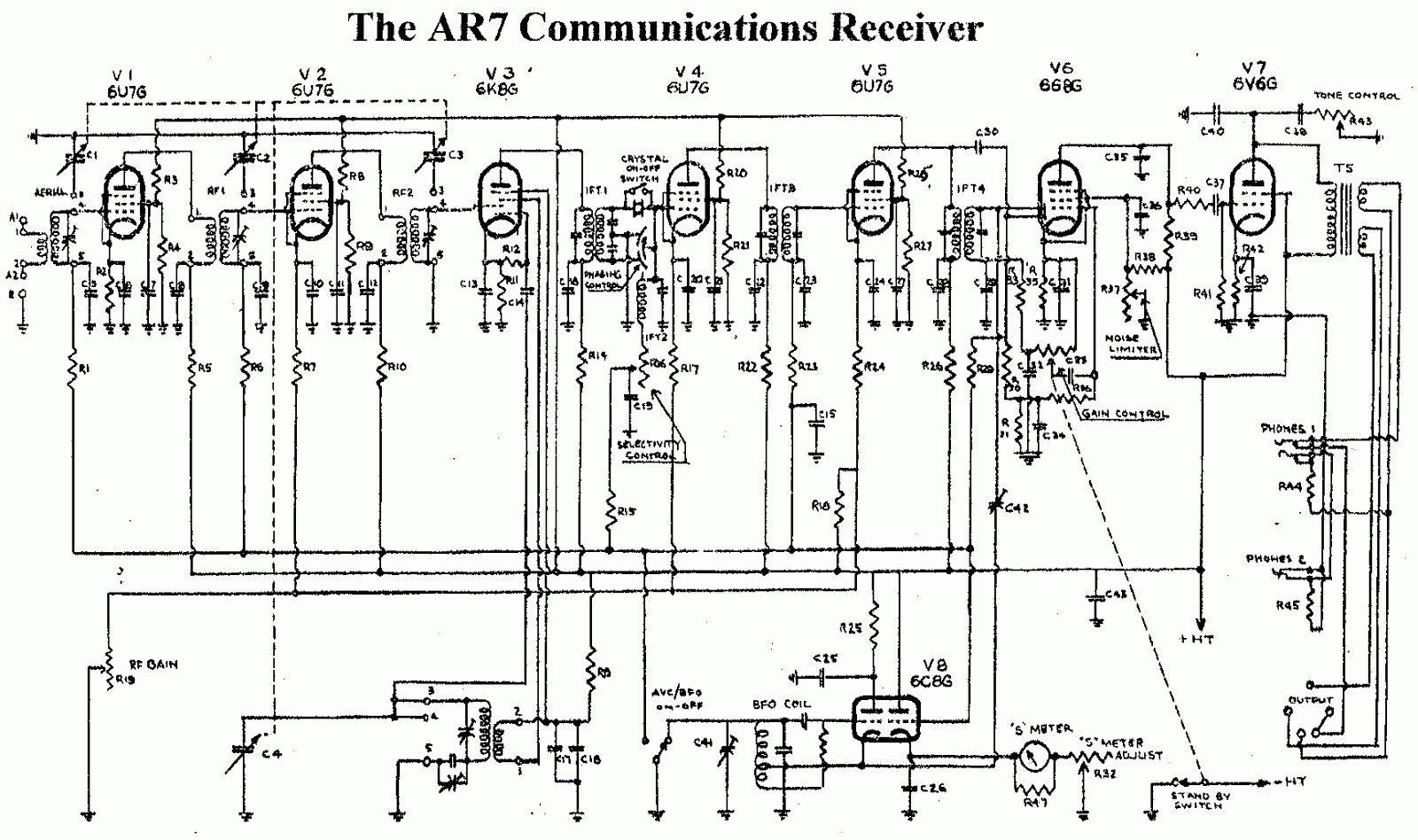
The AR7 is a communications receiver covering LF and HF bands. It was made in Australia during 1940 and bears an extremely close resemblance to the National HRO receiver. The receiver has a tuning range from 138 kcs to 25 mcs, with a gap of 45 kcs either side of the 455 kcs IF amplifier. The internal design is a single conversion superheterodyne receiver with 2 RF stages, 2 IF stages, a BFO and an “S” meter amplifier. The sensitivity is quoted as 1 microvolt. The front panel is stainless steel and it is a very distinctive looking receiver.
It is a good performer, sensitive, has a nice feel, is easy to tune, but hard to find the correct frequency, by reading the frequency from the dial number and coil box graph. It really needs a crystal calibrator. I use it for the weekly W.I.A. (Wireless Institute of Australia) broadcast, so it gets turned on once a week, and is so stable, than I don’t have to retune. It is very clear for AM but a bit fiddly for SSB.
The controls are: RF gain, BFO note, AVC/BFO switch, Adjust “S” meter, Tone, Tuning, Noise limiter, Selectivity, Crystal IN/OUT switch, Crystal Phasing, Audio gain. The Audio gain control has an OFF position which removes the HT so that the coil boxes can be changed.

It has two 6U7G RF stages, a 6K8G mixer, two 6U7G IF stages at 455 kcs, a 6G8G detector/AVC/audio preamplifier, and a 6V6G audio output amplifier. It has a 6C8G twin triode as a BFO and “S” meter amplifier. It also has a crystal filter. The IF alignment should be done very carefully, as any misalignment will reduce the effectiveness of the filter. It is best done with a sweep generator. The 6 volt valve heaters are connected in series, for 12 volt operation.
The external power supply and speaker, are usually mounted in a short 19″ rack, the AR7 at the bottom, the speaker in the middle, and the power supply at the top. The complete unit weighs about 118 pounds. The power supply was switchable between 12v and 240v.
The receiver was used as a ground monitoring receiver for aircraft. It was extremely stable. The model shown has an R.A.A.F. nameplate, and serial number 1786. The manual I have is a D.C.A. (Department of Civil Aviation) version and is a 1947 issue.
It has 5 plug in coil boxes. The coil boxes are: band A 140-405 kcs, band B 490-1430 kcs, band C 1.420-4.3 mcs, band D 4.25-12.5 mcs, band E 12.5-25 mcs. The Army version had an extra coil box covering 50-150 kcs. The large dial is a 20:1 reduction drive and has graduations from 0 to 500. It acts like a flywheel when tuning across the band, and has an effective scale length of 12 feet. The dial shaft goes into a right angle reduction gearbox and has 2 output shafts that drive 2 dual gang capacitors. The graph on the front of each coil box is used to covert the dial reading to frequency.














