Archive for the ‘radio’ Category
 W5IG Cool Transmitter
 April 25th, 2012 |
  Author:
 A very creative way to add an important addition to your station. I would argue this may be essential for any radio amateur who find themselves in the hamshack for long periods.
Allow me to introduce myself
Hello AmateurRadio.com readers! I am Neil, W2NDG, a resident of the North Shore of Long Island in New York. I am a recent ham (August 2011), but a life-long techie and a shortwave listener since 1973. I will be posting from time-to-time here and wanted you to know a little about me first. I write mostly on my own sites, which can all be reached through the landing page at neilgoldstein.com.
I will be taking a look at the hobby from a newcomer’s point of view, but also covering the areas where computers and amateur radio cross over. I intend to learn code and build some QRP equipment by the end of the summer, so follow along, and we’ll have some fun with all of this. I also have some interesting plans involving SDR that I hope to be able to share in the months to come. I want to try to appeal to those of you out there on a limited budget, and help you find what you need without breaking the bank. These are tough times for many of us, but it shouldn’t keep us from having a great time with amateur radio. I also have 3 (possibly more) family members currently studying for their Technician licenses, which should make things interesting. My first post is a research piece I did for my club (LIMARC) here on Long Island about kit sources for amateur radio. So, 73s for now. See everyone soon.
Neil, W2NDG
QST Digital Edition beta
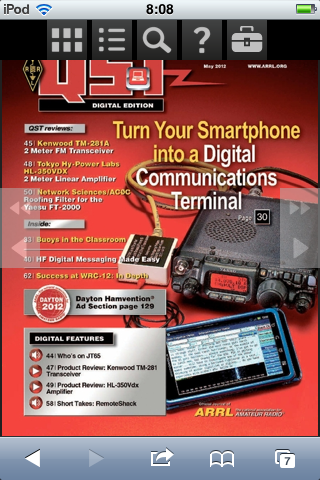
The other day I received, like some unknown number of others, an invitation to try the QST Digital Edition beta for the May 2012 issue. I am not a hard-core mobile/digital media user. But, Sarah is a librarian who has specialized in management and procurement of electronic journals and books. So, she gave me the low-down on what to look for. And, over the years, I’ve given her what-for about eBooks because, as I like to say, “I am willing to risk a single print copy of something by taking it places I wouldn’t risk taking an electronic reader.” That sums up the perspective I took when reviewing e-QST.
You can read about the Digital Edition on ARRL’s FAQ here. The desktop version requires Flash to use in-browser or Adobe Air and an enormous download to go stand-alone, neither of which really warmed my heart. But, it does work in the web browser of a mobile device. I have a 2nd generation iPod Touch running iOS 4 and it worked great in Safari. I now have a bit of insight as to why people might love their iPads (which I have always viewed as a more-expensive, less-convenient version of the iPod Touch or iPhone). There appear to be only two levels of zoom: fit page width and zoomed-in. No matter how good your eyesight, you need to be zoomed in to read because the characters don’t render legibly otherwise. I think iPad’s larger screen might make reading it easier.
Browsing page thumbnails was OK, but it’s difficult to actually know what you’re looking at before you select the page. It also would be nice if the pages were numbered in thumbnail view.
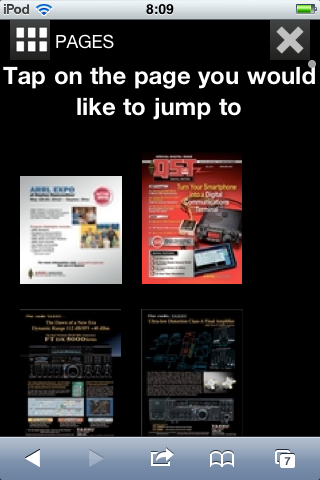
One of the big advantages of the Digital Edition is that you can do things you can’t do with the print version, like including audio of JT65. Granted, I think almost anyone who’s active on HF CW or digital knows what JT65 sounds like, but it’s a basic demonstration of the kinds of things that will be possible in the new format.
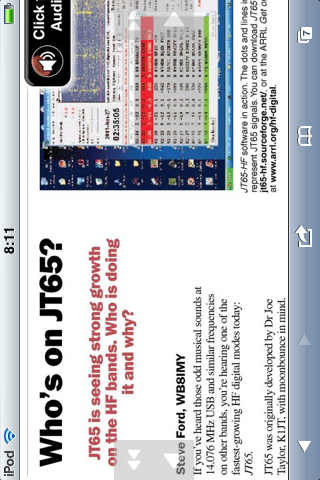
Given that I’m usually done with one month’s issue by the time the next one comes out, the Digital Edition is alright for basic browsing and reading. It’s much faster to skim the print issue, at least with my barebones 768 kbps DSL connection and the higher visual bandwidth of print (read Tufte’s essay The Cognitive Style of PowerPoint for more on this and other interesting reasons to hate slide decks). The mobile version also requires you to be connected to the Internet to browse. It turns out that an entire issue is on the order of 350 MB to download stand-alone on a computer. This makes it difficult to take places where I often want to read QST (on airplanes, for instance)… It is possible to print from the desktop version (I tried it using 32-bit Windows XP and Firefox), although it seems to be slower than the mobile version (not entirely unexpected).
Another thing that’s a bit different is that if you download the offline content to your desktop, you still need to authenticate to open it. It’s not clear whether this continues if you drop your ARRL membership. It is a bit different than owning boxes of back issues…even if you drop your membership, you still have the magazines. I don’t think this is a huge concern for most hams, who probably wouldn’t be interested in old QSTs if they dropped the membership.
In summary, I like the concept of the Digital Edition, but I wish I could carry off-line issues around on my mobile device. ARRL hints at this in the FAQ, so I am hopeful.
Logs and QSL cards
Since I logged my first HF QSO back in 2005 I have been using one type or another of software logging. I have also enjoyed exchanging QSL cards but never developed a good system at keeping them organized. Jumping from one logging program to the next, managing the “sent” and “received” QSL card fields have been hit or miss. A good portion of my contacts were uploaded to eQSL. Some were pushed out to LoTW. But I am not at all certain that either accurately reflects all my logged contacts. Compounding the problem has been multiple moves and military facilitated DXpeditions to Iraq and Korea. So what I am left with is a filing cabinet drawer full of QSL cards and a hard drive full of various log files.
It would be nice to get this mess sorted out.
I taking a three-step approach to establish order out of chaos.
(1) Gather all my software based log files. Use a file format compatible with fldigi and convert all the log files accordingly… with the end result of one consolidated log.
(2) Organize all QSL cards by date. I have a few boxes that QSL cards fit in nicely as well as tabbed dividers. This will allow me to fairly easily crosscheck the cards I have against the digital log.

(3) Stick with fldigi as my logging program. Update the QSL card “sent” and “receive” fields as I mail out cards or receive them. File received cards by date of contact.
(BONUS) I am pretty sure I achieved DXCC back in 2007, but have never been able to sit down and pull out the 100 cards I need. With a consolidated log and QSL cards organized by date, I will be able to easily find my 100 cards.
Back seat ham
It has been a long time since I mustered up the time to post but there’s been a lot going on in West Cumbria and unfortunately most of it hasn’t had anything to do with radio. I did manage to get a day out last Sunday to the Norbreck Rally, thanks to Noel G4PEW for the driving, to help out with the club stand and pick up a couple of goodies for the portable enthusiast. I’ll post about them later when the work dust has settled.
You may remember that a while ago I bought a 2 element lightweight 50Mhz antenna that is currently sitting in a 95% completion state so that will need a bit of finishing off and talking about.
I also purchased a Prowhip 5 band fishing pole antenna on a bit of a whim, partly because I was going to make one and thought I wouldn’t have the time to do it this side of the summer and partly because it was so cheap I doubt I could have got the parts and made one up myself for much cheaper. It calls itself a multiband antenna but its really a 1/4 wave vertical in a fishing rod that will tune to 40m and a few higher bands with a tuner. More on that later.
The other thing I’m involved with is helping with the Workington club (MX0WRC) to try and help out some of the novices and non home brewers to make a simple 3 element 2m band antenna out of ‘stuff from a hardware shop’. There are some well established designs that work but the focus is on getting the guy’s and girl’s to make their own.
I’ll also be helping out with the Fred Whitton Cycle Challenge with the local Raynet group shortly so weekends are looking quite busy .So as you can see, plenty on the plate but no time to get on the air. Something is going to have to stop, my vote is work but I doubt the mortgage will get paid, mores’ the pity.
OAx/K8GU
Loyal readers know that from time to time, I am fortunate to travel to interesting and exotic locales for work—they usually come in pairs, so Greenland and Peru are it for a while. Although the motivation is usually field work, occasionally a conference pops up. The International Symposium on Equatorial Aeronomy occurs every three to four years and can be counted on for an exotic locale. Sarah had such a good time when we attended the 12th ISEA in Crete in 2008 that she insisted on attending the 13th in Peru with me this year. Of course, Evan complicated that a bit, and so we evaluated the pros and cons of leaving him with grandparents or bringing grandparents along, eventually finding a willing pair of grandparents to come along. If you’re interested in a general travelogue (and following posts) and some photographs, you might check out my father’s blogs. This short post is mostly focused on radio aspects of the adventure.
In retrospect, it may not have been such a good idea to bring ham gear to this meeting. Between being the most seasoned traveler in my family and the only one with a functional command of the Spanish language, plus Evan, plus hours of meetings and collaborations each day, there was little time/energy to actually operate. Getting to Peru was uneventful—we took an American Airlines codeshare flight on LAN Airlines via Miama to Lima and got there early in the morning. Unlike their neighbors to the south, Peruvian Customs is by far the most curious I’ve encountered while carrying radio gear—just a minor headache but Sarah was a bit concerned when they took me away for additional questioning. I carry modest gear—a Yaesu FT-840, Astron SS-30 (this should be replaced with something smaller, but it’s what I have), WKUSB, Palm Mini-Paddle, the K8GU portable antenna system, and various cables to connect it all up. After clearing Customs, we boarded a bus to Paracas, where the meeting would be held…
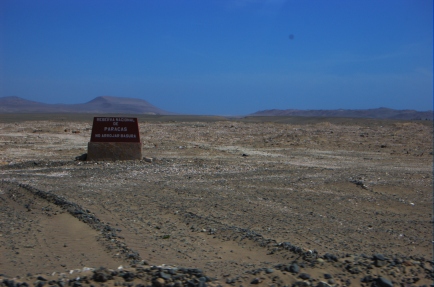
Paracas, which is about four hours’ drive south of Lima, was the site of a major earthquake several years prior and is still in recovery. The hotel that hosted the conference and a few nearby hotels had all been rebuilt from the ground up since the earthquake. The city is on a small bay that is protected from the Pacific. It’s very beautiful—desert sands that go right down to the bay. After a few days at the meeting, I managed to get the antenna set up.
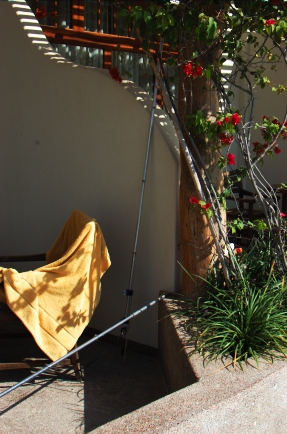
One of the things that surprised me was an excellent JA opening on 20 meters just after sunrise before I went to breakfast and then the meeting. I am pretty sure it was a direct-path opening because the signals did not sound like long path and the long path crosses the southern auroral oval, whereas the direct path does not. (Auroral absorption, by the way, is one reason that the long path can be more effective than the short path.) Any time I called CQ as OA5/K8GU, I was greeted with a roaring pileup. Not bad for an antenna propped up on my veranda. Verticals on the beach rule, and this one wasn’t even really on the beach.
At the request of a friend, I made a special effort to operate on 12-meter CW in the afternoon. The portable antenna would not tune up on 12 meters with the wire radials I had laid out. In a moment of desperation, I assembled some extra pieces of my portable antenna to produce a tuned radial that I clip-leaded to the ground lug as depicted in the photo above. It worked right away and I was quite popular there as well.
A comment about computers—my standard work-issued computer is a MacBook Pro, which although perfect for my work, is essentially useless for amateur radio. I know this will generate a torrent of discussion, but if you are accustomed to real contest/DXpedition logging software available for DOS and Windows, you know that the stuff for the Mac doesn’t cut the mustard. I have logged DX operations on paper (CE/K8GU), or in the case of the OX/K8GU operation, brought along a second computer. However, in a long-delayed flash of insight, I bought and installed VMware Fusion on the Mac in February. It runs Windows XP and TR4W with the WKUSB just brilliantly and with no special configuration. Aside from having to press Fn+F1 to CQ, this was an epic win. KB9UWU tells me that there’s an option in VMware to eliminate this nuisance as well.
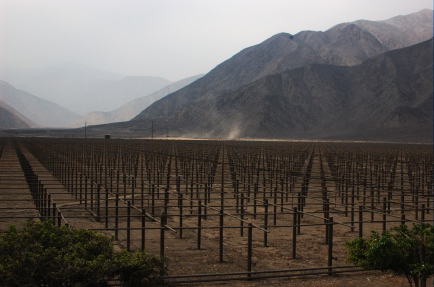
After the meeting in Paracas, we returned to Lima, where we celebrated the 50th anniversary of the Jicamarca Radio Observatory. The cornerstone of the Jicamarca facility is a 49.92-MHz radar that feeds an 18,720-element phased array, pictured above. Jicamarca is one of the most powerful radio transmitters in the world, capable of 4.5 MW output, and is used for a variety of atmospheric, ionospheric, and space science experiments. Like Arecibo, it was originally designed to perform incoherent scatter measurements of the ionospheric electron density profile.
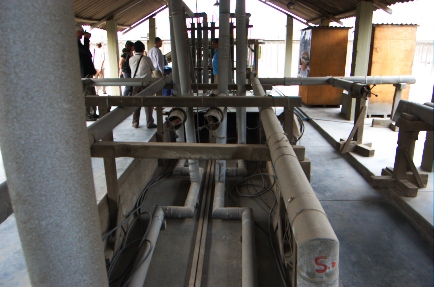
Lots of fire in that wire! Have you ever seen a coaxial cable that’s rated for over a megawatt at 50 MHz? This is the feedpoint of the phased array. There are a few tuned stubs in there, too.
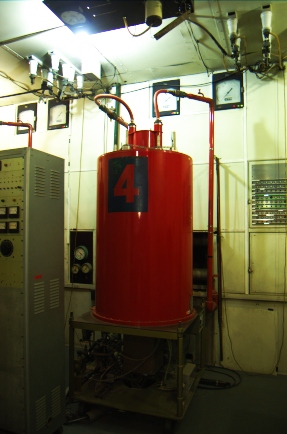
Here’s one of the four 1.5-MW transmitter cavities. A maximum of three are used together. When configured for three transmitters, the driver stage puts out 7 kW! Needless to say, everything is custom made on site. The transmitting tetrodes (8973s, if I recall correctly) are refurbished by the manufacturer as needed.
After Jicamarca, we went to Cusco, which is south and east of Paracas, and much more lush than the deserts around Lima and Paracas.
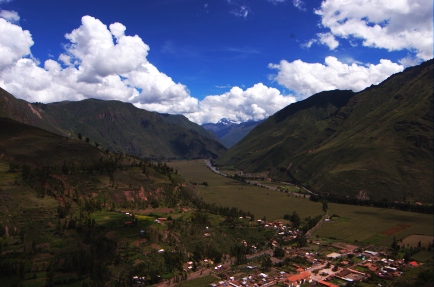
We spent a lot of time being tourists in Cusco and vicinity and I had some difficulty with my computer so I only made a handful of OA7/K8GU QSOs from Cusco on 17 meters. It is quite remarkable how much better the bands were from the coast. As someone who has operated from W3, W8, W9 and W0, I can attest to that difference as well. I missed my morning JA run…
A final thought—we drove through a lot of towns and communities in OA4, OA5, and OA7, on this trip. Nearly every town, no matter how small, had at least one building with an HF fan dipole on the roof. HF is alive and well in a mountainous country like Peru!
QSL information: If you worked OA5/K8GU or OA7/K8GU, the best way to get a confirmation is through ARRL’s Logbook of the World. I have been responding to direct cards (to my FCC address) with a one-day turn-around lately.
Fred Whitton challenge support
A few years ago, when children, pets and work didn’t need so much attention I took part in a bike race (commonly called a sportive) which took in 6 passes in the lake district (kirkstone, honister, Newlands, Whinlatter, Hardknott and Wrynose) in a 112 mile day out on 2 wheels. This time I shall not be cycling but helping out with the local Raynet group.
Saturday had us checking the local communication paths for the various areas. It’s the first time I’ve been involved in any of this kind of thing so Paul, 2E0EET took me through the basics and now I’m looking forward to being a spectator and watching those who’ve trained for months on end to attempt this formidable ride.
It took me over 7:30 hrs when I did it do giving up the same amount of time with the rig at cockley beck (not too far from the Hardknott summit) seems a small price for my earlier enjoyment.













