Archive for the ‘radio’ Category
 Hamvention from afar…
 May 19th, 2012 |
  Author:
I was unable to make it out to Dayton but am enjoying seeing the onsite action through various mediums:
(1) w5kub.com – live streaming. It has been a bit hit and miss on the quality and coverage, but the feed is quite popular and it is a lot of fun seeing all the hams walking around the outdoor market. Lots of hams in front of the live feed cam seem to stand there, stare at the camera, and call home (or a buddy) to have them get on the website to see them on the live feed. At certain times the live feed appears to be an actual video version of hamsexy.com. The best part about amateur radio is the people and it is always great to see what an amazing variety of folks who share a common interest.
(2) Jeff, KE9V, is on the grounds of the Hara Arena and is frequently Tweeting and posting pictures. Jeff had an interesting picture of a vendor called Horse Fence Antennas. The product appears to be a dipole antenna that is built into what we in the Army call a cargo strap. The antenna looks a bit bizzare, but the eHam reviews are 5.0.
(3) D-STARS! I have not hooked up my DVAP and IC-92AD since I returned for Korea, but did so yesterday so I could monitor REF038C. Lots of great hamvention chatter on the reflector.
(4) I am going to look for any HF stations operating from the Hamvention. Often W1AW will setup up a special event station – those are always fun to work.
Hopefully I will be able to go next year…. 2013, Dayton or bust!
Thoughts on Digital
I have opined in the past (although perhaps not on the blog directly) that CW is the reason I am still an active ham after almost 19 years…actually, I think a week from today marks the 19-year anniversary of passing elements 2 and 3A in the basement of the Stark County Sheriff’s office. CW permitted me to make interesting, intriguing, compelling QSOs that I simply could not complete on SSB with my meager station as a beginner.
Over the years, I have used this as the argument for retaining the Morse code testing requirement: Morse code proficiency gave newcomers the opportunity to make exciting DX contacts under all solar conditions (except disturbed, of course) and hook them on the hobby.
PSK31 was the first mode that challenged CW in that arena. I made a couple of PSK contacts almost 10 years ago now and decided it was harder than CW. So, I did not pursue it. Aside from making a half-hearted effort to get ARRL’s Triple Play Worked All States using only unassisted (no cluster, no RBN, no skeds) contest contacts, I haven’t really operated digital modes much and didn’t really understand why anyone would want to because CW is so much easier. I’ve seen dozens of JT65 posts by fellow AmateurRadio.com bloggers. And, about a year ago, I met Paul, N8HM, who lives in an apartment in DC. He’s very active on HF digital modes with a shoestring setup…and he’s very passionate about it. That’s when it clicked.
Digital modes are the new CW: the DX mode for the average ham. I must be slow!
I still think CW is way easier than digital QSOs, especially in contests and pileups: there is a certain amount of critical humanity (varying timing, sending speed, spacing, or calling frequency) that you can’t apply to cracking a digital pileup…or maybe I just haven’t figured it out yet. I guess I have years of Morse practice and shouldn’t expect digital to be easy just because the computer is doing the sending and decoding. But, I think I understand digital operators a little better after this revelation.
You guys are alright.
Recent tinkerings (19 May 2012 edition)
I try not to do these “meta-posts” too often, but time has been of the essence lately and it’s been hard to find enough time to sit down and write something coherent when most of my “ham time” has been devoted to DXing or antenna work. This post covers tinkering and operating from K8GU since January (!!).
I am not at Dayton this year.
Worked 7O6T on three bands (20/17/15) on CW and also on 20-meter SSB. The only one I spent more than five minutes for was 20CW, which was during the first few days of the operation. Normally, I would have waited, but since this was in the land of pirates and AQAP, I decided to play it safe in case there was an international incident that curtailed the operation. My friend Steve, K0SR, gave me a hard time when I bragged about working them with 100 watts and a dipole. You can do that on the East Coast. He’s right. DXing and DX contesting from the Upper Midwest (aka The Black Hole) is hard.
Did not work 6O0CW (Somalia) or 9M0L (Spratly). XX9E (Macao) is doubtful since it’s a short DXpedition and I’ve only heard them once so far.
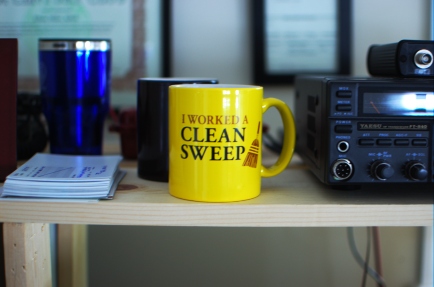
My 2011 Sweepstakes “Clean Sweep” mug arrived. Sarah banished it from the kitchen because it’s canary yellow. I think it’s hand-wash anyway, so it will continue to hold baby-proofing outlet covers and look good on the top shelf in my shack next to the liquid-crystal painted Jicamarca mug. Speaking of baby-proofing, Evan is on the move…
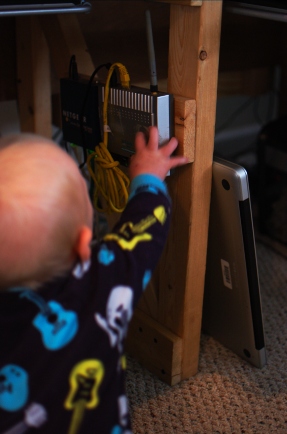
I built a gate that fits in the aperture of my shack desk. An unintentional feature of this is that I can still reach the keyboards through a gap at the top. It’s a little hard to send CW through there. But, it keeps curious Evan away from the jungle of wires that make up this “wireless” station.
In January, I took down my VHF antennas from the main house chimney. I had estimated the wind surface area of the chimney and determined that the wind load of the antennas increased it by 15-20%. Since I know that the guys (it was built in 1946ish, so yes, guys) who built the house didn’t do any calculations I figured that the safety factor was at least a factor of two. But, I was growing increasingly uneasy about the torque exerted by the antennas on the chimney, so I took them down.
In March, I had the opportunity to pick up (from K3AJ, who beat me by three QSOs in ARRL SS CW last year…need to be disciplined since I left 4 hours on the table) a M2 2M9SSB Yagi for two meters on great terms (per usual). This antenna is lighter and stronger than the homebrew K1FO that I had been using. I cut up the elements from the 2-meter K1FO to make Yagis (also K1FO designs) for 222 and 432 on 10-foot booms. Need to finish those and put them up.
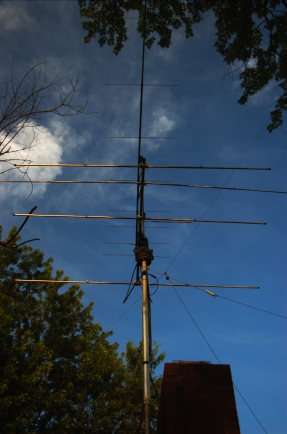
We have another, shorter chimney on the addition that houses my hamshack. This chimney has served as the anchor for my 10-meter rotable (by the Armstrong method) dipole for a while now. Branches from a nearby tree have impinged on the rotation somewhat, but since it’s bidirectional it hasn’t been a big deal. But, I decided that this might be a good location for the new 2M9SSB, the A50-3S (3-el 6-meter Yagi), and the 10-meter dipole. I himmed and I hawed. Then, I climbed the tree and sawed. It’s a miracle I didn’t end up with poison ivy.
I upgraded the 10-meter dipole using hardware from DX Engineering so it could be mounted to a mast (old method was not mechanically sound, especially for something that would be rotated with a T2X).
A few weeks ago, I assembled and installed the whole mess…see photo at the top of the post. I’m now using a Hy-Gain T2X (purchased at Dayton in 2005—I showed up at my in-laws’ grinning ear-to-ear with the motor in one hand in the control box in the other—they still love to tell this story) instead of a CDE TR-2 rotator. The T2X can probably turn the house.
A spring wind storm dislodged the branch that supported my 80-meter wire vertical and one end of the 20-meter dipole. So, I cleaned that up last weekend. By “cleaned,” I mean I took both of those antennas down. I also took down the 160-meter TEE because one of the TEE wires was very close to the new VHF array. At this point, I was only QRV on the “Technician bands”…minus 80…40/15/10/6/2. I almost got the 160-meter wire all the way out of the tree except the rope that supported the center (TEE junction) bound up with the junction about 10 feet off the ground. So, I improvised a hot knife on a stick to cut the poly rope:
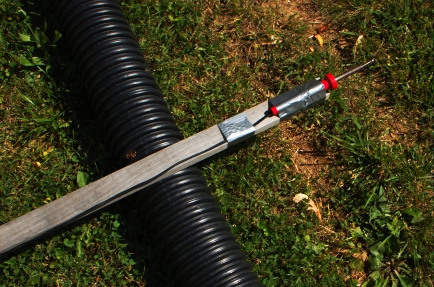
It worked great. As she should have, Sarah gave me a hard time. There are two types of people: those who watch Red Green and there are those who inspire Red Green.
Taking a wonderful brilliant hint from N4YDU, I replaced my 30-meter coax-fed dipole with a 30-meter open-wire-fed dipole. While I prefer resonant single-band antennas for contesting (clean patterns and nothing to touch when changing bands), every other kind of operation can tolerate tune-up. The open-wire-fed 30-meter dipole not only tunes well on 17 and 12 meters, it just has a slightly narrower pattern! An aside: After the 2010 ARRL 10-meter contest, I posted to the PVRC reflector that I had been running 100 watts to a dipole at 30 feet. This prompted my neighbor (who lives about 2 miles away, a neighbor for bands below 76 GHz) K3KU to pay me a visit because I had beat him in every pileup that weekend. He thought surely I was running a KW to 5 elements at 60 feet! He runs an open-wire fed 135-foot long dipole on all bands through a tuner. The pattern of that antenna looks like a sea anemone on 10 meters!
Worked D3AA on the third call on 30-meter CW last night. So, I guess that antenna is working. Also worked VP9GE on 6 meters. There’s a certain amount of satisfaction working DX with a transverter you designed (mostly) and built yourself.
I have a wicked RFI problem on 6 meters when I run the amp (150-watt Mirage brick). It’s probably RF on the power lines, although it doesn’t set off the CO detector like 40 meters does. So, it could be RF pick up on the audio wiring in my shack. In any case, need to get that worked out before the ARRL June Es contest.
Big Gun
It’s not often I hit some DX but WSPR helps me out quite a lot. Here’s a screenshot from my latest 1w big gun escapade

1w into Hustler 6-BTV
Whilst some might say that lifes too short for QRP. Newly licenced hams take note. 1w into a lossy vertical in a bad location doesn’t mean you’re stuck with QSO’s as far as the end of the street.
All this was achieved with a modest transceiver (IC-7000) and a modest antenna (Hustler 6-BTV with a few radials). The lesson here is that DX isn’t just for those with limitless pockets of cash, elevated QTH’s and antenna systems that can rival your nearest broadcaster. You just might not be talking to the other station!
Armed Forces Day Crossband Test
 I had a fairly successful day participating in the Armed Forces Day Crossband Test. To recap, I am currently at Fort McCoy, Wisconsin for a brief period of time supporting a National Guard exercise. Normally when I go around to different Army units and assist in their exercises I fly. But I decided to take my Toyota Tundra on this trip and re-installed my HF rig. I have never preiously particpated in the Armed Forces Day Crossband Test and have always wanted to…. this was my chance.
The AFD Crossband Test has two components to it. The first is to receive a message from the Secretary of Defense which is transmitted in various digital modes from different military stations during the day. The second part of the Test is to make contact with the military stations with the military stations operating in their band and the amateurs in their band (hence the term “Crossband”).
For the Secretary of Defense message I hooked my Rigblaster Plug & Play to my IC-706MKIIG and brought my laptop into the truck (which has fldigi installed). The Rigblaster worked like a charm and I was able to copy the SECDEF’s message from WAR (at The Pentagon), AAZ (Fort Huachuca, AZ), and AIR-2 (New York). All these transmissions were in RTTY, which fldigi was able to read without issue. Now I need to print out copies of the messages I copied (which are the same, except the header information which reflects what station was transmitting the message) and send them in to the corresponding station. In return, I believe, I’ll receive a certificate from the SECDEF (suitable for framing, I’m sure).
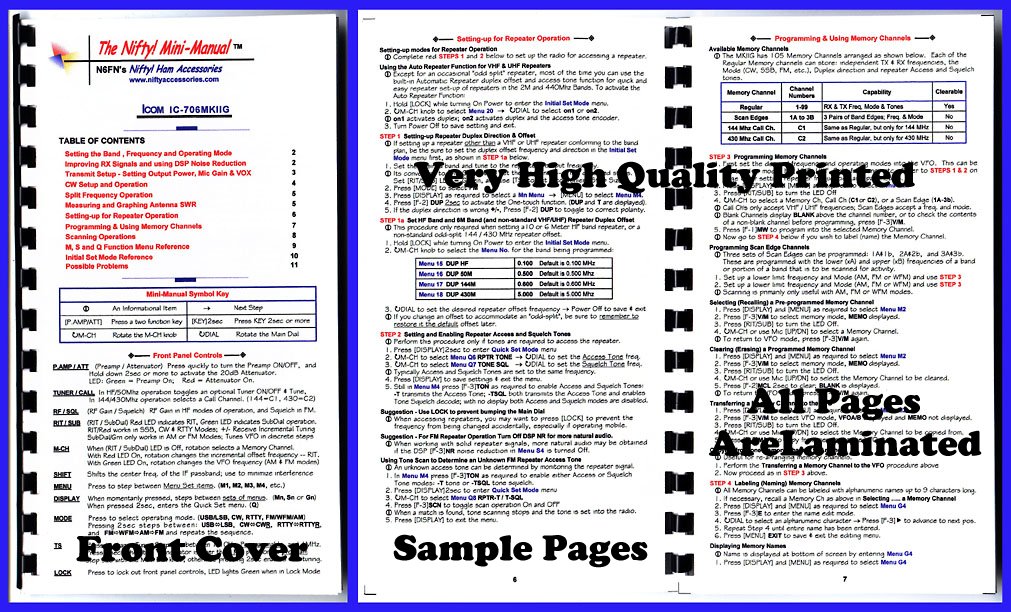
The crossband contacts caused me to take a crash course in split frequency operations for my IC-706MKIIG. Fortunately I had my Nifty “Cliff Notes” version of the manual and was able to figure it out pretty quick. Although the actual execution took a bit of time to get down. First, obviously, I had to hear the station calling. MARS HQ publishes ahead of time a list of each station and the frequency that they will transmit from. I built a spreadsheet that allowed me to sort by frequency which made it easier to search for the transmitting station. The searching was done in the IC-706MKIIG’s VFO A. Once I found the station, I had to listen for them to announce the amateur frequency they were listening to… which most stations did periodically. Once I got their listening frequency, I flipped over to VFO B, dialed up the frequency, tuned the Tarheel screwdriver antenna, flipped back to VFO A, then hit the Split function, and waited for a chance to call. In the end, I was successful in contacting five different stations: WAR (at The Pentagon), NWKJ (located on the USS Yorktown, Charleston, SC), NMN0CQQ (located on the USS Midway, San Diego, CA), AAZ (good ol’ Fort Huachuca, AZ), and NWVC (a Navy MARS station in Indiana). For these contacts I get to send in my QSL card and hope for a response.
None of this was exotic DX but it was fun and exciting… and a bit challenging trying to do it all from inside my Toyota Tundra. I hope I am able to particpate again next year.
$3 AIR-2 AIR-2 MESSAGE FOLLOWS
RYRYRYRYRYRYRYRYRYRYRYRYRYRY
RYRYRYRYRYRYRYRYRYRYRYRYRYRYDE AIR-2 AIR-2 MESSAGE FOLLOWS
SECRETARY OF DEFENSE
ARMED FORCES DAY 2012 MESSAGE
TO AMATEUR RADIO AND
MILITARY AUXILIARY RADIO SYSTEM
OPERATORSQUOTE
FOR THE PAST SIXTY-THREE YEARS, OUR NATION HAS RECOGNIZED
THE DISTINGUISHED GLOBAL SERVICE OF OUR UNITED STATES
MILITARY DURING THE ANNUAL ARMED FORCES DAY CELEBRATION.AMATEUR RADIO AND MILITARY AUXILIARY RADIO SYSTEM OPERATORS
PROVIDE ESSENTIAL CONTINGENCY COMMUNICATIONS TO RELIABLY SUPPORT
OUR NATIONS MILITARY AND GOVERNMENT AGENCIES. YOUR SUPPORT OF
COMMUNICATIONS BETWEEN DEPLOYED SOLDIERS, SAILORS, AIRMEN,
MARINES, SUPPORTING CIVILIANS, AND THEIR FAMILIES IS DEEPLY
APPRECIATED.ON BEHALF OF ALL UNIFORMED SERVICES, I EXTEND MY SINCEREST
APPRECIATIMN FOR YOUR HARD WORK, SELFLESS DEDICATION, AND
VITAL SERVICE TO OUR GREAT NATION. WELL DONE!/S/ LEON E. PANETTA
SECRETARY OF DEFENSE
UNQUOTE
APPROVED FOR TRANSMISSION,
DE AIR-2 AIR-2
SK
On The Road Again
When I left for Korea, I had to pull out the HF installation on my truck… as the truck was staying in Kansas and I was not. Pulling out the rig and tuner was easy. The Tarheel antenna was also fairly simple. A disconnect at the base and then I coiled up the feedline and the cable that powers the screwdriver so they would be mostly out of the elements.
I returned back to Kansas last June but did not reinstall my HF setup in the truck. My only real modification was swapping out my VHF/UHF antenna with a fold-over. The new house afords me the opportunity to park in the garage(!) but rather than unscrewing the antenna every time I enter the garage, now I just have to pull it down. Works great.
My assignment here in Kansas has me traveling quite a bit and this week I am headed up to Wisconsin. I have only driven through Wisconsin once so instead of flying, I am going to make the 9 hour drive. This had me thinking that if I am on the road for 9 hours, I need my HF rig. So today I put the radio back in and reattached the Tarheel antenna.
Everything was set – I fired up the rig and heard the Turbo Tunner beep that it was on and ready. I hit the 706′s tuner button but the screwdriver failed to turn. Troubleshooting time. I took the base of the antenna down to the bench. Then I dug out the original rocker switch that came with the Tarheel. I hooked it up to the bench power supply and then hit the switch. Nothing. After a bit of jiggeling and wiggeling, the screwdriver engaged. I guess the almost two year siesta had taken a bit of a toll.
After a test drive today, it appears as if the mobile HF rig is working FB!… one QSO with North Carolina and another with Massachusetts. So look for me (AD7MI-9) as I make my way to Fort McCoy, Wisconsin and maybe I will catch you on 20M.
Bad day
For quite a while now I’ve not been able to get into the shack. Not because its stacked to the rafters with new gear but because I’ve had too much on to even think about it. Yesterday I managed to squeeze some time in and quite frankly I wish I hadn’t bothered.
My FT817 lives in a padded bag when its not in use along with its charger and an old Miracle whip. Now the Miracle whip no longer has a whip courtesy of my youngest who managed to snap it in half. Whilst it isn’t the finest antenna it was extremely useful for travelling. Now I need a replacement telescopic whip and I’m guessing they’re either hard to get hold of or unnecessarily expensive.
The other doom was the CI-V controller (mine is a G4ZLP USB digimater pro+) which has given some sterling service over the last couple of years but now has decided to read the frequency but not PTT or supply audio. Several wasted hours later the status quo remains. Reliability of kit in my shack isn’t that great at the best of times and this just confirms that a law based on expense and reliability. ‘No matter what it costs the chances are that it’ll stop working for no apparent reason’.
At this rate I’ll have nothing left either as a result of a 3 year old or its own suicidal components..