Archive for the ‘radio’ Category
 OK, OK! I Will Write that Ham Radio Book!
 July 30th, 2012 |
  Author:
 Ever since I began writing articles about my hobby of choice–amateur or “ham” radio–for my ham radio web site and several others, people have been asking me when I was going to do an amateur radio book. The truth is, I have just been too darn busy to even think of such a thing. And I also knew, in my heart of hearts, that it be would difficult indeed to get any kind of decent book contract for such a niche book. I presented my idea of a half-fiction/half-nonfiction book to the ARRL and they passed, so that confirmed my feelings. If they had no interest, I doubted anyone else who published books would either.
Fast-forward to July 2012. Things have changed, both in my personal life and in the wild and woolly world of big-time book publishing.
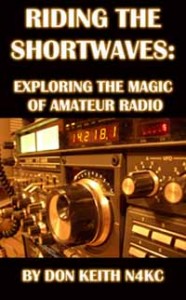
Don Keith N4KC has just published his new book of short stories, articles, advice, and more about ham radio.
First, I retired from my 60-hour-a-week day job back in May. And as I shuffled through the articles I had in the can, several more I was working on, and a few still in my head, I realized I was closer to a book than I had thought. And I truly believed I had something that would be different and could find a readership.
Secondly, as I investigated Kindle Direct Publishing at Amazon.com for the re-issue of a couple of my previous now-out-of-print books, I realized that I should absolutely pull the ham radio book together for that outlet–Kindle and some other e-book readers–at least. Amazon has become a real threat to traditional publishing companies–especially when it comes to e-books–as the old-line publishing houses struggle to figure this newfangled thing out. At the very least, it gives me the opportunity to make my book available at a very reasonable price to those interested in amateur radio. No, I don’t make much money at the price I set, even if I actually sell some downloads of the book, but that is not really the object anyway. As I have said many times, and not totally facetiously, if I wanted to make a fortune writing books, I would write pornography (See FIFTY SHADES OF GREY).
Then, as I considered other options, I realized that Amazon offers a truly unique opportunity for works like this one that allows me to offer the book in a traditional paperback format with minimal investment up front. Remember, I’m retired, on a fixed income these days! Amazon’s is a print-on-demand deal, but they seem to have it down to a science. I ordered some copies as soon as I got the book and cover uploaded and accepted for publication. The very next day I got the email that they were being shipped that day. Wow!
Again, this was with very little upfront cost and minimal hassle. Now, the paperback will be available not only via Amazon.com, but through major distributors, for order by libraries, and even in many European markets. We will see how good the print job is, but believe me on this: the major houses don’t necessarily produce the highest quality book any more either. They have to cut where they can to make a profit and printing, binding, and warehousing is a big drain on them.
Talk about rapid technological change and its effect on society and the media! Broadcast radio, TV, the Internet and telephone communications are not the only things evolving at a dizzying pace. Include the anachronistic business of book publishing in that mix, too!
Realistically, will tons of booksellers and all the Barnes & Noble stores order a box full of the books each? Or will hundreds of thousands of libraries order up a couple dozen copies each? Of course not. The big publishers do have sales staff to encourage that sort of thing. But a) no big publishing house was going to do a contract for RIDING THE SHORTWAVES: EXPLORING THE MAGIC OF AMATEUR RADIO and b) even if they did, it would be somewhere near the bottom of the sales staff’s sample case, so c) Amazon’s various self-publishing options are perfect for this kind of book.
By the way, if you have any interest in the dynamic and rapidly growing hobby of ham radio–believe me, it ain’t your weird uncle’s past-time any more!–then you may want to stop by Amazon.com and take a look “Inside the Book,” read the description, and maybe buy a copy or two…for yourself or someone you know and want to spark the interest in our amazing hobby.
See, right there in that last sentence, I did more publicity for RIDING THE SHORTWAVES than the big publishers do for most of the books they print up and ship out!
73,
Don Keith N4KC
www.donkeith.com www.n4kc.com
The new shack desk

I thought I’d catch it before it all goes wrong with too much stuff on it! The only enhancement it needs is a full size rig (or two)
A new addition to the shack
I seem to suffer with the same addiction that so many other hams have. One hand held is just not enough.
It was my birthday the other day and seeing as I’m officially really old according to my kids I thought I could treat myself to a 2m hand held that I could happily take with me when I’m out on my mountain bike (Its full suspension, which goes with my old age, apparently!). I’ve never been too keen on taking the excellent Yaesu VX8-G that is my primary summit radio. I don’t regularly come off but I wouldn’t want to come off with that in a back pack. So like many others a Baofeng UV5 was ordered through eBay. After a 3 week wait it landed on my doorstep, out of the XYL’s view and was quickly moved into the garage retreat.
The specs are well known and whilst you shouldn’t expect too much for 30 quid I was quiet surprised when I sneaked it into the car when we had a trip to Mirehouse at the weekend. Even with the short and doubtful antenna I got a good signal report from M0YDH on Robinson from Keswick.
Now then what about one for 4m?
Kits for the club
Monday night was club night
I must have been a bit tired from the long bike ride I did at the weekend but I offered to run a construction evening based on a simple kit. This was really to help build confidence in soldering and making ‘stuff’ that might be handy for the up and coming ham’s shack.
Anyone who knows me will know that I can build a kit but can’t design a circuit for toffee. So the hunt for a suitable kit began, Julian, G4ILO happened to mention at nerly the same time that a QRSS TX is available through Hans Summers which looks like a cheap and simple one to go for and a company called radio kits do a simple needle based SWR kit or a digital one.
The crucial thing is to be able to talk around the principle of operation as well as the construction otherwise the exercise is missing a trick. I’ll be ordering the bits very shortly and making sure I know they work long before I let myself in for an overly complicated explanation to a bunch of blank faces. Especially if they are wielding soldering irons.
Price is obviously an issue as the club has members with a variety of incomes, but if there are other kits about that could be made up. I would really like to hear of an 4m FM TXRX’s that can be built. For some reason most of the members have an obsession with that band. Otherwise its a suitable SSB HF rig for a long term project. First off though is the easy one. Famous last words?
Aurora 15 July 2012
I was enjoying a leisurely sweltering summer Sunday afternoon in the back yard with Evan, Sarah, two Adirondack chairs, a kiddie pool, and the schematics for an IC-290A I have on the bench. I came in to get a glass of water and while I was inside, I checked my e-mail (since I have some equipment for sale). No prospective buyers, but I did have a message from Sean, KX9X, that he was working aurora on 6 and 2 meters. I quickly plugged in the 2-meter rig and swung the beam around to the north. Sure enough, there were raspy aurora signals all over two meters. I quickly put N9GX (EN60) in the log for my first ever aurora QSO. This was at least as cool as working K5QE on 2-meter Es with 10 watts.
So, I fumbled around a drawer and pulled out a cable to connect the TS-700S to the computer and fired up Audacity. I made this interesting recording of KA1ZE/3. I started out with the beam to the NE (45 degrees azimuth) with a strong auroral buzz on Stan’s signal. Then I swung the beam around to the NNW direct path (345 degrees azimuth). I’m in FM19la and he’s in FN01xt, which is exactly 200 miles (322 km) direct path. On the direct (forward tropo scatter) path, there is still a hint of aurora, but the tone is a bit purer. When I turn the rotor there is pretty bad hum from a (not unexpected) ground loop.
In order to better visualize a few things, I ran a short-time Fourier transform (this is the actual technical term for a “waterfall”) on the audio file. I need to code-up a polyphase implementation of the FFT like that used in Rocky, but there are only so many hours in a day. Click on the image for full-size.
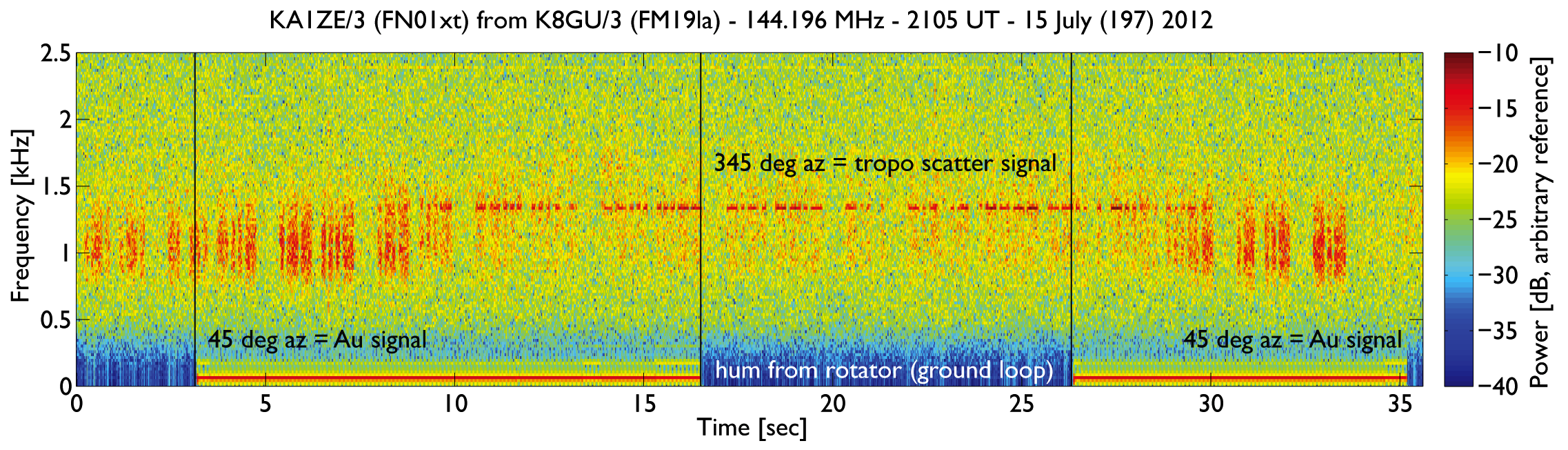
There are lots of interesting details here. First, you can see that the auroral scatter is both Doppler-shifted (lower in frequency) and Doppler-broadened (spread out from the central frequency) compared with the direct tropo scatter signal. Second, you can see the ground-loop-induced hum at the low-frequency end. Auroral backscatter comes from field-aligned plasma density irregularities embedded in the auroral convection flow. Because most readers will be allergic to the vector math, we make the (somewhat gross) approximation that KA1ZE and I are transmitting and receiving from the same location. Now, we can take a stab at estimating the flow velocity from the following equation:
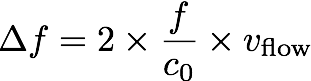
Where delta-f is the Doppler shifted frequency (about 300-Hz from these data), c0 is the speed of light (300,000,000 m/s), f is the carrier frequency (144 MHz), and vflow is the flow velocity. While we’re making approximations, if we round f up to 150 MHz, the twos cancel and we get the Doppler shift of 300 Hz corresponding to a flow velocity of 300 m/s (670 mi/hr). Fast! Because it is lower in frequency than the direct signal, we can also infer that the flow was directed away from us.
There you have it! Science fair projects with your ham radio.
Are you a gambling ham?
The Good News
TAPR have opened up the shop for Hermes SDR customers.
The Bad News
The transceiver is set to cost around $1000 with no real warranty. If you want one you’ve got until the 25th to place an order. After that its not going to happen.
Hermes is the next generation SDR developed by hams from round the world and when I originally saw one I immediately felt my jaw hit the floor. The receiver was excellent and the whole thing was very versatile. TAPR have long supported the project from what I can see but the terms and conditions leave a lot to be desired. Initial estimates have increased a touch and that’s ok with me. There are always additional costs which may not have made it into the original estimate but as unit without any form of safeguard that it would turn up working at your doorstep I find it underwhelming. In fact I’m not even sure it is legal to supply goods to the UK where the buyer takes responsibility prior to it being received. Caveat Emptor indeed.
The rig has a list of features that rival the outstanding Elecraft K3 and whilst the power output currently isn’t the same and no doubt the operating form factor does not appeal to everyone it does offer something different. The unassuming silver Hammond case I saw at the recent club meeting gave little in the way of clues as to what was going on inside and its definitely not a rig for those who like to wield a soldering iron. But, it is a rig for those who are into SDR or who want to get into the bleeding edge of technology without shelling out multiple thousands of pounds for huge desktop devices that are equally at the bleeding edge but in a different form factor.
So the choice was to gamble a grand on something I really wanted in what would need a PA of sorts to compliment it further and turn an excellent rig into a world class station. Or to save selling my existing rig ready for the upgrade and putting the money to one side and hope that TAPR can offer it with a slightly less roulette wheel approach. I’m not a gambling man, especially with so much money.
To say that I’m gutted is an understatement. I have waited quite a while since seeing prototypes in one of the key project members shacks. Seeing one just a couple of weeks ago watching one in action at the club just added fuel to that desire. Unfortunately, that desire has been stamped on by some unacceptable terms and conditions. Imagine parting with the cash only to find your rig doesn’t work and you can only partially claim compensation from a shipper if you can prove they were at fault. I suppose the IC-7000 will be on the desk for a little while longer.
June 6 and 10 report and other bits
Martin Harrison, G3USF has sent me the June short form report from the 6 and 10 club. It is available at the usual place, here. I trust you find it useful.
Personally I have barely touched the rig over the last couple of weeks. What with a broken PSU and a phenomenally expensive replacement switch that cost me more to put it in the post than the switch itself. The cheeky monkeys also sent it second class post so they made a tidy profit on sending it as well as on the switch. Hmmmmm.
Once I’ve got the PSU fixed, hopefully this weekend then I’ll be back up and running fully, just in time for the poor band conditions I’m reading about.
On another note I’ve had a wrestle with the Raspberry Pi as have a few other hams and its been tough going. Being a computer half wit I can’t really programme so I’m attempting to convert the little knowledge I have into making applications like Xastir run on the RPi. I’ve managed that but can I get the maps to work. Well simply, no I can’t. Still as a digipeater it has the potential but it needs a bit of extra hardware to accept audio in. Currently the board does audio out but not in. I expect that as time does on the platform will get developed further and bits and pieces will be produced in a similar fashion to the Arduino. At the moment its a bit like the wild west.
I should really spend the time fixing the PSU rather than playing with the RPi. That reminds me I need to fix the bike as well.













