Archive for the ‘radio’ Category
 Lighter yagi’s
 September 4th, 2012 |
  Author:
 Over the summer I managed to ‘do’ 2 out of the 5 available 2m Backpacker contests. These to me are a great opportunity for me to get out on the fells and enjoy a longer spell on a summit with a nice qrp rig and some simple gear. The trouble with contesting is that inevitably you want to do better. So what’s the likely areas for improvement. Well there’s the rig, coax and antenna.
The rig is an ft817 and its not going anywhere fast. I sold once once then instantly regretted it. So it’s not going to be changed in a hurry. Yes it has its problems but frankly it just works and is relatively light so its a keeper.
Coax…Hmm work in progress. RG213 is too heavy, Ecoflex just isn’t flexy enough for summit packing. I’m yet to find the ‘perfect coax’. I’m leaning towards a trial with some Messi & Paoloni Ultraflex 7 as I like Mini 8 as a size but am looking for perfection here kids. This just means a reduction in losses to something as low as reasonably practicable as the saying goes
Antenna. Well I do like my now obsolete Sotabeams SB270 ( A 3 element yagi that lives inside its own plastic boom). Its light and doesn’t get thrown about too much in the wind and has lasted years. Trouble is it’s looking a bit knackered now and 3 elements is a bit short. I bought a 5 element LFA off innovantennas years ago and was really disappointed with the build quality. The elements just weren’t secure enough and it was way too heavy. Too heavy for a UKAC /p so no good for a summit. But it is well designed and the elements are quite light.
So the plan is to change the coax. I’ll do that over the winter. In the mean time I’ve taken a few grams off the yagi.
The boom was very substantial 32mm2 2mm thick Aluminium (note spelling you stupid browser ;-)). The boom weighs in at 1150g as is.Swapping this for 20mm2 1mm thick boom I’m down to 560g. Roughly half the weight. Element clamps have been swapped for the G1YBB method of IML mouldings plates and cheapo pipe clamps

You can see the immediate difference in size. The original beam is clearly made for sticking up at home then forgetting about it, ignoring the defects with this particular one.
Now with the elements added. They simply snap in to the pipe clamps and are held in place without any bother.

We’ll see how easy it is to carry up the Old Man of Coniston next year but at 1240g it is nearly 500g lighter than the original with the same RF performance.
I bought 2 pieces of aluminium and have a larger 2m and 70cm DK7ZB yagi that needs the same treatment (I went the other way this time, it was too light and flimsy) that I’ll give a run out during the Christmas Cumulative content
Portable in Devon
The summer here in the UK may have been the home of the Olympics and Paralympics, in fact I’ve just worked 2O12L, the special event station for the Paralympics. But one thing over everything else has dominated every Englishman’s mind. Just exactly how wet and miserable has the summer been. As I write this it is chucking it down again and the temperature is sliding towards ‘Autumn’. I can confirm that not all the UK is under water, all the time.
That said I have had a lovely week in a small village in Devon called Instow. We rented a small house opposite the beach and did the usual things with the kids. Sand castles, ice creams and cream teas as well as a bit of body boarding (for the kids, not me. I didn’t manage to get a surf board out but that’s probably a good thing). I did manage to sneak in my FT817 and Prowhip antennas fishing rod antenna into the car before the XYL spotted it.
Not many contacts to add into the log but it was nice to hit a US special event station W9IMS in Indianapolis with just a couple of watts. Perhaps it was the overly relaxed operating position.

The pursuit of The Elser-Mathes Cup
 The story of the Elser-Mathes Cup may be familiar to many of you. For those of you who are not in the know, you can get all the details from the article by Fred Johnson Elser, W6FB/W70X, in the November 1969 issue of QST. To summarize, the establishment of the Elser-Mathes Cup in 1929 was directly inspired by the leaps and bounds up to that point in radio technology combined with Hiram Percey Maxim’s fascination with the planet Mars. The cup is to be awarded in recognition of the first amateur radio two-way communication between Earth and Mars. I would bet that the cup’s initial establishment was somewhat tongue-in-cheek. Although Fred Johnson Elser’s QST article, on the tail of the success of Apollo 11, gave the cups existence and purpose a good deal more veracity.
How close are we to finally awarding the Elser-Mathes Cup? Lets look at some recent milestones:
Earth-Moon-Earth Bounce
In January 1953, Ross Bateman, W4AO, and Bill Smith, W3GKP successfully bounced at 2M signal off the Moon.
Signal reception of Voyager 1

On March 31, 2006, German radio amateurs successfully received transmissions from Voyager 1 which was already well outside the Solar System (~7,436,464,581 miles away from Earth).
Earth-Venus-Earth Bounce

On March 25, 2009, German radio amateurs achieved another first by bouncing a 2.4 GHz CW signal off of Venus – which at its closest point to Earth is a mere 24,000,000 miles away and 162,000,000 miles at its furthest.
Earth-Mars-Earth Bounce?
Mike Brink, ZR6BRI, has definitely done his homework to show the feasibility of radio amateurs bouncing a signal off of Mars (which has a distance from Earth that varies from 36,000,000 miles to 250,000,000 miles).
However, bouncing a signal off of Mars will not win The Elser-Mathes Cup. The amateur contact must be two-way.
 Could the Mars Science Labratory (Curiosity) fulfill the role as the second party of an amateur QSO?
Curisoity does have UHF communication capability. One of Curiosity’s antennas is nicknamed “Big Mouth” and is used to send large data sets to one of three orbiters around Mars: the Mars Reconnaissance Orbiter (which will probably do most of the work), Mars Odyssey Orbiter, or the European Space Agency’s Mars Express orbiter. The orbiter then relays the data via the Deep Space Network (DSN) back on Earth using X-Band.
“Big Ear” is Curiosity’s high-gain, directional X-Band antenna that can be used to communicate directly with the DSN on Earth. “Little Ear” is an omni-directional, X-Band antenna that is designed to be used primarily to receive low data rate transmissions from the DSN.
Putting aside the fact that Curiosity’s X-Band frequencies are outside the authorized US amateur frequency allocation and given the German amateurs success with Voyager and Venus – amateur communication with Curiosity looks possible (but probably not with my Arrow II antenna).
So, if it is possible for Joe Amateur (along with a heap load of expensive gear) to have a QSO with Curiosity – what would prevent the actual hacking of Curiosity?
Damon Poeter’s August 9th article “How to Hack NASA’s Curiosity Mars Rover” takes a look at this proposition. Mr. Poeter all but dismisses the possibility of a private citizen contacting Curoisty and instead focuses at actually hacking through NASA’s control system. Then on August 10th, Mr. Poeter submits “Unknown Actor Soliciting Partners for Mars Rover Hack”. Now, possibily, there are individuals who are actually trying to hack their way through NASA by soliciting help in determining what frequencies are used to communicate with the orbiters above Mars.
Here on an IT secuirty forum, a question is asked concerning the secuirty of Curiosity. One of the responses is from a former controller who is somewhat familiar with NASA’s general communications protocal with spacecraft and identifies the transmission of bogus communications to Curiosity as a possibility. Although the post’s author identifies that the capability to conduct such an act would have to be another country (…. and everyone loves pointing the finger at China).
It is easy to forget that radio amateurs have been intercepting space communications for sometime, with Sputnik’s signal on 20.007 MHz and Apollo 11 communications being primary examples.
All this being said, I think The Elser-Mathes Cup will continue to gather dust for a bit longer.
KH6 – Hawaii Bound
 My current assignment at Fort Leavenworth has me traveling quite a bit. My intent has been to bring a rig with me and have some casual QSOs while on the road. My success has been mixed. I would mostly attribute this to either a lack of planning on my part or being in a stuck in a hotel room with zero antenna opportunities.
One of the most inspiring ham radio blogs I ever ran across was the 100 Pound Dxpedition. I enjoyed how Scott, NE1RD, covered his adventures of conducting portable operations… documenting what worked and what did not. His last post on that paticular blog was back in 2007, but I still use the site as a reference. Scott’s praise for the Buddipole led me in using the Buddipole during my recent tour in Korea. Another tip from Scott I am going to try out is using a hardside golf bag case to transport my Buddipole to Hawaii.
 Now for a rig… I think the Elecraft KX3 would be ideal for a Hawaii trip. With 10 watts output and an internal battery, I can’t think of better rig to take to the beach. But the wait time for the KX3 is still quite a while. I have both an Elecraft KX1 and a Yaesu FT-817ND. The KX1 would be great due to its small size and ease of use. But it is limited to only CW and I would like to do some PSK in addition to CW.
I pulled out my FT-817 and conducted an inventory:
- – West Mountain Radio RIGblaster Plug n Play connects directly to the DIN socket on the back of the rig.
– CAT cable that connects from the RIGblaster to the rig’s ACC socket which enables rig control.
– PowerPole 12v adapter.
– Palm Paddle.
– Elecraft T1 Auto-tuner.
– Nifty manual for the FT-817.
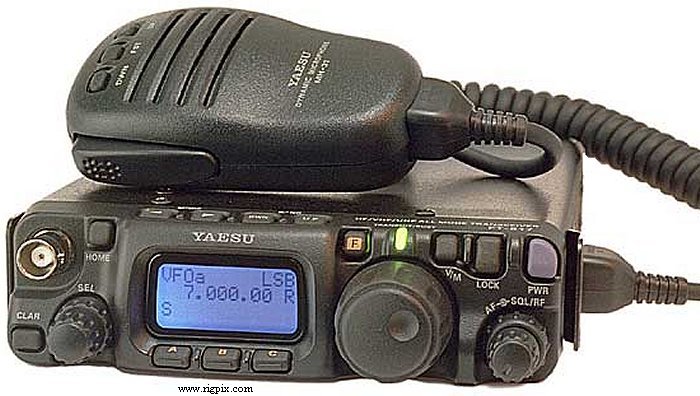
My FT-817 has quite a few of the optional bells and whistles from W4RT:
- – DSP module
– Kranker Knob – probably the most useful of any of the options
– One Board Filter (300 Hz)
– Speech compressor built into the MH-31 handmike
– Why all the options? The FT-817 was the center piece of my 2009 Field Day setup and I was attempting to get the most I could out of the pint-sized rig.
I also splurged on two recent upgrades:
- – Peg Leg tilt stand – I think this will be helpful as one of my significant dislikes of the FT-817 is the small display which is hard to see.
– Magnets for the Palm Paddle – this is critically important as the Palm Paddle by itself is not heavy enough. The magnets allow the Palm Paddles to firmly stick to the top of the FT-817.
For PSK, rig control, and logging I have my Dell Mini netbook. I had not used the netbook in a while, so I started it up to see how it was working. I initally purchased it back in 2009 baselined with Ubuntu and have kept Ubuntu installed on it since then. After booting it up. I updated the distribution to 10.04 LTS and installed fldigi. The RIGblaster easily interfaced with the netbook via a USB connection and the headphone/microphone jacks.
I configured fldigi to work with the RIGblaster to include rig control using Hamlib:
- – Audio: PortAudio using the netbook’s hardware soundcard for both Capture and Playback
– Rig: Hamlib; Device /dev/ttyUSB0; Baud rate 38400; Stopbits 2; PTT via Hamlib command checked
… clicked on the Initialize button and I was good to go.
Setting up the macros on flidigi is pretty straightforward with the default macros only needing slight tweaking for my personal preferemces.
Once I fired everything up all I had to do was switch to 14.070 MHz, switch the mode to DIG, and drop the input level a bit. With the narrow yellow PSK streams cascading down the waterfall, I picked one that was calling CQ and answered. Transmit worked and my home antenna provided a nice low SWR, no need for the tuner. My macros worked and the QSO was concluded successfully. All with 5 watts.
I plugged in the Palm Paddle, switched to 7.115 MHz, listened and heard nothing, then used the paddles to send QRL? a few times. SWR still looked decent. After a few CQ calls, I got an answer followed by a short QSO. Great – both PSK and CW were working FB.
Now the question is: do I want to bring my small Tokyo Hy-Power HL-100B amplifier that will raise the output to 100 watts? If I bring the amp, I will have to bring a power supply and a different tuner. I am thinking I need to be able to use two different configurations:
- (A) Beach and Buddipole: using the barefoot FT-817, running everything on batteries.
(B) Lanai Portable: used from the hotel room, with amp and assoicated power supply.
Now it is time to go through my Buddipole bags and figure out what I need to pack.
Looks like I will be there during the Hawaii QSO Party!

Trail Radio
Ham radio and trail hiking have been a natural pair. There are a few hams (that I know of) who have stood out over the last few years in hitting the trails with their amateur radio gear.
 The first is Ed, WA3WSJ. He has been out on the Appalachian Trail (or AT) numerous times and has brought along a minimalist setup to get on HF and make some contacts. Chances are that you have heard of the Appalachian Trail – it streches from Georgia to Maine and allows an individual to hike from start to finish.
 Ed’s an advocate of pedestrian mobile (WA3WSJ/pm) and has published a few books that tells of his experiences and offers advice for those interested in following his footsteps. He also has established the Great Outdoor Radio Club, which offers resources to avid and aspiring radio trail men.
Another amateur radio hiker is Dennis, K1YPP. He actually completed the Apalachain Trail and also wrote a book on his expierences. Hiking from one end to the other involves reducing the backpack weight as much as possible. Dennis successfully used QRP rigs during his time on the trail.
Here is a podcast of two hams who discuss hiking the Appalacian Trail, including the use of amateur radio (ham radio) and QRP (low power, less than 5 watts) along the way. From the series at Atlanticon 2006 in Timonium, MD.
The APRS folks also are involved in activities on the Appalachian Trail (check out here and here).
 Heading west, the next major trail is the Continential Divide Trail. The trail goes from Mexico to Canada and spends a good portion of its time following the Rocky Mountains. Although not a dedicated Continential Divide Trail hiker – Steve, WG0AT, has spent plenty of time in the Rocky Mountains making amateur radio contacts. Steve’s take on hiking is a bit different as he brings two goats with him that help carry the equipment. If you have not seen his Youtube videos, then you are missing out.
Bob, K0NR, is also active in the Rockies… having most recently participated in a unique ham radio event – The 14er. Paul, W0RW, is an pedestrian mobile ham who has taken to the mountains to log contacts. However, I do not think either Steve, Bob, or Paul have actively hiked the Continental Divide Trail along with their rigs.
 Further west is the Pacific Crest Trail. I was curious to find that not many hams head to the Pacific Crest Trail for hiking and QRP work either. There is a repeater guide by Bill, AA6J – but I am not sure how much of the trail he has hiked or if he brought any HF gear. The only ham I can find that has attempted the hike was Bruce, N7RR. It also looks like he did not make it all the way. Being a Californian, I am surprised that more west coast hams have not hit the trail along with their HF radio gear.
Have you had a QSO with a ham on the Appalachian Trail, Continental Divide Trail, or Pacific Crest Trail?

How do you feel about the idea of packing up a rig and heading for the mountains?
Lank Rigg
For the first time in many months the weather and workload was just about right to get out on one of the local fells for a ‘quick’ activation. I say quick because that was the plan but it didn’t really pan out that way.
Lank Rigg is a fairly unassuming fell not too far fro the cold fell road near to Ennerdale Bridge. I cycle past it very often but so far it hadn’t shown itself as somewhere to go for a summit activation. I only had the morning to play with as I had committed to going to the club to help sort out our shack which is creaking under the weight of under use. I managed to get this rare shot of some sun shining somewhere where I wasn’t – the sun does exist after all!

Approaching the fell from the fell road is easy enough and I only had the company of a few sheep and slugs on the way to the summit. A bit of mist on the summit cleared then re-appeared with vengeance so after some longer QSO’s I headed off down the direct route rather than following the valley between Lank Rigg and Whoap which forms the easy route. This was supposed to be quicker but turned out to be significantly longer due to the amount of water in the beck at the bottom. Heavy rains hadn’t fully cleared and I chickened out of the crossing as I was fairly sure that the volume of water could have knocked me over if I wasn’t careful. So having made my bed I had the follow the route all the way to a footbridge and walk back up the road. Several miles of detour.
So, today’s summit activation lesson is, watch out for becks that need bridges or pack some waders if you’re feeling brave. Otherwise enjoy the longer walk back to the car and see parts of the valley you wouldn’t ever expect to see.
St. Joseph, Missouri – The Patee House
This past Sunday, we decided to take a small trip north to St. Joseph, Missouri. St. Joe is full of history and one of my favorite places to go there is the Patee House Museum. Two parts of the museum I enjoy the most:
(1) A railroad telegraph office with a nice collection of telegraph keys


(2) An amazing display of vintage radios as well as an old amateur radio station


Julius B. Abercrombie, W0NH (ex 9NH) was a member of the Old Old Timers Club and first got on the air back in 1906! It looks like Julius was one of the original Midwestern Big Guns.
I really enjoyed his collection of convention pins (…open the image below to see the details of the pins)














