Archive for the ‘radio’ Category
 All it needs is a title
 September 28th, 2012 |
  Author:
 I found this on a scrap piece of paper at the club last night. Being a bit thick and not knowing what it was for certain I asked a few people and the response was fairly consistent.
‘Its a…errr…y’know…..that you know used to do as kits for err’
Obviously I wasn’t the only one who was a little stuck. Well I don’t know what it is exactly, but I can have a few guesses – I’ll nail my colours to the mast and suggest it is a current meter of sorts. Anyone else care to join in the guesswork with more confidence? It took me long enough to find out what brass treblet tube is!

Ultimate QRSS kit
The kit building is carrying on at my garage before the cold weather comes and means that it’ll be less than appealing to go in there. This time it is a seemingly simple kit from Hans Summers, G0UPL called the Ultimate QRSS kit. Ultimate because presumably the kit does more than QRSS, however the kit is essentially a QRP (~150mW) beacon transmitter for QRSS and other modes, the attraction for me is that it also generates the tones for WSPR and as well as offering the QRP transmitter it also has the ability to generate just the audio for use with another transceiver. I was drawn to it because it offers the opportunity for a little bit of experimentation. Although things haven’t quite gone as smoothly as I’d hoped for.
The list of features for such a price is quite impressive. This is taken directly from Hans Summers’ website (http://www.hanssummers.com/qrsskitmm.html). Which is well worth a visit if not for this kit.
The kit supports the following modes:
– QRSS mode (plain on/off keyed slow CW)
– FSK/CW mode (frequency shift keyed slow CW)
– DFCW mode (dual frequency CW)
– WSPR mode (Weak Signal Propagation Reporter)
– Slow-Hellschreiber (frequency shifted slow-Hell)
– Full-speed Hellshreiber
– Half-speed ("DX") Hellshreiber
– CW (plain CW)
– Customisable FSK patterns
Other features:
– 24-character LCD + two-button user interface
– User-programmable (callsign, message, speed, FSK, mode, etc.), settings stored in EEPROM
– GPS interface, for locking the frequency in slow-speed modes
– On-chip generation of WSPR encoded message (no PC required)
– WSPR maidenhead locator can be generated from GPS-derived latitude/longitude
– Selectable “frame” size, for stacked QRSS reception
– Plain CW callsign identifier at selectable interval
– Produces 150mW RF output, or AF output for driving an SSB transceiver
– Higher output power by additional PA transistor and/or higher PA supply voltage
My 30m version has been sat on the shelf whilst the good weather (ahem!) was continuing. This came to head over the weekend when I warmed up the soldering iron and started piecing it all together. The kit took a few hours to build and I would image that a skilled builder would have it all together much quicker than I could with the excellent instructions.

Unfortunately on powering up things haven’t exactly gone according to plan. It only seems to power when it fancies it and certainly doesn’t generate the tones as you might expect although I am receiving a carrier roughly in the right area. The other small issue is that the LED doesn’t appear to do anything visual, this may be a design feature but seems a little bit odd to me.

All these faults are almost certainly a result of my work, not the kit although it didn’t help having to scratch off the solder mask from the coil connections. I think the fault finding will take longer than the building in this instance but with a bit of luck it will involve some learning and there is no harm in that.
Still where’s the fun in it working first time?
A couple of 6 and 10 reports
Martin Harrison, G3USF has collated a couple more 6 and 10 reports which he’s passed on to me. They are available at the usual place (here). Any feedback is always welcome so please don’t hesitate in getting in contact if you would like to add anything.
Digital SWR meter final adjustments

Here’s the finished digital SWR and power meter kit from Radio Kits that is being used by the Workington Amateur Radio Club as a bit of soldering and coil winding practice. Not the poor lining up of the LCD screen. Shame really as the soldering was one of my better bits and that’s going to be covered up. All in all a nice kit to put together, I’m no soldering super star and I took my time so instead of it bring an ‘evening’ kit it I’d more like a ‘weekender’.
Deep breath….and relax
2 months to supply a switch, 2 months!
My PSU has a faulty switch (as diagnosed by a telephone conversation with a the suppliers service dept). Ah ha a replacement should fix that sir. Great, well I can live with the mark up if it turns up quickly and I can get back on the air.
A completely different switch was supplied. Several conversations and apologies later a second one was despatched, second class. Again different and again returned. This so far has taken 2 months and a lot of chasing on my part.
I felt a ‘snot-o-gram’ was needed, one was crafted and sent yesterday evening. Today I received a phone call and more apologies after then being passed around 3 people the last person told me to de-solder the one they are going to send to me and re-solder the wires on the switch of mine that they have. Good quality British customer service.
Would it not have been easier to say this 2 months ago?
I will now be taking some deep breaths.
The case of the ……
Well Dr Watson, its wobbly metal.
Enough of the Tom Foolery and down to the serious business of an issue that must be fairly common. Drilling larger diameter holes in flexible metal sheet generally found on hobby cases. Just in case you were wondering though Tom Fool (aka Tom Skelton) is apparently a ghost of a Jester at our local castle, Muncaster so here’s hoping he’s had plenty of opportunity to wander round the house and grounds with odd shaped holes in his thin sheet metal parts.
A lot of trouble I have with when its time to put a project in a case is that the 16mm hole needed for an SO239 for example causes me no end of trouble. I have tried a number of different ways to make the holes without giving a figure of 8 or elongated hole. Step drills tend to give slightly better results that piloting and increasing the bit size. I have found that the latter can easily end up with a poor hole if any vibration is imparted into the case.
So what’s the answer, well, I just don’t know. Punching would seem to be a better solution as would routing the holes but in the case of pre folded sheet I’m sure this isn’t too practical. I’m wondering if people have had better results with other ways of making these holes.
The Birthplace of the Wind
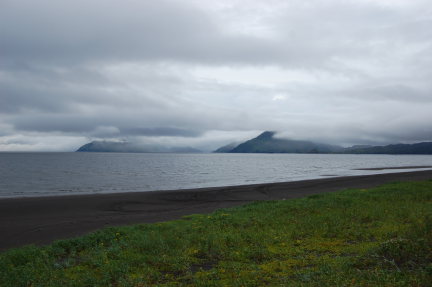
I recently had the good fortune (Sarah and some Alaskan friends might question the use of the adjective “good”) to spend about 10 days on the Aleutian island of Adak for work. In the midst of preparing for the trip, I learned that my fellow travelers Kevin, KJ4OAP, and Nathaniel, W2NAF, were planning to bring ham gear. Of course, I was as well, so we ended up with quite the merry bunch of hams on Adak. I don’t collect IOTAs, but I know it’s popular. So, I checked out Adak Island in the IOTA directory—NA-039, Andreanof Group. Fewer than 20% had claimed it, so it’s not super-rare, but not super-common, either. I was assured by at least one friend that we would be very popular, especially in Europe.
One of the first things you notice about Adak when you get off the plane is the wind. In fact, the locals call Adak “the Birthplace of the Wind.” It’s actually quite poetic considering that the winds are so strong that you don’t leave furniture outside and that the houses shudder with typical gusts. I experienced 75-mph gusts and 60-mph sustained winds during my short visit alone.
Adak is probably best known as the forward base from which the U.S. conducted its counteroffensive against the Japanese invasion of Attu and Siska during World War II. It also played an important role during the Cold War and although the military left some 10 years ago, it retains much of the infrastructure including heavy machinery, a port, and a large airport. The population shrank rapidly from a peak of just over 6000 in the 1990s to around 150 today. Just before the military (principally Navy) pulled out, they were in the process of building new base housing. The housing was completed nevertheless and so there are literally dozens if not a hundred homes that have never been occupied! Some of the others have been converted into a small hotel (this is where we stayed).
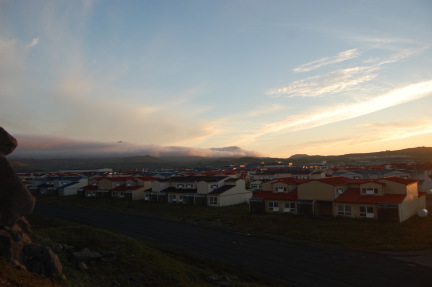
The economy is heavily dependent on fishing and fish canning right now. However, the locals are excited about the possibility of becoming a logistics hub for oil and gas work in the Bering Sea. In fact, the aircraft I came out on (An Alaska Airlines 737-400) had an unprecedented 60+ passengers on it because executives from an oil company were coming to check the place out.
Alaska Airlines operates “regular” flights twice per week.
Due to a fiction of time zones, Adak is only one hour behind Anchorage, despite being some 27 degrees west. So, sunrise and sunset are both very late in local time. It is also very far south, about the same latitude as Vancouver. Although I arrived at 6:30 pm, it was still light out for almost another four hours. So, I quickly put up the vertical on 20 meters just before sunset.
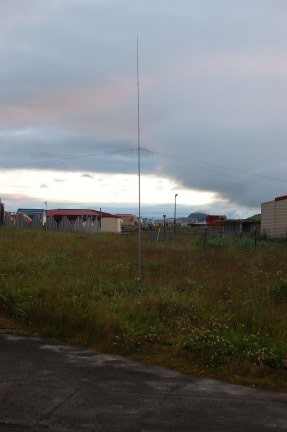
While we were putting up the vertical, Nathaniel met Jeff, KL2HD, who happened to have flown in on the same flight as us and who also happened to have his office and station across the street from my apartment. Neat. He works for U.S. Fish and Wildlife Service and they have field sites throughout the Aleutians. They use HF to communicate with their camps. So, he just plugs into a well-installed folded dipole to do his hamming. Have you ever seen a folded dipole installed between two (yes, two) Rohn 45 towers? Intense. Wind.
Due to our work schedule (8-10 hours per day plus meals), I often did not manage to get on until 0500 UT at the earliest, and sometimes even later. But, when I did, I was greeted with a roaring pileup of the “deserving.” This elicited a little bit of mail from my East Coast friends about getting on the air earlier. It turns out, however, that for most of the trip, 20 and 17 meters were open to the entire U.S. until 0630 UT. Both the skimmers and the QSOs bear this out.
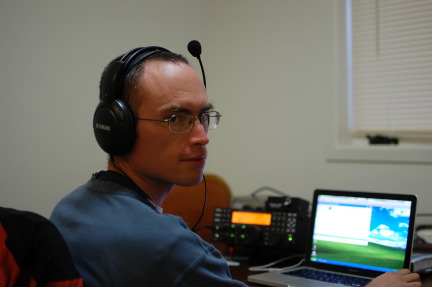
Why yes, I did get a new radio to replace the FT-840. More on this in the future.
It was pretty apparent that I had a lot of callers who couldn’t (for a variety of reasons) copy me. European friends reported a total lidfest on their end the first night I was on the air, although I learned a lot about pileup control on this trip. I have great respect for the “real” DXpeditioners who do this from the rarest locations. This was tremendous fun, though, and I enjoyed working each and every one. Thank you for calling!
There was one night on 17 meters that I CQed dead air for almost a half hour, making just two QSOs with stateside stations. And like a switch, the Europeans came in over the pole. It was incredible: I made 300 QSOs in 2.5 hours that night…mostly Europeans and Japanese.
Oh, one more photo…this is one of our rental vehicles on Adak. No, your ARES group cannot buy it. The siren and lights don’t work anyway.
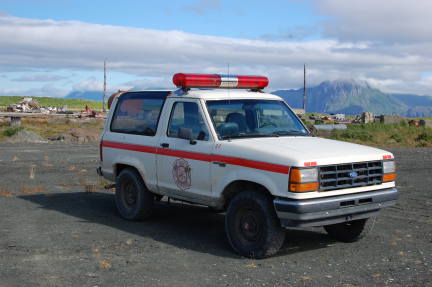
So, I got home on Monday and Sarah is amused by the amount of fan mail (QSL cards) the trip generated. Speaking of QSLing, the log has been uploaded to LoTW and has already generated about a 25% return rate. If you worked KL7/K8GU, you can get a nice photo card by sending an SASE or SAE+green stamp to my callbook address. I also use the bureau. To this point, Kevin and Nathaniel and I have been planning to share a card. They are still there for another week (so, if you missed me, you still have a chance for NA-039) and then we will figure out a card and order them. So, it will be a few weeks until cards can go out.













