Archive for the ‘radio’ Category
 Kits for the club
 July 19th, 2012 |
  Author:
 Monday night was club night
I must have been a bit tired from the long bike ride I did at the weekend but I offered to run a construction evening based on a simple kit. This was really to help build confidence in soldering and making ‘stuff’ that might be handy for the up and coming ham’s shack.
Anyone who knows me will know that I can build a kit but can’t design a circuit for toffee. So the hunt for a suitable kit began, Julian, G4ILO happened to mention at nerly the same time that a QRSS TX is available through Hans Summers which looks like a cheap and simple one to go for and a company called radio kits do a simple needle based SWR kit or a digital one.
The crucial thing is to be able to talk around the principle of operation as well as the construction otherwise the exercise is missing a trick. I’ll be ordering the bits very shortly and making sure I know they work long before I let myself in for an overly complicated explanation to a bunch of blank faces. Especially if they are wielding soldering irons.
Price is obviously an issue as the club has members with a variety of incomes, but if there are other kits about that could be made up. I would really like to hear of an 4m FM TXRX’s that can be built. For some reason most of the members have an obsession with that band. Otherwise its a suitable SSB HF rig for a long term project. First off though is the easy one. Famous last words?
Aurora 15 July 2012
I was enjoying a leisurely sweltering summer Sunday afternoon in the back yard with Evan, Sarah, two Adirondack chairs, a kiddie pool, and the schematics for an IC-290A I have on the bench. I came in to get a glass of water and while I was inside, I checked my e-mail (since I have some equipment for sale). No prospective buyers, but I did have a message from Sean, KX9X, that he was working aurora on 6 and 2 meters. I quickly plugged in the 2-meter rig and swung the beam around to the north. Sure enough, there were raspy aurora signals all over two meters. I quickly put N9GX (EN60) in the log for my first ever aurora QSO. This was at least as cool as working K5QE on 2-meter Es with 10 watts.
So, I fumbled around a drawer and pulled out a cable to connect the TS-700S to the computer and fired up Audacity. I made this interesting recording of KA1ZE/3. I started out with the beam to the NE (45 degrees azimuth) with a strong auroral buzz on Stan’s signal. Then I swung the beam around to the NNW direct path (345 degrees azimuth). I’m in FM19la and he’s in FN01xt, which is exactly 200 miles (322 km) direct path. On the direct (forward tropo scatter) path, there is still a hint of aurora, but the tone is a bit purer. When I turn the rotor there is pretty bad hum from a (not unexpected) ground loop.
In order to better visualize a few things, I ran a short-time Fourier transform (this is the actual technical term for a “waterfall”) on the audio file. I need to code-up a polyphase implementation of the FFT like that used in Rocky, but there are only so many hours in a day. Click on the image for full-size.
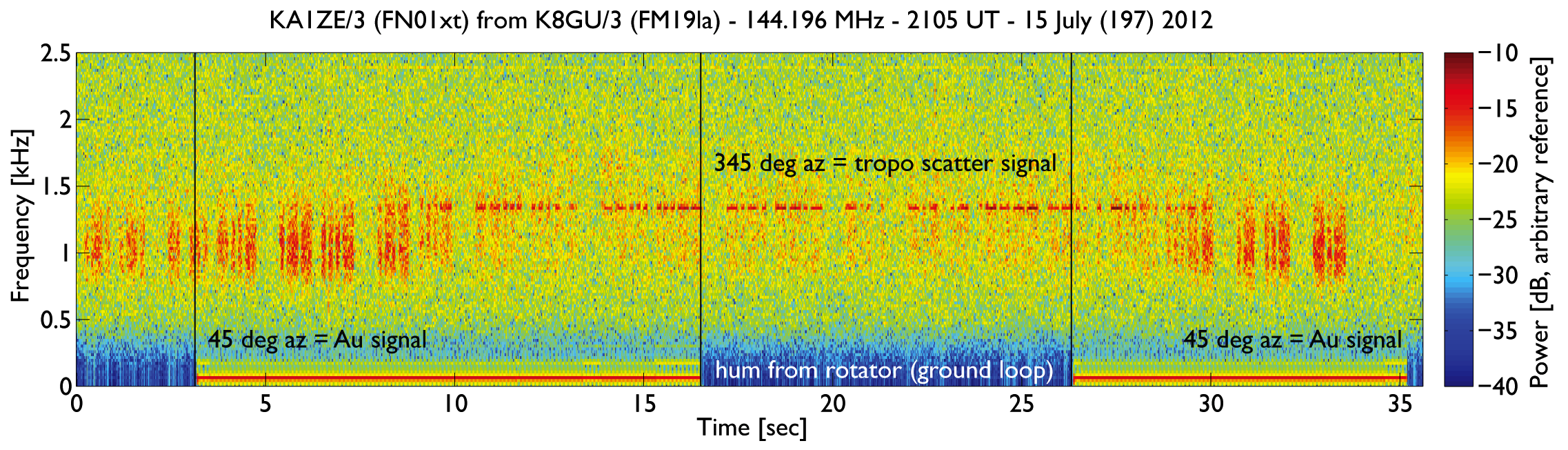
There are lots of interesting details here. First, you can see that the auroral scatter is both Doppler-shifted (lower in frequency) and Doppler-broadened (spread out from the central frequency) compared with the direct tropo scatter signal. Second, you can see the ground-loop-induced hum at the low-frequency end. Auroral backscatter comes from field-aligned plasma density irregularities embedded in the auroral convection flow. Because most readers will be allergic to the vector math, we make the (somewhat gross) approximation that KA1ZE and I are transmitting and receiving from the same location. Now, we can take a stab at estimating the flow velocity from the following equation:
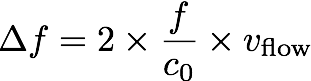
Where delta-f is the Doppler shifted frequency (about 300-Hz from these data), c0 is the speed of light (300,000,000 m/s), f is the carrier frequency (144 MHz), and vflow is the flow velocity. While we’re making approximations, if we round f up to 150 MHz, the twos cancel and we get the Doppler shift of 300 Hz corresponding to a flow velocity of 300 m/s (670 mi/hr). Fast! Because it is lower in frequency than the direct signal, we can also infer that the flow was directed away from us.
There you have it! Science fair projects with your ham radio.
Are you a gambling ham?
The Good News
TAPR have opened up the shop for Hermes SDR customers.
The Bad News
The transceiver is set to cost around $1000 with no real warranty. If you want one you’ve got until the 25th to place an order. After that its not going to happen.
Hermes is the next generation SDR developed by hams from round the world and when I originally saw one I immediately felt my jaw hit the floor. The receiver was excellent and the whole thing was very versatile. TAPR have long supported the project from what I can see but the terms and conditions leave a lot to be desired. Initial estimates have increased a touch and that’s ok with me. There are always additional costs which may not have made it into the original estimate but as unit without any form of safeguard that it would turn up working at your doorstep I find it underwhelming. In fact I’m not even sure it is legal to supply goods to the UK where the buyer takes responsibility prior to it being received. Caveat Emptor indeed.
The rig has a list of features that rival the outstanding Elecraft K3 and whilst the power output currently isn’t the same and no doubt the operating form factor does not appeal to everyone it does offer something different. The unassuming silver Hammond case I saw at the recent club meeting gave little in the way of clues as to what was going on inside and its definitely not a rig for those who like to wield a soldering iron. But, it is a rig for those who are into SDR or who want to get into the bleeding edge of technology without shelling out multiple thousands of pounds for huge desktop devices that are equally at the bleeding edge but in a different form factor.
So the choice was to gamble a grand on something I really wanted in what would need a PA of sorts to compliment it further and turn an excellent rig into a world class station. Or to save selling my existing rig ready for the upgrade and putting the money to one side and hope that TAPR can offer it with a slightly less roulette wheel approach. I’m not a gambling man, especially with so much money.
To say that I’m gutted is an understatement. I have waited quite a while since seeing prototypes in one of the key project members shacks. Seeing one just a couple of weeks ago watching one in action at the club just added fuel to that desire. Unfortunately, that desire has been stamped on by some unacceptable terms and conditions. Imagine parting with the cash only to find your rig doesn’t work and you can only partially claim compensation from a shipper if you can prove they were at fault. I suppose the IC-7000 will be on the desk for a little while longer.
June 6 and 10 report and other bits
Martin Harrison, G3USF has sent me the June short form report from the 6 and 10 club. It is available at the usual place, here. I trust you find it useful.
Personally I have barely touched the rig over the last couple of weeks. What with a broken PSU and a phenomenally expensive replacement switch that cost me more to put it in the post than the switch itself. The cheeky monkeys also sent it second class post so they made a tidy profit on sending it as well as on the switch. Hmmmmm.
Once I’ve got the PSU fixed, hopefully this weekend then I’ll be back up and running fully, just in time for the poor band conditions I’m reading about.
On another note I’ve had a wrestle with the Raspberry Pi as have a few other hams and its been tough going. Being a computer half wit I can’t really programme so I’m attempting to convert the little knowledge I have into making applications like Xastir run on the RPi. I’ve managed that but can I get the maps to work. Well simply, no I can’t. Still as a digipeater it has the potential but it needs a bit of extra hardware to accept audio in. Currently the board does audio out but not in. I expect that as time does on the platform will get developed further and bits and pieces will be produced in a similar fashion to the Arduino. At the moment its a bit like the wild west.
I should really spend the time fixing the PSU rather than playing with the RPi. That reminds me I need to fix the bike as well.
Hermes HPSDR comes to MX0WRC
Last night was club night. Its a good chance to catch up in person with the local hams and exchange bits of useful information. Normally how to fix the things I have broken, which seems to be quite a few things at present including 3 bikes, but that’s another story.
Kevin, M0KHZ came along with the view of giving us an understanding of where the Hermes High Performance Software Defined Radio (HPSDR) is. He started with a brief history which explained for us lesser mortals how the project got started and how the project team got to where they are today.
The prototype that was on display at Dayton and Friedrichshafen was fired up and Kevin showed us how the rig could be controlled over wifi and the potential of Hermes to take SDR to the next level and then further. Even though Kevin was tight lipped I got the impression that this was not the end of development
The detail is way over my head and the likelihood of me understanding these concepts fully is fairly slim but it doesn’t stop me wanting to get my paws on one. Needless to say I have approached the local financier / XYL who was less than interested so there’s more ground work needed there. The impression I got was that although there is a fairly full ‘expression of interest’ list at HamSDR (you’ll need to log in to add your name to the list) the commit to buy list isn’t yet up and orders are not likely to be taken until September. Plenty of time to save up.
SDR doesn’t fill everyone with the same excitement as it does me but its fair to say that whatever your stance you can’t fault this small project team for their dedication and know how as well as doing this not for commercial gain.
K8GU/5 Field Day 1B1Op Battery
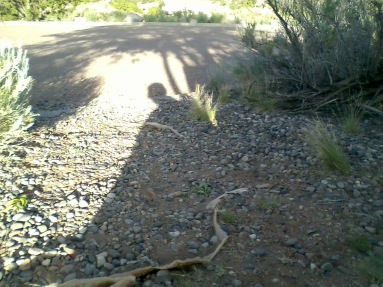
I found myself in Santa Fe, NM, for Field Day this year to attend a conference. As I have shared before, I have mixed feelings about Field Day, but this was a genuinely good time. I first checked ARRL’s Field Day finder map and the local club’s web site for activity. Zilch. So, I remembered staying at the Fort Marcy Hotel Suites on several previous visits to Santa Fe. These condos are up on a hill overlooking town. Across the street is Hillside Park, with a couple of scraggly trees that might be suitable for antennas.
Instead of bringing the “usual” portable station, I brought a Small Wonder Labs SW-40, a K1EL K12 memory keyer (assembled especially for this trip), Palm Mini paddles, a 40-meter dipole, and a AA battery pack. The whole station took up less space in my luggage than my notebook computer and set up in 15 minutes. I got the dipole center about 4-5 meters off the ground and the ends sloped down to about 2-3 meters high…just enough to allow cars and small trucks to pass under them in the parking lot. Apologies for the photographs…they were taken with my cell phone (which is a regular old “dumb” phone).
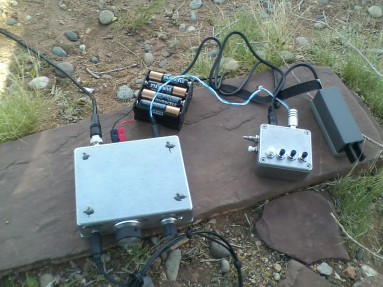
The SW-40 did not appear to be transmitting correctly when I first hooked everything up. So, I pulled the cover off (packing a Leatherman tool is another good reason to check a bag) and wiggled some wires around until it fired up. Not an auspicious sign.
But, I did manage to operate for about an hour and make 12 or 15 QSOs. They’re logged in a notebook, but I haven’t looked at it since making the contacts. Virtually every QSO was a struggle. Low power (1.5 watts), wrong band (20 meters would have been better), a low antenna, and the fact that I hadn’t used the SW-40 for any QSOs in over 10 years, conspired to make thing difficult. Most operators pulled me right out once I was in the clear and zero beat (which I think was a serious challenge with the slightly drifty and definitely touchy SW-40).
My final QSO was with my old radio club from my college days, W8FT. The operator was my good friend Bill, AD8P, who worked hard to pull me out once he got my call right. After I packed up, I noticed that I had a missed call on my phone…sure enough it was from Bill. So, I gave him a call and we talked for a couple of minutes. “When he answered the phone, he said, `New Mexico?!?! I told Kelsey (N8ET) that’s what I had copied.’” We had a nice chat as I hiked back down the hillside into town and he pulled into his driveway after his FD shift.
I don’t think I’ve ever been so delighted with a Field Day effort of so few QSOs (except maybe my first Field Day, which was much more work for about twice the number of QSOs). Including the walk from my hotel to the park, setup, tear-down, and operating, I think the whole exercise took about 3 hours, and was tremendously FUN.
What can you do?
When your PSU gives in, a replacement part costs an arm and a leg and 6m is up?
Not a lot it seems. My ft817 was hearing a lot of eastern and western European stations but with 5w max and a home made antenna you’re not going to get far despite some patient operators on the other end.
Still it was worth a go and thanks to DL5EL for letting me have more than my fair share of attempts.













