Archive for the ‘radio’ Category
 KH6 – Hawaii Bound
 August 8th, 2012 |
  Author:
  My current assignment at Fort Leavenworth has me traveling quite a bit. My intent has been to bring a rig with me and have some casual QSOs while on the road. My success has been mixed. I would mostly attribute this to either a lack of planning on my part or being in a stuck in a hotel room with zero antenna opportunities.
One of the most inspiring ham radio blogs I ever ran across was the 100 Pound Dxpedition. I enjoyed how Scott, NE1RD, covered his adventures of conducting portable operations… documenting what worked and what did not. His last post on that paticular blog was back in 2007, but I still use the site as a reference. Scott’s praise for the Buddipole led me in using the Buddipole during my recent tour in Korea. Another tip from Scott I am going to try out is using a hardside golf bag case to transport my Buddipole to Hawaii.
 Now for a rig… I think the Elecraft KX3 would be ideal for a Hawaii trip. With 10 watts output and an internal battery, I can’t think of better rig to take to the beach. But the wait time for the KX3 is still quite a while. I have both an Elecraft KX1 and a Yaesu FT-817ND. The KX1 would be great due to its small size and ease of use. But it is limited to only CW and I would like to do some PSK in addition to CW.
I pulled out my FT-817 and conducted an inventory:
- – West Mountain Radio RIGblaster Plug n Play connects directly to the DIN socket on the back of the rig.
– CAT cable that connects from the RIGblaster to the rig’s ACC socket which enables rig control.
– PowerPole 12v adapter.
– Palm Paddle.
– Elecraft T1 Auto-tuner.
– Nifty manual for the FT-817.
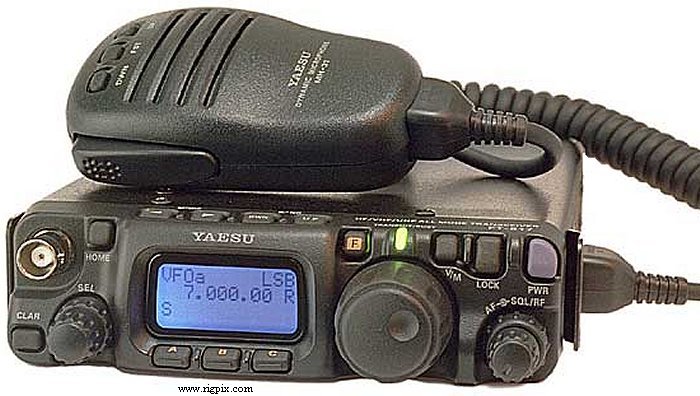
My FT-817 has quite a few of the optional bells and whistles from W4RT:
- – DSP module
– Kranker Knob – probably the most useful of any of the options
– One Board Filter (300 Hz)
– Speech compressor built into the MH-31 handmike
– Why all the options? The FT-817 was the center piece of my 2009 Field Day setup and I was attempting to get the most I could out of the pint-sized rig.
I also splurged on two recent upgrades:
- – Peg Leg tilt stand – I think this will be helpful as one of my significant dislikes of the FT-817 is the small display which is hard to see.
– Magnets for the Palm Paddle – this is critically important as the Palm Paddle by itself is not heavy enough. The magnets allow the Palm Paddles to firmly stick to the top of the FT-817.
For PSK, rig control, and logging I have my Dell Mini netbook. I had not used the netbook in a while, so I started it up to see how it was working. I initally purchased it back in 2009 baselined with Ubuntu and have kept Ubuntu installed on it since then. After booting it up. I updated the distribution to 10.04 LTS and installed fldigi. The RIGblaster easily interfaced with the netbook via a USB connection and the headphone/microphone jacks.
I configured fldigi to work with the RIGblaster to include rig control using Hamlib:
- – Audio: PortAudio using the netbook’s hardware soundcard for both Capture and Playback
– Rig: Hamlib; Device /dev/ttyUSB0; Baud rate 38400; Stopbits 2; PTT via Hamlib command checked
… clicked on the Initialize button and I was good to go.
Setting up the macros on flidigi is pretty straightforward with the default macros only needing slight tweaking for my personal preferemces.
Once I fired everything up all I had to do was switch to 14.070 MHz, switch the mode to DIG, and drop the input level a bit. With the narrow yellow PSK streams cascading down the waterfall, I picked one that was calling CQ and answered. Transmit worked and my home antenna provided a nice low SWR, no need for the tuner. My macros worked and the QSO was concluded successfully. All with 5 watts.
I plugged in the Palm Paddle, switched to 7.115 MHz, listened and heard nothing, then used the paddles to send QRL? a few times. SWR still looked decent. After a few CQ calls, I got an answer followed by a short QSO. Great – both PSK and CW were working FB.
Now the question is: do I want to bring my small Tokyo Hy-Power HL-100B amplifier that will raise the output to 100 watts? If I bring the amp, I will have to bring a power supply and a different tuner. I am thinking I need to be able to use two different configurations:
- (A) Beach and Buddipole: using the barefoot FT-817, running everything on batteries.
(B) Lanai Portable: used from the hotel room, with amp and assoicated power supply.
Now it is time to go through my Buddipole bags and figure out what I need to pack.
Looks like I will be there during the Hawaii QSO Party!

Trail Radio
Ham radio and trail hiking have been a natural pair. There are a few hams (that I know of) who have stood out over the last few years in hitting the trails with their amateur radio gear.
 The first is Ed, WA3WSJ. He has been out on the Appalachian Trail (or AT) numerous times and has brought along a minimalist setup to get on HF and make some contacts. Chances are that you have heard of the Appalachian Trail – it streches from Georgia to Maine and allows an individual to hike from start to finish.
 Ed’s an advocate of pedestrian mobile (WA3WSJ/pm) and has published a few books that tells of his experiences and offers advice for those interested in following his footsteps. He also has established the Great Outdoor Radio Club, which offers resources to avid and aspiring radio trail men.
Another amateur radio hiker is Dennis, K1YPP. He actually completed the Apalachain Trail and also wrote a book on his expierences. Hiking from one end to the other involves reducing the backpack weight as much as possible. Dennis successfully used QRP rigs during his time on the trail.
Here is a podcast of two hams who discuss hiking the Appalacian Trail, including the use of amateur radio (ham radio) and QRP (low power, less than 5 watts) along the way. From the series at Atlanticon 2006 in Timonium, MD.
The APRS folks also are involved in activities on the Appalachian Trail (check out here and here).
 Heading west, the next major trail is the Continential Divide Trail. The trail goes from Mexico to Canada and spends a good portion of its time following the Rocky Mountains. Although not a dedicated Continential Divide Trail hiker – Steve, WG0AT, has spent plenty of time in the Rocky Mountains making amateur radio contacts. Steve’s take on hiking is a bit different as he brings two goats with him that help carry the equipment. If you have not seen his Youtube videos, then you are missing out.
Bob, K0NR, is also active in the Rockies… having most recently participated in a unique ham radio event – The 14er. Paul, W0RW, is an pedestrian mobile ham who has taken to the mountains to log contacts. However, I do not think either Steve, Bob, or Paul have actively hiked the Continental Divide Trail along with their rigs.
 Further west is the Pacific Crest Trail. I was curious to find that not many hams head to the Pacific Crest Trail for hiking and QRP work either. There is a repeater guide by Bill, AA6J – but I am not sure how much of the trail he has hiked or if he brought any HF gear. The only ham I can find that has attempted the hike was Bruce, N7RR. It also looks like he did not make it all the way. Being a Californian, I am surprised that more west coast hams have not hit the trail along with their HF radio gear.
Have you had a QSO with a ham on the Appalachian Trail, Continental Divide Trail, or Pacific Crest Trail?

How do you feel about the idea of packing up a rig and heading for the mountains?
Lank Rigg
For the first time in many months the weather and workload was just about right to get out on one of the local fells for a ‘quick’ activation. I say quick because that was the plan but it didn’t really pan out that way.
Lank Rigg is a fairly unassuming fell not too far fro the cold fell road near to Ennerdale Bridge. I cycle past it very often but so far it hadn’t shown itself as somewhere to go for a summit activation. I only had the morning to play with as I had committed to going to the club to help sort out our shack which is creaking under the weight of under use. I managed to get this rare shot of some sun shining somewhere where I wasn’t – the sun does exist after all!

Approaching the fell from the fell road is easy enough and I only had the company of a few sheep and slugs on the way to the summit. A bit of mist on the summit cleared then re-appeared with vengeance so after some longer QSO’s I headed off down the direct route rather than following the valley between Lank Rigg and Whoap which forms the easy route. This was supposed to be quicker but turned out to be significantly longer due to the amount of water in the beck at the bottom. Heavy rains hadn’t fully cleared and I chickened out of the crossing as I was fairly sure that the volume of water could have knocked me over if I wasn’t careful. So having made my bed I had the follow the route all the way to a footbridge and walk back up the road. Several miles of detour.
So, today’s summit activation lesson is, watch out for becks that need bridges or pack some waders if you’re feeling brave. Otherwise enjoy the longer walk back to the car and see parts of the valley you wouldn’t ever expect to see.
St. Joseph, Missouri – The Patee House
This past Sunday, we decided to take a small trip north to St. Joseph, Missouri. St. Joe is full of history and one of my favorite places to go there is the Patee House Museum. Two parts of the museum I enjoy the most:
(1) A railroad telegraph office with a nice collection of telegraph keys


(2) An amazing display of vintage radios as well as an old amateur radio station


Julius B. Abercrombie, W0NH (ex 9NH) was a member of the Old Old Timers Club and first got on the air back in 1906! It looks like Julius was one of the original Midwestern Big Guns.
I really enjoyed his collection of convention pins (…open the image below to see the details of the pins)

OK, OK! I Will Write that Ham Radio Book!
Ever since I began writing articles about my hobby of choice–amateur or “ham” radio–for my ham radio web site and several others, people have been asking me when I was going to do an amateur radio book. The truth is, I have just been too darn busy to even think of such a thing. And I also knew, in my heart of hearts, that it be would difficult indeed to get any kind of decent book contract for such a niche book. I presented my idea of a half-fiction/half-nonfiction book to the ARRL and they passed, so that confirmed my feelings. If they had no interest, I doubted anyone else who published books would either.
Fast-forward to July 2012. Things have changed, both in my personal life and in the wild and woolly world of big-time book publishing.
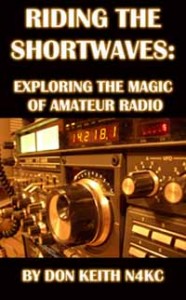
Don Keith N4KC has just published his new book of short stories, articles, advice, and more about ham radio.
First, I retired from my 60-hour-a-week day job back in May. And as I shuffled through the articles I had in the can, several more I was working on, and a few still in my head, I realized I was closer to a book than I had thought. And I truly believed I had something that would be different and could find a readership.
Secondly, as I investigated Kindle Direct Publishing at Amazon.com for the re-issue of a couple of my previous now-out-of-print books, I realized that I should absolutely pull the ham radio book together for that outlet–Kindle and some other e-book readers–at least. Amazon has become a real threat to traditional publishing companies–especially when it comes to e-books–as the old-line publishing houses struggle to figure this newfangled thing out. At the very least, it gives me the opportunity to make my book available at a very reasonable price to those interested in amateur radio. No, I don’t make much money at the price I set, even if I actually sell some downloads of the book, but that is not really the object anyway. As I have said many times, and not totally facetiously, if I wanted to make a fortune writing books, I would write pornography (See FIFTY SHADES OF GREY).
Then, as I considered other options, I realized that Amazon offers a truly unique opportunity for works like this one that allows me to offer the book in a traditional paperback format with minimal investment up front. Remember, I’m retired, on a fixed income these days! Amazon’s is a print-on-demand deal, but they seem to have it down to a science. I ordered some copies as soon as I got the book and cover uploaded and accepted for publication. The very next day I got the email that they were being shipped that day. Wow!
Again, this was with very little upfront cost and minimal hassle. Now, the paperback will be available not only via Amazon.com, but through major distributors, for order by libraries, and even in many European markets. We will see how good the print job is, but believe me on this: the major houses don’t necessarily produce the highest quality book any more either. They have to cut where they can to make a profit and printing, binding, and warehousing is a big drain on them.
Talk about rapid technological change and its effect on society and the media! Broadcast radio, TV, the Internet and telephone communications are not the only things evolving at a dizzying pace. Include the anachronistic business of book publishing in that mix, too!
Realistically, will tons of booksellers and all the Barnes & Noble stores order a box full of the books each? Or will hundreds of thousands of libraries order up a couple dozen copies each? Of course not. The big publishers do have sales staff to encourage that sort of thing. But a) no big publishing house was going to do a contract for RIDING THE SHORTWAVES: EXPLORING THE MAGIC OF AMATEUR RADIO and b) even if they did, it would be somewhere near the bottom of the sales staff’s sample case, so c) Amazon’s various self-publishing options are perfect for this kind of book.
By the way, if you have any interest in the dynamic and rapidly growing hobby of ham radio–believe me, it ain’t your weird uncle’s past-time any more!–then you may want to stop by Amazon.com and take a look “Inside the Book,” read the description, and maybe buy a copy or two…for yourself or someone you know and want to spark the interest in our amazing hobby.
See, right there in that last sentence, I did more publicity for RIDING THE SHORTWAVES than the big publishers do for most of the books they print up and ship out!
73,
Don Keith N4KC
www.donkeith.com www.n4kc.com
The new shack desk

I thought I’d catch it before it all goes wrong with too much stuff on it! The only enhancement it needs is a full size rig (or two)
A new addition to the shack
I seem to suffer with the same addiction that so many other hams have. One hand held is just not enough.
It was my birthday the other day and seeing as I’m officially really old according to my kids I thought I could treat myself to a 2m hand held that I could happily take with me when I’m out on my mountain bike (Its full suspension, which goes with my old age, apparently!). I’ve never been too keen on taking the excellent Yaesu VX8-G that is my primary summit radio. I don’t regularly come off but I wouldn’t want to come off with that in a back pack. So like many others a Baofeng UV5 was ordered through eBay. After a 3 week wait it landed on my doorstep, out of the XYL’s view and was quickly moved into the garage retreat.
The specs are well known and whilst you shouldn’t expect too much for 30 quid I was quiet surprised when I sneaked it into the car when we had a trip to Mirehouse at the weekend. Even with the short and doubtful antenna I got a good signal report from M0YDH on Robinson from Keswick.
Now then what about one for 4m?













