Archive for the ‘radio’ Category
 IARU HF 2014
 July 14th, 2014 |
  Author: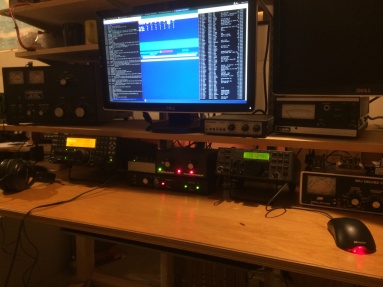
Call: K8GU
Operator(s): K8GU
Station: K8GU

Class: SO CW LP
QTH: FM19li
Operating Time (hrs): 5
Radios: SO2R

Summary:
 Band  CW Qs  Ph Qs  Zones  HQ Mults
-------------------------------------
  160:    0     0       0       0
   80:   50     0       3       4
   40:   87     0      11      12
   20:   47     0       7      15
   15:   16     0       7       9
   10:    0     0       0       0
-------------------------------------
Total:  200     0      28      40  Total Score = 25,092

Club: Potomac Valley Radio Club
Since the birth of our second child, I’ve had to become a little more creative in my approach to operating contests. There are rare days when both children are in phase with their eating and sleeping needs and we can accomplish some things, and then there are the other days. With the coincidence of the quadrennial World Radiosport Team Championship (WRTC) and IARU HF World Championship contests this year, I thought I would make a game of trying to contact all 59 of the competitors rather than maximizing contest score. The motivation for this is that WRTC was in New England this year, which is a stone’s throw away from me and middle-of-the-night operation would yield QSOs with the WRTC stations on 40 and 80.
I did end up working all 59 of the WRTC stations with their distinctive 1×1 callsigns by furiously searching and pouncing on both radios on 40 and 80. In fact, I worked most of them twice before I finally found K1T. I’m going to do an analysis of the standings of the teams versus when I worked them to test if any of the teams were better at “marketing” than others. Should be fun! Anyhow, all of these operators were really outstanding but a special congratulations to N6MJ and KL9A who seem to have run away with the whole thing operating as K1A.
In the lead up to the contest, I finally managed to get the station fully SO2R (single operator, two radio—essentially the ability to operate interference-free duplex on any pair of HF bands) again. And, in the process, I have automatic band switching again, so I don’t have to run across the basement to switch antennas. Thank goodness for small conveniences.
Here’s the mess for low-power (100 watts and less): KK1L 6×2 switch to connect two radios to any of six antennas, W3NQN single-band 200-watt transmitting filters for each band (10-80 meters shown here since I still don’t have a 160 antenna yet), and the K6KV-K8GU triplexer that allows me to share the feedline to the G3TXQ broadband hexagonal beam with both radios. All this stuff was homebrewed by me but it is all available in commercial form as well.
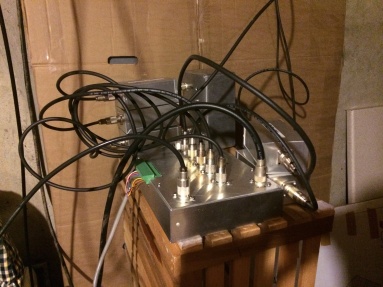
I’ve described the W3NQN filters considerably in the past, but the triplexer is new (built in March 2014) and since I’ve had some e-mail traffic from a couple of people who know I built one, I’ll probably write something up on it in the next few weeks. I mention it here because WRTC is actually one of the events that popularized the use of triplexers, which are downright freaky when you think about plugging two 100-watt class radios into a box that separates/combines the signals. Electrical engineering for the win on this one. Anyhow, I based my triplexer off the K6KV QST article from June 2010, finding some beautiful Johnson capacitors in a flea market for $5 each and using leftover toroids from the W3NQN filter project instead of the solenoid coils used by K6KV. The whole thing set me back about $30 total and it works great with the W3NQN filters, to say the least.
This was the second contest with TRLinux contest software by N6TR and W9CF. It has some idiosyncrasies, such as the effect of CAPS LOCK on the shortcut keys. For example, did you know that ALT-r is not the same as ALT-R? The great thing about it is that TRLinux talks natively with the YCCC SO2R+ box that I use to handle keying and audio switching for both radios. And, the band data is handled by the YCCC SO2R+ with TRLinux, so I didn’t have to buy a band decoder for the K2. That whole process of setting up the band decoding was another midnight oil project Friday night before the contest started. Fun and games. But, it worked flawlessly.
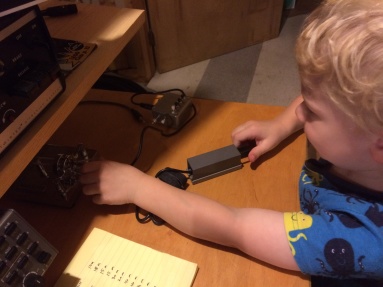
And my three-year-old son, future SO2R CW operator, rocking the Bencher and Palm paddles…”I’m doin’ lots of Morse code!”
Radio Scouts
 Radio Merit Badge Requirements
I was cleaning up the shack on Friday. Unfortunately, the shack becomes a dumping ground for “stuff” that I think I may need at some point in the future. I have a bag of RS232 serial cables. Probably have at least a dozen. 75 ohm TV coax cable and splitters. POTS (RJ-11) two and four wire extension cords. A collection of Palm Pilots with a multitude of accessories. I don’t think any pf the Palm Pilots work anymore. A vast cornucopia of audio cables and connectors. A box of WiFi routers. Computer keyboards. Etc. Etc.
So, I was cleaning and organizing the “stuff” when I just happen to come across a station calling CQ on 40M. “CQ CQ 40 Meters, CQ Boy Scouts, Boy Scouts, this is KD0VMM”. That definitely got my attention. After a short QSO I figured out that these were Scouts from a camp about an hour north near St. Joseph, MO called Camp Geiger and these Scouts were working on their Radio Merit Badge. I continued to monitor the Scout’s QSOs until I heard a bugle blare in the background. The Merit Badge Counselor got on the air and explained the bugle (which had just blown at the top of the hour) signaled an end to that hour’s Merit Badge class. Additionally, there was another Radio class that was just beginning and the Scouts would be back on the air in about 20 minutes. Sure enough, this was the case and I was able to talk to another Scout. After an email exchange with Bruce, owner of KD0VMM, he explained that another group of Scouts would be back on the air next Thursday and Friday as they were finishing up their requirements for the Radio badge.
How cool having a Scout camp offering the Radio Merit Badge! I attended Scout camp many a summer as well as even being a counselor one year, but the Radio badge was never offered as a merit badge that could be earned. What a great opportunity to introduce Scouts to radio!
 After a bit of research, it was interesting to see that back when the badge was created in 1918 it was called the Wireless Merit Badge. Then in 1923, it changed names to the current Radio Merit Badge. Requirements for the badge has evolved over the years… and most recently in 2009.
What I didn’t ask Bruce, KD0VMM, was if the Scouts had the opportunity at camp to earn the Morse Code Interpreter Strip. The Morse Code Strip is a fairly recent edition to Scouts and can be earned by:

Boy’s Life, the Boy Scouts of America’s monthly periodical, recently put up a web application called the Morse Code Machine. Looks like fun!

… as a final note, don’t forget about the Boy Scout’s Jamboree-On-The-Air (JOTA). This event occurs annually during the third weekend in October.

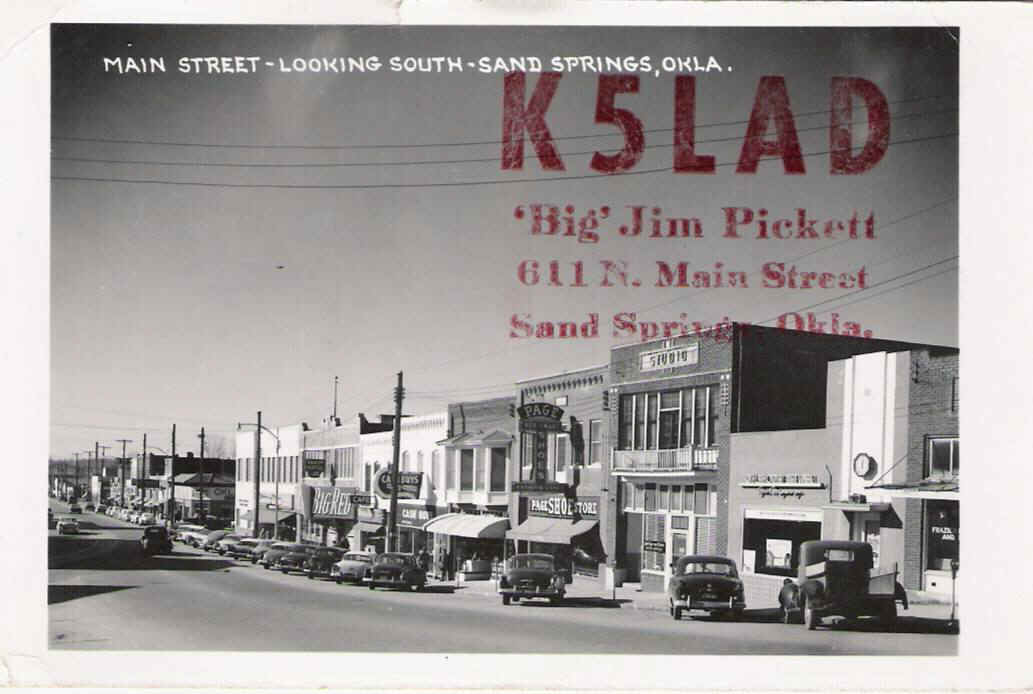
Jim’s Jumpin’ Junque – K5LAD
Two things that always pique my interest: ham tales of yore and the backstories of what led a individual to the hobby. I bumped into Jim, K5LAD’s site and found both. If you have a minute or two, dive into Jim’s “50+ Years of Ham Radio Memories” and follow his path through amateur radio. As I am reading through it, I am not sure if there is an aspect of the hobby that Jim hasn’t dabbled in.
CALLING ALL RADIO AMATEURS – THIS IS W1AW IN NEWINGTON, CT
I would suspect that if you have done even a bit of tuning around the HF dial in the last few months, you have probably heard W1AW/0-9 making contacts. This week W1AW, the ARRL mothership in Newington, CT, has been on the air as W100AW in celebration of the ARRL anniversary.
As busy as that sounds, W1AW is consistently on the air with a great variety of activities. Yesterday I took the opportunity to copy their digital modes broadcast. http://www.arrl.org/digital-transmissions
ARRL has various means of promulgating a great deal of information. The primary way I usually receive a good portion of it is via email. I thought it would be interesting if I could try and copy their digital transmission of their bulletin, which I was able to do yesterday.
Every weekday, W1AW sends out a bulletin twice a day on multiple bands while rotating through three different digital modes: Baudot (RTTY), PSK31, MFSK16. The first broadcast kicked off at 5pm (local) which I was able to copy of 17M (18.105 MHz). It appears to be ARRL’s propagation bulletin. Here is what I copied:

Please find my full copy here.
Later in the evening (8pm local), I copied the next broadcast which looks like their DX bulletin:

…. and the complete text is here.
During the 8pm transmission, I was able to copy the bulletin on 10M, 15M, 17M, and 20M. I could not find it on 40M or 80M.
Although these bulletins are easily obtainable via email or from ARRL’s website, I enjoyed copying the broadcast from here in eastern Kansas.
Build a Zork Teletype Machine
I thought this linux teletype project was pretty amazing. If you have not heard of Zork, read up here.
Are there any amateurs still running old teletype equipment for regular RTTY QSOs?
The Wouff Hong
One of the most interesting and unique artifacts from the early days of radio was not powered by batteries nor did it have any electronic components. I far as I can tell, Radio Shack never stocked it on their shelves and you can’t order it from Ham Radio Outlet.
From the 1969 ARRL “Radio Amateur’s Operating Manual”:
Every amateur should know and tremble at the history and origins of this fearsome instrument for punishment of amateurs who cultivate bad operating habits and who nourish and culture their meaner instincts on the air…
This is the Wouff Hong.
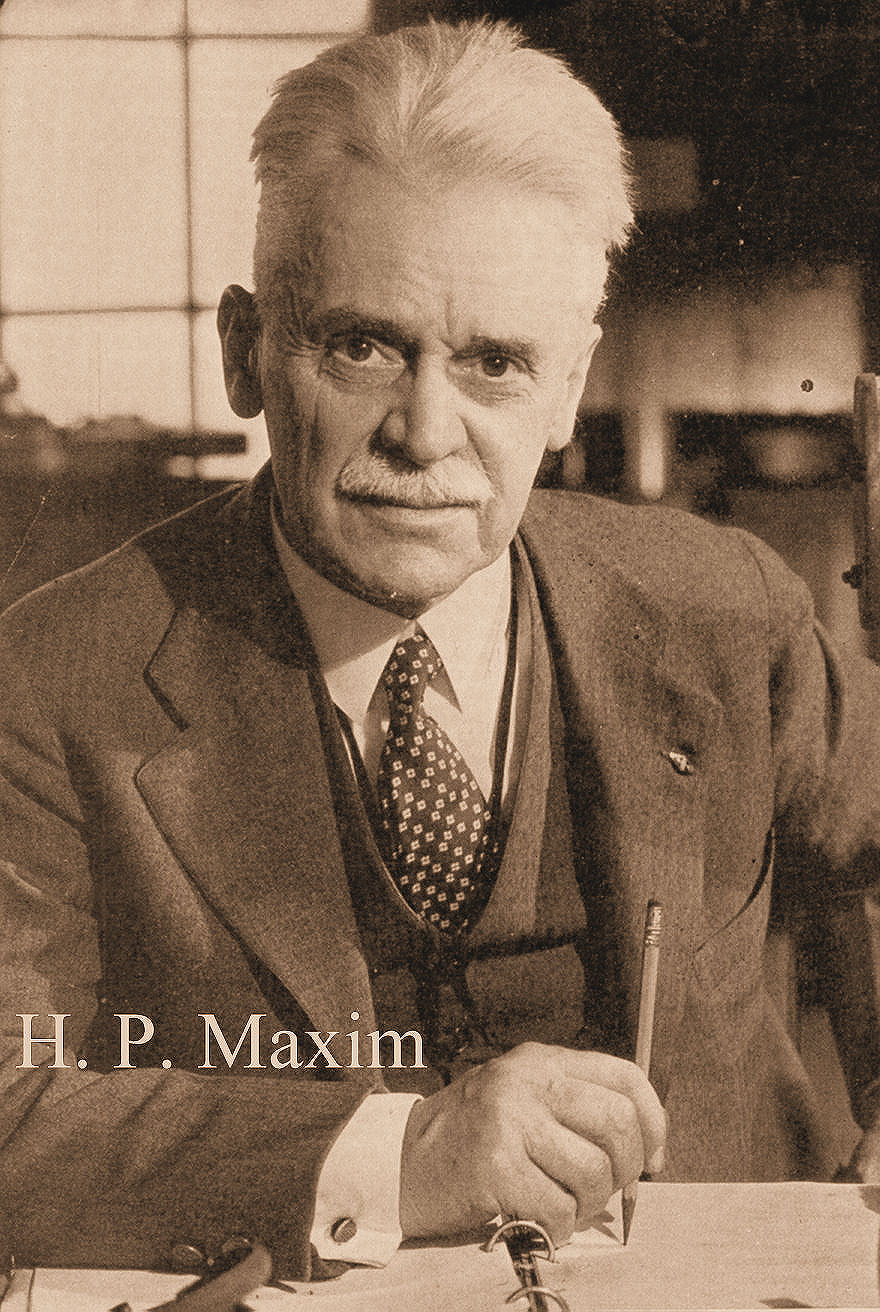
It was invented -or at any rate, discovered- by “The Old Man” himself, just as amateurs were getting back on the air after World War One. “The Old Man” (who later turned out to be Hiram Percy Maxim, W1AW, Co-founder and first president of ARRL) first heard the Wouff Hong described amid the howls and garble of QRM as he tuned across a band filled with signals which exemplified all the rotten operating practices then available to amateurs, considering the state of the art as they knew it. As amateur technology and ingenuity have advanced, we have discovered new and improved techniques of rotten operating, but we’re ahead of our story.
As The Old Man heard it, the Wouff Hong was being used on some hapless offender so effectively that he investigated. After further effort, “T.O.M.” was able to locate and identify a Wouff Hong. He wrote a number of QST articles about contemporary rotten operating practices and the use of the Wouff Hong to discipline the offenders.
Early in 1919, The Old Man wrote in QST “I am sending you a specimen of a real live Wouff Hong which came to light out here . . . Keep it in the editorial sanctum where you can lay hands on it quickly in an emergency.” The “specimen of a real live Wouff Hong” was presented to a meeting of the ARRL Board and QST reported later that “each face noticeably blanched when the awful Wouff Hong was . . . laid upon the table.” The Board voted that the Wouff Hong be framed and hung in the office of the Secretary of the League and there it remains to this day, a sobering influence on every visitor to League Headquarters who has ever swooshed a carrier across a crowded band.
The Old Man never prescribed the exact manner in which the Wouff Hong was to be used, but amateurs need only a little i
imagination to surmise how painful punishments were inflicted on those who stoop to liddish behavior on the air.
Read more about the Wouff Hong:
http://amfone.net/WouffHong/wouff.htm
http://www.netcore.us/wh/
http://everything2.com/title/Wouff+Hong
… and you can buy your very own miniature replica of the Wouff Hong in the form of a pin from ARRL. Now how cool is that?

Classic Radio Periodical Covers

Like others, I enjoy learning about the early history of radio. It gives me an idea of how far the hobby and technology has come as well as inspiring the imagination.
I found a great site, MagazineArt.org, which allows the viewer to peruse many of the covers from a variety of periodicals from the early days of the wireless.
Check out some of them here:
Popular Radio
Radio Age
Radio Craft
Radio News
The Wireless Age
Shortwave Craft













