Archive for the ‘radio’ Category
 Progress on the node
 September 17th, 2014 |
  Author:
 There’s been a bit of positive progress on the node at g7kse headquarters.
Mucking about with Echolink software proved a time consuming affair. This and that connected but not playing with each other and some absolutely horrendous noises coming out of all sort places and some shocking audio means that there is a good chance that isolation is needed. So a couple of transformers have been ordered.
Once the software is sorted on windows and I have all the hardware playing nicely I’ll move onto the RPi. I have a lot less experience with linux and image that hours will be consumed (lost) compiling and fulfilling dependencies and other joyous things that you get just installing stuff on linux. The benefits way outweigh the drawbacks. A headless and simple set up is key to a lightweight setup.
Once the odds and sods have arrived I hope to get something up and running reasonably quickly. Daniel, M6ENL and I had a quick go with it last night and it worked well enough for us it was nowhere near robust enough to be let out in the wild.
Onwards and upwards…….
p.s. The GPS on the U3 died as well so there’s that to fix too. Bugger.
MB7IAH
Today I received a very nice email from Ofcom. It was my NoV for my echolink node.
MB7IAH
Whilst I won’t be able to get it up and running this weekend because we have guests I hope to have everything up, running and ready for use early next week.
There is a restriction of 1.6w TX output using the 1/2w dipole (vertically polarised) but I’m keen to get the thing up and running. Eventually It’ll all be on the RPi but for now it might be quicker to install onto one of the old netbooks and to use that as a way of optimising audio and tx settings before going headless. There are a few restrictions on its use but they are perfectly sensible and being able to be unattended is a real bonus.
Exciting times. Here’s hoping it’ll get used by more than just me.
Echolink Node?

Over here in G (or M or 2) land echolink nodes need to have permissions from the grown ups. So I’ve sought permission from Ofcom, with the help of the RSGB. I applied for an MB7 node, which means it is can be unattended. In order to do this I needed a minimum of 4 people who are key holders so the node can be shut down quickly. Sounds reasonable? Sounds a bit British to me. Belt and braces and some more belts just for luck.
The node will hopefully be on 2m and I have been told that if it gets granted then I could expect around 2w ERP. I don’t want to sound selfish but I have only heard 2m simplex used in this area for the local net and once in a blue moon Dent gets activated by a SOTA or WOTA chap(ess). VHF in general is scarcely used and its a shame. UKAC evenings and the normally quiet repeaters with their occasional skeds excepting mean that both 2m and 70cms are dead.
What can be done about it?
Making it appealing to use, perhaps? A bit of activity always helps.
Internet link may give some users an opportunity not only with existing amateurs but could make it appealing to those on the periphery of the hobby. Makers for example.
Anyway, let the waiting begin and we’ll see where we get to with Ofcom
Custom Backshells for Cinch-Jones Connectors
What do you do to complete these hamfest bargains? 3D printing for the win!
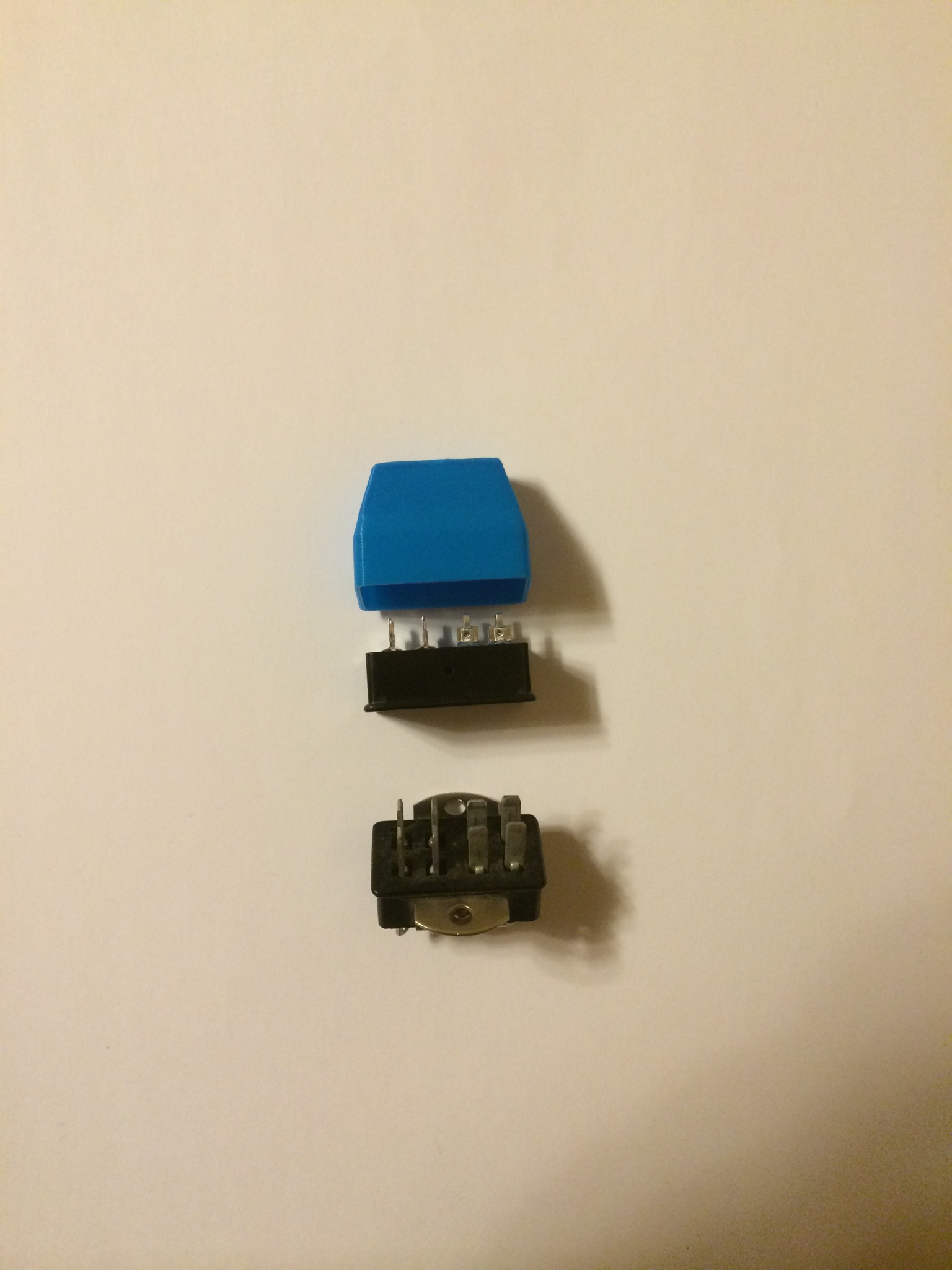
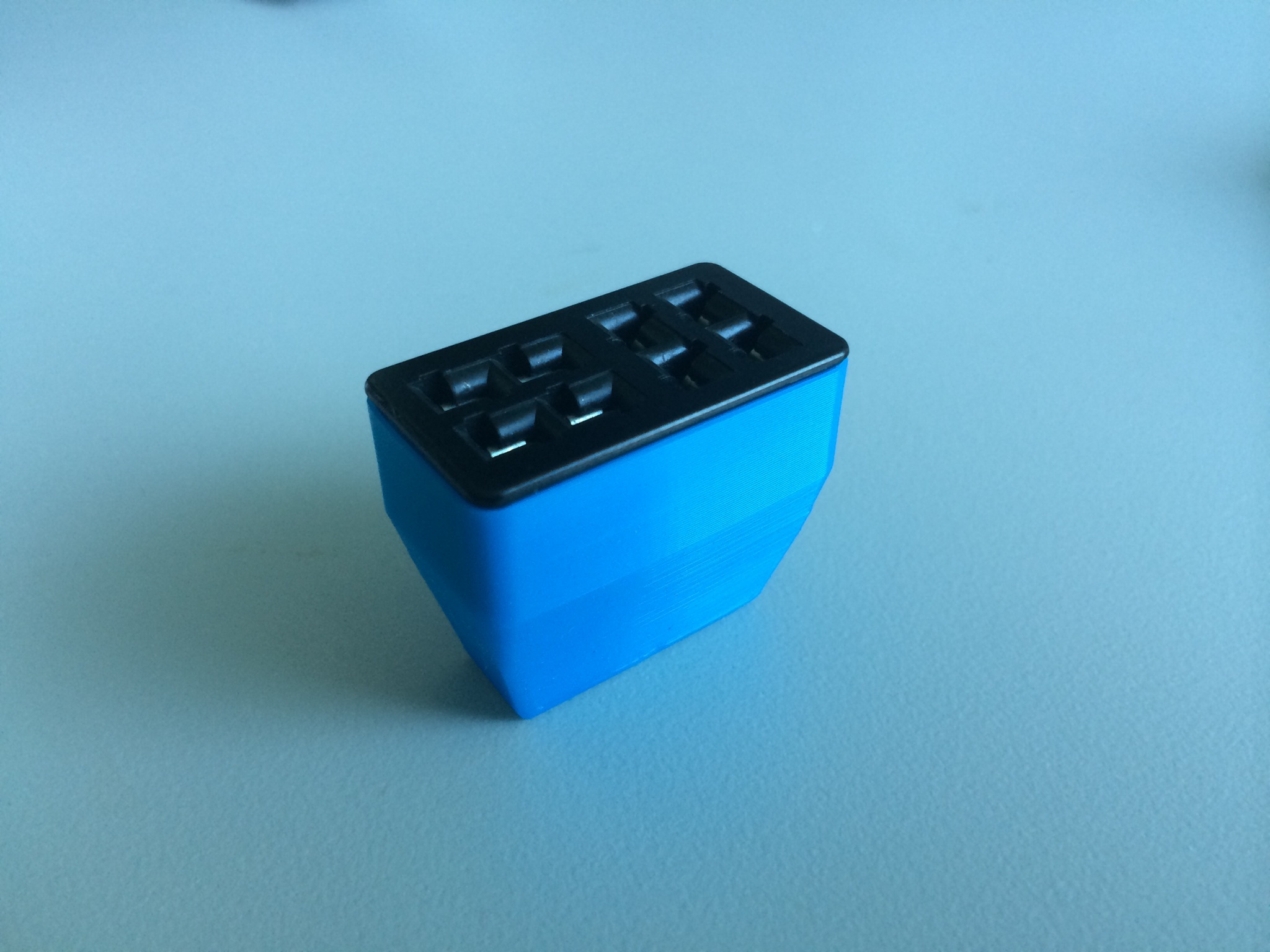
The best thing about it is that you can color-code the connectors, too! Finally, props to a CAD-ninja coworker for whipping up the beautiful SolidWorks model in a couple of minutes.
Signal and Noise
“One man’s signal is another man’s noise,” began Dr. Kudeki as he derived incoherent scatter radar theory from Nyquist’s noise theorem in ECE458. I think of that statement often, whether it be QRM on the ham bands or sifting through the pocket litter of web users looking for their consumption preferences.
This morning, I admired just such an example of signal and noise while watching the NOAA Doppler weather radar. Undesired targets of a radar that return echoes are termed “clutter” in the radar parlance and one simplistic way of eliminating clutter, especially when you expect the desired scatterers (“targets”) to move, is to assume that all of the stationary returns are clutter. In the weather radar, we get clutter from all sorts of stationary things like trees, hills, and buildings. Of course, what causes the clutter to move?
You see, it was one of those humid August mornings when a ham’s mind wanders to…tropospheric ducting. Yes, indeed the clutter returns were moving, intensifying before and after sunrise. I was fixated on this and watched the loop over and over again before noticing an even more interesting bit of clutter!
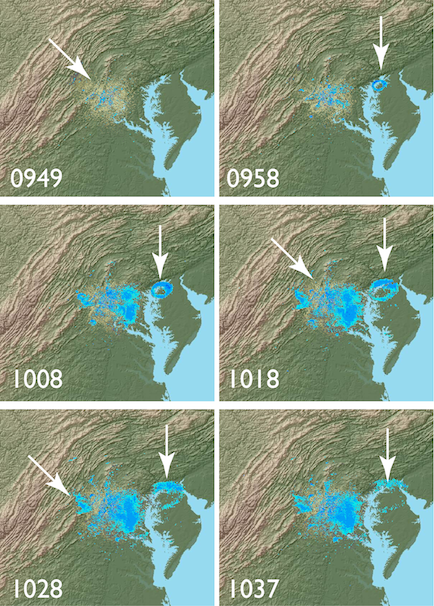
Beginning at 0958 UT on 4 August 2014, there is a small ring forming out over the Elk River area. The ring, which is indicated by the downward-pointing vertical arrows, expanded over the next >40 minutes. I was puzzled and watched the loop over and over. I considered and discarded a number of theories before resorting to Google. Apparently, it’s very likely a flock of birds. Sure enough, the epicenter of the ring is Elk Neck State Park. Fascinating.
The slanted arrows in the figure above indicates the ground clutter that I was originally noticing as a signature of tropo ducting, obviously now of secondary interest in this sequence of images!
Epilogue: I sent these frames to my father, who is an avid observer of the natural world. He passed them along to two friends back home who are birders. At press time, one reported that he had learned of these “bird circles” from Greg Miller, another birder from the area who got famous as one of the subjects of the book (and movie of the same title) The Big Year. I haven’t read/seen it, but I guess they went to Adak, which has a special place in my heart. Anyhow, it’s a funny small and interesting world in which we live.
Notes and Ramblings
Three perhaps noteworthy amateur radio activities occurred recently around K8GU: 1. During the course of some HVAC upgrades, I was able to get two holes core drilled through the foundation to bring coax and control cables into the house; 2. I operated in the NAQP August CW contest; 3. Evan and I went to the Berryville, VA, hamfest.
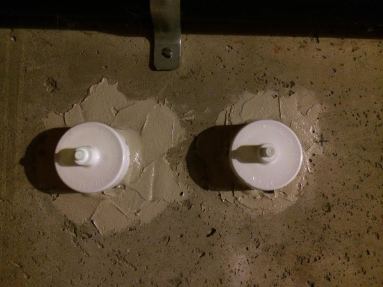
These two ports exit the basement into a crawl space where I will ground the cables before they enter the house. I still need to get some hydraulic cement or other quick-setting patch mortar to clean up the drill crater on the outside. Total cost: $5 in materials and a large pizza for the crew.
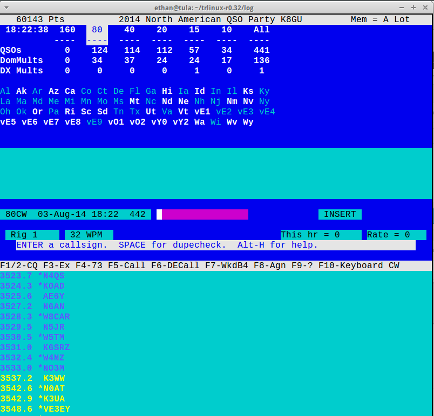
Screenshot above shows TRLinux after the end of the contest (obviously it was today, not last night). TRLinux performed flawlessly again with the YCCC SO2R+ box driving the KK1L band-decoder and 6×2 switch. I operated for about five hours (probably a little more, and definitely more if I used the NAQP 30-minute time-off rule to calculate it). I got up after my first operating sitting at the beginning of the contest and left the shack. As I exited the door, I was hit with the smell of hot electronics. You know the smell: like when you just let the smoke out of a transistor. I walked over to the antenna switch matrix where I was using a triplexer to split the hexagonal beam to both radios. It was warm to the touch. It seems to have continued to function, but I’ll have to disassemble it at some point to see if any irreversible damage was done.
The August NAQPs are always fun for us out East because there is the ever-present opportunity for sporadic-E throughout the contest, giving us a chance to work nearby states, which can really drive up the multiplier (and QSO, depending on the direction of the opening) total. Of course, this is the real boon of having a second radio: you can call CQ on your most productive band while looking for openings on the others. I came down after supper with the family to “work 40 meters before it goes long” and ended up with blistering 10- and 15-meter runs into the Midwest and South. Since Evan and I were planning to go to the hamfest and I don’t yet have a 160-meter antenna at the “new” QTH, I pulled the plug at midnight local time (0400). Not sure 40 meters was even getting long at that point. At any rate, it was wonderful to say “hi” to so many old friends from MRRC, MWA, SMC, PVRC, and beyond!
A final comment: You can really tell how much better one radio is than another when you have them both side-by-side on your desk. This was quite apparent when I had the K3 and the TS-930S and it is also apparent with the K3 and the K2. The K2 is a wonderful radio and fun to operate, especially in the field, but it’s not the K3 as far as fit and finish, among other things. No, I’m not buying another K3 anytime soon. The K2 is quite enough for the second radio.
I’ve always heard that the Berryville, VA, hamfest had a good boneyard/fleamarket/swapmeet but I’ve never managed to attend. I resolved to attend this year and was pleasantly surprised. Evan came along for the ham-and-egg breakfast, which was good but he rejected the ham after only consuming about 1/3 of it, and a trip to the playground at the school across the road. This is still a “real” hamfest like the ones I remember going to in the early 1990s before eBay and online trading really took the wind out of swapmeets. There were plenty of rigs spanning the spectrum of boatanchor to relatively modern, HF and VHF/UHF. There were lots of amplifiers, as well, (and a small quantity of CB junk; Texas Star, anyone?) There were also lots of antennas, and even some Rohn 25. The computer and cell phone accessory dealers were mercifully few and there were lots of tables of parts, bits and pieces. This is a ham’s hamfest and I’ll be returning. I picked up a bunch of Cinch-Jones plugs and sockets for my new cable ingress, plus some SMA connectors and flexible coax jumpers. Plus, I ran into a few friends, although not the ones I expected to see!
Uploading ADIF logs from fldigi to LOTW
 I’ve been attempting to get my arms around my various logs from different callsigns. Previously I have had mixed luck with LOTW. Then I pretty much abandoned it. This time I read and re-read the instructions. Today I got my TQ6 file and was off an running.
I exported my current log from fldigi as an ADIF file and then used the TQSL application to upload it. Error, error, error. What was this? I hit Google and started researching:
ARRL’s tqsl messes with fldigi saved QSO_OFF time
I learned more than I wanted to know this morning about what the ARRL¹s tqsl application for LoTW does when it signs your saved fldigi newlog.adif file. It does more than just applying your digital signature. I had a busted QSO with Jeff, N8NOE, on LoTW and spent some time trying to understand what happened. The problem was with the time of the QSO. Both of us log the time at the the end of the QSO; however for there was a disconnect because my QSO time at LoTW showed up as Time ON, rather than Time OFF. Fldigi logs both TIME_ON and TIME_OFF; however, when you ask the ARRL tqsl application to apply your digital signature, it ignores the fldigi saved Time_OFF and converts the TIME_ON to a nonstandard ADIF format called QSO_Time. If you want your fldigi logs uploaded to LoTW to reflect QSO OFF time, you have two options. You can manually edit your On and Off times in Logbook-newlog.adif panel read the same. Another workaround is to use the fldigi File/Export ADIF with the option for Time ON unchecked. Then use a text editor to search and replace TIME_OFF with TIME_ON. This will fool the ARRL tqsl application to log the correct correct QSO time. Another option for someone to think about could be a new macro command that would reset the QSO times (ON and OFF) to be the same when you click on log. If you don¹t believe tqsl changes your fldigi logged QSO TIME_OFF, open one of your last .tq8 files with text editor (I use BBEdit) and scroll down and you will note the nonstandard QSO_TIME time that matches your your ADIF TIME_ON rather than TIME_OFF. 73 Dick AA5VU
… and that is what I did. And it worked! Although the issue Dick describes and the issue I was having were different, the solution still worked.
Now I am trying to add the logs for both my YI9MI and HL9MI operations. We will see how that goes.













