Archive for the ‘qrp’ Category
 Just a short time on the radio
 July 28th, 2013 |
  Author:
 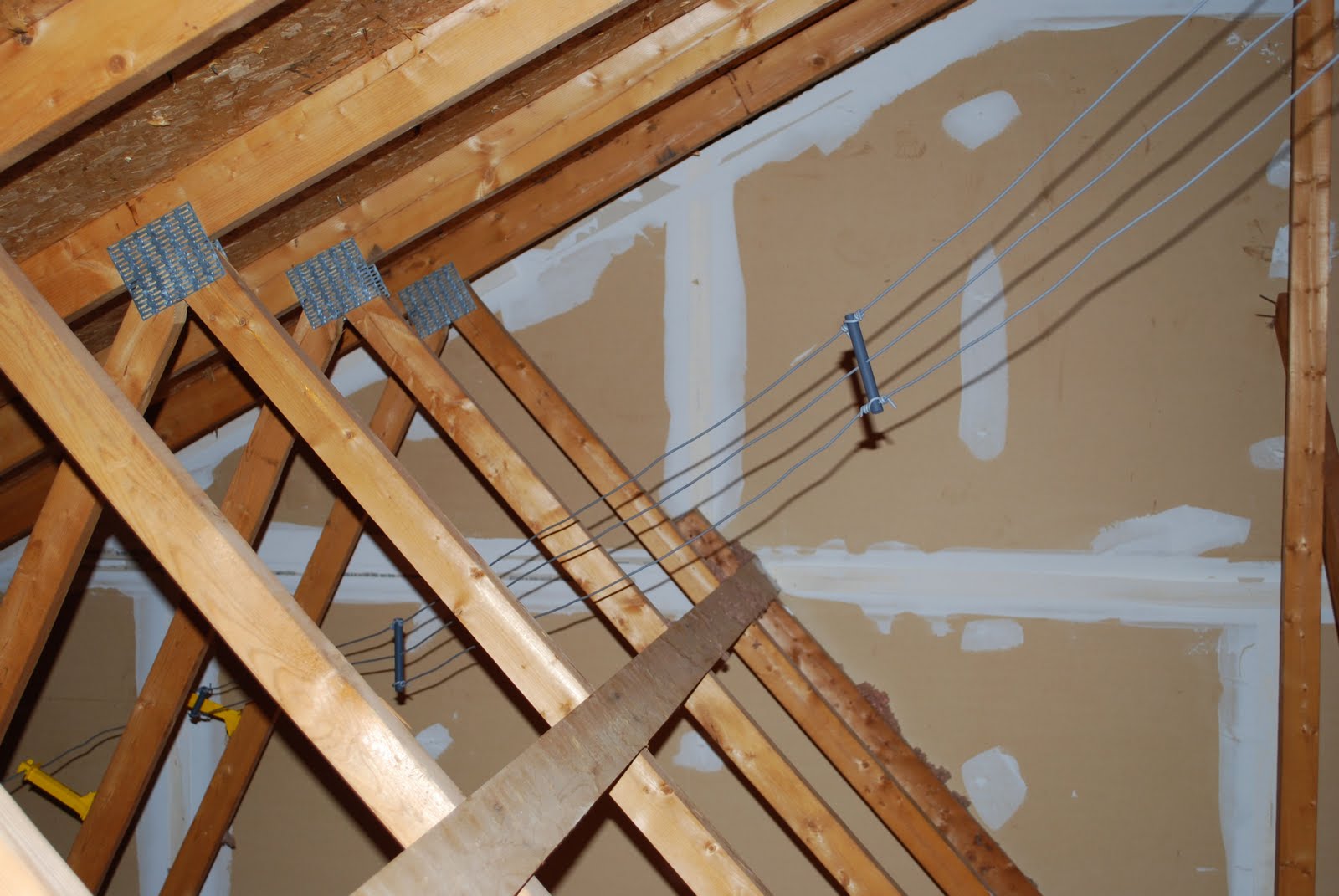 |
| The attic dipole is working it's magic agian! |
Have a good week everyone
QRP Respect Day 2013
It is a QRP party, that is, a non competitive contest for QRP hams, especially those operating in portable mode with simple home made antennas.
The time is 08:00 UTC – 12:00 UTC and the bands are 40, 20, 15, 10 meters. It is recommended to stick around QRP frequencies, according to Region 1 band plan: CW 7030 – 14060 – 21060 – 28060; SSB 7090 – 14285 – 21285 – 28,365.
You can find other informations on http://qrprespect.jimdo.com/ (Rules http://qrprespect.jimdo.com/qrp-party-it/) Click on the English tab.

Courtesy of DXCoffee www.dxcoffee.com
The time is 08:00 UTC – 12:00 UTC and the bands are 40, 20, 15, 10 meters. It is recommended to stick around QRP frequencies, according to Region 1 band plan: CW 7030 – 14060 – 21060 – 28060; SSB 7090 – 14285 – 21285 – 28,365.
You can find other informations on http://qrprespect.jimdo.com/ (Rules http://qrprespect.jimdo.com/qrp-party-it/) Click on the English tab.

Courtesy of DXCoffee www.dxcoffee.com
Lighter, Easier to Pack, Telescoping Pole
I've been busy with day job, rock band and some of my other hobbies, but I've been meaning to write about this subject for a while. As I have been analyzing my approach to portable QRP SOTA operations I have been tweaking and lightening my load. One of the major advances is the telescoping pole that I use. As most of you know, Locktite has a very nice set of poles, up to 33 feet as does SOTA Beams. However, the issue is that when collapsed they are still close to 4 feet in length and 2 -3 lbs in weight. This means the pole is fine to carry in your car, but it is awkward to carry up a 14,000 mountain. So what to do?
I found, through KT5X, a supplier of Japanese made carbon fiber, telescoping fishing poles. It telescopes to 21 feet, weighs 7 oz. and collapses down to 25 inches. Brilliant. Now, these are a little pricey, from $75 -$120, but if you are carrying it for a few miles, the price amortizes nicely:-).
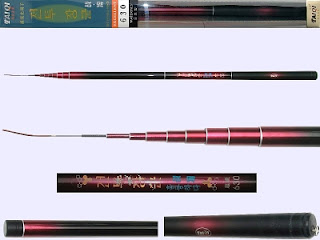
I found, through KT5X, a supplier of Japanese made carbon fiber, telescoping fishing poles. It telescopes to 21 feet, weighs 7 oz. and collapses down to 25 inches. Brilliant. Now, these are a little pricey, from $75 -$120, but if you are carrying it for a few miles, the price amortizes nicely:-).
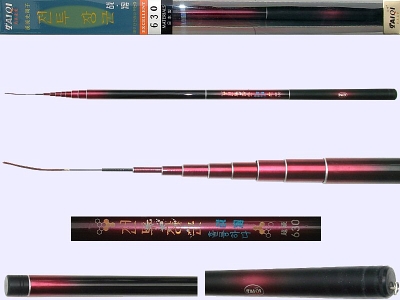
Carbon Fiber Telescoping Poles
There are a couple of caveats with these poles. There is no tip guide and the ends are a little flimsy. However if you wrap the top three sections with rod guide thread and coat it to strengthen the tip, it should suffice. You will also need to add very small rod guides, I used 3 mm guides, or buttons, yes buttons, to route the antenna wire down the pole. The buttons, two hole buttons, will need to be of varying sizes so that each will go further down the pole. The second hole of the button is what you thread the antenna wire through. If you use rod guides they should be mounted at the top of the last 3 or 4 sections so that the pole will still collapse. Once you start pondering this, while looking at a pole, it will make more sense. More on this in a later post.
I've found the best way to deploy an EFHW, where there are trees is to use the pole to place the end of the antenna, wrapped around a winder, over the highest branch you can reach with the pole. Let the winder fall to the ground and tie it off. So now the end of your antenna is 20+ feet high over the branch that you selected. Then thread the other end of the antenna wire down your pole and extend the antenna until the end of the antenna is a couple of feet off the ground, threaded down the pole. Use a velcro wrap to secure it, attach your matching device and you're good to go. I often prop my pole on the limbs of another tree, so there is no need to guy the pole.
So to sum up, this lightens the load considerably and the deployment approach eliminates the need to throw a line or use a sling shot to try to get it over the right branch.
I will post some pictures of my pole in a later post. The poles are available at http://www.allfishingbuy.com/
in a variety of lengths and wall thicknesses.
Ham radio and software……….
1. It's no good as it's not supported.
2. Since it's free it must be very simple and buggy
3. I am sure it's not updated.
As for the software for a price I have heard and read......
1.It's way over priced.
2.Why pay when free software is out there?
3. Someone is just trying to make a buck.
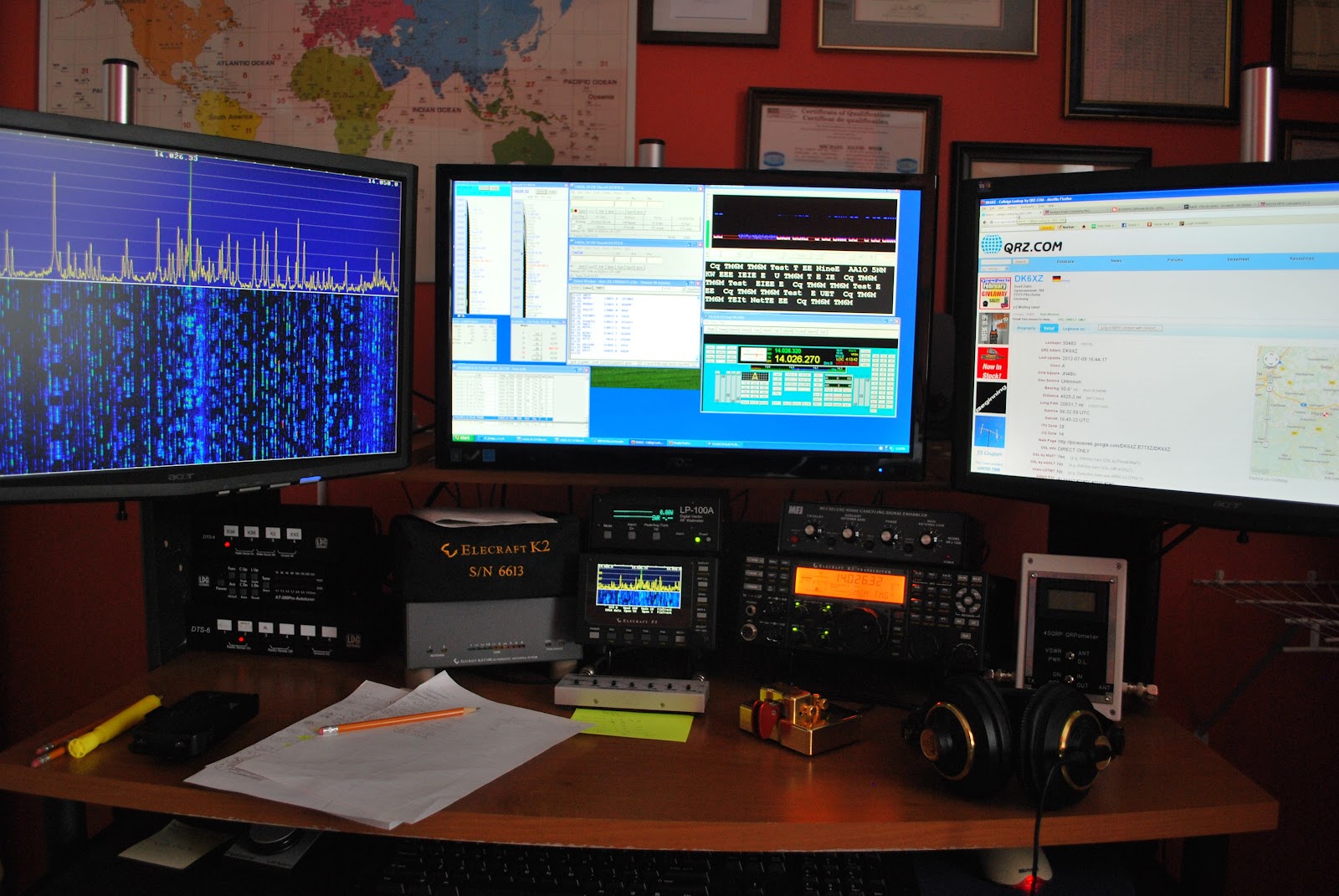
I have both free and software I had to paid for and am very happy with both products. My software is not the be all and end all but it's what works for me. There is some fantastic software out there that can make you grow in your ham radio journey. I hope to just excite you to look to see what is out there.
Here is what I use and as most ham I know they love free stuff and here is the free software I use.
1. DXlabs for my every day radio adventures I am sold on DX Labs! This software has rig control, logging, world map view of DX, QRZ (and many more) look up feature and much more. With this software and with the click of a mouse able to use many features of my K3. At a glance I am able see on a world map DX spots, I am told if I worked this country before....on what band.....and what mode. There is a huge amount this free software can do. As for updates it seems that it's almost daily this software is improving. Oh and as a side note updates are a breeze to instal and no need to jump through hoops to get the latest and greatest upgrade. If you are not sure about a feature or if the software does not seem to be doing what it should, support is fast and readily available on the internet.
2. If you are into contesting (like me) then once again the free stuff comes to the rescue. N1MM seems to be one of the staples for contesting. Again it has rig control features, CW and SSB features, VFO A and B control, spotting networks this is just to name a few things this amazing software can do.
There are regular updates and bugs are very few and far between. Again if you have troubles the support is there and it's fast.
Ok lets talk crazy now.....paying for ham software
1. When contesting I said I use N1MM but I also use a rig control program by N4PY and it's not free but WOW does it enhance my contesting. (now this software is not only for contesting I just chose to use it this way) This program allows me to adjust most of my Elecraft K3 controls with the mouse or keyboard. I can used my K1EL keyer, this program allowed me to use my Flexcontrol knob.
2. Another program I dished out some coin for and never looked back is MRP40 cw decoding program. Now I know what your thinking "there are lots of free CW decoding programs out there" This is true I have tried them and they are good BUT MRP40 is GREAT. In contesting when the speeds get to what I call "crazy speeds" this program has no trouble at all decoding them.
Lets say you want to have multiple programs work together without a hitch.........
3. Then LP Bridge or VSP manager come to the rescue. These are free programs and will allow your computer to set up virtual ports thus having multiple programs working at the same time and talking to each other. These programs work like a dream and as far as my needs go no bugs at all.
4. If you are into the digi modes like I was and in the near future hope to be there is a free program called Quickmix. This program will remember all the audio settings you use for each digi mode, so for example when operating PSK and you want to now switch to WSJT-X which has new audio settings for you PC. You no longer have to remember them Quickmix can in the blink of an eye adjust the sound card to the new settings for the selected digi mode!!
SOTA Expedition to NM and CO
Last week was a great week. I took a week of vacation and my wife and I headed to the mountains. We flew to Santa Fe, NM on Monday and that night had a nice dinner with local SOTA enthusiasts’,Fred KT5X aka WS0TA, John K1JD and Doc K7SO and their XYL’s. It is always nice to get together with friends with similar interests. We had a lot to talk about as we planned to do two 10 point SOTA summits the next day, a doubleheader if you will. We would work in teams of two and summit the separate peaks at roughly the same time. This would allow us to have summit to summit (S2S) QSO’s with each other. The S2S contacts count toward a separate award within the SOTA program. We would then descend from the peak we were on and ascend the summit that the other team had just activated. You must make 4 QSO's from each summit for it to qualify for activator points.
Since the forests were closed in the Santa Fe area due to high fire risk we went east of Taos, NM. Our activation targets were W5N/SS-019, Peak 10,900 and W5N/SS-024, Sierra de Don Fernando, both are 10 point peaks and are in excess of 10,000 ft. ASL. The activations went well, making HF contacts t qualify the summit and VHF, S2S, contacts with our buddies on the other summits. My portable station, documented in my previous post, worked very well. I used my ATS-4 transceiver, an EFHW strung up in a tree for an antenna and a 500 mAH lipo battery for my power supply.. We had a great time and only had a few rain drops fall on us. We were deep in the forest and the smells and sounds in the mountains are very therapeutic. The plan almost worked to perfection. Fred, Cris (XYL) and myself were on one team and John and Doc on the other. We were down from the second summit when Doc called in on 2m to let us know that they had a flat tire. So we were forced to wait on them in the cool forests of New Mexico.
After successfully activating these two summits we said goodbye to our Santa Fe friends. We then headed to visit Jeff, my old backpacking buddy, and his wife Becky in Red River, NM. There are several 10 pointers in the Red River area and we decided to just do one, Greenie Peak, W5N/SS-015, on Wednesday morning. This would allow us more time to visit and catch up.
Wednesday turned out to be an adventurous day. The Greenie Peak activation went well. There are beautiful views from there and it has a large summit area. Despite poor propagation I quickly filled the log and we determined, with thunder in the distance, we should head down.

Operating on Greenie Peak, NM
My Station is on the right
On the way down however, we saw a sign on the trail to Sawmill Peak. Sawmill is another 10 pointer that I had considered but there is no trail to the top. After seeing the sign, I thought maybe I had found a trail no-one else had found. The 4WD trail dead ended into what appeared to be a hiking trail. It was not, but lead to a bushwhack over 3 lesser peaks to finally reach Sawmill. Again, the summit wasn't planned. We reached the summit, started deploying the antenna and the skies opened up. There are commercial antennas on the top of Sawmill and we found refuge under a pier and beam building there. We got wet. After an hour and a half rain delay we set up again in light rain. My hands were wet and cold and the micro key seemed very small and I had considerable trouble operating it. The rain continued to fall.
I called CQ for 10 minutes before NS7P called and then spotted me. We made a few more QSO's despite the keying problems and qualified he summit. Thanks for those who stuck it out with me. We hiked back in the rain, but with 20 points in the bag rather than 10. Is was a satisfying day, activating Sawmill Mountain, which had only one previous activation, unexpectedly, felt good.
I called CQ for 10 minutes before NS7P called and then spotted me. We made a few more QSO's despite the keying problems and qualified he summit. Thanks for those who stuck it out with me. We hiked back in the rain, but with 20 points in the bag rather than 10. Is was a satisfying day, activating Sawmill Mountain, which had only one previous activation, unexpectedly, felt good.
On Thursday morning we bid farewell to our friends and headed north to Colorado. We planned to climb Mt. Sherman which is 14,036 ASL. I previously have climbed 6 of Colorado’s 54 14’ers, but I haven’t done one for more than 15 years. I live near San Antonio, TX, so acclimation to altitude is always a concern. I keep myself in decent shape, but the question in the back of my mind was, “can I still do it”. This climb and activation would culminate a great week of SOTA activations. All four summits for the week were 10 pointers, so going into Friday the plan had gone very well, but the big target for the week was Mt. Sherman, 14,036’ ASL.
My XYL (who has five 14ers to her credit) and I had re-conned the trail-head on Thursday afternoon. There is a gate, open in the summer, and we found that you can drive a long way up the mountain, if you want to, probably close to 12,800 if you have a 4WD. However there were no cars at the trail-head at the time so I wasn't sure where the typical starting point was. So the next morning we arrived at the gate at a little before 7:00 am. There were a handful of cars already parked outside of the gate, but none were parked past it. I didn't want to be the guy that drove his car way up the hill, when everyone else starts at the gate. So we parked there and were quickly on the trail/road up the summit. We followed a local guy, who seemed to know what he was doing, however it turns out that he didn't. We missed the main trail, i.e., the road that goes to 12,800, and is relatively easy hiking. Instead stayed left and climbed up a fairly steep pile of rocks to the old mine. That snafu, while not really adding any distance, probably added 30 minutes to our time. We realized this when we go to the top of that climb when a couple came walking up the road that goes around the rocky slope. Oh well, as my friend Jeff says,” If you know what’s going to happen, it’s not an adventure”.
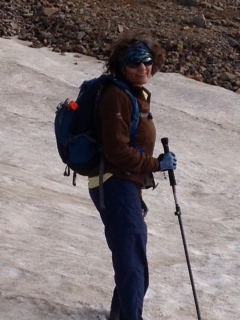
My XYL Cris on the way up Mt. Sherman
The rest of the climb was just the grind that all 14ers are. You settle into a pace, enjoy the views and try to breathe. We summited at 9:30, a little later than I had hoped, since there was an outside chance I might do Mt. Sheridan, another 10 pointer, which was a across the ridge from Mt. Sherman. We actually felt pretty good at the top, tired by not overly so, and no altitude induced maladies. We enjoyed summiting another 14’er, the views are magnificent.
So now to the radio. I had used an EFHW all week but, in the deluge of rain and hail on top of Sawmill Mountain the previous Wednesday, I had lost the buttons I use as guides for the antenna wire on my crappie pole. So I decided to take my back up Buddi-stick vertical. I've had good luck with this antenna before and it’s very quick to deploy. However, for some reason the SWR was high and I couldn't get it down with quick adjustments of the radials, so my signal suffered in what weren't good conditions to start with. I started well with an S2S with NM5S who was on Mt. Windom in Colorado, another 14er, but then it became hard work. NS7P called in with his usual loud signal and gave me good report and then WA2USA followed with a 229. After that I didn't get any calls for what seemed like an eternity. After several fat finger, altitude induced mistakes, I finally was able to post that I needed one more QSO via my iPhone, and W0MNA, W6UB and ND0C called in. Looking to the west I could see that, while still a ways off, rain clouds were forming. So I packed up. Not a glamorous activation, but it counts. With rain clouds on the horizon, I decided to leave Sheridan for another day.
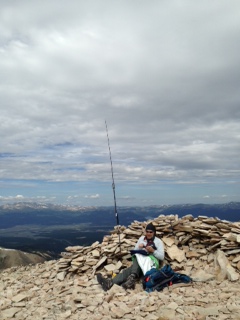
On our way down, at around 13,500 ft. we encountered a husband and wife climbing with their 4 month old daughter. While it is a courageous thing to do, I wondered about the wisdom of such an adventure. My wife said that seeing that made her feel like a wimp. Despite that we pressed forward and made steady progress down the mountain as the rain clouds formed. It always surprises me that people will start up a 14er at mid-morning. We encountered several who were on the way up as we were descending that clearly would not summit before noon, which is the time you should be off the mountain. This time we took the road rather than descend the rocky slope that we needlessly climbed on the ascent and it was fairly easy going once we reached that point.
After we made it back to the car, my XYL and I high-fived, having proven to ourselves that “we still got it”. As we did that, the first rain drop fell. As I shut the door of the SUV, the hail started falling and the clouds let loose. Perfect timing for us, down just in time, but I couldn't help but think about that little 4 month old. I hope the parents were prepared to keep her warm and dry.
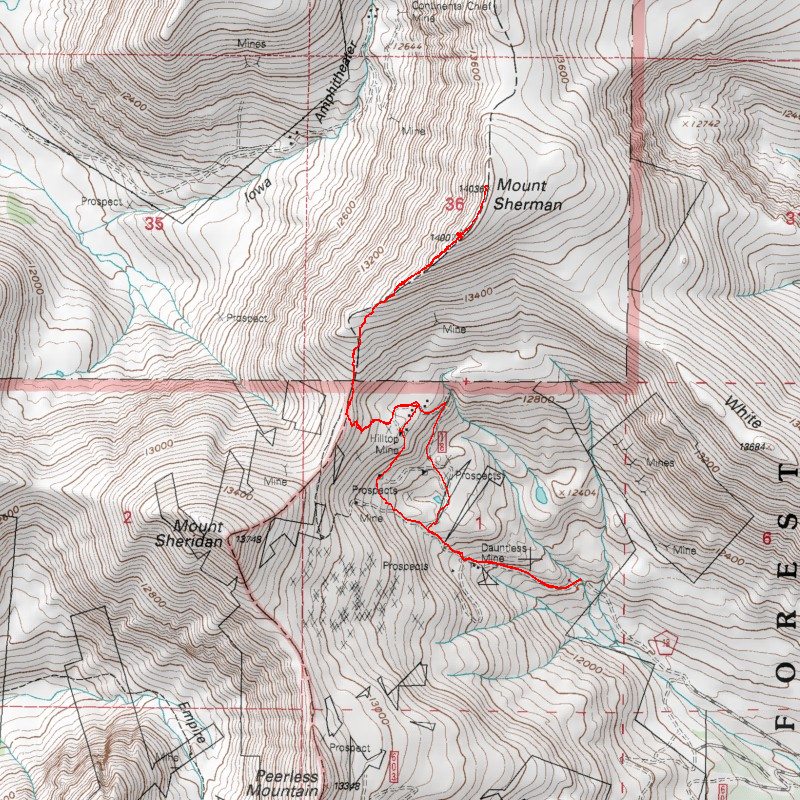
The hike is 5.2 miles round trip and ~ 2200 feet vertical gain from the gate. The red track above illustrates our route up and down Mt. Sherman. The left route on the way up is not easiest way up. The red dot on the summit plateau is where I operated from.
So another double header of sorts, another summit activated and finally another 14er climbed. What a great day. For the week, 50 activator points, 76 S2S points and 36 chaser points; not too bad.
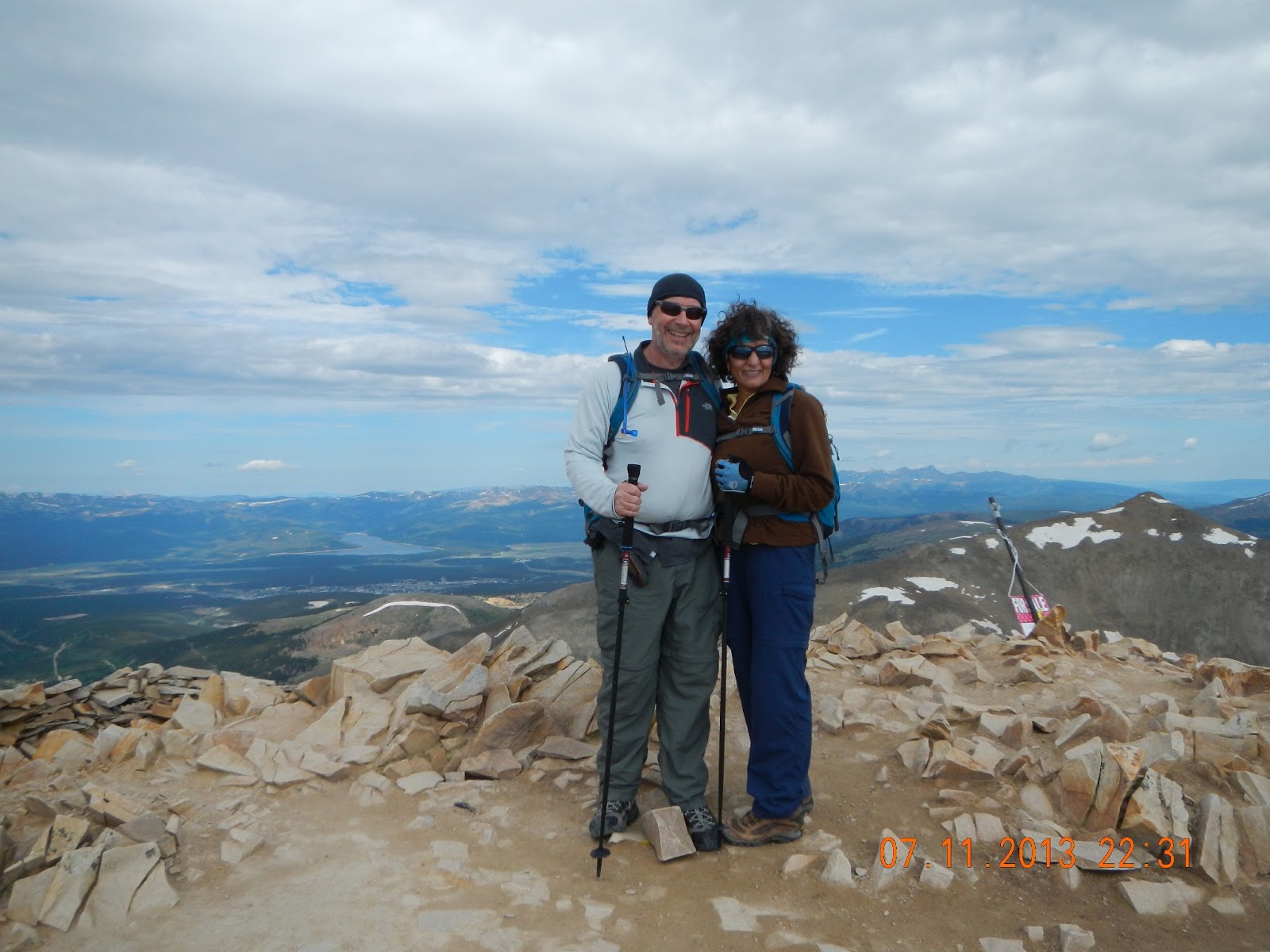
AD5A and XYL Cris on the summit of Mt. Sherman
(date and time wrong on the picture)
QRP portable at Luther Marsh
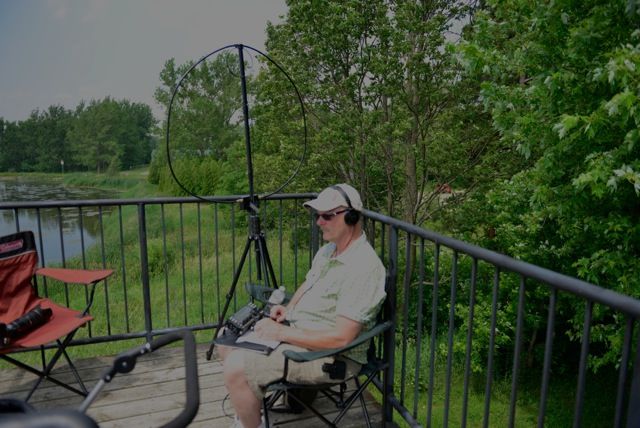 |
| QRP at Luther Marsh... note one of Julies cameras |
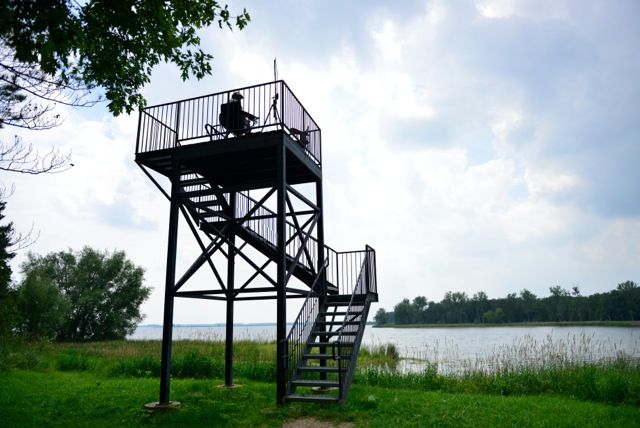 |
| A view from below |
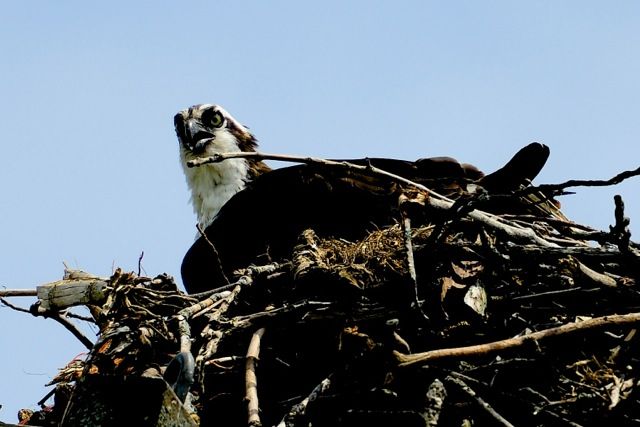 |
| Julie's shot of the day an Osprey |
I took with me my Elecraft KX3, Alexloop, tripod and a spare battery. It was great, there was no noise level at all on the KX3 and one would wonder if the rig had a receive problem. I started to call CQ and it was not long before VE1AB in Nova Scotia came back to me. John gave me an RST of 559 and we had a nice long CW chat it seemed that John had been to Luther Marsh several times when in Ontario. I did have to say 72 to him as my batteries had to be changed in the KX3. I then called CQ again on 20m and WW2SUB came back to me.......hey guess where he was???? This was the first time EVER I had contacted a Submarine . He was on the USS batfish. I thought my CW was off and it was supposed to be copied as battleship. When I got home and did a QRZ.COM search....it was in fact called the USS Batfish!
 |
| Camera and ham gear stroller (mainly camera gear) |
My New SOTA Portable Station
I few weeks ago I took a trip to Santa Fe, NM for a long weekend and activated a couple of SOTA Summits. I was fortunate to meet Fred, KT5X and John, K1JD. I learned quite a lot from them on portability and efficiency. So motivated by John, I have developed my new portable SOTA Station.
I purchased an ICON portfolio designed to carry an iPad or similar notebook. It is hard sided and the inside lining can hold on to velcro.
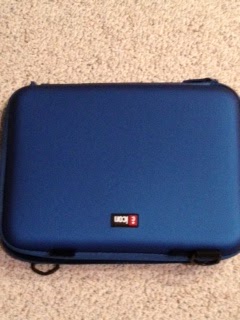
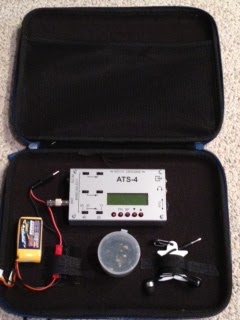
I purchased an ICON portfolio designed to carry an iPad or similar notebook. It is hard sided and the inside lining can hold on to velcro.
The ICON Portfolio closed the handles removed
So I removed the handles and some unnecessary attachments from the inside and laid out my station. With a little help from velcro, everything stays put while transporting and operating.
ICON Portfolio SOTA Station
I mounted the ATS-4, a 500 mAH Lipo and a small container that holds my micro key and also serves to keep any pressure from the sides, when closed, off the radio. I also have my earphones wound on a cool little winder. Just add an antenna and I ready to to call CQ.
The whole thing weighs 18 oz and fits nicely in my backpack. Credit to John, K1JD, who I stole the idea from.













