Archive for the ‘hf’ Category
 New Antenna: The Following Footprints Are of My CW Signals (2021-March-14 @ 04:00 to 04:20 UTC).
 March 15th, 2021 |
  Author:
 The following footprints are of my CW signals on 2021-March-14 at about 04:00 to 04:20 UTC.
Click on this image to see a larger version of this image:
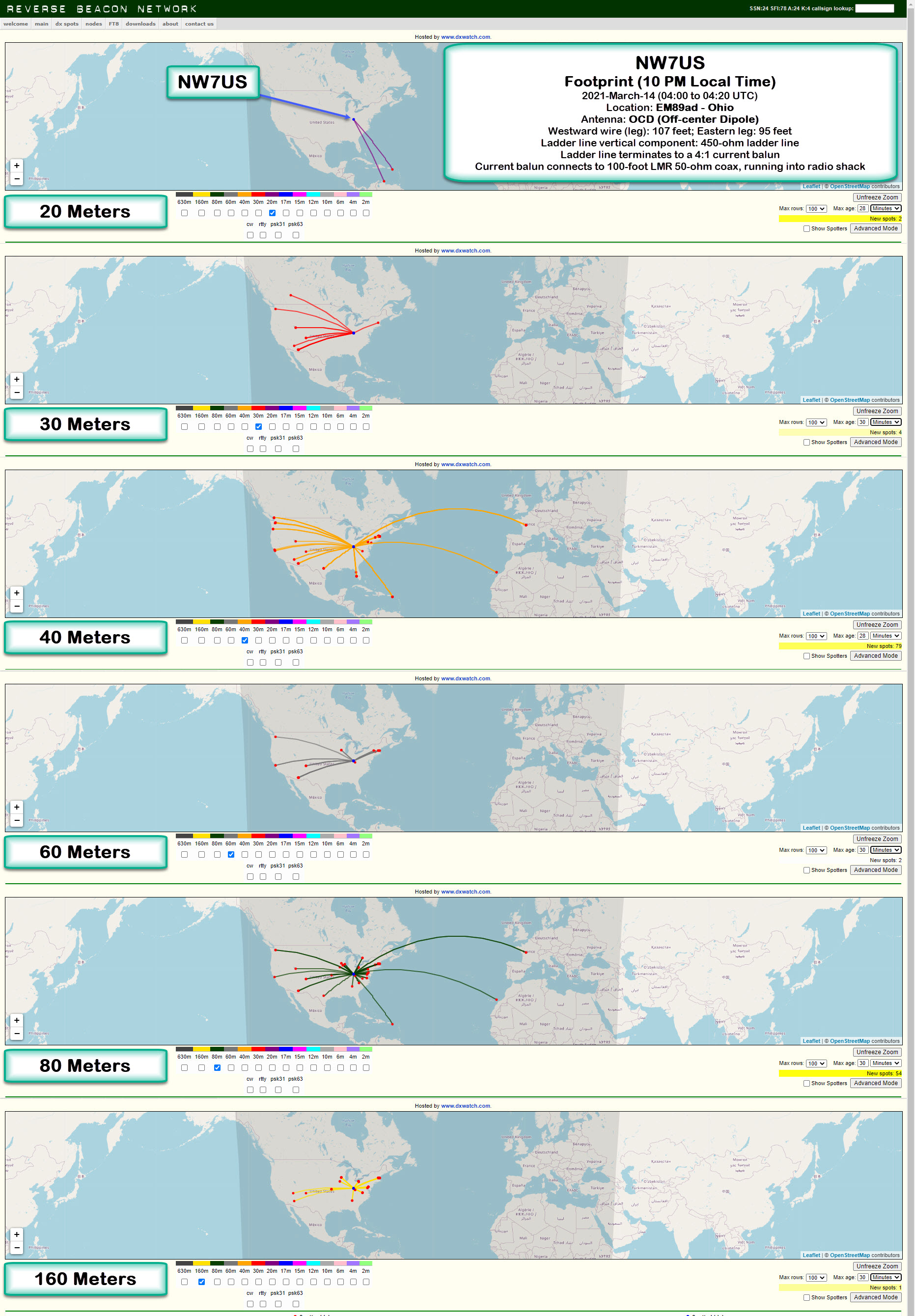
Location: EM89ad – Ohio
Antenna: OCD (Off-center Dipole)
Description of Antenna:
This is an off-center dipole, with the two legs running East-East-South (approximately 125 degrees of North), and West-West-North (about 306 degrees on the compass). The westward wire (leg) is approximately 107 feet in length, while the eastward leg is about 95 feet in length.
These legs (an off-center-fed dipole) is directly connected to about 90 feet of 450-ohm ladder line, which is hanging directly below, vertically, the feed point. The feed point is 50 feet above the ground.
The ladder line terminates (at the 12-feet-above-ground point) to a 4:1 current balun. This current balun then connects to a 100-foot LMR 50-ohm coax, which is running into the radio shack. It is connected via an antenna switch to my Icom IC-7610 transceiver. I am transmitting a 100-watt CW signal using an Icom IC-7610, in the following format:
TEST TEST TEST DE NW7US NW7US NW7US
The Reverse Beacon Network reports any spotting of this test transmission. The beta mapping interface, at http://beta.reversebeacon.net/main.php, then maps the resulting spots. To learn more about the RBN, visit http://beta.reversebeacon.net/index.php, or, http://reversebeacon.net/index.php.
I show the 20-, 30-, 40-, 60-, 80-, and 160-Meter band footprints.
I’ve been capturing these CW transmission spots, at different times of the day, today. I’ll get data from several days, at regular intervals, and create a overview of how the antenna appears to be working during this month and under these propagation conditions.
73 de NW7US dit dit
..
Radio Fun on Threemile Mountain (W0C/SP-107)
Lately, for the ARRL January VHF contest, I try to find a SOTA summit to activate. Operating time is usually just a few hours, so it does not make for a big score. The main advantage is for VHF SOTA (Summits On The Air) because there is a lot more activity on 2m CW and SSB. This year, I wanted to go for the mountaintop trifecta of SOTA, POTA (Parks On The Air) and VHF contest in one activation.


Threemile Mountain (W0C/SP-107) emerged as the activation summit because it is not too far from our cabin and accessible in the winter. (This time of year, the roads to many of our favorite summits are blocked.) For POTA, it is located in the Pike National Forest (K-4404). Because it is a short hike, I concluded that I could carry the Yaesu FT-911 and the 20 Ah Bionno battery. This would cover all the bands, give us more RF punch and still have plenty of battery capacity.

I carried quite a collection of antennas which gave us plenty of operating choices. We started out on 2m and 70 cm FM, working mostly local stations. This quickly got us enough contacts for SOTA and POTA points. We used a rollup J-pole for 2 meters and 70 cm, until it became intermittent and the SWR went wild. Then we switched to the Arrow 3-element Yagi for 2 meters.

About that time, I decided to see what was happening on 2m SSB. There were a number of contest stations on the air, mostly from the front range cities (Denver, Boulder, Colorado Springs, …). I worked a bunch of them using 50 watts from the FT-991 to the 2m Yagi antenna (horizontally polarized).

Suddenly, I was surprised to hear N0LL from Kansas calling me. I’ve worked Larry before from Colorado but it usually was from a really good location such as Mt Herman or Pikes Peak. Even then, we often had to switch to CW to complete the contact. Today he was louder than many of the Denver stations. We easily worked on SSB, which turned out to be a new personal best DX for me from a SOTA summit (372 miles).

After things slowed down on 2m SSB, I decided to make some HF contacts. The North American QSO Party (SSB) was active, so I decided to set up for 20m and see who I could work. Running 100 watts to an endfed halfwave kept me competitive with the contest stations. Then I moved up to 17m SSB and worked non-contest POTA and SOTA chasers.

We both accomplished the three-in-one mountaintop activation for SOTA, POTA, and the VHF contest. I also worked the NA QSO Party, so that makes it four-in-one, but who is counting? The January weather cooperated with us with almost no wind on the summit, about 28 degrees F. We sat there in the sunshine and just enjoyed the view before hiking back down.
73 Bob K0NR
The post Radio Fun on Threemile Mountain (W0C/SP-107) appeared first on The KØNR Radio Site.
A Different Approach to a New Year: the Ham Systems Think!
What is the most important aspect of life? Having fun! (Of course!).
Perhaps it is unusual to wax philosophical in an amateur radio forum, but I am going out on a limb to share a perspective that hopefully is refreshingly new and full of life: Systems thinking — an amateur radio approach.
What I’m sharing herein, I find very intense, invigorating, challenging, and motivational! The more I think about amateur radio with this perspective–the Systems Thinking perspective–the more fun I’m able to define, and then accomplish.
In my opinion, this approach to life is REVOLUTIONARY! Why isn’t this knowledge distributed far and wide? Why aren’t these precepts taught in the schools for young children, so that they can be equipped for a life full of accomplished purpose? Perhaps it is due to the deceptive simplicity of approaching life with the perspective of Systems Thinking.
SYSTEMS THINKING AND AMATEUR RADIO

Amateur Radio as a Service – a System, not a Collection
What is Systems Thinking?
In a very simplistic sense, a system is any group of parts that make up one complex whole. Each part cannot function as the whole, and each part interacts with other parts, such that this behavior affects that end result which is expressed by the whole.
Think about a motorcycle. Let’s play with that thought: I disassemble my motorbike in your living room. Once the bike completely taken apart and the parts are scattered all over your living room floor, can any one of those parts support my riding it out to the countryside, and back again? No. Only the bike can act, when it is made whole again, as a motorbike. But, even if the individual parts, doing their part well, try to be the bike all by themselves, but fail, in the end realize that the parts are very important. Each part has a place and a job. Each part belongs.
By now, as you think about this, you probably realize that there is a difference between collections, and systems, of course. A bag of rocks is not a system. A motorcycle is a system. A bag of motorbike parts is not a motorbike. The assembly of the motorbike parts does make a motorcycle.
What does this have to do with amateur radio?
The amateur radio service (hobby) is a system, not a collection. There are many parts–and one of the most important component of the amateur radio system is you and me. We interact with each other, exchanging knowledge, reports, friendships; we each function, lending our functioning the the autonomous self, the amateur radio service.
It takes more than one of us to make up the amateur radio service. It would take at least two amateur radio operators, at the most extreme emaciated existence as a public service. It is obvious that one ham, all by herself, does not make the amateur radio service. No one of us is the amateur radio service, by ourselves. We need each other in order to have a ham radio community–the amateur radio service. Ourselves, our radios, antennas, computers, knowledge, schedules, and so on, are all parts of the big system with which we participate in our community.
Let that sink in.
Ponder the long-term repercussions of this revelation: We need each other, and we need our resources (time, skills, knowledge, radios, etc.).
How do we shape our System? What will elevate our System so that it is effective? And, so we begin to do this, SYSTEMS THINKING.
Please read, and ponder these thoughts, as you read through this article:
https://thesystemsthinker.com/a-lifetime-of-systems-thinking/
Additionally, you should check out this video–it is great!
[embedyt] https://www.youtube.com/watch?v=EbLh7rZ3rhU[/embedyt]
Bonus (not necessary but still VERY good deeper dive):
[embedyt] https://www.youtube.com/watch?v=yGN5DBpW93g[/embedyt]
In my estimation, Dr. Russell Ackoff is amazingly wise, and inspiring!
SYSTEMS THINKING
At the moment, I am studying and trying to implement system thinking. It is the topic I am mostly studying right now.
The following is an introduction to Systems Thinking:
https://thesystemsthinker.com/
Download this useful paper that helps you understand system thinking:
http://nw7us.us/systems-thinking/Introduction-to-Systems-Thinking-IMS013Epk.pdf
I would very much like to hear your thoughts on all of this. Seriously. Take your time. But, let’s start wading through this pool of refreshing water…
Happy New Year!
Tomas Hood
NW7US
Addendum: I do not necessary agree with every perspective, conclusion, or point made by Dr. Russell Ackoff. Never-the-less, the overarching idea of systems thinking seems valid, and is worth considering.
POTA: Arkansas River Headwaters State Park (K-1208)
The Arkansas River Headwaters is a unique recreation area that follows the upper Arkansas River in Colorado, extending roughly from Leadville to Pueblo. POTA has it listed as the Arkansas River Headwaters State Park, but the Colorado Parks and Wildlife website shows it as the Arkansas Headwaters Recreation Area. This area is a bit unique, a cooperative effort involving Colorado Parks and Wildlife, the Bureau of Land Management, and the US Forest Service. See map here.

Joyce/K0JJW and I decided to activate this park earlier this week, enjoying a nice sunny day. We operated from the Collegiate Peaks Overlook, which has a picnic area and an excellent view of Mount Princeton and adjacent peaks.

For POTA, our standard station configuration is the Yaesu FT-991 transceiver driving an end-fed halfwave antenna, usually on 20m or 15m. We have a collection of end-fed halfwave antennas that cover 40m and up. We have bigger and smaller transceivers available to us, but the FT-991 is small enough to be portable but includes an antenna tuner and has 100 watts of output available. (Typically, we run about 50 watts of RF output on battery power.) Our power source is a Bioenno 12V 20aH LFP battery. This battery is lightweight and compact, capable of running the FT-991 for hours.
Bob working VE4RBH and AG7KO on 20 meters.
We set up our station on a convenient picnic table. We had hoped to lash the mast to a conveniently-located post or tree, but none were present. Our backup plan was the drive-on mount, held by the front tire of the truck. The 20m band was alive so we just set up on that band and never looked back. We also worked some of the locals on 2m FM. It is always fun to see who shows up on that band.
Here’s Joyce working AA5UY in Louisiana.
I don’t think we have really optimized our POTA setup but we have found an approach that works well. Never underestimate a properly-fed halfwave antenna up in the air.
73 Bob K0NR
The post POTA: Arkansas River Headwaters State Park (K-1208) appeared first on The KØNR Radio Site.
Strongest X-Ray Solar Flare in New Cycle 25! A Class M4.4 Flare on 29 Nov 2020

Here’s a look at the strongest X-ray flare so far in Cycle 25, and the strongest in three years. The flare measured as an M4.4-class Solar Flare, and it peaked at 13:11 UTC on 29 NOV 2020.
HF SOTA on Threemile Mountain
For Summits On The Air activations, I have been exclusively using the VHF/UHF spectrum. I like the HF bands but for SOTA, I just think that Height Above Average Terrain (HAAT) of a summit is an ideal match for frequencies above 50 MHz. See Summits On The Air VHF Mountain Goat.

After much nagging peer pressure encouragement from my fellow W0C SOTA activators, I decided to give HF a try. (The solar index had markedly increased in the past week, so the timing seemed right.) I chose an easy summit to hike (Threemile Mountain), so I could just focus on the radio operating. Plus, Joyce/K0JJW and I were carrying a bit more radio gear, the usual VHF station plus my Yaesu FT-817 for the HF bands. For HF antennas, I dug two single-band EndFedz halfwave antennas for 20m and 15m out of the basement.
We quickly made four contacts on 2m FM and then set up the HF station. I used a telescoping fishing pole as the antenna support, strapped to a conveniently-located pine tree. The halfwave antennas were mostly horizontal and not that far off the ground (maybe 15 feet at the highest point).

A quick check of the SWR using the internal FT-817 meter showed that the transmitter was happy. Then, I called Bob/W0BV on 14.346 MHz to see if I was radiating anything. I was not real strong at his location but we made the contact. As soon as he spotted me on SOTAwatch, I had a nice pileup of stations calling. In the meantime, Joyce kept working stations on 2m FM.

I quickly made 12 QSOs on 20m, including F4WBN in France (best DX for the day). Before I left 20m, Bob/W0BV met me on 14.061 for a CW contact. Just because. Then, I took the 20m antenna down and hoisted the 15m halfwave, the same configuration but a bit shorter in length. The 15m band was not quite as good and had more fading but I made 7 QSOs there.

I was very pleased with the results, especially being able to use the 15 meters, my favorite HF band. I could have brought along additional antennas to try 17m, 12m and 10m, but there’s always next time. I had a great time working the SOTA chasers on HF, so I will surely do it again.
73 Bob K0NR
The post HF SOTA on Threemile Mountain appeared first on The KØNR Radio Site.
Just Get On The Air! (A Makeshift Temporary Dipole Shortwave Antenna)
It might not take as much antenna as you may think would be necessary to make two-way contacts on shortwave radio (as an amateur radio operator putting an HF transceiver on the air). However, often, makeshift antennae are effective enough to be viable–just look at all the contacts many amateur radio operators make with their low-power (QRP) rigs (transceivers) using short, helically-wound, mobile antenna sticks. If they can work magic with such inefficient antenna setups, surely your effort at an antenna would pay off to some degree. Right?
[embedyt] https://www.youtube.com/watch?v=-k5Su–ez2Y[/embedyt]
Of course, I want to make a proper dipole out of this example antenna. But, while I wait for the rest of the parts I need to complete this antenna project (pulleys and a ladder, and maybe a potato launcher), I’ve put this makeshift antenna on the air, with it just high enough so that I can enjoy some time on the shortwave bands.
With this antenna, I’ve made successful two-way voice and Morse code contacts (QSOs) with stations in Europe and across North America. I am able to tune it on the 60-, 40-, 30-, 20-, 15-, 17-, 12-, and 10-Meter bands. Reverse beacon detection picks up my Morse-code CW signals, especially on 40 meters (the band on which it is tuned physically).
The bottom line: just get something up in the air and start communicating. Improve things over time. You’ll have much fun that way.
73 de NW7US dit dit













