Archive for the ‘ham radio’ Category
 SOTA Summit W0C/SP-042 Activation
 August 5th, 2014 |
  Author:
 For the 2014 Colorado 14er Event, Joyce K0JJW and I decided to try a summit close to our cabin near Trout Creek Pass. The basic idea was to activate a non-14er SOTA peak with good VHF paths to all of the Colorado mountains. We also wanted to demonstrate the idea of activating Summits On The Air peaks during the 14er event.

SOTA summit W0C/SP-042
We chose an unnamed peak (W0C/SP-042) that rises to 12,792 feet near Cottonwood Pass . This summit was already on my list of SOTA peaks to activate, so that was another plus. The trail starts at Cottonwood Pass, right on the continental divide and runs along the divide for about 2 miles.
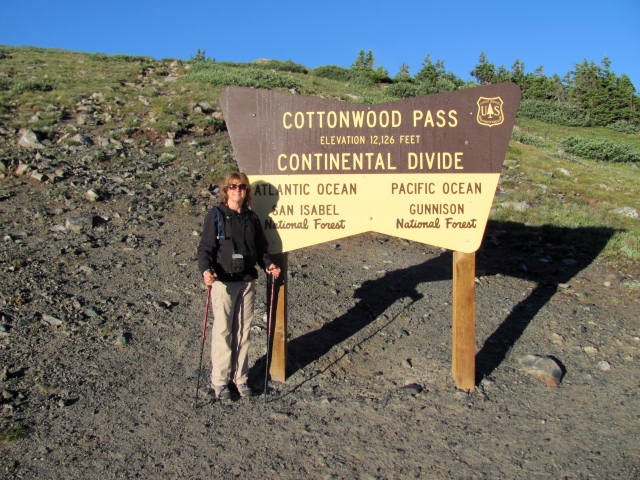
Joyce (K0JJW) at the trail head, Cottonwood Pass.
In fact, we followed the Continental Divide Trail (CTD) to get to this SOTA peak. I’ve done several backpack trips on the CTD and its always a blast to be walking along the top of the continent enjoying the awesome views.
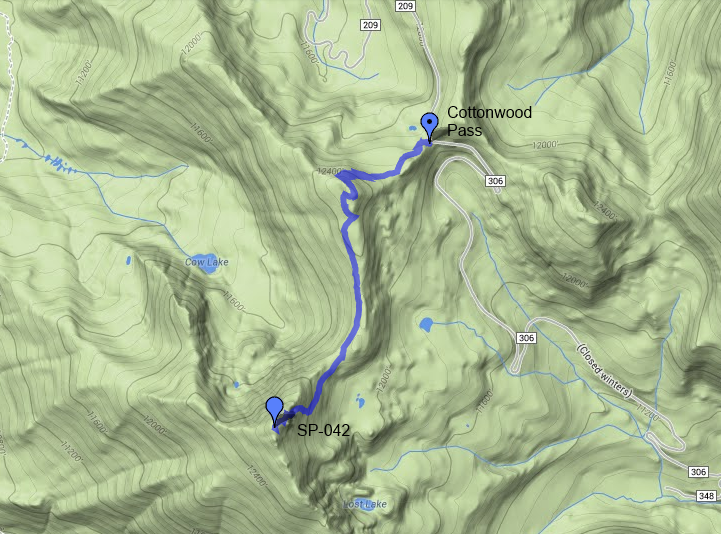
The trail starts at Cottonwood Pass and runs along the Continental Divide.
The main trail passes over the top of another summit at 12,400 feet before continuing on to SP-042. The trail does not go to the top of SP-042, passing it on the east side. We just stayed on the trail until we were due east of the summit, then climbed up the east side which turned out to be a bit steeper than it looked. On the way down, we left the summit by following the ridge a bit to the south and found a gentler route back to the trail. Also on the way back, we followed a side trail to the east of the 12,400 foot summit, saving some vertical gain and loss. My GPS app on the iPhone logged the one-way distance as 2.2 miles (including going over the first summit). It looks shorter on the map but the switchbacks add some distance.

Bob (K0NR) on the trail.
After we reached the summit around 9 am, I quickly assembled the 2m/70cm Arrow antenna and mounted it on my hiking stick. Once I had the FT-817 up and running, I spotted myself on Sotawatch.org using the SOTA Goat app. Logging was done with HamLog on my iPhone.
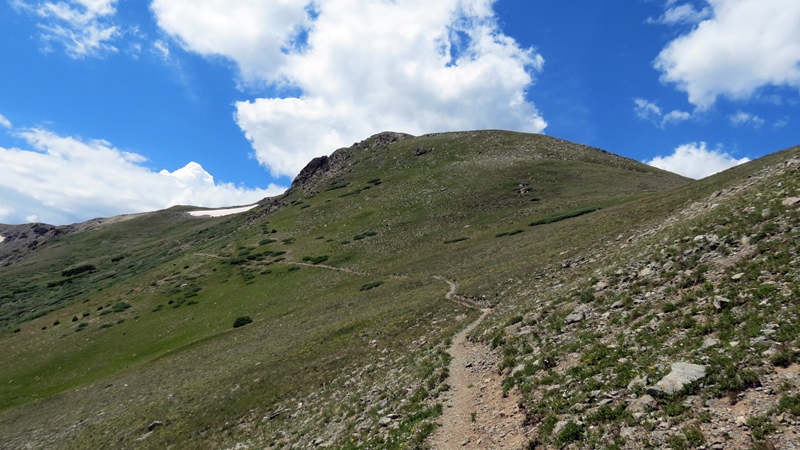
Typical trail conditions on the CTD.
I worked a number of mountaintop stations on 2m fm (147.42 and adjacent simplex frequencies) with the best DX being N4MMI on Redcloud Peak, about 80 miles away. I tried calling on 2m and 70 cm SSB without any luck. Joyce made a few contacts on 446.0 MHz using an HT with a vertical antenna.
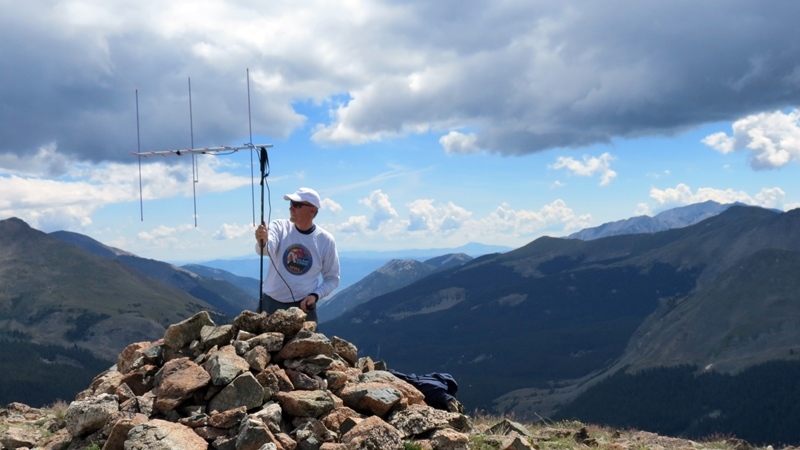
Bob (K0NR) pointing the 2m yagi (vertically polarized) for maximum signal strength.
The weather cooperated all morning with mostly white fluffy clouds. We stayed on the summit until noon and then hit the trail back to the pass. This hike is now one of our favorites, really good for visitors that want a taste of hiking above treeline with great views.
73, Bob K0NR
QRP Works – QRO Works Better
For more than a decade, beginning in 1996, I adopted the QRP lifestyle and had more fun building kits, learning about antennas, making friends and filling the log than I had during any other period of my many decades in the hobby. Granted, my goals during that period were modest, but I’ve never had much problem making contacts using QRP and CW with wire antennas.
Count me as a believer in the magic of QRP. But while contacts can be made using QRP, that doesn’t mean it’s always easy for the guy on the other end of the link, who may struggle mightily just so I could put him in the log and publicly proclaim, “QRP Works!” Low-power enthusiasts should always acknowledge that any success is not so much theirs as it is the guy on the other end of the contact.
Beyond that, admitting that there are benefits to be derived from generating a potent signal is important because they are many. You don’t read much about that in the posts of QRP blogs. Most seem to take great pleasure in pointing out that “QRP works” without mentioning the obvious — if low power CW works then high power CW works too.

This last weekend, John Shannon, K3WWP, a devoted QRP and CW enthusiast and co-founder of the North American QRP CW Club (NAQCC) surpassed the 20 year point in a continuing “streak” of days (7,305) making at least one CW contact. Using low-power and simple wire antennas. From a less than desirable HF radio location. It’s an impressive show of perseverance and tenacity that he says was done to show that QRP CW works. He wrote:
“This is dedicated to all those who say things like ‘You need high power, big antennas, and a great location to be able to make ham radio contacts’, or ‘Life is too short for QRP’, or ‘CW is dead’ and other such remarks denigrating QRP/CW.”
But I would suggest that there are fewer operators who claim “QRP doesn’t work”, than there are QRP enthusiasts willing to concede that finding a potent signal that pops out of the noise floor is one of the great joys of abiding in the shortwaves.
The “right tool for the right job” is an eternal wisdom. It’s always been good advice. “If all you have is a hammer, every problem begins to look like a nail” is another nugget of wisdom. Putting them together and stretching them to fit, I came up with a corollary:
If all you want to use is QRP, you’ll spend your life preaching how well it works.
Common sense, and physics, support the notion that if a five watt CW signal can be copied, a 1,000 watt signal will be easier to copy despite the vagaries of propagation, QRN, and QRM — though you won’t find that truism bandied about much.
QRP Works – QRO Works Better.
I’m going to have that tee-shirt made. Who wants one?


Five Ways IRLP is Better Than D-STAR
The history of the Internet Radio Linking Project (IRLP) goes all the way back to the last century when David Cameron, VE7LTD created it. His was an effort to link repeater systems across Canada using the Internet. Since then, the system has evolved, matured and grown. And it’s still growing. Today, there are nearly 1700 active nodes around the globe.
I built an IRLP node (4212) way back in 2003 and have operated it as a simplex UHF node in my home ever since. With it and my handheld transceiver, I’m only ever just a few touch-tone presses from linking my system to repeaters and other simplex nodes around the planet.
These days, much attention is heaped on D-STAR, the growing digital network promoted by ICOM. Digital systems have some advantages that might be very useful going forward in the amateur service. I use and support the continued deployment of D-STAR, but if you’re thinking about diving into linked systems, I can think of five good reasons why IRLP should be considered before taking the digital plunge:
- IRLP uses standard FM. There are few radio amateurs who don’t already have a standard two meter or 440 transceiver at their disposal. D-STAR equipment is generally more expensive, and it obsoletes perfectly good hardware.
- D-STAR systems usually require all new repeater hardware. IRLP can make use of existing, standard FM repeater installations with the addition of some simple equipment. Clubs don’t have to chuck their previous investment in their repeater system to deploy IRLP.
- If you can push-to-talk and press a few touch-tone keys, you can link your local IRLP system to others. D-STAR equipment is much more complex to use. Programming software is generally employed to make the task of setting the new D-STAR radio up a bit easier but despite ICOM’s best efforts to make it simple, it remains a steep learning curve.
- The D-STAR system can be accessed directly via the Internet via the DV-Dongle. While this could be seen as an advantage, radio purists will blanch at the notion of operators “getting on the air” directly via the Internet. Sure, the Internet provides the backbone for IRLP, but it’s a system design requirement that real radios are required on both ends of an IRLP link. That’s why VE7LTD used the “keeping the radio in ham radio” motto.
- And then there’s the audio. Listening to an FM transmission from a properly adjusted ham radio repeater is a joy. D-STAR audio on the other hand is compressed, tinny-sounding. It’s not a showstopper and most D-STAR fans will tell you they have grown to prefer the pinched audio. Still, the first impression of many is that the audio is painfully compressed.
I might also add that IRLP is available over a wider geographic region than D-STAR. That’s probably due to its ease of deployment, lower investment, and the five year head start it has on digital systems.
Linked VHF/UHF repeater systems aren’t for everyone, but I see plenty of utility in amateur radio having its own “intercom” system that provides reliable, stable, enjoyable communications — when the Internet is up and all systems are “go”.


Long Shadows of Summer
When I got home from work last night I quickly mowed the lawn because the weatherman said there was a sixty percent chance of rain on Saturday and Sunday and I wanted to get ahead of the game. After working in the yard I plopped down in the shack to see if I couldn’t make quick work of the W1AW/1 and W1AW/9 portable stations.
Worked them both within a whisker of each other on 40 meter CW then worked them both again later on 80 meter CW for insurance. I didn’t think the Indiana station would be difficult, but I wasn’t quite as confident about Rhode Island but all’s well that ends well and both are logged and another week of the QSO Party is behind us.
Given that the weatherman said it would probably rain, I shouldn’t have been surprised to wake up this morning to sunshine and blue skies. I swear the weather prognosticators are getting worse at their jobs even as technology has delivered into their hands unfair advantage over the elements.
Brenda says it’s because the weather has become “news” and all of them want to be the first to report a bad storm using giant touch-screens powered by super, frappa, chappa, slappa doomsday doppler radar systems.
She might be right…

Anyway, with the sun shining we hit the local farmers market early this morning and picked up more sweet corn, tomatoes, and a great big melon. And get this, the guy who was selling from the back of his melon truck, told everyone who would listen that he would be back in two weeks — with apples.
Yep, the days are ticking away and the orchards around here are near to busting with autumn goodies. Another cold snap is due to arrive here on Monday and it looks like the first few nights of August could break a few records.
Not to worry though, I’m certain there remains yet a few more days of blistering heat before Summer yields to Fall, but we’re on the backside of 2014 with school days and sweet apple cider coming up fast.
Filed under: Ham Radio, Life Tagged: cw, hr, qso


Baby Steps in the Second Century of Radio
Everyone is talking about where the hobby is going in this “Second Century” of amateur radio and big ideas are falling like rain. Here’s something fairly simple that I’d like to see come to fruition. It should go without saying that these are fictional press releases…
#PRESS RELEASE
January 3, 2015
Chinese electronics manufacturer WunDuko announed today the immediate availability of a new VHF/UHF handheld transceiver for the amateur radio market. The device supports a thousand memory channels with alphanumeric display. The advanced communications device includes low-power Bluetooth communication permitting it to be programmed and upgraded via Bluetooth from a smartphone or personal computer. The handheld is expected to retail for $159 US.
END
#PRESS RELEASE
January 4, 2015
Internet Labs today announced the availability of a suite of Android applications intended to work with the new dual-band amateur handheld from WunDuko. The software enables Bluetooth communications between a smartphone and the transceiver. One of the apps included provides easy access to the full menu of options in the handheld, including the ability to program the memory channels, via the phone interface.
One of the other apps provided in the suite enables GPS data from a capable smartphone to be transmitted periodically via the handeld transceiver while position data from the radio appears on the phone via Google Maps. A company spokeman said, “it’s the perfect mobile APRS solution. There’s no klutzy hardware interface required between the devices and no reason at all to carry multiple GPS receivers.”
He also noted that the GPS in the smartphone works regardless of having a cellular connection. “Pairing the smartphone that you carry everywhere you go with the new handheld transceiver is the kind of sensible innovation we’ve been waiting on from the Japanese manufacturers for years”.
The Android app suite is available now in the Google Play Store for $9.99 US. Look for it to also be available on iOS in the coming months.
END
Filed under: Ham Radio Tagged: aprs, fiction, future, hr


DXCC Manager Injured
DXCC Manager Bill Moore, NC1L, was seriously injured in an automobile accident about two weeks ago. His neck was broken, leaving him paralyzed from his upper body down, with limited movement of his arms. Recovery will be difficult and slow, and is not expected to be total.
Bill would like to hear from his friends. He is currently in the Mount Sinai Rehab Hospital in Hartford, but cards and well wishes should be sent to 92 Reservoir Rd, Newington, CT 06111.
Filed under: Ham Radio


This Spewed Out of the Internet #28
 More important
 things have spewed forth from the interwebz:
HamRadioNow interviews the Ham Hijinks guys and has the nerve to actually publish the video. Later the Hijinks crew posted this article about changes being made to Field Day.
Baofeng is going to change its name. Or is this just another Ham Hijinks article?
WE2F writes: 146.52 Reasons to Monitor VHF Simplex but whatever you do, do not use 146.52 MHz on Field Day. Mike AD5A posts Why Operate QRP from Summits? The FCC kicks the butt of a cell phone jammer manufacturer, to the tune of $34.9M and also fines a couple of 14.313 MHz problem children.
A Broadband Over Powerline (BPL) provider bites the dust. Did I mention that it is a really dumb idea to transmit bits over AC power lines?
I did a little explaining about those antenna connectors on handheld radios. Randy (K7AGE) has a neat video showing some basic 2m FM portable operating.
I knew it: Digital is overrated and vinyl is making a comeback. Really.
Due to popular demand, I updated the VHF QRP page. Yes, some radio hams do operate QRP above 50 MHz…apparently for the same reasons that people operate HF QRP. Which is to say we really don’t know why.
I also found that the domain name for the Colorado 14er Event was broken, so I fixed it. See ham14er.org This event is the most fun you can have dorking around with radios in the Colorado mountains. Also, be sure to check out these operating tips.
73, Bob K0NR













