Archive for the ‘ham radio’ Category
 The list of projects is huge!
 August 22nd, 2014 |
  Author:
 I have been having serious radio withdrawal – I am really itching to get on the air and operate! Unfortunately, life is happening and I have had zero time to operate.
When this happens I usually watch a lot of videos and read blogs. This then leads a big list of “I wanna do that” type projects.
So I thought I would list the top 3 or 4 here and set a goal of getting them done by Christmas:
1. Get a long wire inverted L 9:1 UNUN antenna installed at the house. I have the UNUN built and I have the small gauge “stealthy” wire from the Wire Man – just need to get it up in the trees!
2. Rockmite 40 – I have had this kit along with the Mitybox for several years – just need to get it built.
3. DIY Powerpole Distribution Block – There are some great plans for this here: http://www.qsl.net/wd4bis/connect.htm
4. Magnetic loop antenna with automatic controller. I have the board, just need some components to get the board built up and working – I really want to get this going early this fall!
The list is much longer – but this is the top four I want to get done right now.
What is on your project list?
The list of projects is huge!
I have been having serious radio withdrawal – I am really itching to get on the air and operate! Unfortunately, life is happening and I have had zero time to operate.
When this happens I usually watch a lot of videos and read blogs. This then leads a big list of “I wanna do that” type projects.
So I thought I would list the top 3 or 4 here and set a goal of getting them done by Christmas:
1. Get a long wire inverted L 9:1 UNUN antenna installed at the house. I have the UNUN built and I have the small gauge “stealthy” wire from the Wire Man – just need to get it up in the trees!
2. Rockmite 40 – I have had this kit along with the Mitybox for several years – just need to get it built.
3. DIY Powerpole Distribution Block – There are some great plans for this here: http://www.qsl.net/wd4bis/connect.htm
4. Magnetic loop antenna with automatic controller. I have the board, just need some components to get the board built up and working – I really want to get this going early this fall!
The list is much longer – but this is the top four I want to get done right now.
What is on your project list?
KA9Q on Rebooting ISEE3
Phil Karn, KA9Q is an Internet pioneer with his name on at least six RFC‘s. Best known in the world of amateur radio for his KA9Q NOS as well as numerous AMSAT satellite communications projects.
Retired from Qualcomm, Karn seems to be staying busy with other interesting projects — like this one.
Phil Karn on the reboot of the 1978 International Sun/Earth Explorer-3 (ISEE-3)/ (International Cometary Explorer) from InterWorking Labs on Vimeo.
Filed under: Ham Radio Tagged: amsat, ka9q, satellite, space, video 


Time Passages
Shortwave Broadcasting is Dead
Who among us didn’t get baptized in ham radio via shortwave listening? A special committee on the future of shortwave broadcasting paints a grim picture. “While there is still a critical need for shortwave in key countries, it is a medium of marginal and continuously declining impact in most markets.” The report said that even in countries where shortwave radio enjoys significant usage levels, “audiences will migrate to other platforms as they become more accessible.”
QRP Blog Ends Syndication
W2LJ decided to end the syndication of his ham radio blog on AmateurRadio.com, a popular blog aggregator. I don’t know how long his posts had been picked up and re-broadcast there, but it’s been available for quite some time. His explanation was guarded, though he did write that it was a decision he’s been mulling “since this past Easter”. He also mentioned that not all his musings are about ham radio, some of them detail his religious beliefs and that may have played a factor.
Larry says his blog will remain open for business.
Leaving TenTec
In other passages, Jim Wharton, NO4A has resigned from TenTec. He assumed day-to-day operation of the company as President in January of this year when Jack Burchfield, K4JU retired.
This is likely related to the new association with RF Concepts and the assessment of the need for multiple leaders as a result of the merger. Or Wharton found a better gig. Or maybe TenTec really is going belly-up. Hard to say as the situation there seems anything but predictable…


Adventure Tuner Kit
The Adventure Tuner Kit from SOTABEAMS is an affordable small project suitable for beginners and pros who will end up with a useful wire antenna tuner. According to SB:
It’s an L network tuner – but with a difference: the L network is bi-directional to increase the matching flexibility of the tuner. Both sides of the L network can be used for the antenna or the radio. It’s got co-ax socket on both sides of the network too so it can be used to extend the useful tuning range of narrow-band co-ax fed antennas – such as making an 80 m dipole usable across the whole band.
The inductance is provided with switched inductors giving a range of 0 – 5.6 uH in 0.1 uH steps. Hyper-bright LEDs indicate antenna current to aid tuning. They are in circuit all the time to give you reassurance that your system is working at peak efficiency. The typical matching range of the Adventure Tuner is 3.5 – 30 MHz.
It looks like another swell Saturday morning project melting solder followed by radio adventures from the field and shack.
What’s not to like?


Pursuit of Happiness
The Amateur Radio Parity Act of 2014, is a congressional effort to direct the FCC to extend the “reasonable accommodation” provision for ham radio antennas to include all types of land-use regulation, including deed restrictions and restrictive covenants. I predicted this would die a swift death, and while I still expect it to fail to become law, the “swift” part may not come to pass as the bill continues to gain co-sponsors.
So while that works its way through the political maze in Washington, it has sparked a more interesting debate in the world of amateur radio. Most of us might expect the fraternity to embrace any regulation that benefits us, yet a few cracks of dissension have started to show. Beginning with an appearance on HamRadioNow (#158) by Mike Alexander, N8MSA who cited his libertarian view that the government shouldn’t get involved in private contracts.
While his is far from the prevailing view, I’ve been surprised by the number of hams who have adopted it as their own and are reciting it in online forums, mailing lists, and social media.
Though I have my own reservations about shoving ham radio down the throats of muggles via government legislation, I also find a chuckle or two in the notion that this is a desirable libertarian cause. I mean come on, ham radio inhabits a swath of radio spectrum that can only be used by federally licensed devotees. The entire notion of a select group of citizens being exclusively handed publicly owned radio spectrum is anti-libertarian. For the true zealot, the proper view would be that the airwaves belong to “we the people”, not the federal government, who should auction it off to the highest bidder and get out of the business of regulating it altogether.
You might have a more difficult time finding any supporters for that kind of political correctness among the rank-and-file radio hobbyists.
What this really comes down to is decisions, choices, compromise, and the pursuit of happiness. One fellow’s 70-foot tower and antenna brings him happiness but ruins it for his neighbor. Another fellow wants his kids to go to the best schools, be near the amenities of city life — while abiding in a Norman Rockwell painting neighborhood — but he doesn’t want to agree not to plant an antenna farm in that Nirvana. Or worse, he does agree and signs on the dotted line, but now wants Uncle Sam to bail him out of his poor decision.
I understand the broader issue is much more complicated than that, but it’s tough to get much sympathy from those of us who made the decision to live outside the confines of fancy neighborhoods in favor of owning a home with no land-use restrictions.
But you can’t throw the baby out with the bath water. In a vacuum, local governments are as bound to overreach as the feds. Without legal protection, whose to say that some local tin-horn dictator won’t slap antenna restrictions on places that have never before heard of them? I like to think that PRB-1 provides that protection, but who knows?
It all feels a lot less reassuring when you read how an HOA expert interprets these things.


SOTA Summit Activation: Sandia Crest (W5N/SI-001)
Joyce KØJJW and I were headed to the Duke City Hamfest in Albuquerque when we decided to make a side trip up Sandia Crest for a low overhead (read: slacker) Summits On The Air (SOTA) activation.
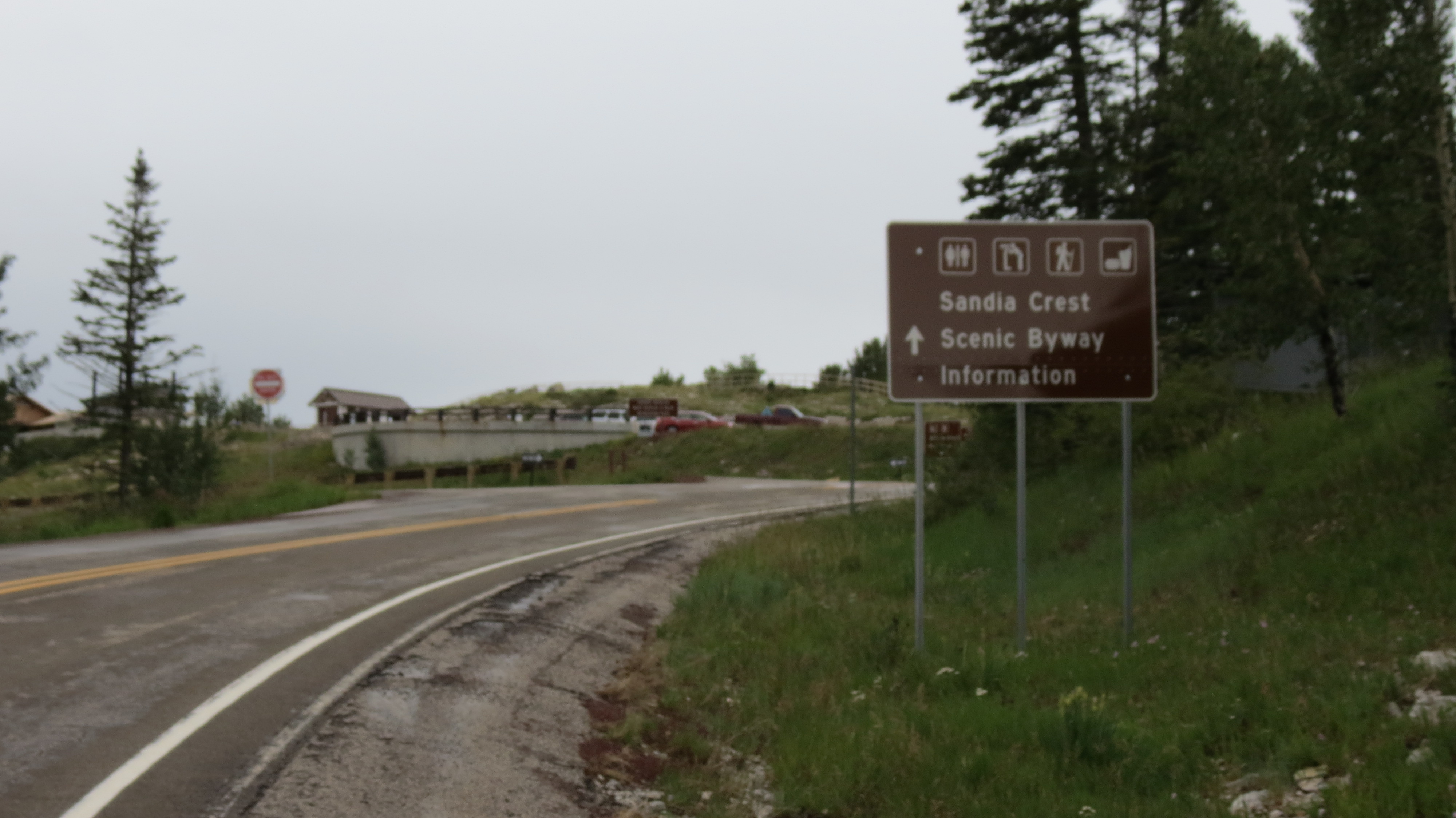
The view of the summit when approaching via the Sandia Crest Road.
Sandia Crest pokes up 10,678 feet, towering over Albuquerque at roughly 5000 feet. Although the weather was rainy, we enjoyed the drive up the paved Sandia Crest Road through the Cibola National Forest. This looks like a great area to explore and we’ll probably be back sometime in the future.
At the parking lot, about 40 vertical feet below the summit, we paid the $3 per day use fee (self-service USFS station), grabbed the radio gear and headed up the walkway to the top. There is a gift shop and restaurant at the south end of the parking lot, along with several hiking trails. A large radio site on the north end of the parking lot has numerous towers and high power transmitters. The field strength is so strong that a sign has been placed there to warn of radio interference to car alarms and keyless remotes.
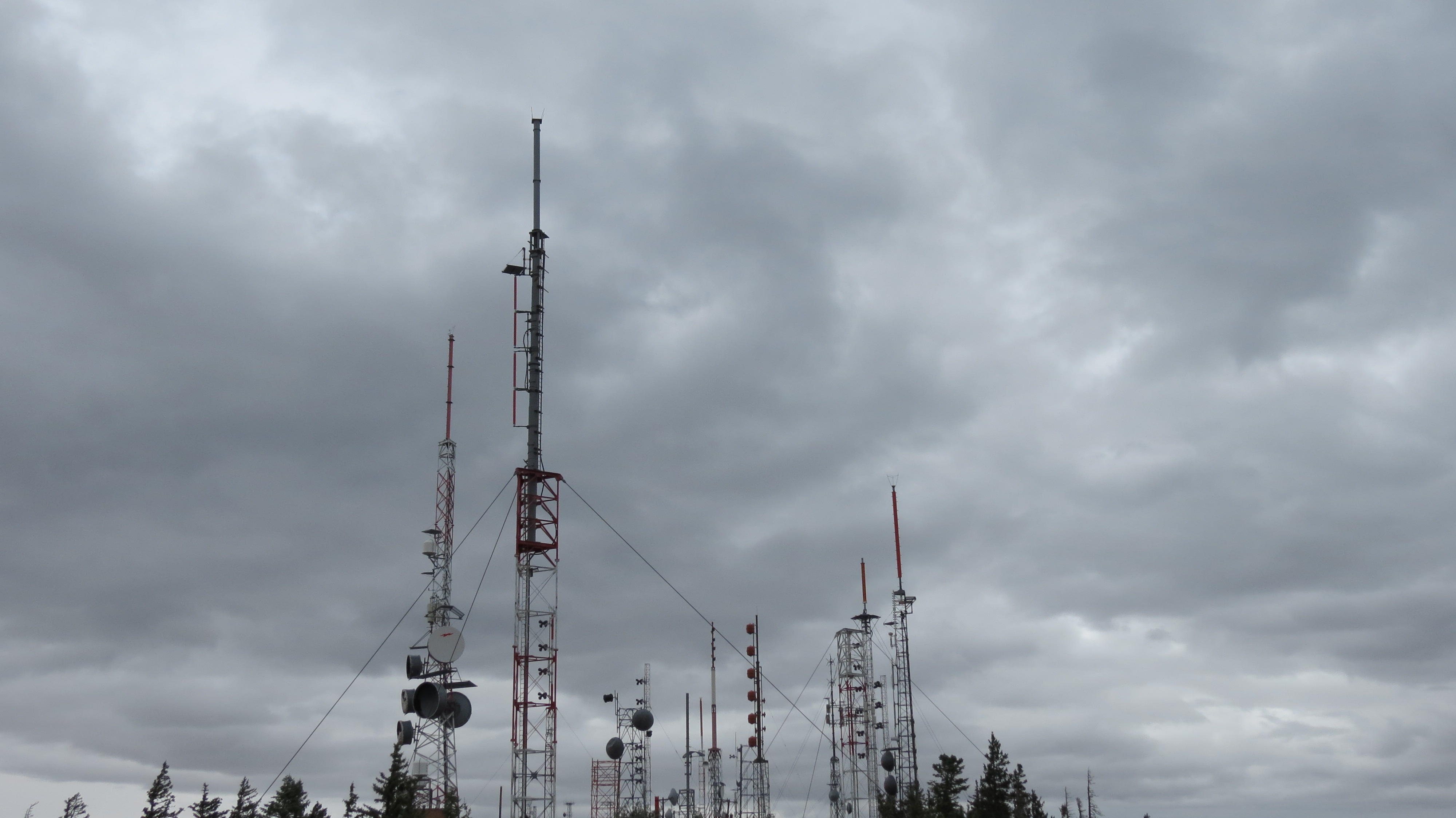
There is a large radio site with powerful transmitters near the summit.
I pulled out the trusty Yaesu FT-60 handheld transceiver with the MJF-1714 1/2-wave antenna for 2 meters. I gave a few calls on 146.52 MHz and heard no replies. I am thinking, “surely with so many hams in town for the hamfest, someone is listening on five two.” Joyce was standing next to me with her FT-60 and a rubber duck antenna. We noticed that her radio was hearing signals that I could not hear.
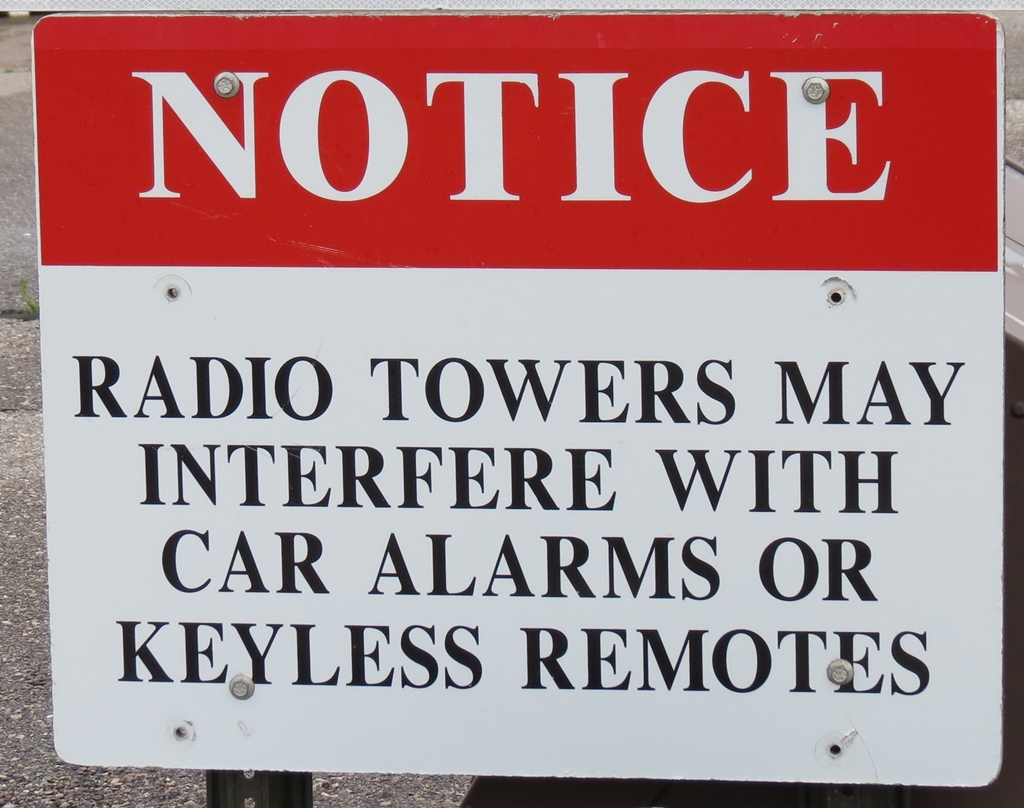
Well, this sign did warn me of radio interference.
Hmmm, the radio with the better antenna is not able to hear anything but the radio with a crummy rubber duck is working fine. At this point, I realized that my HT was being overloaded from the transmitter site with my high-efficiency antenna doing a great job of coupling those signals into my radio. I had to chuckle about this since I’ve often pointed out the poor performance of your typical rubber duck antenna. In this case, the less effective antenna was doing us the favor of reducing interference.
I swapped antennas and began making calls on 2m fm with the rubber duck. I also moved further away from the radio site to reduce the signal level. Yep, now I heard some guys coming back to me on 146.52 MHz. I could tell there was still some interference but it was workable. In short order, I had these stations in the log: KE7WOD, W5AOX, K5LXP, WB5QXD and K0JJW (after moving downhill outside of the activation zone),. Thanks for the QSOs!
I will admit that NM5SW mentioned the interference problems on this peak, so I had fair warning. Keep in mind that the FT-60 has reasonably good intermod performance, probably better than your average HT, and was getting completely blocked with the long antenna. I was glad that I was not using one of the Baofeng HTs. It made me wonder how well my FT-817 would do under the same conditions, but that will be a test for another day.
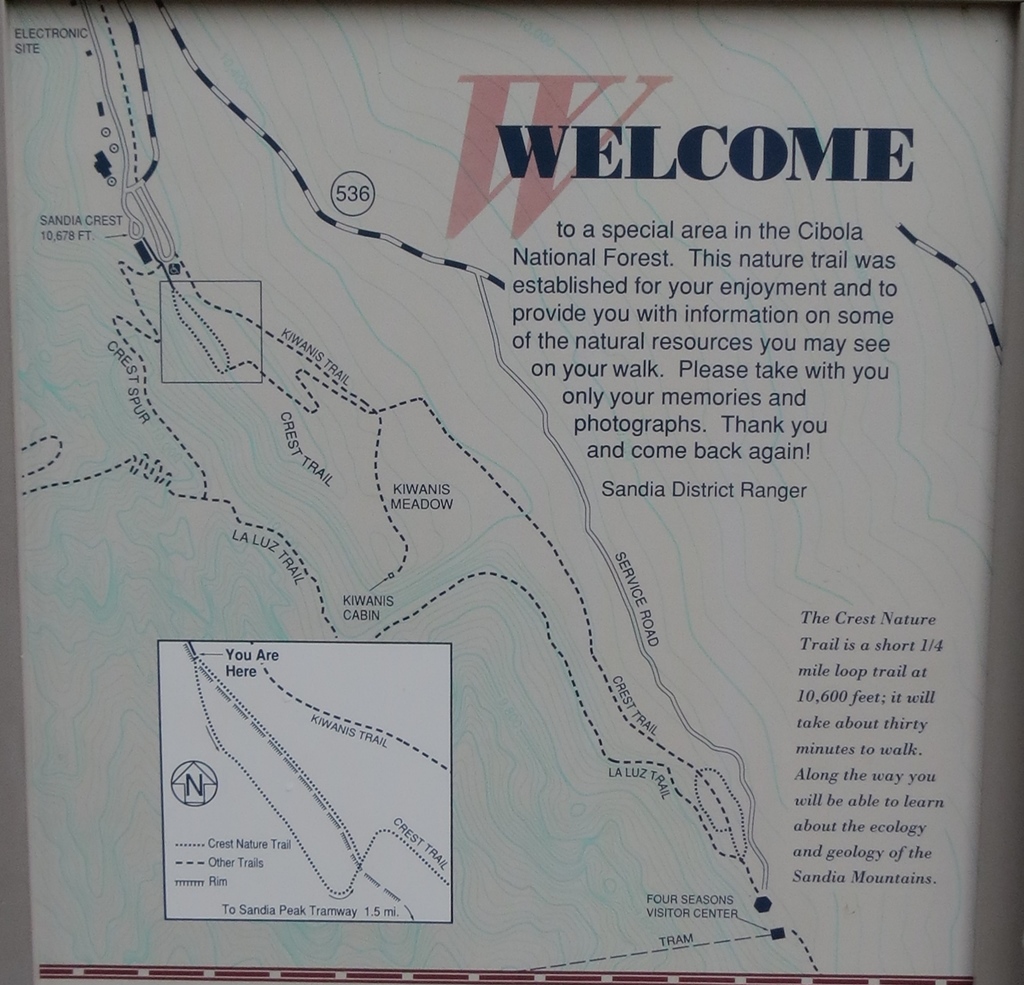
This sign shows the trail system at the summit and the location of the tram.
Another way to ascend the peak is via the Sandia Peak Tramway, which comes up from the Albuquerque side. We came across this sign that shows the trail system near the summit and indicates the top of the tram (click to expand). The tram drops passengers off some distance from the actual summit, so you’ll have about a 1.5 mile hike to the summit.
In summary, it was a successful activation although the weather could have been better. The big thing I learned was that a more efficient antenna is not always the best antenna. Sometimes a crummy rubber duck does better!
73, Bob K0NR
P.S. I later heard from Mike KD5KC that the Kiwanis Cabin (shown on the map) is a good place to operate from without radio interference issues on HF and VHF.













