Archive for the ‘ham radio’ Category
 That’s Not Real Ham Radio
 April 12th, 2017 |
  Author:
  Things had been pretty quiet on the ham front lately but then I ran into a string of “That’s Not Real Ham Radio” discussions. This happens from time to time…I usually ignore it…but this time I got sucked into the topic.
It started with some HF enthusiasts I know talking about how “digital modes” are just not very satisfying. Their point is that with CW and SSB, there is an audio connection to your ear that makes you an integral part of the radio communication. The extreme-DSP modes such as JT65 insert serious signal processing that essentially removes the human connection. This can quickly lead to the generalization that these digital modes “aren’t real ham radio.”
I think its fair to say that most hams think of the HF bands as the center of the hobby…getting on the air, bouncing signals off the ionosphere to talk to someone over the horizon. Some hams will go even further and say that CW is the only way to go. Anything less is just phone. FM and repeaters? Forget that stuff…not enough skill required. And certainly, don’t get stuck on 2 meters.
In a previous post, I argued we should not confuse religion with modulation. I do occasionally make snarky comments about the continued use of AM (AKA Ancient Modulation), but I’ve tried to tone that down in recent years.
What About DMR?
Just last week, I was playing around with a DMR hotspot on the Brandmeister network. It really struck me that people on the system were having a blast talking to each other across North America and around the world. But then that nagging little voice in the back of my head said “hey, wait a minute…this is not real DX…the RF signal might only be traveling 20 feet or so from an HT to a hotspot.”
This caused me to put out a plea for insight on twitter:
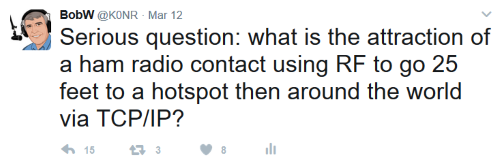 I received a lot of good replies with the answers tending to clump into these three categories:
- I don’t know (“That’s Not Real Ham Radio”)
- It’s fun, new technology
- It’s a digital network that brings ham radio operators together
My interest seems to fall into the second category: this is fun, new technology. Which does make me wonder how long this new technology will remain interesting to me. Well, that is difficult to predict but I’ll invoke the principle of try not to overthink it. The idea that DMR is a digital network that brings ham radio operators together makes some sense. In the past, I have argued that amateur radio is not for talking. In other words, if you just want to talk someone, there are much more convenient ways of doing that. Still, there is something attractive about this ham-radio-only digital network.
It really is important to not overthink this kind of stuff. Ham radio is supposed to be fun, so if you are having fun, you are probably doing it right. If you are not having fun, then you might want to examine what you are doing. See my post on the Universal Purpose of Amateur Radio.
Sometimes hams can get a little spun up about those other guys that don’t appreciate our way of doing ham radio. What the heck is wrong with them anyway? I’ve always been inspired by the Noise Blankers Mission Statement:
Do radio stuff.
Have fun doing it.
Show people just how fun it is.
If your preferred form of ham radio is so superior, it ought to be easy to show other hams how cool it is. If not, then maybe you aren’t doing it right. Conversely, as long as other hams are having fun and operating legally, don’t knock what they are doing. In fact, encourage them. We need more people having fun with ham radio, even if it’s not your favorite kind of fun.
That’s my opinion. What do you think?
73, Bob K0NR
The post That’s Not Real Ham Radio appeared first on The KØNR Radio Site.
Add an On The Air LED to Kenwood MC-60 Desk Mic
In this video I show a few things to test before adding an “On The Air” LED indicator to a Kenwood TS-50 ham radio transmitter. I tested for the best brightness of the LED and lowest current using a ganged restore test box I built. The LED was then mounted in my Kenwood MC-60 desktop microphone.
You can help support my channel by purchasing items from my Amazon Store at no additional cost simply by using my store links.
I have lots of store categories and I own most items or similar items that you’ll find in my store.
Thanks for joining and please subscribe to my YouTube channel.
DMR Codeplug for Tytera MD-380
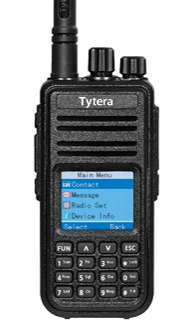 At our radio club meeting on Monday night, I talked about DMR radio, the fastest growing digital format on VHF/UHF. Wow, did I get a positive response! There is a lot of interest in this topic and many of our members are out buying DMR radios and getting on the air. My presentation is available here: DMR W0TLM Meeting Presentation.
Most folks are buying the UHF Tytera MD-380 due to its attractive price point. The price on Amazon seems to fluctuate but it is typically around $100: TYT MD-380 – UHF DMR Ham Radio. Main Trading Company usually has a good price on the radio, too.
A good source of codeplugs for Colorado is the Rocky Mountain Ham Radio web site. I adapted a recent MD-380 codeplug for use in the Monument area: K0NR Rev 1 RMHAM_MD380_2017-10-28.rdt
You’ll need to use the MD-380 software to load/edit this codeplug. See the VA3XPR web site if you need the software. Under General Setting, you must change these entries:
Radio Name – enter your callsign
Radio ID – enter your DMR-MARC radio ID number
Intro Screen – recommend putting your name and callsign there (or whatever you want)
In the codeplug, I created the W0TLM zone for use in the Monument area which should cover most of your needs. After you get used to the programming software, you can add/modify channels and zones. But be careful as there are many parameters that need to be entered correctly.
I will be updating this codeplug from time to time. Let me know how it works for you.
73, Bob K0NR
Update 18 Nov 2017: I updated the codeplug to incorporate the latest RM Ham Radio repeaters. This is based on the latest RM Ham codeplug dated 28 Oct 2017. I highly recommend you adopt the TyMD380toolz so you can just pull all of the worldwide DMR radio ID database into your radio.
The post DMR Codeplug for Tytera MD-380 appeared first on The KØNR Radio Site.
Where are Those New Hams Coming From?
The Tri-Lakes Monument Radio Association just completed another successful Technician license class resulting in 21 new Technicians plus one person that passed both the Technician and General exams. We survey the class a week or two later to get their feedback and capture some demographic information. In recent years, our Technician class has consistently filled to capacity, causing us to ask the question “Where are those new hams coming from?”
The key relevant question on the survey is:
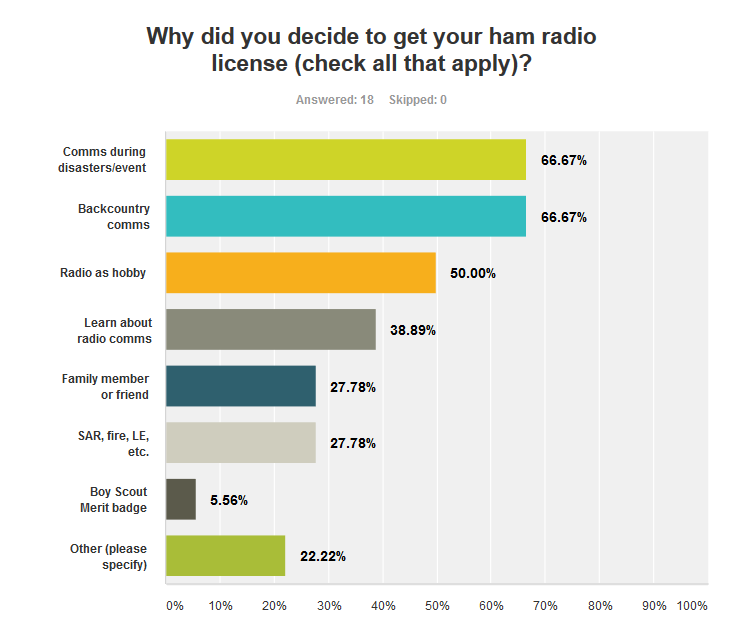 I’ve abbreviated the response choices so they read better on the graph. For example, “Comms during disasters/event” actually says “For communications during disasters or other major events” on the survey. These 18 responses represent over half of the students so they are representative of the class. However, it is a small sample size overall, representing just one class at one time at one location in the US. I will add that the surveys from our other classes are similar.
The two highest responses, both with 67%, are Comms During Disasters/Event and Backcountry Comms. It was no surprise that communications during a disaster would be a prime motivation for getting a ham radio license. Per FCC Part 97, this is one of the stated purposes of the Amateur Radio Service. Here in Colorado, many people have had the recent experience of wildfires disrupting communications causing them to look for alternatives. In general, the prepper movement is causing people to think in terms of disaster preparedness. Communications in the backcountry includes hikers, climbers, fishermen, dirt bike riders, four-wheel drive enthusiasts and anyone who spends time in the mountains. There are many locations in Colorado that don’t have cellphone coverage, so people are looking for alternative communications. This is likely a regional phenomenon…I don’t think you’d see “backcountry communications” on the short list of amateur radio interest is downtown Chicago.
Radio as a hobby gathers 50% of the responses, followed by 39% interested in learning about radio communications. This says that about half of the students are pursuing ham radio as a hobby. I wonder if this is different that the historical average from 20 years ago? I suspect it used to be higher but I don’t have any data to support that. This would likely be a leading indicator for how many of these new licensees get deeply involved in ham radio activities. I have seen students start out with a narrow focus on emergency preparedness but then discover there’s a lot more to ham radio that they choose to pursue.
What do you think about these results?
73, Bob K0NR
The post Where are Those New Hams Coming From? appeared first on The KØNR Radio Site.
Winter SOTA on Monarch Ridge South
Joyce KØJJW and I were out for a little snowshoe activity near Monarch Pass in the San Isabel National Forest. Initially, we were headed to Old Monarch Pass when we noticed that the snow and weather conditions looked favorable on Monarch Ridge (also called Monarch Crest). Last winter, we tried snowshoeing Monarch Ridge twice, failing both times, once due to blizzard conditions that blew us off the summit.
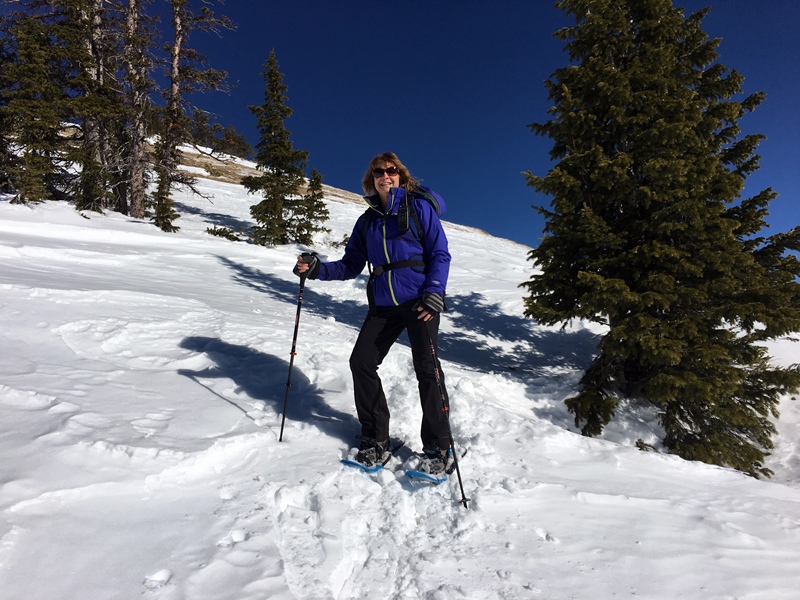
Monarch Ridge South (W0C/SP-058) is the high point and a Summits On The Air (SOTA) summit, so of course it was a great idea to showshoe up there. In August of 2016, we road to the top using the tram. Take a look at that posting for more information on the summit.
For SOTA, Monarch Crest South is a versatile and very accessible peak. The slacker method is to ride the tram up during the summer months. It also can be an easy summer hike. Monarch Pass is at 11,312 feet in elevation and Monarch Crest South rises to 11,898 so the vertical gain is about 600 feet. In winter, it is a reasonable snowshoe trip. However, watch the weather carefully: you might get blown off the summit.
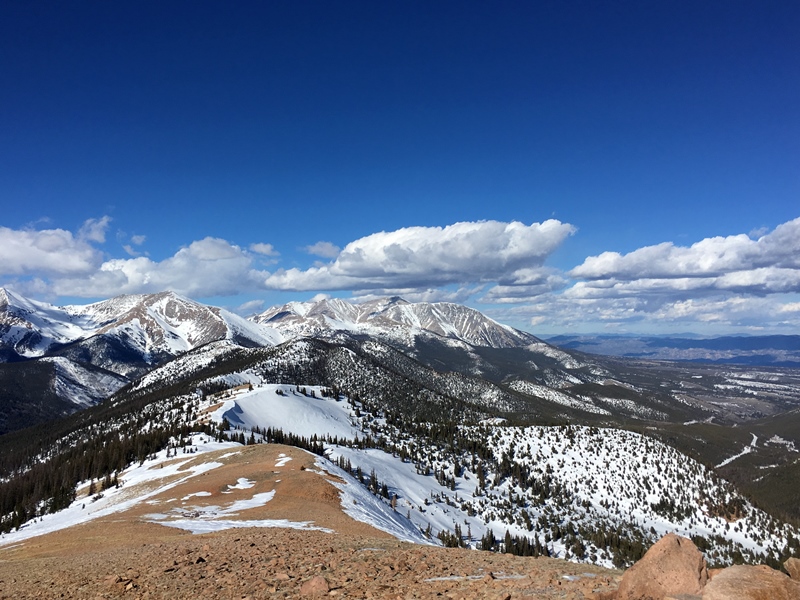
We started from the Monarch Pass parking lot and snowshoed straight up to the summit, roughly following the tram line. This route is simple but steep. Near the top, the ground was bare, so we removed the snowshoes and hiked on bare ground and rocks. I did not have cellphone coverage at the parking lot but I did get “one bar” about halfway up the mountain. I used this to post a SOTAwatch alert and send an email notice to hams in the area.
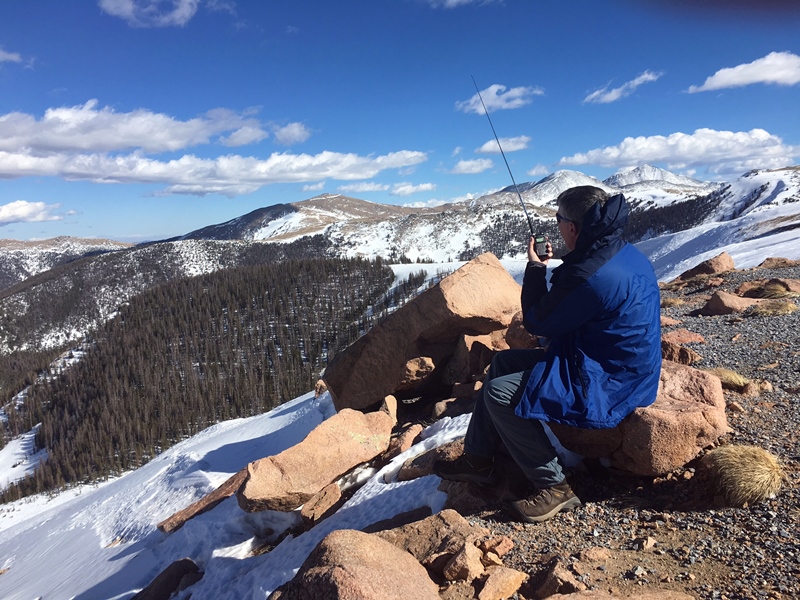
Just like last time, I did have some minor interference on 2m fm from the radio site at the summit, which seemed to peak up right around 146.52 MHz. Lovely. But it did not keep me from making contacts.
As you can see from the photos, it was a gorgeous day. The temperature hung around 35 degrees F with some wind at the summit, so no problem with that. Another great day in the mountains, playing with ham radio.
73, Bob K0NR
The post Winter SOTA on Monarch Ridge South appeared first on The KØNR Radio Site.
HF Ham Radio Kenwood TS-50S Panel Button Repair
The buttons in my Kenwood TS-50S ham radio started falling out when the foam inside started getting old. The foam was the only thing holding the buttons in so I used jewelry repair rings from Michaels Store to clamp around the base of the buttons inside the bezel face plate which then holds the buttons in nicely yet lets them have full travel and good tactical feel.
DMR Hotspot from SharkRF
Amateur adoption of Digital Mobile Radio (DMR) continues to increase, with a number of new innovations playing out. It was way back in 2012 when I wrote this article about DMR for CQ VHF Magazine: TRBO Hits the Amateur Bands.
 A few years ago, I picked up some used MOTOTRBO gear to use on our local DMR repeater system (MOTOTRBO is Motorola’s version of DMR). Here in Colorado, the Rocky Mountain Ham Radio group has been instrumental in establishing a great network of DMR repeaters, a real asset for Colorado radio amateurs. See Rocky Mountain Ham Radio TRBO/DMR Network. Worldwide, the DMR-MARC organization has created a robust network of MOTOTRBO repeaters in over 60 countries.
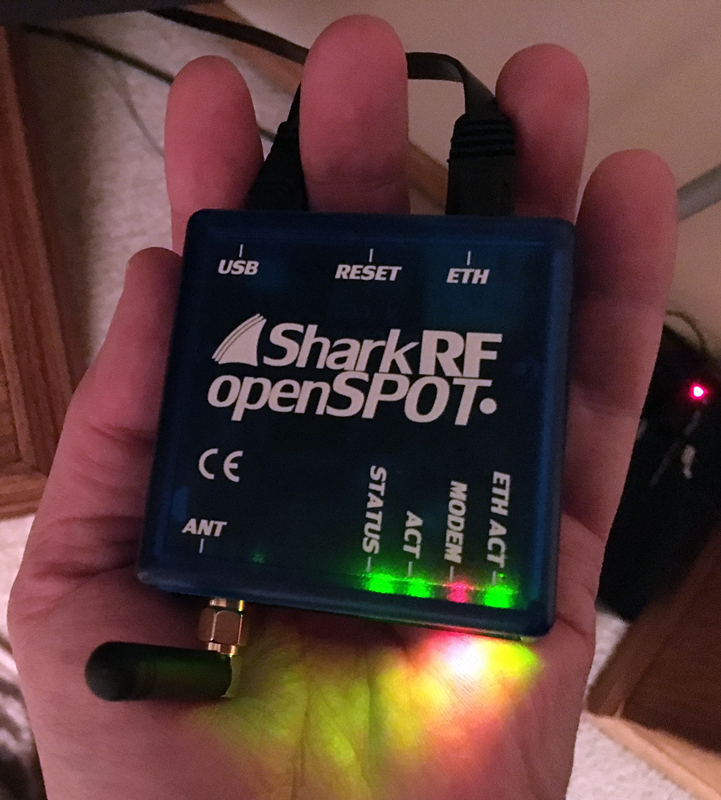
A more recent development is the establishment of the BrandMeister Network, which promotes more of a homebrew approach to DMR. This evening, the BrandMeister dashboard shows 634 industrial repeaters (commercial equipment), 263 homebrew repeaters and over 1300 hotspots of various types. A variety of DMR hotspots are available, including the DV4mini. I’m not going try to list all of the hotspots available as I’m sure I’ll miss something. The SharkRF openSPOT caught my attention because of this excellent review by John ‘Miklor’ K3NXU. Because of its popularity, the openSPOT is on backorder (price: 182.5 Euro).
This HamRadioConcepts video walks through the setup and basic operation.
I thought the openSPOT would be a good widget to have around the shack. It is a standalone hotspot, so I don’t have to dedicate a computer to it. Also, it is very turnkey…no assembly required…but some configuration to work out. Its user interface is a web page that you access via your local network…nicely done. I got it working in less than one hour and have been fiddling around with it ever since.
Hotspots are a funny item. They have very limited RF range, so their main purpose is to provide local RF access into the network (just like your Wi-Fi hotspot). One role they play is to provide fill-in coverage when no repeater is available. Another role they fill is being a personal device that can be connected to your favorite reflector or talk group.
I should point out that the openSPOT also operates as a D-STAR and Yaesu Fusion (YSF) hotspot. You just change the configuration of the modem and it starts speaking the selected modulation. More surprising is that I was able to use a YSF handheld radio to talk to the openSPOT which routed me to a DMR talkgroup. Yes, a Yaesu YSF radio talking on DMR.
The first thing I noticed when listening to some of the more active talk groups is that it seems like every person getting on the system said “I just got this Tytera MD-380 radio and you are my first DMR contact.” OK, sometimes it was a Connect Systems or Motorola radio but the MD-380 at around $100 is having a big impact. I picked up an MD-380 and while its not quite as nice as my Motorola, I really do like the radio. (Note that there are other low cost DMR radios that have serious technical issues.) There will be other radios on the market…the technology will keep improving and improved models will hit the market. Right now, everyone is wondering who will create a good dualband 2m / 70cm transceiver for DMR.
I see some very strong technology and market trends in play here that are going to impact the ham radio world. First off, DMR is a true industry standard (ETSI), well designed and documented. Second, we are seeing multiple radio vendors offering competitive, low cost transceivers. Third, there is high quality commercial repeater gear available from land mobile providers such as Motorola and Hytera. But there’s one more thing that really tops this off: the number of ham-built products emerging that are focused on DMR. This is classic ham radio adaptation and innovation that leverages commercial gear for ham radio use.
Stay tuned…this is going to be interesting!
73, Bob K0NR
The post DMR Hotspot from SharkRF appeared first on The KØNR Radio Site.













