Archive for the ‘ham radio’ Category
 WØC Summits On The Air Dinner
 March 6th, 2018 |
  Author:
 It is time for another W0C (Colorado) Summits On The Air dinner!


Last year, we had 15 people get together for an informal dinner in south Denver (Lone Tree): Steve WG0AT, Wayne AD0KE, Brad WA6MM, Caleb W4XEN, Carey KX0R, John N0TA, Curtis KC5CW, Mark N0MTN, Bob K0NR, Joyce K0JJW, Steve K7PX, Al KH7AL, James KI0KN, Walt W0CP and John N1OIE. It was so much fun meeting people and swapping SOTA stories that we are going to do it again this year.
Wednesday March 21th at 6 pm
Chili’s, 10460 Park Meadows Dr, Lone Tree, CO 80124-5413
Dinner details:
No agenda, no organization, just have fun, pay for your meal
Please wear something with your name/callsign (name tag, shirt, cap, etc.) to aid in making connections
Please send this to anyone you know that might be interested.
RSVP back to Bob K0NR: [email protected] so we have an accurate count for the reservation.
I hope to see you all there!
73, Bob K0NR
The post WØC Summits On The Air Dinner appeared first on The KØNR Radio Site.
My #POTA Pickle, or How I Learned to Stop Worrying and Love the ARRL #DX Contest
Sunday March 4th was a beautiful and slightly cool (mid-seventies) day in Jupiter, Florida and was the day I selected for my first #POTA activation (parksontheair.com). I picked the 11,000 acre Jonathan Dickinson State Park, KFF-1887, just six m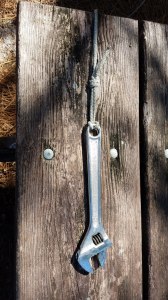 iles from my Florida QTH. I scouted out locations a few days earlier and chose the picnic area near the river, with cooperating pine trees with handy limbs. Using my unique antenna launch tool (see pic) on only the second try I hit my target limb and hoisted the “high” end of an EndFedz antenna cut for 20 meters. My battery was charged, I had my sandwich, I even had a cushion for the hard picnic table bench seat. Right on time I was ready to spot myself, all settled and happy. Do you hear a “but” coming?
This was 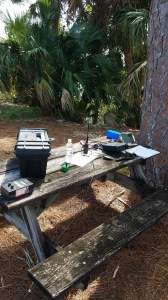 also the weekend ARRL chose, without checking with me, for their hugely popular annual DX Contest. There were a few thousand hams on 20m, most, it seemed, with a kilowatt and a pretty good beam competing with me barefoot with a dipole up all of fifteen feet. I spotted myself on DXSummit.fi but apparently nobody cared. I raised my friend Rick on the local repeater and got him to listen for me at 14.244 a few miles away and we could barely hear one another on ground wave. We were in a wall of sound (and I was learning the value of a filter for sideband.)
So there’s my POTA Pickle; I’m in the right place and all set to operate POTA but cannot compete with a thousand big gun stations. Well golly, let’s join in on the fun then.
First I took down the End Fedz that just doesn’t work that well for me and put up my link dipole made from lamp cord and began to hunt and pounce. Worked a dozen international stations in an hour and called it, after all, a good non-POTA day.
This is Wayne, K4WK, http://www.hamdom.com. Thanks for listening; you’re in the log.
Ham Radio Deluxe 6.4.0.794 Released
I just received some good news from Mike, WA9PIE. He writes in an email:
The first release of Ham Radio Deluxe for 2018 (Ham Radio Deluxe version 6.4.0.794) is now available for download. Please download it from the Download pages on our website at:
https://www.hamradiodeluxe.com
This release includes a number of important changes including the addition of the Icom IC-7610, resolves a Logbook exit problem, resolves “sort on LOTW date”, API for QSO Forwarding now populates Logbook with My Station data, a number of fixes for the Kenwood TS-480, applications remember screen position, enable CI-V address to be entered directly, and a number of stability enhancements.
The full release notes can be found here:
http://ReleaseNotes.hamradiodeluxe.com
I would like to acknowledge and thank Mike Blaszczak (K7ZCZ) and our beta team on their hard work in getting this release out.
All those who have purchased Ham Radio Deluxe at any time in the past should download and install this version in order to benefit from all bug fixes. You are entitled to them. Our clients who are covered by an active Software Maintenance and Support period are entitled to Feature Enhancements.
As announced previously, we expect to release as many as 9 releases in 2018. There will be no releases between 1-Nov and 1-Jan. We continue to focus on reducing our development backlog with five developers dedicated to all applications in the suite.
Please watch these newsletters for updates. Pass these updates along to your friends. Newsletters will also be posted on our website’s blog at:
https://www.hamradiodeluxe.com/blog
Thank you es 73 de Mike, WA9PIE
HRD Software, LLC
Travel Footage: 3Y0Z Antarctic Bouvet Island DXpedition 2018 Expedition (by EY8MM)
Here is video footage of the journey to Antarctic Bouvet Island, made by the 3Y0Z amateur ham radio team. This footage caught a few moments on the deck of M/V Betanzos.
As you can see in the last moments of this footage, the weather conditions contributed to the decision to abort the DXpedition, as it was far too dangerous to continue this expedition.
As reported by ARRL:
“Our captain has decided that it is in the best interest of safety and expediency to proceed directly to Capetown, South Africa, rather than Punta Arenas, Chile. We are now heading north to avoid the possibility of encountering ice. Currently, there is no ice in sight or on radar. In due time, we will head easterly toward Capetown. Our entire team is safe. Most are resting in their bunks and in good spirits. We will keep the amateur radio community and our families informed, as we continue our journey.”
In a huge disappointment for the DX community and the members of the 3Y0Z Bouvet Island team, the DXpedition’s leaders announced at 2000 UTC today (February 3) that a decision had been made to abort the DXpedition and head back to Chile.
“During the last 72 hours, we continued to experience the high winds, low clouds, fog and rough seas that have prevented helicopter operations since our arrival at Bouvet,” said an announcement on the 3Y0Z Bouvet Island website. “No improvement was predicted in the weather forecast for the next 4 days. Then, last night, an issue developed in one of the ship’s engines. This morning, the captain of the vessel declared it unsafe to continue with our project and aborted the DXpedition. We are now on our long voyage back to Punta Arenas. As you might imagine, the team is deeply disappointed, but safe. There is already talk about rescheduling the DXpedition.”
Bouvet Island currently is the third most-wanted DXCC entity, behind Kosovo and North Korea. The 3Y0Z DXpedition, comprised of top operators with considerable DXpedition experience, has been in the planning stages for 2 years and had attracted contributions from clubs and individuals around the world.
A dependency of Norway, Bouvet is a subantarctic island in the South Atlantic. The last Bouvet activation was 3Y0E, during a scientific expedition over the winter of 2007-2008.
Video Author: Nodir Tursun Zade, EY8MM
This copy is used BY PERMISSION from EY8MM, given in writing on 23 February 2018
Review – BTech AMP-25 series for Analog & DMR
The AMP-25 series VHF / UHF Amplifiers

The recently announced BTech Digital and Analog amplifier series puts a whole new spin on mobile operation. It performs more like a mobile than it does a power amp. The D series are true TDMA Tier2 DMR amplifiers.
Note: This review was done using an Anytone D868UV on both DMR and analog.
In the Box
Included with the 40W Mobile Amp are:
– Mounting Bracket
– 3′ Interface Control Cable (Kenwood K1 connectors)
– 3′ RF connect cable (SMA-M to SMA-F)
– Microphone and Hanger
– All necessary mounting hardware
– User Guide
General Description
– UHF or VHF Power Amplifier
– 2-6W > 20-40W Output
Modes of operation include:
| V25 U25 | V25D U25D |
| Analog (FM) C4FM (Fusion) P25 (Phase 1) NXDN IDAS dPMR MPT1327 | > DMR Tier II (TDMA) > P25 (Phase 2) Analog (FM) C4FM (Fusion) P25 (Phase 1) NXDN IDAS dPMR MPT1327 |
A Different type of Mobile Amplifier
I found these to be much more than a typical power amplifier. Although they can function as a simple ‘In and Out’ power amp, this is about as close to a full mobile as you can get. Although the driving  force was my DMR handheld sitting in my cup holder, the transmit audio was that of the included hand microphone and the receiver audio out was coming through the built in speaker driven by a four watt audio amplifier.
Transmit Power
I tested the power on two different models. The VHF V25 (non TDMA) and the U25D for UHF DMR. The power was tested using the analog side of both into a calibrated Bird Termaline wattmeter. The maximum current drain from my 13.6V 30A power supply was just under 6A. This is low enough for the amp to be powered by the 10A accessory jack in your vehicle.

Enclosure
The basic frame measures 4.6″W x 1.3″H x 5.5″D (excluding the SO-239) and weighs in at 26oz. I was curious to see the internal layout of the amp and to no surprise, there was a 5/8″ finned heat sink spanning the entire length and width of the case along with air vent along the back of the enclosure.
Operating Modes
These are single band amplifiers.
V25(D) = VHF 136-174MHz
U25(D) = UHF 400-480MHz.
Note: The V25D and U25D were designed to include DMR Tier II (TDMA) and P25 Phase 2 along with all other modes. Their operation varies slightly.
V25 / U25
To operate VHF through the UHF (U25) amplifier, or UHF through the VHF (V25) amplifier, simply power off the amplifier. This will allow you to run straight through directly to the antenna without power amplification on that band.
V25D / U25D
These amplifiers will only operate within their specified VHF or UHF range. This is due to the circuit switching design of DMR Tier II and P25 Phase 2.
Hook Up
The simplest configuration is using the included RF cable to attach the radio to the amp. You could add a Spkr/Micr to the handheld, but you would still be bypassing some of the best features.
I use the two included cables. The 3′ RF cable to attach the radio to the amp, and the control cable. This allows me to use the full size hand microphone as well as connecting the four watt audio amp powering the speaker. The power included power cable is compatible with handhelds using the standard two pin Kenwood style connector, such as an MD380, D868, GD77, UV5R, F8HP, UV82, etc.

I use an Anytone D868 on DMR as well as analog with the hookup diagrammed below. Depending on your radios antenna jack, you may need to pickup an SMA-M to SMA-M adapter.
Convenience
All channel selection and volume adjustments are done using the handheld. No duplicate programming or code plugs are necessary. Whatever is in my handheld is what I operate in the mobile
Operating my handheld in the low power position, I still get 22W out on UHF and my handheld’s battery life remains excellent, but high power gives me a solid 39W.
Conclusion
I was glad to see someone finally develop what is a full featured mobile amplifier capable of DMR as well as all other modes including C4FM and D-Star that is small enough to mount in the car, boat, and on top of your computer. This amplifier is Part 90 certified and definitely worth considering.
Available from Amazon: V25 V25D U25 U25D
and 
VHF /UHF
Digital / Analog
Mobile Power Amplifiers

Rescue on Uncompahgre Peak (1992)
I came across this story in my archives, written by me way back in August 1992. This was before mobile phones were commonly available, so ham radio turned out to be critical in this incident. Even today, there are many places in the Colorado backcountry where mobile phones don’t work but amateur radio can communicate. My callsign at the time was KBØCY
Something happened on the way to Uncompahgre Peak on August 8, 1992.
Around noon, my brother, my two nephews and I made it to the summit and had just signed the log. I called on 146.52 and contacted Chris, NQ5V, who was somewhere to the east of me (Creede, I think). This must be his summer location, since his callbook address is Texas. We talked about the trail up Uncompahgre, since he was interested in hiking it.
After I signed clear with NQ5V and was about to start down the mountain, a teenage boy came up to me and said he had been sent to “find the guy with the radio” because a girl had been hit by a rock down below and was hurt. I am not sure how they knew I had a radio, other than I used it once on the way up the trail. The story seemed rather sketchy and I was skeptical but asked NQ5V to standby on frequency because we may have a medical emergency. At that time, Arnold, W7JRC, from Cedaredge, CO, came on frequency and said he had a phone nearby. (NQ5V did not have a phone available.) A second, older teenager came up the the trail with more information. He said he was a pre-med student and had search and rescue experience. He had more detailed info which made the story more clear. At this time, I concluded that we had a real emergency and asked W7JRC to call the authorities. I handed my HT to the older teenager and had him describe the victim’s condition to W7JRC. W7JRC had some trouble contacting the police, but eventually got through to the Ouray County Sheriff’s Office. (It turned out we were in Hinsdale County, but we did not know that at the time.)
Jim, NR5Y (also close to Creede, I think) came on frequency and said that he was close to a telephone. I was not always able to communicate with NR5Y, so NQ5V relayed to NR5Y. Since W7JRC was having trouble with getting the telephone call through, I asked NR5Y to also try to place a call. He called the Mineral County Sheriff, who relayed to Hinsdale County. All this time, I was moving down the mountain to try to get closer to the victim without losing my radio contact. About this time, my HT battery went dead, so I switched to my spare (Good thing I had one!) As I moved onto the saddle below Uncompaghre, I lost contact with W7JRC and contact with NQ5V got much worse, but usable. About this time, Doug, NØLAY, came on the air and his signal was very strong at my location which allowed me to stay on low power and conserve my HT batteries. N0LAY apparently came on the air in response to a call from the Hinsdale County Sheriff. N0LAY also had a radio which was on the sheriff’s frequency and relayed information from me to the sheriff’s dispatch.
I had not proceeded down any further because I was certain that I would lose radio contact with NØLAY. The victim had several people with her that had First Aid training and was about 1000 feet below me at the bottom of a cirque. I sent the older teenager back down to the victim with instructions to signal me as to her condition. We both had signal whistles – two whistles meant her condition was the same (stable), three whistles meant her condition had deteriorated. After I got the two whistles back, I felt like things were going to be OK.
About that time, NØLAY relayed that an ambulance had been dispatched to the trailhead and a search and rescue person was on the way up the trail with a trail bike. Also, a helicopter had been dispatched from Montrose. It took us a little while to communicate to the sheriff where the victim was, but we had a pretty good topo map, so we eventually gave them an accurate fix on the location. As I was listening to NØLAY relay, I realized that my Kenwood TH-77A could receive most police frequencies. NØLAY provided me with the frequency and I programmed it into the HT, scanning between 146.52 and the sheriff’s frequency. This allowed us to listen in on what was going on. In fact, many times I was clearly hearing the various parties while they were having trouble communicating.
The S&R guy on the trail bike made it to the accident scene without us noticing him. He had parked his bike about half a mile away from us and had scrambled down to the victim. The first time I was aware of his position was when he transmitted from the accident site. He confirmed that the girl was pretty bashed up, but stable, and needed a helicopter ride out. About this time, the sheriff’s dispatch reported that the helicopter was about 5 minutes out (I think it turned out to be more like 15 minutes away). Soon the helicopter came up on the sheriff’s frequency and I could hear the S&R guy coordinating with the helicopter pilot The two-seater helicopter landed and they put the girl in the second seat. Apparently, she was stable enough to walk to the helicopter with some assistance. The alternative was to put her outside the chopper in a litter. The helicopter lifted off and set back down a few minutes later near the ambulance which was near the trailhead. The two-seater chopper was not a medical evacuation helicopter and the plan was that Flight-For-Life from Grand Junction would pick up the victim at the ambulance location. It turned out that Flight-For-Life was unavailable so they took the victim to a hospital by ambulance (to a local clinic, then Gunnison, I think).
We stayed on the ridge until the chopper headed for home, then we did the same. On the way down, the S&R guy on the trail bike caught up with us and we talked about the accident. He said the girl lost some teeth, had facial cuts, internal bleeding and swelling in the face, but was in stable condition. He said that without the radio report that they would be just getting the initial call at the time he was heading home. That is, we saved about 5 hours on the response time with amateur radio.
I have carried my HT on every 14er hike I have ever done and had considered the possibility of using of using it for emergency communications. I guess I never gave it too much thought because people venturing into the backcountry need to have a self-sufficient attitude. That means being prepared and preventing or handling any emergency situation on your own. But the unexpected happens, and here I was in the middle of a medical emergency. It certainly has caused me to take this emergency communications thing more seriously.
Things I learned that day:
- Always carry an extra HT battery (or two)
- Always carry a decent portable antenna (more than a rubber duck)
- Always carry a good topo map, even if you don’t need it to follow the trail.
- Make note of what county you are hiking in when in unfamiliar parts of the state. This aids in getting to the right Sheriff’s office. (This is important because the person you contact via radio is likely to be two or three counties away.)
- My signal whistle (which has caused considerable abuse from a few hiking companions) is actually useful.
- Extended coverage receive is very useful in emergencies. (I am still thinking about extended transmit — I clearly could have used it in this case.)
I was very pleased that everyone reacted quickly but in a professional manner. The radio amateurs all helped out when they could be stayed out of the way when appropriate. I am sure we can find some things that could have been done better, but I felt like things went well overall.
– Bob KØNR
The post Rescue on Uncompahgre Peak (1992) appeared first on The KØNR Radio Site.
On the Air – SOTA, POTA, BOTA, IOTA and now, COTA
The newest OTA I’ve discovered is the World Castles Award, or COTA – Castles on the Air. Not sure if COTA is official or not, but let’s call it that for now, since it rhymes so well with SOTA, POTA and BOTA. (IOTA is only a half-rhyme).
You might think “We Americans don’t have any castles here; we were settled after the period of castle-building, so how is this relevant to me?” Well, you can think that if you want to, but you might be wrongish. True, we have no castles in North America (or do we? – see below), but we do have other structures that the wise men and women of WCA have recognized as eligible structures of note. Happy Dance! Here’s a new game we can play once we’re all worn out activating all the mountains in SOTA, parks in POTA, and beaches in BOTA.
Here in the Southeast that I inhabit, there are scores of eligible structures. In my own tiny hometown of Decatur, GA, pop. 18,000, I find that we, too, have a castle called Oakhurst Castle. I need to find out what that is, and of course, activate it. Look for me on Dxsummit some day.
Forts, even if not fortified, can qualify, such as Fort Jackson, SC, where I spent three happy months one summer and most if not all other military bases with “Fort” in their title. Also, historic forts like Castillo de San Marcos in St. Augustine, Florida qualifies but the towns of Fort Lauderdale, Fort Myers and Fort Pierce where we can imagine forts once stood, are sadly excluded. However, don’t despair – you can still go to the beach in those towns and activate your suntan via BOTA!
Mansions, or “Stately Homes,” also seem to qualify, such as the indisputably stately Biltmore House in Asheville (raise your hand if you’ve been there). The WCA styles it as “Biltmore Castle.”
Scanning the list I see others in my haunts I can consider activating and some that raise questions such as one on Marco Island known only as “Unknown Castle.”
But there is one I expected to see that has been overlooked – probably the only purpose-build Castle in the United States, and it’s certainly not unknown; of course I’m talking about Cinderella’s Castle at the Magic Kingdom (raise your hand again if you’ve been there). If you are as hurt as I am at this (rather slight) slight, please join me in a letter-writing campaign to the WCA to help right this wrong. We’re Americans – we fought for our freedom, now we must fight for Cinderella’s honor!
Signing off for now, de k4wk, www.hamdom.com. Thanks for listening; you’re in the log.













