Archive for the ‘ham radio’ Category
 Radio Virgin: the First QSO
 April 10th, 2018 |
  Author:
 My first QSO (and, yeah, it was with Morse code) was petrifying and…
What’s your story of your first QSO?
73 de NW7US
My Rebuttal Regarding the Petition by ARRL to the FCC to Expand Technician-Class Privileges
This is my reply to many responses that I have been receiving on my original blog entry, located at this AmateurRadio.com website,(my shortened URL: https://g.nw7us.us/arrl2fccR2) as well as to the original video, posted in that blog entry.
I wish to reply to all of those who are against the idea of expanding the privileges of the Technician-class licensee, the expansions including the ability to operate Voice and Digital in limited slices in a subset of lower-than-Ten-Meter amateur radio shortwave allocations.
It seems to me, that…
…the issue is not one of Technician-class licensees wanting more privileges, as a whole. What the ARRL is addressing is the *lack* of desire by most current Techs to upgrade.
The logic behind the idea of expanding privileges concludes that if you give them a taste of lower-shortwave propagation and excitement (by moving past the CW-only restriction on the lower tech allocations), then they *will* want to upgrade.
This logic is already proven as applicable by the fact that the General class exists! All that this proposal will do is allow the Tech to experience what could be very attractive–just like for the General. If it worked in the past with Novice, Technician, General, Advanced, and Amateur Extra (exposing to all of HF, even if by way of a CW-only requirement), then it will work, now. The difference is that the CW-only requirement on lower HF bands is highly restrictive because the mode is no longer needed to operate on any frequency, and, most will not take the time to learn it just to see if they WANT to explore the lower HF bands, or ever upgrade.
The bottom line is that we should make the Tech ticket more relevant. The expansion is not dumbing down, nor does it give away the farm.
I discuss this original point in the two videos that were lower down in the original post:
[embedyt] https://www.youtube.com/watch?v=ty9HINa3nAg[/embedyt]
and,
[embedyt] https://youtu.be/83I3EEQxfZA[/embedyt]
Thanks for reading, watching the videos, and having a useful dialog about this very important change to the amateur radio regulations in the USA.
P.S.,
That aside: This may, in the long term, reveal one of two possible truths:
1. There is no real need for three license classes. Two would suffice. General and Amateur Extra, or Technician (merged with General) and Amateur Extra.
2. There is no real need for three license classes. One would suffice. Make the test hard enough to cover the Extra-class material, and all material under that class, and merge everyone into one tested class. I believe that this has been tried in other countries, and it appears to work well.
I’ll be crucified for stating those ideas, but, hey, this is just a hobby.
Short Demonstration of Using Ham Radio Deluxe with WSJT-X and FT8 Digital Mode
Ham Radio Deluxe can log your WSJT-X FT8, JT65A, and JT9 QSOs, via the JT-Alert software. This is a demonstration of my use of HRD and Logbook, during an FT8 QSO,today.
As some of you know, I have had some differences of opinion regarding the selection of frequencies chosen by the FT8 creators and advocates. Regardless, I do still use the mode. Here is proof:
Go ahead and share, if you would. And, please subscribe to my YouTube channel, as I will be creating many how-to videos in the near future.
Thanks and 73 … de NW7US
Opinions About ARRL Petition to FCC: Expand Technician HF Privileges!
In this video, I expound on another point of view regarding the ARRL petition to the FCC. The petition requests an expansion of operating privileges of Technician-class operators in the USA. The ARRL believes that giving broader shortwave access, using digital communications, to Technicians, will better entice the Techs to upgrade to General or Amateur Extra. In this video, I discuss this a bit.
If you are wondering why I’ve made a few videos about this topic, when the topic has been the hot item on many forums already, I believe that the drama will not cease until well after the FCC makes a decision, because this is a relevant topic, and one that has a significant impact on the amateur radio community at large. It is not a trivial conversation about which type of coax is best suited for Arctic field activity.
After some replies came from various viewers, I clarify my point. I stand corrected.
I failed to mention that there are a limited few slices of VOICE (SSB) spectrum on HF that the petition seeks for the Tech licensee. The ARRL states, “ARRL has asked the FCC to expand HF privileges for Technician licensees to include limited phone privileges on 75, 40, and 15 meters, plus RTTY and digital mode privileges on 80, 40, 15, and 10 meters.”
More specifically, “ARRL proposes to provide Technician licensees, present and future, with phone privileges at 3.900 to 4.000 MHz, 7.225 to 7.300 MHz, and 21.350 to 21.450 MHz, plus RTTY and digital privileges in current Technician allocations on 80, 40, 15, and 10 meters. The ARRL petition points out the explosion in popularity of various digital modes over the past 2 decades. Under the ARRL plan, the maximum HF power level for Technician operators would remain at 200 W PEP. The few remaining Novice licensees would gain no new privileges under the League’s proposal.” Reference: http://www.arrl.org/news/arrl-requests-expanded-hf-privileges-for-technician-licensees
My point holds: give some reason to desire to upgrade to a higher class. Do this by granting HF operations on lower bands (lower in frequency than 10 Meters), with more than a CW-only privilege.
If a tech can only use CW on 80m, but doesn’t know CW, then it is likely she won’t ever try making contacts on 80m. Hence, no exposure to the magic of 80-meter DX. If, however, the Tech can dabble with digital or limited SSB, on 80m, then she gets a real, practical exposure to the magic, and may well upgrade. Why do you think a General, who has limits, would ever upgrade? What am I missing here?
The following video expands this idea:
[embedyt] https://www.youtube.com/watch?v=83I3EEQxfZA[/embedyt]
The truth is, I see a strong argument for just ONE license, permanent. Or a temporary entry-level training ticket, then the permanent. But, that would make us like some other countries. That can’t be good.
The original video to which this new video continues is here:
[embedyt]https://www.youtube.com/watch?v=BWSAvDWE3Js[/embedyt]
Some viewers are asking me why I am making a video while driving. They try to convince me that talking while driving is too distracting. My answer is here:
[embedyt]https://www.youtube.com/watch?v=pyNHKViyCGE[/embedyt]
73 de NW7US
#POTA Activation of JD Mac Arthur SP in South Florida
This, my second POTA activation, was a much bigger su ccess (39 qso’s in an hour) than the first (a mere dozen), despite #2 being on a weekday afternoon vs. Sunday for #1. I attribute this to my savvy scheduling to avoid ARRL’s DX Contest and at the same time, ARRL’s respectful consideration for a Big Gun like me in not trying to compete! As the Borg said, “Resistance is Futile.”
The other big factor was getting a few hams to spot me on the clusters. I was quite surprised, and thrilled actually, to be the subject of a pileup for a few minutes. Imagine, lil’ ol’ me, being sought after; I hardly knew how to handle the fame!
Things started kinda slow, my first contact being a ham about two miles away; I’m thinking, oh boy, this’ll be a long afternoon. Will I ever get the requisite ten qso’s to count a POTA activation? I tried to spot myself but on Dxsummit.fi it is so awkward to do on your smartphone. With ten thumbs like me, mistakes are made. I did ask several hams to spot me and soon a few did, and then I was in demand, even at 4pm on a Tuesday afternoon. I never knew there were so many retired or unemployed hams sitting around bored during the day. From South Florida I worked hams in NY, CT, MI, PA, MN, AZ, CA, England and Spain!
I used my link dipole antenna up approx 24′ at the apex, set for 20m. By closing a pair of links, it can be reset for 30 or 40 meters. I built this antenna a while back, and tuned and trimmed it carefully for each of these bands, so no tuner necessary. I’ve tried a PAR EndFedz and a homebrew Buddipole for HF and this is the best for me, thus far.


From left to right: the dipole (made of speaker wire) rolled up on custom deluxe wire winder; middle, the handsomely crafted center SO; and right, the links for 30m, left open so antenna resonates at the shorter 20m cut. Note “stress relief” at the SO and use of safety pins to carry the tension of the dipole when hoisted. Below is pic of my antenna launching tool; it was too heavy at first so I drank half the contents. Also below is a pic of my tie down line, fluorescent builder’s twine. I’ve decided to be stealthier in the future and will change that out for something that’ll blend better.


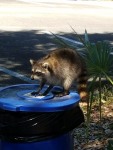
I want to be stealthier so I don’t draw attention to my station and my suspicious behaviors. Even though I have a right to be there at a picnic table not all Park Rangers got the memo and some may think they should run me off. Last week a Ranger did stop by and I thought “well, here we go,” but actually he just wanted to chat; his Dad had been a ham, so I tried to recruit him. I had another visitor, too; note to self, don’t operate so close to garbage cans!

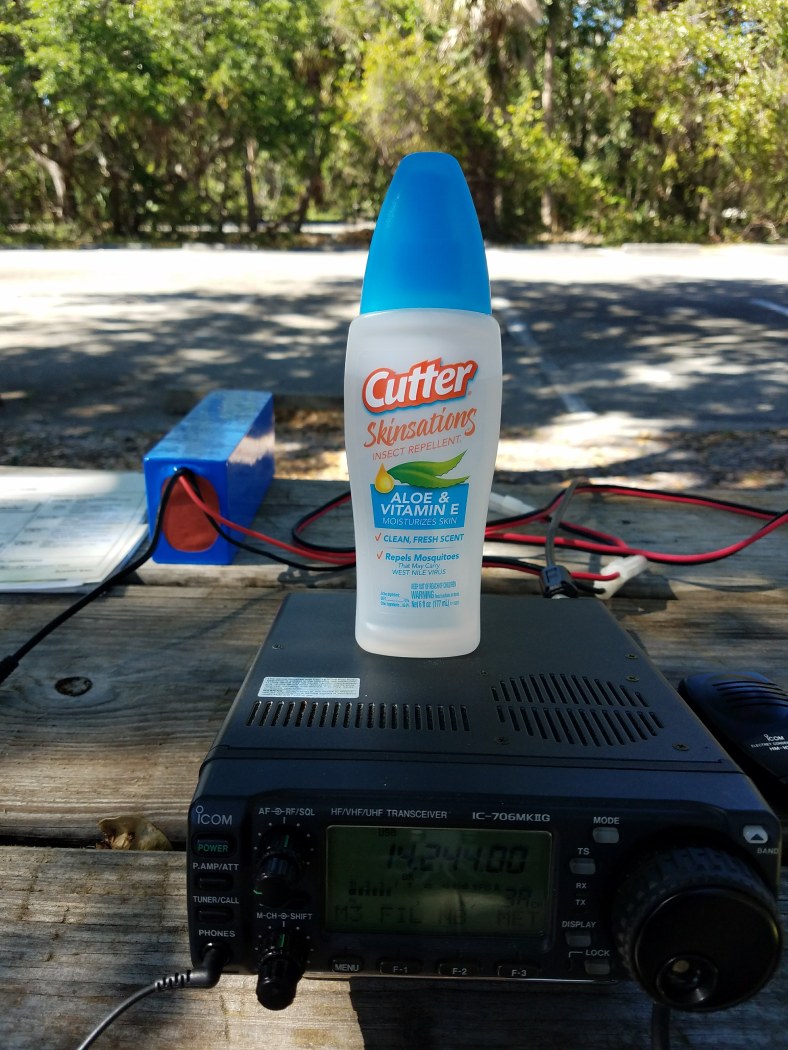
And finally, a note to the wise for operating out of doors in Florida; bring your bottle!
This is Wayne, k4wk, http://www.hamdom.com. Thanks for listening; you’re in the log.
ZF2NR: Another Slacker DXpedition
Operating from countries outside the US can be a lot of fun. I just completed another another Slacker DXpedition, this time to the Cayman Islands. The formula for this type of operation is simple: identify an interesting vacation spot that is also considered DX, travel there with friends & family, take along some compact radio gear and get on the air. A key point is to not overdo the radio operating or the friends & family will veto any radio activity on future trips.
 Licensing for the Cayman Islands is relatively easy if you hold a US FCC amateur radio license. Complete info can be found on the Ofreq web site. Licensing for the Caymans is typical of many Caribbean countries: fill out the application form, send it to Ofreq by email along with a copy of your US license, passport and $25US. Visitor call signs have the prefix ZF2 and you can request your favorite two-letter suffix. That’s how I got ZF2NR.
I was issued a Class A license which has all operating privileges. My spouse Joyce/K0JJW holds a US General Class license and was issued a Cayman Class B license, which has limited HF privileges (no phone on 40m, 20m, or 17m). So keep that in mind if you have a General Class license.
Grand Cayman is in grid EK-99 and is IOTA NA-016.
My equipment strategy was the same as my V29RW operation on Antigua (see V29RW: Slacker DXpedition to Antigua). The basic kit is a Yaesu FT-991 driving a end-fed halfwave (EFHW) wire antenna for the band of interest. Never underestimate the power of getting a halfwave antenna up into the air. The FT-991 fits in my carry-on bag and it covers all bands from HF through 70cm.
There is a 2m repeater (146.76 MHz) on Grand Cayman that works quite well. We received a friendly welcome on the repeater from Phil ZF1PB and several other Cayman hams.
Vacation Home
Our group rented a nice vacation home near Rum Point on the north side of Grand Cayman. This place is right on the water with an excellent sand beach. Denny KB9PDF/ZF2PF and I put up the EFHW 20m antenna supported by my SOTAbeams pole strapped to a palm tree. This setup worked quite well and we soon had a nice pileup of stations calling us on 20m. We did have some issues with local noise sources, the worst of which was traced to some dimmer switches in the house. This is one of the problems with a portable setup like this…you never know what RFI problems you’ll encounter. Later in the week, we put up a 40m EFHW and made a few contacts on that band, too.


ZF1A
Bruce/K0BJ suggested that I check into using the Cayman Amateur Radio Society club station (ZF1A) which they make available to visiting hams. I connected with Eden/ZF1EJ who confirmed that the station was available later in the week. Again, I did not want to overdo the radio thing, so we settled on operating at ZF1A during the middle of the day on Wednesday.

This turned out to be a great move. ZF1A has multiple towers with some very capable antennas. Like I always say: Never underestimate the power of using a large directional antenna on top of a big tower. Eden/ZF1EJ met us at the station (it is literally in his backyard) and helped us get situated. Our operating strategy was simple: use the highest HF phone band that had good propagation and work as many stations as possible. We were also prepared to use FT8 if things were really bad but that was not needed. It turned out that 15m was dead but 17m was open into North America and Europe, so we did most of our operating there.

Here’s a short video to give you a taste of the pileup.
I did work some of the folks back home, which was a treat: K0AV, W0CP, K0BJ, W0RLY, W0GAS, WG0AT, KD0RQU. I had noticed that Steve/WG0AT was doing a Summits On The Air (SOTA) activation on Crooked Top Mountain (W0C/SP-090) and I gave him a call. Being QRP, his signal was very weak at my location but he could hear me with no problem.
Here’s the QSO audio that Steve recorded on his end:
Satellites
We worked two OSCAR satellite passes (AO-91, AO-92) using a pair of handheld radios and an Arrow 2m/70cm yagi antenna. The pair of handhelds gave us full-duplex capability: I ran the 70cm uplink on my HT while Denny ran the downlink on 2m. No surprise to find the FM satellites quite busy and a bit frustrating to work. I logged these stations from ZF2NR: KI0G, K3SV, TI2CDA, TI4DJ, HP2VX.
Results
My ZF2NR log shows 376 HF QSOs, most of them made by me. Joyce K0JJW/ZF2JW braved the pileup to make a few contacts. Denny/KB9DPF had some additional contacts as ZF2PF. QSL to our home callsigns.
I’ve loaded the ZF2NR log into Logbook of The World.
Band Mode QSOs
   7 LSB    5
  14 USB   65
  18 USB  306
 Total    376
In retrospect, I realized that we had the antenna pointed north most of the time and we probably should have looked in other directions. In particular, we only worked a few South American stations.
Most important is that a good time was had by all. Thanks to everyone that worked us while we were in the Cayman Islands.
73, Bob K0NR/ZF2NR
The post ZF2NR: Another Slacker DXpedition appeared first on The KØNR Radio Site.
What? ARRL Petitions FCC to Expand Privileges of Technician-Class Amateur Radio Operators
I have my opinion on ARRL asking FCC to grant more HF privileges to Technician-class licensees.
I verbalize them in this video:
[embedyt]https://www.youtube.com/watch?v=BWSAvDWE3Js[/embedyt]
After you hear my comments, please leave your comments.
Thanks, 73 de NW7US dit dit













