Archive for the ‘ham radio’ Category
 Here’s the SOTA Transceiver I’d Really Like
 April 23rd, 2021 |
  Author:
 Joyce/K0JJW and I did another activation of Mt Herman (W0C/FR-063) today. This is a repeat summit for us this year but we were looking for an easy hike not too far from home.

As usual, we were just using the VHF/UHF bands for the activation. My favorite rig for this type of SOTA activation is a Yaesu FT-90, a very compact mobile transceiver (4 x 1.2 x 5.4 inches) that is no longer manufactured. It has a unique heatsink with an integral fan that can handle the heat from the 50-watt transmitter. We use a Bioenno 4.5 Ah LFP battery to supply the power for the radio.
I was trying to work Bob/W0BV about 65 miles away and we were not able to complete the contact. The distance is not too difficult but there are several mountain ranges in the way. Sometimes we can get the electromagnetic waves to sneak through, but not today. Hiking down the mountain, I was thinking about how we could have probably made the QSO on SSB or CW, instead of FM. I chose not to bring the all-mode transceiver (FT-817) along today, so that was not an option.
That is when the idea hit me. The FT-90 is the right form-factor and power level for VHF/UHF SOTA but it is limited to FM. Yaesu, if you are listening, here’s what I’d really like to see in a small mobile transceiver:
- FT-90 size radio, perhaps a little larger but not much
- 2m and 70 cm bands (include 1.25m if you’d like)
- At least 25 watts of output power, more would be better (say 50 watts)
- All mode capability (CW/SSB/FM/Digital), sure go ahead and toss C4FM in too.
- No internal battery…I’m going to have to use an external battery anyway to get enough battery capacity
At various times, I have had people ask “why don’t they put SSB in handheld radios?” They recognize that SSB has weak-signal advantages over FM, so they wish their handheld transceiver (HT) could do it. I say rather than shove more features into an HT, put it in an FT-90 size radio. It would be a much more usable solution.
Although I arrived at this radio concept thinking about SOTA, it would also be a great mobile rig for general use. The FT-90 was popular because it was very compact AND it had a removable faceplate that could be mounted almost anywhere. There really is no way to get VHF/UHF SSB into a vehicle other than those all-band radios like the FT-857 and the IC-7100. Oh, did I say FT-857? Sorry, that model has been discontinued. The satellite operators will love it, too, especially if it could work 2m/70cm crossband full-duplex.
So there you go, Yaesu (or Icom)…a fantastic product concept at no charge. I would be happy to beta test it for you.
That’s my idea for today. What do you think?
73 Bob K0NR
The post Here’s the SOTA Transceiver I’d Really Like appeared first on The KØNR Radio Site.
10-10-10 Event-Happy B-day WØC-SOTA

WG0AT/Steve
May 1st, 2010 – WGØAT/Steve sent a CQ from Mount Herman in Colorado and thus inaugurated the birth of Summits On The Air (SOTA) in WØ land with 33 CW contacts around the world.
Fast forward to today, Steve is still sending CQs from Mount Herman (WØC/FR-Ø63), and other peaks, almost on a daily basis but he also inspired countless hams (incl. yours truly) to join a growing bunch of people who love the outdoors and combine their hiking activities with their radio hobby.
Some statistics… during the last 10+ years the Colorado Association (WØC) grew from:
- 219 initial (seed) summits to a total of 1797 qualifying summits
- a handful of Activators to ~180
- a few chasers to almost 200
These highly motivated men and women of all ages activated more than 7,400 summits, generated more than 40,000 points and 15 Mountain Goats (MG) – many of them double or even six-fold (thanks KXØR/George).
WØC Chasers worked over 90,000 stations around the world, generated almost 500,000 points and 33 Shack-Sloths.
To celebrate our 10th Anniversary1, WØC-SOTA is organizing a 10-10-10 Event2 with a challenge for Activators and Chasers alike.
Activator challenge: Activate 10 (or more) 10K (or higher) summits (in WØC) within 10 days.
Chaser challenge: Chase Activators on 10 different (or more) qualifying WØC summits (10K or higher) within the 10 days.
Event Date: We will kick-off the event in conjunction with the Colorado 14er event on August 7th, 2021 and conclude on August 16th.
Everybody is invited to participate. Plan your vacations and business-trips to Colorado accordingly. Block off these days in your calendar. Get in shape… repair your antennas and radios. It’s a once in a decade event 😉
There will be a ranking of all participants who meet the challenge. Photographer and new SOTA enthusiast Dan Oldfield (NØOLD) is generously donating a personalized and autographed print from his Colorful Colorado collection to each of the top 3 in both challenges.
More details will be announced as soon as they are hashed out on the WØC-SOTA Website (you can subscribe to get the latest updates) and the NA-SOTA group.

For the org. team
KØMOS/Matt
1 It’s actually the 11th Anniversary but the COVID-19 Pandemic and historic Wildfires in Colorado interfered in 2020.
2 All SOTA rules apply
Looking at VHF/UHF SOTA Data
On Twitter, someone recently commented that it would be nice to have more 2m SSB activity for Summits On The Air (SOTA). It is well known that FM is a more commonly used mode but that its performance suffers for weak signals. This got me wondering about which bands and modes are being used for SOTA above 50 MHz.
Above and Below 50 MHz
First off, I wondered what portion of SOTA radio contacts are on VHF/UHF. Looking at the SOTA database Facts and Figures page, I simply grouped the number of QSOs as “Above 50 MHz” and “Below 50 MHz.”
| Frequency | QSOs | % of Total |
| Above 50 | 1346206 | 21% |
| Below 50 | 5144547 | 79% |
| Total | 6490753 | 100% |
So we can see that about 1/5th of the SOTA QSOs are done using VHF and higher frequencies. Certainly, we’d expect that the HF bands would dominate the total but this VHF+ percentage is higher than I expected.
Breaking Down > 50MHz
That leads to the question of what bands are used above 50 MHz? The table below shows the >50 MHz data broken out by band. The % of Total column indicates the percent of all QSOs (Above and Below 50 MHz), while the % of >50 MHz column shows the percentage relative to only >50 MHz radio contacts. Simply put, the % of Total column will sum to 21%, matching the number in the first table. The % of >50 MHz column sums to 100%.
| Frequency | QSOs | % of Total | % of >50 MHz |
| 50MHZ : | 48035 | 0.74% | 3.57% |
| 70MHZ : | 10921 | 0.17% | 0.81% |
| 144MHZ : | 1202311 | 18.5% | 89.3% |
| 220MHz : | 1064 | 0.02% | 0.08% |
| 433MHZ : | 126202 | 1.94% | 9.37% |
| 900MHz : | 204 | 0.00% | 0.02% |
| 1240MHZ : | 12526 | 0.19% | 0.93% |
| 2.3GHZ : | 1554 | 0.02% | 0.12% |
| 3.4GHz : | 142 | 0.00% | 0.01% |
| 5.6GHZ : | 468 | 0.01% | 0.03% |
| 10GHZ : | 1186 | 0.02% | 0.09% |
| 24GHZ : | 167 | 0.00% | 0.01% |
| Microwave : | 382 | 0.01% | 0.03% |
Well, it doesn’t take a degree in statistics to see that the 144 MHz band (2 meters) is the most popular VHF/UHF band for SOTA. Almost 90% of the QSOs are on this band. The next most used band is 433 MHz (70 cm) at a little over 9%. The 6m band (50 MHz) comes in at third with about 3.5%. The other bands are so small, they don’t really add much to the total.
The data on the SOTA page does not break out mode used by band but it does provide some aggregate mode numbers. The number of FM contacts (using any band) is 1186542. It is reasonable to assume that almost all of these FM QSOs were made above 50 MHz. (FM is used a bit on the 10m band but that combination is rare in SOTA.) That means, for frequencies >50 MHz, 88% of the QSOs (186542/1346206) were completed using FM. We don’t know how the remaining 12% splits out but I would expect them to be a mix of SSB and CW, but dominated by SSB.
Given the high number of 144 MHz contacts in the mix, it is safe to say that 2m FM is the dominant mode for VHF/UHF SOTA. After all, it is The Utility Mode. The reasons are obvious…almost every radio ham has a handheld transceiver that can do 2m FM. It makes for an easy way to get on the air and active a summit. More importantly, it is an easy way to chase a summit. When I plan a SOTA activation, I think about the kinds of operators that will be within range and what kind of gear they are likely to have. It does me no good to drag along equipment for 2m SSB/CW if there is no one around to work that band/mode.
This analysis does confirm that the number of non-FM QSOs on VHF/UHF is relatively small. The 12% of non-FM QSOs above 50 MHz corresponds to only 2.5% of all SOTA QSOs. So why is this? Clearly, the affordability and popularity of the FM handheld transceiver is a big factor. There are portable radios that can do “all modes” on VHF/UHF such as the Elecraft KX3 (2m option), Yaesu FT-818, and the Icom IC-705, but these are much more expensive.
What About 70cm and 6m?
Now, it is interesting that the 70cm numbers are small compared to 2m. Many of those handheld transceivers that get used for 2m also have 70cm included, so you might expect there to be more 70cm QSOs in the mix. For a given boom length, a 70 cm Yagi antenna will have more gain than a 2m Yagi. So gain is easier to come by on the higher band.
Note that the SOTA rules do not encourage working the same station on more than one band. You only get credit for working a station once on an activation. (Compare this to VHF contest scoring which usually adds in additional credit for working stations on multiple bands.) So if a chaser works someone on 2m, they typically don’t bother working them on other bands. I am not saying this is bad, I am just trying to explain why we don’t see more QSOs on 70cm.
The other band you might expect to see more activity is 50 MHz (6 meters). This band is available to Technicians in the US and, when the band opens up, you can easily work a thousand miles or more via Sporadic-e propagation. (Sometimes F-layer propagation, too, but we’ll need a whole bunch more solar activity for that to happen.) Many HF rigs include 6m as a “bonus band”, even some of the QRP radios popular with the SOTA crowd (KX3, IC-705, etc.) So why are the 6m numbers so low? This band offers a metric ton of fun, but it dishes it out randomly. There is a reason they call it the Magic Band…sometimes the Magic is there and sometimes it is dead quiet. When it’s dead quiet, it is a poor imitation of the 2m band. It also requires larger antennas, so if an activator decides to use antenna gain to help their signal, a portable Yagi for 2 meters is going to be a lot handier than one for 6 meters.
CW and SSB
This data does show that CW and SSB are lightly used for SOTA on the VHF/UHF bands. This is an opportunity. If more of us used these modes, it would improve our ability to squeeze out contacts when the signals are weak.
Bob K0NR
The post Looking at VHF/UHF SOTA Data appeared first on The KØNR Radio Site.
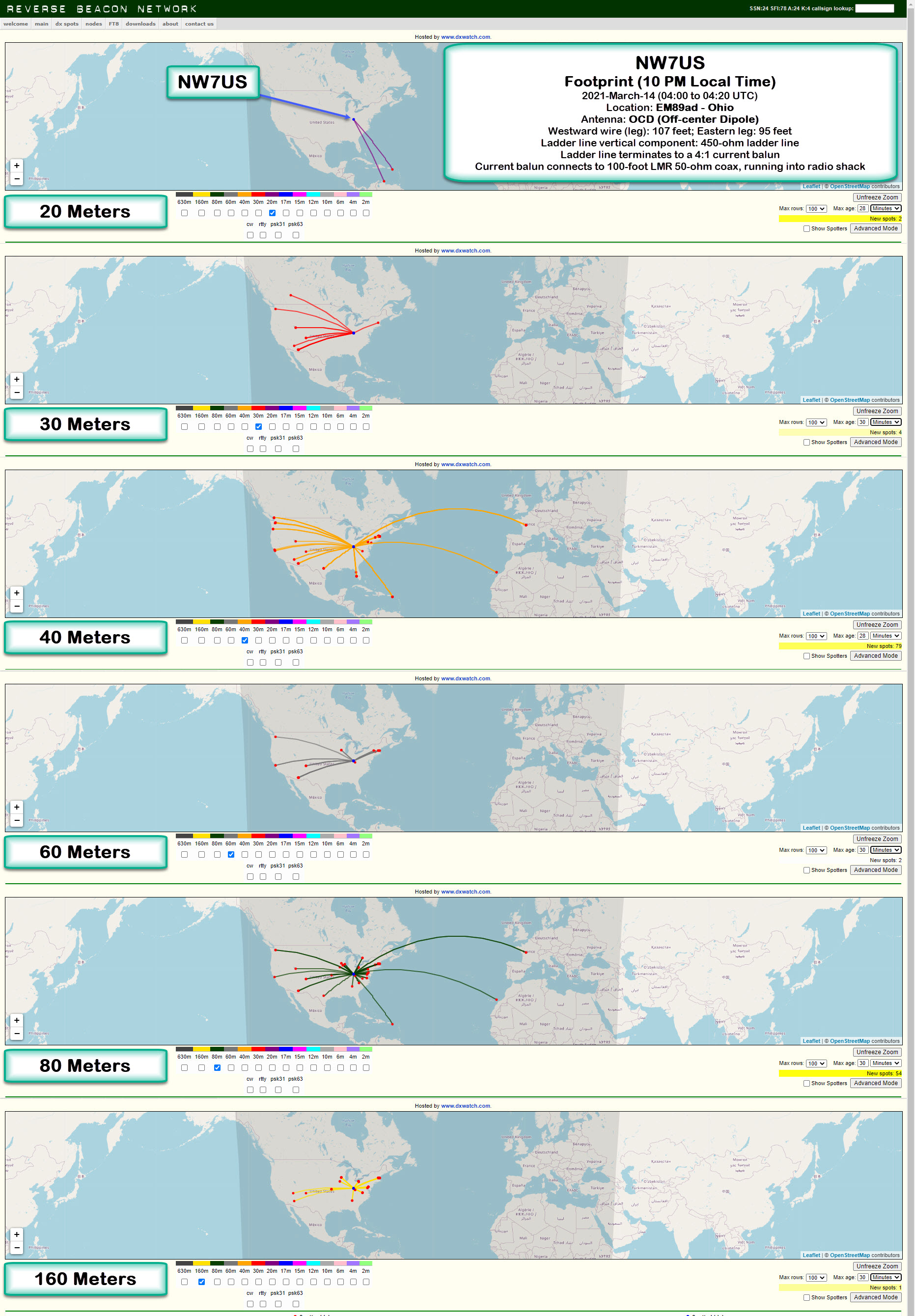
New Antenna: The Following Footprints Are of My CW Signals (2021-March-14 @ 04:00 to 04:20 UTC).
The following footprints are of my CW signals on 2021-March-14 at about 04:00 to 04:20 UTC.
Click on this image to see a larger version of this image:
Location: EM89ad – Ohio
Antenna: OCD (Off-center Dipole)
Description of Antenna:
This is an off-center dipole, with the two legs running East-East-South (approximately 125 degrees of North), and West-West-North (about 306 degrees on the compass). The westward wire (leg) is approximately 107 feet in length, while the eastward leg is about 95 feet in length.
These legs (an off-center-fed dipole) is directly connected to about 90 feet of 450-ohm ladder line, which is hanging directly below, vertically, the feed point. The feed point is 50 feet above the ground.
The ladder line terminates (at the 12-feet-above-ground point) to a 4:1 current balun. This current balun then connects to a 100-foot LMR 50-ohm coax, which is running into the radio shack. It is connected via an antenna switch to my Icom IC-7610 transceiver. I am transmitting a 100-watt CW signal using an Icom IC-7610, in the following format:
TEST TEST TEST DE NW7US NW7US NW7US
The Reverse Beacon Network reports any spotting of this test transmission. The beta mapping interface, at http://beta.reversebeacon.net/main.php, then maps the resulting spots. To learn more about the RBN, visit http://beta.reversebeacon.net/index.php, or, http://reversebeacon.net/index.php.
I show the 20-, 30-, 40-, 60-, 80-, and 160-Meter band footprints.
I’ve been capturing these CW transmission spots, at different times of the day, today. I’ll get data from several days, at regular intervals, and create a overview of how the antenna appears to be working during this month and under these propagation conditions.
73 de NW7US dit dit
..
Reactions to the North America Adventure Frequency
 While I did not originate the idea, I have been promoting the use of 146.58 MHz as the North America Adventure Frequency. (Rex/KE6MT and George/Kj6VU came up with the idea.) My previous blog post explained the thinking behind it, along with my own personal biases, I’m sure.
When presented with the idea of The Other Simplex Frequency, I generally get three types of reactions:
1. Great idea! These people generally live or operate in locations where the 2m FM calling frequency (146.52 MHz) can get kind of busy, so they see that having an alternate frequency that everyone knows about has value. They may or may not still call on .52 but having another designated frequency is a plus.
2. It will never get used in my area This reaction comes from locations where people tend to congregate on 146.52 MHz and will probably not monitor any other frequency. The SOTA activators say stuff like “I’ll never contact anyone on 146.58 MHz so I’ll have to just use keep using 146.52.” This is not a problem, do whatever makes sense. The North America Adventure Frequency will probably not get used everywhere and that is just fine.
3. What, people actually talk on 2m FM simplex? These folks are just plain missing out. I don’t know how to help them.
73 Bob K0NR
The post Reactions to the North America Adventure Frequency appeared first on The KØNR Radio Site.
The 2 Meter Band: Much More Than FM
Way back in the Wayback machine, when I was working on getting my Technician license (in the 20th century), I recall looking at the frequency bands available to Techs. Technicians had operating privileges for everything above 50 MHz, which looked like a lot of useful spectrum to me. The idea at the time was that Technicians were exploring the new frontier of amazingly high frequencies. Since then, the Technician license has morphed to be the entry level license.
ICOM has a good graphic that shows all of the ham bands and shows the common subbands for various modes. I snipped out the portion that covers the most popular VHF/UHF bands (below). Wow, look at all the stuff you can do! Also, it is 4 MHz of spectrum, big enough to fit eleven 20 meter bands inside it. (Yeah, yeah, the propagation is a lot different.) Speaking of bandwidth, take a look at the 70 cm band, with 30 MHz of spectrum. (Not shown is the 23 cm band, which spans 60 MHz.) The higher you go in frequency, the more spectrum there is.
Most people think of the 2-meter band as just FM and repeaters, but it is much more than that. I copied the 2-meter band graphic and added my own notatation on the various uses of the band.
 Much of the band is allocated to FM, which is consistent with the popularity of the mode. I didn’t mark all of the FM segments, so refer to the color coding to see them. But there is much more than FM simplex and repeaters. Down on the low end is the CW-only segment and EME activity (Earth-Moon-Earth or moonbounce). The “weak-signal” enthusiasts tend to use the SSB portion, with the SSB calling frequency of 144.200 MHz. You may often hear CW in the SSB subband and radio hams flip back and forth between the modes depending on propagation. Meteor scatter is mostly done via the WSJT-X mode of MSK144 around 144.140 MHz.
Automatic Packet Reported System (APRS) activity is mostly on 144.390 MHz, using FM-based 1200-baud packet radios. Other packet radio usage is not shown but is usually around 145.01 MHz. The 2m band is very attractive for satellite use, with VHF propagation properties and manageable doppler shift for Low Earth Orbit (LEO) satellites. The downlink from the International Space Station (ISS) is usually 145.80 MHz.
Over time, I’ve used all of these 2m modes mentioned above, with the exception of EME. I am still working on that one and I hope to have a new 2m Yagi installed sometime this year that will enable it.
73 Bob K0NR
The post The 2 Meter Band: Much More Than FM appeared first on The KØNR Radio Site.
What Cows Think About 146.52 MHz
I see a lot of cows standing around in Colorado ranch land, and I often wonder what they are thinking. As a result, I’ve been experimenting with a series of graphics that show cows standing out in the field thinking great thoughts. Surprisingly, they are often thinking about ham radio topics. Who knew? I’ve posted these on Twitter (@K0NR) which usually generates some responses.
Recently, the cows were thinking about the 2m FM calling frequency.
 Some of my international followers pointed out the 2m FM calling frequency is not 146.52 MHz in their country. Sometimes it is difficult to localize VHF content, so sorry about that.
EA3IEK commented that the calling frequency should also be the listening frequency. (This is the crux of the problem with calling frequencies on 2m FM…what is the best ratio of calling and listening?) So I quickly modified the photo.

Then I could not resist posting this one, inspired by Joey on the Friends television show. Moo. It’s just a cow’s opinion.

73 Bob K0NR
The post What Cows Think About 146.52 MHz appeared first on The KØNR Radio Site.













