Archive for the ‘ham radio’ Category
 New Book: Learning, Living, and Loving Morse Code…
 March 19th, 2023 |
 Author:
There is a new book from a fellow Morse code amateur radio operator, Chris Rutkowski (NW6V), about “Learning, Living, and Loving Morse Code (in a Digital World).” NICE!
Title: “The CW Way of Life“
link: https://amzn.to/3Tm3KfD

I received a new book! Here it is, at my radio shack operations desk, at NW7US radio station.
Already, I think it rivals any other book on the topic, including “The Art and Skill of…,” or, “The Zen of…”
It is not, however, meant to replace, but to augment, what is available. But, it is a complete guide, including a “work book” section (nearly half of the book?) on how to improve your skill. Really good stuff, but I’m only in one day.
73 de NW7US dit dit
https://nw7us.us
..
ARRL DX (SSB) Contest
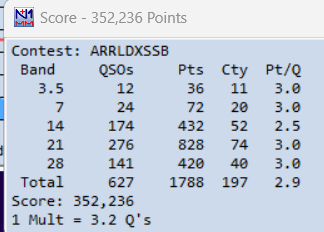
Another successful event
I think we made a commendable showing this weekend, thanks to
all. Statistics below and log attached.
Thanks to all participants and especially the new guys, Doug and Larry,
who jumped in got their feet wet.
The bands were open although a recent solar storm could have had an impact. Most remarkable was 10m which was wide open worldwide on Sunday morning. The best contact of the event was Namibia, V55Y, by John VE7TI, on Sunday
afternoon 10m. Also Reunion Island FR8TZ off the SE coast of Africa. This is a good way to learn your geography!



Close to Denver: Green Mountain (W0C/FR-107)
Sometimes you just want a close-in SOTA summit that is easy to access and allows you to get on the air. On the west side of greater Denver, a few summits meet that requirement. One of them is Green Mountain (W0C/FR-107), near the intersection of I-70 and C-470. This would make a good beginner summit or an easy-access summit for visitors to the area. Joyce/K0JJW and I activated this 1-point summit today.

Access is easy and convenient, the trailhead can be found by going west on Alameda Parkway, off C-470, then north on S Rooney Road. There is a large parking lot there and an obvious trailhead with pit toilets. From here we hiked east over C-470 into William Frederick Hayden Park. We followed signs for the Green Mountain Trail, which is basically an unimproved road, to the summit of Green Mountain (see map above). This is not the only option because the park has an extensive trail system to explore. Check out the Lakewood parks map here. Also, you can check the trail conditions here. My mapping app recorded the hike as 1.6 miles (one way) with an elevation gain of 800 feet, not very difficult but still a decent hike. On a cool Saturday afternoon, we met many hikers and mountain bikers on the trail.

This hike starts out with a lot of road noise from C-470 but things soon quiet down as we left the highway behind. On the summit, we could see many higher summits to the west and downtown Denver to the east. We only had a couple of handheld VHF/UHF radios with us and made a bunch of contacts on 2m FM. This is usually the case when you have line-of-sight to the Denver area, with plenty of activity on 146.52 MHz.
This summit is not the best SOTA summit in the state but if you are itching to do a SOTA activation without driving deep into the mountains, this one will work!
73 Bob K0NR
The post Close to Denver: Green Mountain (W0C/FR-107) appeared first on The KØNR Radio Site.
The March – April 2023 SARC Communicator
Another BIG issue!
'The Communicator' digital periodical of Surrey Amateur Radio Communications is now available for viewing or download.
Read in over 145 countries now, with almost 10,000 downloads for the November-December issue, we bring you 124 pages of Amateur Radio news from the South West corner of Canada and elsewhere. With less fluff and ads than other Amateur Radio publications, you will find Amateur Radio related articles, projects, profiles, news, tips and how-to's for all levels of the hobby.
You can view or download it as a .PDF file:

Previous Communicator issues are at:
https://ve7sar.blogspot.com/search/label/The%20Communicator
and a full index is HERE.
As always, thank you to our contributors, and your feedback is always welcome.
The deadline for the next edition is April 15th.
If you have news or events from your club or photos, stories, projects or other items of interest from BC or elsewhere, please contact us at [email protected]
73,
John VE7TI
'The Communicator' Editor
My Story on QSO Today
 About five years ago, Eric/4Z1UG interviewed me for the QSO Today podcast. He recently retrieved and remixed the audio recording and posted it on the QSO Today webpage. There are a few places where the discussion seems dated (such as the discussion of Yaesu Fusion, which was relatively new at the time.) However, for the most part, the dialog was good and still relevant. Well, at least to me, because it was my story.
During the interview, I mention some of my Elmers, including Virgil/W0INK who influenced me early in my ham career. I also talk about the concept of 360-Degree Elmering, which means that Elmers (mentors) can be found in many different places. Other topics include: Summits On The Air, Colorado 14ers, the Tri-Lakes Monument Radio Association (W0TLM), repeaters, DMR in Colorado. There is a plug for Ham Radio School, where I continue to help out. Somehow we got on the topic of lists in amateur radio: DXCC entities, SOTA summits, states, etc.
Anyway, you may find it interesting.
73 Bob K0NR
The post My Story on QSO Today appeared first on The KØNR Radio Site.
Another AI Blog Post: Who is Bob K0NR?
Here is another lazy attempt by me at generating a blog post using ChatGPT. This time I asked the machine to “tell me about Bob Witte K0NR”. I figured there are quite a few things available in the public domain about me, so it would be interesting to see what the AI came up with. Here’s the result with [my comments] inserted.
Bob Witte, also known by his callsign K0NR, is an experienced and respected ham radio operator who has been licensed since the mid-1970s. He is based in Colorado, USA and is known for his contributions to the amateur radio community. [I like the sound of this.]
Bob has a passion for promoting amateur radio and encouraging others to get involved in the hobby. He is a regular contributor to the popular ham radio blog, “The KØNR Radio Site,” where he shares his experiences and knowledge with other hams. He also co-hosts the “HamRadioNow” video podcast series, which covers a wide range of topics related to amateur radio. [Correct on my blog, but I don’t co-host any type of podcast.]
Bob is an active member of several ham radio clubs and organizations, including the American Radio Relay League (ARRL) and the Radio Society of Great Britain (RSGB). He has served in various leadership roles within these organizations and has been recognized for his contributions to the amateur radio community. [Yes on the ARRL, but I am not an RSGB member.]
Bob’s interests in ham radio include VHF/UHF weak signal work, contesting, and digital modes. He is also an avid outdoorsman and enjoys portable operations from remote locations. He has a strong interest in emergency communications and is involved in several emergency communication organizations, including the Amateur Radio Emergency Service (ARES). [Not too bad, but my involvement in ARES and other emcomm groups has faded quite a bit.]
Overall, Bob Witte K0NR is a highly respected and knowledgeable ham radio operator who has made significant contributions to the amateur radio community. [Well, I like the sound of this part.]
I would like to get under the hood of ChatGPT to find out how they connected me with HamRadioNow and the RSGB. These are two statements that can easily be checked and found to be false.
73 Bob K0NR
The post Another AI Blog Post: Who is Bob K0NR? appeared first on The KØNR Radio Site.
Blogging With AI (ChatGPT)
Sorry that I have not been posting much on my blog. I have several other projects consuming my time and this blog has been neglected.
Then, it hit me: I should just let ChatGPT, a free artificial intelligence (AI) platform that is getting a lot of attention, write my blog for me. All the Cool Kids are Using It. I just entered “Please write my next blog post about VHF ham radio” and this is what I got back:
VHF Ham Radio: Exploring the World Above 50 MHz
When most people think of ham radio, they usually picture a person sitting in a dark room, talking into a large radio with a huge antenna. However, ham radio can be much more than that, especially when you start exploring the VHF bands.
VHF, or Very High Frequency, refers to the portion of the radio spectrum between 30 and 300 MHz. This includes the 6-meter (50 MHz), 2-meter (144 MHz), and 70-centimeter (440 MHz) bands, which are commonly used by amateur radio operators for local and regional communication.
One of the main advantages of VHF ham radio is that it allows for much greater range than the traditional HF bands (below 30 MHz). This is because VHF signals travel mostly in a straight line, and are less affected by the ionosphere and other atmospheric conditions that can impact HF propagation.
In addition to traditional voice communication, VHF ham radio operators also use a variety of digital modes such as Packet Radio, APRS, and D-STAR, which allow for the exchange of data and information over the airwaves.
Another popular VHF activity is contesting, which involves making as many contacts as possible in a short period of time. Contesting can be a fun and exciting way to improve your operating skills and test your equipment.
VHF ham radio is also a great way to get involved in emergency communication and public service. Many amateur radio clubs and organizations work closely with local authorities to provide communication support during emergencies and events.
If you’re interested in exploring the world of VHF ham radio, there are a few things you’ll need. First, you’ll need a radio that covers the VHF bands. There are many options available, from handheld transceivers to base stations with large antennas.
You’ll also need an antenna that is specifically designed for VHF operation. These antennas are typically shorter and more compact than HF antennas, and are available in a variety of types and configurations.
Finally, you’ll need to obtain a ham radio license from the FCC. The process is relatively straightforward and involves passing a written exam that covers basic radio theory, regulations, and operating procedures.
In conclusion, VHF ham radio offers a world of opportunities for communication, experimentation, and public service. Whether you’re a seasoned operator or a newcomer to the hobby, there’s always something new to discover on the VHF bands.
[ end of ChatGPT article]
How many factual errors did you spot?
73 Bob K0NR
The post Blogging With AI (ChatGPT) appeared first on The KØNR Radio Site.