Archive for the ‘ham radio’ Category
 Duh: Learning Curve #5 Old Lessons Remembered
 September 23rd, 2010 |
  Author:
 POLL RESULTS SO FAR: West Virginia is in the lead for best Ham Radio QTH in the USA… One more week of voting… Have you voted yet? Here’s the link to vote!
Last weekend I played in the QRP Afield event and had fun with fellow Polar Bear QRP Club members on the air. It was a great time. Once again, the antenna tweak won out and under the influence of a great blog post by Polar Bear #20 VA3SIE, Martin in Ontario about the 88ft Doublet, I caved in and put one together the night before the event. Oops, I did it again! But this time I had excellent results and the antenna worked as advertised. LESSON: Sometimes it pays to follow your heart and not your head.

Civil Defense Logo
I also remembered how I learned a lot as a young teen aged ham via the Civil Defense program. Remember that time?
Watching a weather report about tornadoes reminded me of a great learning experience. The Palm Sunday Tornadoes of 1965 hit the counties north and east of my home in Elwood, IN. At only 15 yrs old, I was the assistant emergency coordinator and ran the 6 meter emergency communications net on Sundays. Our county and city Civil Defense teams had setup equipment and were ready for disasters and those tornadoes reeked havoc on our area.

Path of the Palm Sunday Tornadoes
Our teams rolled out the emergency vans, and the adults helped this young ham handle traffic for the state police and other government emergency responders. The old yellow CD Gonset Goonie Bird rig is still something I remember fondly. I loved running that thing!
LESSON: Give the young hams some responsibility and empower them. They will be there when the time comes and will never forget how older folks treated them as peers and gave them an opportunity to do something important. I bet that kind of opportunity will still attract young people to our great hobby. We need them! They need us!

The Yellow Goonie Bird
Handiham World for 22 September 2010
Welcome to Handiham World!
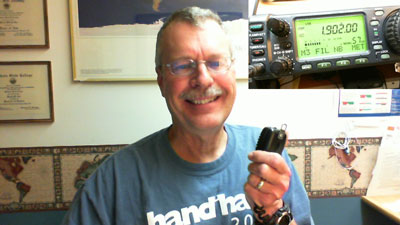
Happy Autumn!
Now that autumn has returned and the equinox is upon us, conditions on the amateur radio bands begin to favor some of the longer wavelength parts of the HF spectrum like 160, 80, and 40 m. True, there is still a great deal of interference from thunderstorms that pop up in the warmer climates, but the interference isn’t nearly so bad as it had been during the height of summer. The longer nights also mean less ionospheric D-layer absorption on those bands, which translates into more opportunities for long-distance contacts. In short, from this point forward we will see rapidly changing conditions on some of the bands where regional HF nets typically meet on a daily basis. This, as you might expect, can lead to potential interference as skywave propagation begins to move out from a few hundred miles to over 1000!
With more and more of our Handiham members earning their General Class tickets and becoming more involved with HF operation, we now have an opportunity to learn how the HF bands change from season to season. As always, we recommend doing plenty of tuning around and listening on the various bands to learn when there are band openings and how the more experienced operators are taking advantage of them.
One of my favorite bands has always been the 75 m band, and I have made plenty of random contacts but also enjoy checking into my favorite regional net, PICONET, on 3.925 MHz Monday through Saturday. Interestingly enough, this net has long been associated with Handihams — way longer then I have been with the Handiham program. Propagation on 3.925 MHz during the 9 AM to 11 AM central time “morning net” is generally the best, because during the previous overnight hours thunderstorms have quieted down and the bands are generally less noisy. As the day wears on, D-layer absorption increases and signal levels drop. There is also an afternoon session, from 4 PM to 5 PM, in the summer. In the winter, the PICONET expands its afternoon session to 3 PM to 5 PM, since conditions for sky wave propagation are better. But this can pose a problem: Skywave is so good that a New York net on the same frequency can now be heard in the Upper Midwest. No doubt the New York stations are also hearing us. Generally this overlap of nets isn’t a problem, but sky wave can work against you when the band “goes long” and stations from over 1000 miles away begin to sound as loud as the stations a hundred miles away. This situation calls for flexibility on the parts of net participants. If it is possible to use a directional antenna, a rarity on 75 m, interference can be mitigated by turning the antenna to favor only the stations in your area. Switching between wire antennas that favor particular directions might also help, as well as using a wire antenna instead of a vertical antenna. The wire antenna will most likely have a higher angle of radiation that will favor closer stations, while the vertical will have a lower angle of radiation that will favor the stations over 1000 miles away. Flexibility on the part of the net control stations is also called for. If interference is a problem, a net control station should consider cutting the net a little short or changing frequency just a bit. Of course this is not always easy when you have a net running and if you, as the net control station, want to change frequency everyone will have to understand the plan and change with you. It can be a challenging job for a net control station to herd everyone to another nearby frequency without having some strays!
160 m is especially useful over the winter months. While there are not as many structured nets on that band, you can run into “regulars” — stations that often get together on the same frequency about the same time every evening. In the summer 160 m is good for propagation in a regional area during the nighttime hours. In the winter, like the 75 m band, 160 m lengthens out and long-distance contacts are possible. If you are planning to try to earn a certificate like Worked All States on 160 m, winter conditions are your friend. Most evenings at 8 PM Central Time there is an informal get-together on 1.902 MHz. Most net participants are members of the Handiham affiliated Stillwater Amateur Radio Association.
40 m is a good band summer and winter and during sunspot lows and sunspot highs. It benefits by reduced thunderstorm interference during the winter months. You can work DX on the 40 m band, and an advantage it has over 160 m and 75 m is that a wire antenna for 40 m will be able to fit into most suburban lots. Furthermore, a vertical antenna for 40 m can be quite efficient and requires less inductive reactance to make it tune, as compared to a 75 or 160 m vertical. As always, cutting ground losses through an extensive radial system will yield good results.
Of course the sunspot cycle is on the way up and we can expect more DX to appear on 14 MHz and higher frequencies, but please don’t forget about 160 through 40 m. With winter conditions approaching here in the northern hemisphere, opportunities for fun on these bands are not to be missed!
I hope to hear you on the air soon.

Lesson from a Heron: Search and Pounce
As a bypass survivor, each morning when possible, I go for a brisk walk. We are blessed to live in a nice development in Orlando which has a bit of lakefront and also has some irrigation and flood prevention ponds. This water attracts a good selection of wildlife which makes it fun to be outside and exercising even though the heat and humidity are often both above the 90 mark.
We have ducks, baby ducks, coots, turtles, snakes, eagles, hawks, osprey, sand hill cranes, storks, cormorant, anhinga, raccoon, possum, squirrels, armadillos, feral cats, foxes, geckos, lizards, frogs, toads and all sorts of other neat critters to entertain us at various times of the year. This morning I spent some time watching the water birds fishing on all the new fingerlings from this year’s hatch of bass, bream and tillapia that gather in the grass along the water’s edge.

Learning S & P from a Heron
Today a heron demonstrated how to do catch fish and I realized that the heron could teach me some things about operating QRP style search and pounce.
The heron has a particular style… they spread their wings like this great photo demonstrates so well (thanks Chris Harshaw and http://www.wikimedia.org). So what’s that got to do with ham radio? Like a karate master who learns from the world around him, a good QRP op can learn from the birds! The heron shades the target with its wings to take the glare off the water so it can see better. It also causes the fish to become confused and they can pick off the loner or easiest target.
Same thing with QRP… we need to spread our wings by tuning around a bit more agressively and listening for the ones we can snag. Not always the strongest, but a signal that is decent and an op that genuinely wants to make a contact. When we find that contact we need to pounce on it and not waste time.
Yes, I learned a bit from watching that heron this morning. He caught quite a few fish in a short time using his form of search and pounce. That heron was quick and moved from spot to spot gingerly and didn’t miss his target very often. No wonder he’s grown so large! I want to be more like that heron when I am on the air.
Still time to cast your vote in the poll for the best ham radio location in the USA.
72,
Kelly K4UPG PB #173
Duh: Learning Curve #4 Oops I did it again!
Ever see one of those tie bars or pins that say, “IYKDWYBDYKGWYBG” My dad had one back in the days when men wore ties. The thing used to bug me cause he didn’t tell us what it meant right away. We tried guessing for a few days before he got tired of 7 kids all ganging up on him.
It is the famous “If You Keep Doing What You’ve Been Doing, You’ll Keep Getting What You’ve Been Getting!” Not sure who gets the credit for that one, but it sure stuck with me all these years. Of course, I’ve heard my bosses recite it a few times along the way too.

It only hurts when I laugh, or think, or move, or…use a new antenna in a contest!
That’s what this series of posts is about. Not repeating mistakes I’ve made. Maybe you can learn from my mistakes and save a bit of time. Or maybe you’ll just get a laugh and some relief from knowing someone else made the same mistake you’ve made. HA!
Well, last night, I did not follow my own advice. I put together a new antenna a few hours before the NAQCC Sprint and set it up. LESSON: As previously mentioned, don’t try to use a brand new antenna in a contest.
Ooops I did it again. Strike TWO! It was a disappointing night and too late to try to get another antenna up before the 2 hour sprint was over. So no contacts for me, I’m still scratching my head. Was it the antenna, me, or the band conditions? BUT… I don’t think I’ll pull that one again. Unless I have a hole in my head…
72,
Kelly K4UPG
p.s. Don’t forget to take the poll on my blog for the best ham radio QTH in the USA! It is on the left side column.
Handiham World for 09 September 2010
Welcome to Handiham World!
Back at work!
The Handiham World weekly is finally back at work after a couple weeks of rest & relaxation. While the e-letter went on holiday, I also took my vacation at exactly the same time. What a coincidence!

In the accompanying photo, I am posing in front of something that would make a perfect ham radio antenna support – the Eiffel Tower. My XYL and I made the trip to celebrate our anniversary, and she was a saint to put up with my obsession with ham radio and antennas. According to Wikipedia, “The tower stands 324 meters (1,063 ft) tall, about the same height as an 81-storey building.” Just imagine the signal you could get out with a multielement Yagi antenna on top, right?
As nice as it is to travel, it’s always great to be back. Today will be mostly filled with member contacts like phone calls and emails, because I have quite a backlog. I hope to get our audio magazine digest updated either later today or perhaps tomorrow if I run out of time today, but rest assured I will eventually catch up – in the meantime, I am coping with the jet lag by draining out the entire coffee pot.
One of the most fun things was checking in to the PICONET on 3.925 MHz via the Handiham remote base from France and Italy. This is certainly proof that a remote base station can be useful when setting up antennas or traveling with lots of radio gear is simply not practical. I also enjoyed making some Echolink contacts, including a check in on the daily Handiham net. These days, one does not need to give up regular operating just because you are staying in a hotel. These new ways to use technology enhance our options to use ham radio, and I’m sure thankful to all of our volunteers and supporters who make it possible. The best thing about ham radio for me has always been staying in touch with my community of friends. In order to get through all of the calls today, this edition will be a bit shorter than usual, but hopefully still worth a few minutes of your time.
73,
Patrick Tice, WA0TDA
Handiham Manager
[email protected]

I am a CPG
Spent my birthday participating (casually) in the Straight Key Century Club Weekend Sprint. My Lake Fredrica neighborhood site was where I set up my shelter and 3 antennas. I had a 40m dipole fed with twinlead up 40 ft and running E-W. An End Fed Halfwave for 20m was nearly vertical suspended by a nearby tree. A twinlead 44 ft doublet on my 20 ft Jackite with the ends at 16 feet was setup running N-S to give me a bit of a mini-smorgasbord of antenna choices. Since it was really sunny, I hooked up my ACME GC100 Solar Charger and VW Solar Panel.
Bands were decent with 40m quiet and some DX coming through early from Eu stations. Nice to hear that again. 20m came alive and was pretty much the go to band for the majority of the day. I did check 15m a couple times but did not hear much and no one replied to my CQ’s.
In the middle of a QSO, my Jackite pole decided to collapse but I was able to finish the QSO with one end of the dipole about 4 feet above the ground. hi hi
The highlight of the day was my last QSO with EA3NO, Lluis in Spain. As the special station for the sprint there was a lot of competition but Lluis hung in there with my weak signal and pulled me out of the crowd after a couple attempts. THANK YOU FOR THE BIRTHDAY PRESENT Lluis!
Still wondering what a CPG is? Contest Point Giver! I am a really casual contester. Really the only reason I participate is that contests offer a fairly good opportunity to make some QSO’s. When you are QRP you have to do a lot of listening, plus pounce and search, but serious contesters will dig out weak signals to make the QSO’s so it is fun. I enjoy giving out points and reading the mail on ops that are faster than my cw comfort zone. Good practice, eh?
Here’s some photos from the day. Enjoy!


72,
Kelly K4UPG PB #173 SKCC #5415
Duh: Learning Curve #3–Coke Choke Works!
Had a great time setting up the C Pole antenna in a tree suspended configuration. My good friend and cohort, Jim Diggs, K4AHO came by with his AIM 4170 Antenna Analyzer and we were ready to tune the antenna and get a feel for it.
LESSON: A good analyzer makes tuning an antenna fast, simple and accurate! The AIM 4170 gave us a TON of info (most of it going over my head) and let us see how the C Pole was doing in several areas. Take a look at this output! (Click on the image for a larger version)

K4UPG C Pole Scan Results
LESSON: I followed Niel’s directions, but did not have a small plastic coffee container so used a Quart Coke bottle instead. So I call it a Coke Choke and it seems to work well. Here’s a photo to show it off!

Coke Choke Ready for Duty
I think this one is a keeper. Goes up easily, hears well and loads nicely too. I made a few brief contacts and called it a day, but look forward to more C Pole action in the days ahead.
72,
Kelly K4UPG PB #173
p.s. Don’t forget to vote in the Ideal Ham Radio QTH poll on the blog!













