Archive for the ‘ham radio’ Category
 Computer Does Not Save Time
 October 13th, 2010 |
  Author:
 Remember when we used to think computers would save us time?

Why did we think the computer would save us time?
I spent the last 6 hours running updates, fixing the problems the updates created and figuring out how to install the updates that would not install automagically. Grrrrrrr!
Think I need some time to play radio, but I won’t be taking a SDR radio with me for a bit. Grrrrr…. need to recover from the 26 reboots and all the time wasted surfing and reading the small print.
Good thing there is a QRP ARCI event this weekend and the following weekend is our Polar Bear Moonlight Madness Event. Grrrr! I’m ready for some CW. CU on the bands!
72,
Kelly K4UPG PB #173
Handiham World for 06 October 2010
Welcome to Handiham World!
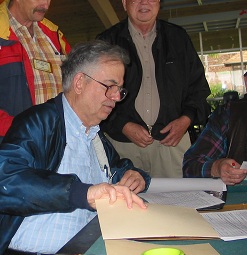
Photo: John Hoenshell, N0BFJ, enjoys being a VE and handles the paperwork at radio camp sessions and also volunteers during VE sessions at Dayton HAMVENTION. He believes that team members with disabilities can participate in a successful session.
Can a VE session be more than just a process of overseeing test takers in a room and handling their FCC paperwork?
This morning I had a different, but VE-related, question from one of our blind members. She was asking how she might participate in a VE session if she became a volunteer examiner. She mused that being a VE sounded interesting and that she would like to participate, but she wondered if it would be practical since she couldn’t see a room full of test takers. Since this topic comes up from time to time, I thought I’d take another look at what a VE session is about. While I am by no means an “expert” VE by experience, I can relate to testing in general – I was trained as a teacher, after all – and I have observed people with disabilities for decades. I have been present at many VE sessions over the years, especially at Handiham radio camps, but have only relatively recently become a VE myself.
I got to thinking about the very best VE sessions I had observed. What made them stand out from the others? It was more than the success of the candidates, though that always helps. It was more than the team arriving prepared and being able to process the paperwork efficiently, too. It was more than promoting the session and arranging a good location, though those things were important.
But what was it?
Well, let’s discuss the typical VE session a bit.
Our blind Handiham member is right in assuming that a blind VE cannot observe a room full of test takers as a sighted person might do during a VE session. That does not mean that a blind VE cannot participate. At our radio camp VE sessions, I suggest that blind VE team members sit at the tables where the exam is being read by volunteer readers to blind test takers. This assures that the exam is being proctored so that all rules are followed. A sighted VE simply looking at a room of test takers cannot know what is being said at each table in this kind of an adapted test session. Blind VE team members understand how tests are given to blind candidates and are potentially better at this kind of observation than anyone else.
The paperwork table is probably one place a blind VE would not be as useful. In every VE session, the team leader should try to match skills & capabilities with the tasks at hand. If there are no blind test takers to proctor, a blind VE might instead be part of the meet & greet team, setting candidates at their ease and answering the usual questions about what to expect during the testing, any rules of conduct (no smoking, quiet please, bring test to table at the side of the room when finished, etc.) As testing progresses and candidates start to turn their exams in for grading, a blind VE can then be stationed outside the testing room to answer questions that candidates might have. Typical information requested ranges from when they can use their new privileges if they pass an element upgrade to the location of the rest rooms.
Another job that every VE team has is communicating test results to the waiting candidates. There is no reason a blind VE cannot help with this job – and a savvy VE team leader will know who is best-suited for the hardest job – the delivery of the bad news. If a blind VE can handle telling a candidate that they didn’t pass but can do so in such a way as to help that person accept the news in a positive way, the entire VE team will be grateful! You don’t have to see to help candidates, successful or not, learn more about your ham radio club. Post-testing is a great time to talk with candidates and invite them to club and ARRL membership, and yes, even Handiham membership if they have a disability.
For the excited new Technicians and Generals, you might start a conversation about which radios are best, pointing out the availability of the club’s repeater system or the best ways to check out the the HF bands during the improving sunspot cycle.
In the end, a successful VE session is one that provides an opportunity for the candidates not only to pass their exams, but to leave the test site with the information and enthusiasm that will carry over to participation in the club and regional activities as well as getting on the air! When you look at a VE session as more than just three team members overseeing a room of test takers, you can easily find places for blind VE team members to be a part of this most rewarding of volunteer activities.
I hope to hear you on the air soon.

A dip in the pool
No one told you there was going to be a quiz, right? I thought it would be fun to pick a question out of the question pool and see how many of us can remember the right answer. Ready? Here we go:
E6A02
What type of semiconductor material contains more free electrons than pure germanium
or silicon crystals?
A. N-type
B. P-type
C. Bipolar
D. Insulated gate
Did you pick answer A, N-Type? That’s the right choice, and easy to remember if you think of “N” standing for “negative” and an excess of electrons in a material would give it an overall negative charge.

More Lessons from the Birds

The Biggest Bird in the Pond
On my morning walk yesterday, I had quite a treat. Sure wish I had taken the camera along. On the shore of the flood control pond that flows out into the golf course, were 4 fine Florida water birds. It is not common to see them bunched together like this. A Great Blue Heron, a Little Blue Heron, a Great Egret and a Comorant were lined up in a space of about 8-10 feet. There was a good bit of shoving and jockeying for position and they were working down the bank fishing in the same small spot.

Cormorant is like a living submarine or scuba diver
Made me think of the pileups a DX station creates… The comorant had a distinct advantage as the only real swimmer and diver of the bunch. It ranged up and down the bank picking off small fingerlings and bullying the other birds by swimming right up to their skinny legs and surfacing. Reminded me of some of the pileup busters I’ve observed from time to time.
At the same time, the little guy, the Little Blue Heron, and the regal looking, very white and tall Great Heron were left to glean around the edges and pick off the fish that were panic striken and confused by the other birds fishing in the midst. This reminded me of all the contests where I have to dodge the big birds and pick off what I can around the edges.
Funny thing is there are tens of thousands of fish all along the bank, not just where these birds were bunched up. What is it about us that piles us up and forces such fierce competition? Hmmm?
Yep, I am a devoted CPG (Contest Point Giver), who had a nice morning walk and got to see a great outdoors show for free. That is why I love operating QRP portable. Being outside and enjoying the free shows only adds to the enjoyment of the hobby and the friendships made on the air.
72,
Kelly K4UPG PB #173

Tall White Bird is really quite skittish

This little Blue Heron really gets around fast
QRPSPOTS.COM and IHAB Do it Again!
Wow! Great way to bring together a lot of ham radio ops on a Saturday using all sorts of technology! Way to go! QRPSPOTS.COM is normally used by QRP ops to spot each other when we are out operating portable or to alert others of band openings. It was ALIVE with reports and updates from all over the USA and even a few DX ops adding input too! In addition, several QRP reflectors were buzzing with updates and info. What a great community effort this turned out! Congrats to all and thanks to QRP ARCI for helping get the word out.

Iowa High Altitude Balloon Project
One of the 4 States QRP bunch, Terry WA0ITP, provided the 20m beacon again and has some great info on his informative website.
But for me, the coolest thing was listening in on the streaming webcast of VE3EN and his wonderful IC-7700. Sure wish I had thought of recording a bit or doing a screenshot to share here. But what a treat to listen in and hear the beacon’s signal right up until touchdown. Thanks Kevin for a fun way to eavesdrop on this event since the lawn mowing crew took over my condo’s yard and didn’t allow me to put an antenna out today. There is a ton of info and creative website construction on Kevin’s website and it is worth spending some time looking at the solar cycle data.
Congrats to the team for a successful event today and for bringing so many hams together for a good learning experience and something out of the ordinary. Well done W0OTM, well done indeed!
Duh: Learning Curve #6 What’s a ham to do?
Here’s my dilemma:
I am a rookie homebrewer. My kit experience is good, but I have struggled to build direct from schematics. Part of it is my lack of ability to conceptualize the physical layout and part of my challenge is lack of building experience and mentoring.

What should I use?
Several of my antenna tuner projects seem to have a TON of hand capacitance effect. They are built in plastic cases, some from the Shack and some from the local surplus shops and hamfests. Most commercial tuners are built in metal cases and I wonder if that would eliminate the sensitivity to the tuning hand?
I have a couple metal enclosures I can use and a great ham friend sent me some thin copper with adhesive tape on the back. I am thinking of slapping some copper tape inside the plastic cases and see how it works.
So, I am putting it to the vote:
Note: There is a poll embedded within this post, please visit the site to participate in this post’s poll.
And for the record, the vote in the poll for best ham radio QTH in the US was won by West Virgina. Here is the top 5:
- West Virginia (17%, 11 Votes)
- Kansas (14%, 9 Votes)
- Texas (8%, 5 Votes)
- Hawaii (6%, 4 Votes)
- New Hampshire (5%, 3 Votes)
Thanks and 72,
Kelly K4UPG
Handiham World for 29 September 2010
Welcome to Handiham World!
At this time of year I am always taken by surprise at how quickly the daylight hours fade every day here in the northern hemisphere. That means more hours of darkness and more HF radio fun in the evenings, as we mentioned last week when we extolled the virtues of 160, 80, and 40 m for long-distance communications. Things are also looking up in the daytime communications department, because my Windows sidebar gadget, “Full Sun 2.1” by John Stephen, shows me the face of the sun becoming more regularly dotted with sunspots. More sunspot activity means that the shorter wavelength HF bands like 10 and 15 meters will soon become much more reliable for very long distance daytime contacts.
If you have a Technician Class license, now is the time to consider an upgrade to General Class so that you can really use and appreciate all of these HF bands at a time when conditions favor some really great operating.
What makes me think about this upgrade business today of all days, when I am busy with your weekly E-letter and podcast is that tonight I will be teaching a two hour General Class course on rules and regulations. The course is open to anyone, but of course Technician Class license holders would probably be the most interested since they have already completed their first license and are familiar with ham radio terminology and operations, at least on the VHF and UHF bands. While some HF frequencies are open to Technician Class licensees, pretty much everyone realizes that an upgrade to General is a necessity if one is really going to enjoy shortwave operation.
One advantage that I feel that I have in teaching rules and regulations is that those who have passed the Technician are already familiar with the fact that we are regulated by the Federal Communications Commission and that the section of the rules governing the Amateur Radio Service are called Part 97. Anyone with a license should already know about frequency charts and about how the various levels of license allow for operation in different band segments. Everyone is already familiar with the fact that transmit power levels are regulated and that examinations are given by a VE team. Starting with this foundation of basic knowledge makes the General Class study regimen that much easier. I always start out the course by assuring my students that the examination for General Class will be 35 multiple-choice questions without any Morse code testing. Yes, I know that the code requirement has been gone for quite awhile now, but I still encounter students who either don’t quite believe it or simply haven’t gotten the news. One thing I have learned over years and years of teaching is that one cannot assume that the students know all of these basics on the first day of class!
Although I am very familiar with teaching into a microphone for our blind Handiham students, these courses taught in front of a class of students from the general public will only occasionally have a blind participant. This is going to sound a little bit odd, but I have to remind myself that I will now be expected to provide some visual learning cues as I speak and answer questions. For a traditional teacher of amateur radio at a typical radio club course the situation is reversed and that teacher may have considerable difficulty working with blind students. It all serves to remind me that the first time I meet my students I am going to have to assess them to find out how they learn and be flexible enough to adapt my teaching style accordingly. In teaching amateur radio courses, flexibility is the key. Your students will help guide you if you are open-minded enough to listen to them – just as we always tell new operators to listen on the bands before transmitting.
When I see a classroom full of students who are interested in amateur radio, I know that they are motivated to learn. After all, amateur radio classes are completely voluntary and these people could be doing something else instead of sitting in a ham radio class. This is a tremendous advantage and opportunity for me – and you – as teachers in amateur radio. Our students want to learn. We need to make sure that we are prepared to teach by having our teaching materials and any audiovisual equipment ready to go at the beginning of class so that we can move right into the topic at hand and make sure that we use the time as efficiently as possible.
Today we have the Internet and all of its amateur radio resources as study aids for post-class reinforcement of each week’s classroom topic. Since I am teaching rules and regulations and the radio club has chosen the ARRL General Class License Manual as the official study guide, I will be referring my students to the section of the ARRL website that provides further information about that particular book, including extra study material, any corrections that might need to be made in the text, and – most importantly – a question pool organized to follow the book. Not everyone knows about this special question pool, so I never assume that my students have discovered it on their own. Believe me, it makes quite a difference to be able to follow the question pool in the same order as the chapters in your textbook. I also freely recommend other amateur radio websites that might help with either studying or practice examinations.
One disadvantage of having to teach the chapter about rules and regulations is that it is not considered a “fun” topic. When one thinks about rules and regulations, it brings to mind memorizing really dull legal-sounding rules and lots of frequency limits. I won’t deny that there is some of that, but your job as an instructor is to help the students learn how to learn. That might mean pulling out the US Amateur Radio Bands frequency chart and helping the students to make sense of a page full of data that might otherwise seem overwhelming. One trick is to divide the frequency bands into the ones where there are no special General Class subsections and those that do have subsections. Breaking the frequency chart down in this manner can help your students remember which bands they may get questions on regarding frequency limits. Of course there is going to be some memory work no matter what you do in the classroom to help the students organize their thinking. I tell my students in no uncertain terms that they will have to sit down and do some memorization and that they will do it as homework. My volunteer instructors at Handiham Radio Camp have told me for years that studying at home is vital to ultimately passing the examination during the VE session at camp. Fortunately most radio club classes meet weekly for 8 to 10 weeks, giving your students much more time to study at home. Just be sure that they understand what to study and help them develop good study habits.
My classes are always interactive. I don’t prefer to lecture from a podium for an hour and then have a question-and-answer session. Most people learn best if their questions are answered the instant they pop into their heads. If you wait to have a question and answer session you will find that many of your students have forgotten questions that might’ve come up during the lecture. A better way to conduct the class will be as a discussion that can be interrupted to answer questions. Time will be a factor, so a good teacher learns to manage this kind of interactive classroom experience in order to keep the class moving along while still allowing the students to participate actively during the entire class period.
Since my class is going to be in a two hour time frame, I am going to plan for a mid-class break. Your students will be more alert if they can attend to personal needs and walk around a bit instead of having to sit for an extended period of time.
Finally, when you are wrapping up your class, your students may feel overwhelmed with all of the material that you have managed to cram into the evening’s session. Once they return home and think about what they have learned, which may even take the rest of the week, they may have other questions that they wish they had asked during the class. That’s why I always provide my e-mail address and invite my students to ask questions whenever they think of them. My radio club teaches classes in Technician and General, offering the first license in the spring of the year in conjunction with an emergency weather spotter course. The upgrade class to General is offered in the autumn. All of the classes are taught by a team of volunteer instructors so that no one instructor will be tasked with many classes to prepare for over the course of 8 to 10 weeks.
I hope your radio club is offering classes as well. Over the years I have received the sad news from time to time that a radio club is dissolving and distributing its assets to worthy causes like the Handiham System. While I am always glad to receive support for our program, I really hate to see an amateur radio club closing its doors. I suspect that one of the biggest factors in the demise of these clubs was the absence of an education program to teach amateur radio classes. A club without an educational program is a club that is not building a base of new amateur radio operators in their community. This is a recipe for an aging club membership that will eventually diminish to a few members and eventually the plug will be pulled on the club. Don’t let that happen to your club. Volunteer to help with an education program. If you have never been an amateur radio instructor, you may want to sit in on a class taught by one of your other club members or even a neighboring radio club’s class. The idea is to learn how to teach and then get out there and do it. Rest assured that your efforts will be rewarded by the new members you will bring into the amateur radio community. You will have more members in your club, and these new members will have new ideas. Eventually they will become instructors themselves and they will also serve in leadership positions and provide new club programs. They will be the ones who will take up the mantle of “Elmers” who will be able to keep amateur radio healthy and growing into the future.
I always feel honored when I am asked to teach one of our classes. I hope you will feel that way, too.
I hope to hear you on the air soon.
73,
Patrick Tice, WA0TDA
Handiham Manager
[email protected]
A dip in the pool
No one told you there was going to be a quiz, right? I thought it would be fun to pick a question out of the question pool and see how many of us can remember the right answer. Ready? Here we go:
G1A01 [97.301(d)]
On which of the following bands is a General Class license holder granted all amateur
frequency privileges?
A. 20, 17, and 12 meters
B. 160, 80, 40, and 10 meters
C. 160, 30, 17, 12, and 10 meters
D. 160, 30, 17, 15, 12, and 10 meters
Do see how sneaky I can be? In my opening remarks I specifically referred to teaching my students about dividing the frequency chart into bands where General Class licensees have full privileges and bands that have frequency restrictions. Think about which one of these is the correct answer and we will provide it at the end of this newsletter and podcast.

New Open Source Rig Project? Dah Mini-Pig+
The QRP-L reflector has been buzzin’ with the news and chatter (positive and some negative btw) about a new project to design and build a new transceiver for QRP HF use. YAHOO!

K8IQY Style Test Setup
What I love the most about this is that the QRP community is able to contribute ideas, resources and participate much like the Open Source software community operates. This could really be a fun project for our Central Florida QRP group. After all, we are not that far from Diz W8DIZ who is facilitating and coordinating this project.
If you like to build, experiment and try some QRP operation with a new rig… you should tune in and join the fun.
This is the last week to vote in the poll on my blog for the best US QTH for ham radio… Here’s the standings as of Sunday at 2100 EDT:
- West Virginia (17%, 10 Votes)
- Kansas (16%, 9 Votes)
- Hawaii (7%, 4 Votes)
- Texas (7%, 4 Votes)
- New Hampshire (5%, 3 Votes)
You can cast your vote by following this link!
72,
Kelly K4UPG PB #173













