Archive for the ‘ham radio’ Category
 Handiham World for 11 January 2012
 January 11th, 2012 |
  Author:
- Fix the website. This morning I tried to reach Handiham.org and it was so painfully slow to load that the web browser just gave up and displayed an error message. We have been encountering this problem more and more over the past year, and it is related to the shared web hosting server that we are using. More than once the hosting company took the site down, surprising us and causing me to have to drop everything else to deal with the problem. Furthermore, I have received complaints about audio files not playing through. This can happen through the loss of connectivity due to server overload. The Fix: Move the website to another hosting service. This project is a major one, and will result in a disruption of our website-based services, but it is going to have to happen sometime soon. We will keep you posted, but before we make the move I would like to hear from you if there is some website feature that you really would like to have that currently does not exist. In the meantime, if Handiham.org appears to be down, it may instead just be really slow due to overload. Wait a while and try again. If audio files do not stream all the way through, an alternative is to download them onto your hard drive then open them. If downloading is slow, try again later.
- Improve our audio recording quality. We depend a lot on audio delivered from the website, both for our weekly audio news and for audio lectures for those who are working on a license or upgrade. And we must not forget about the audio tutorials on how to use various rigs, either. It has come to my attention that some of the audio lectures are incomplete. One, for example, is Extra Class Lecture 59, which simply cuts off at the 42 minute mark. An alert Extra Class student let me know about this, and when I downloaded the lecture to check it, sure enough – the audio file was okay up to 42 minutes, after which it simply flat lined to the end. Checking my original MP3 file, I was disappointed to learn that it was also defective. Unfortunately the original Audacity file was long gone, so recovery was impossible. Since the Extra Class pool changes this summer, we have decided to just leave the defective file in place and concentrate on solving these kinds of quality issues with the new recordings that will begin as soon as the 2012 Extra Class pool is released. To improve our audio, we will be updating Audacity and tweaking the settings. We will also be using a new version of the Lame encoder for MP3 production. Because volunteers also produce audio for us at their own homes, we need to get more information out about how to record digitally. A series of how-to articles on this subject will be appearing in Worldradio Magazine soon.
- Upgrade the equipment at Radio Camp. Recently I proposed that we acquire a new radio for training purposes at Radio Camp. At the same time, we would buy a new rotor to replace a non-working old unit on the 50 foot tower at Camp Courage. The proposed radio is the Kenwood TS-590S with VGS1 Voice Guide module. Following the camp session, the radio could be pressed into service as a remote base station using the accessible Kenwood software interface. This suggestion is under discussion on the Handiham Radio Club mailing list.
- Assess the working space at HQ and make it more productive. A visit to our headquarters will make you a believer – that we need to do something to organize the working space better, that is. A hodgepodge of work stations, storage cabinets, and donated gear that needs assessment greets you as you walk in. We need to put some serious elbow grease into making our headquarters a better space for working and operating, as well as for checking radios and accessories out to see if they are working and to make minor repairs, assemble power cables and coax jumpers, and make sure that each radio has all of its accessories.
- Expand our Internet Remote Base capabilities. The addition of a TS-590S station would definitely be an improvement, but what if we could add a DX station with a tower and beam? That is what we will be discussing as we gather for Radio Camp 2012 in June. In the long run such a station benefits our members whether or not they attend a radio camp session. It is an essential service to offer remote base capability now, having begun as a quirky experimental project at Courage North several years ago. Included in our effort is a revamp of the existing W4MQ software, which could use some additional accessibility features. Since 2011 we have been hosting the W4MQ software project following the untimely death at age 58 of Bob Arnold, N2JEU, who had been hosting it for the past couple of years.
- Prepare a new Extra Class lecture series. As mentioned, the question pool changes on July 1. The Extra Class lecture series, designed to be blind-friendly and accessible to Handiham members with reading disabilities, takes an enormous amount of time to produce. Based on a variety of references, it will take the student through the concepts and not simply a reading of a textbook or the question pool. I hope to get through it more quickly this time and with better audio.
- Plan for the future. In the past we have periodically called on volunteers who serve as members of an advisory board. It is time once again to bring the Handiham Advisory Board back to life so that we can be sure we are hearing from our members as we plan our way forward into the next few years. Obviously technology is changing, and our services must change with it. I can’t see the future any better than the next person, but one thing I have learned from experience is that there is usually wisdom and insight to be gained by bringing knowledgeable people together to tackle projects like this. Any one person has limitations based on their likes and dislikes. In a group, we will have a chance to bring forward new ideas, hash them through, and decide where we need to place our efforts. This is timely, since I will turn 64 in April and will eventually retire. While that may not happen for a few years, we need to plan now for a smooth transition, and that can’t really take place easily without a “future plan” of where the Handiham program should be in the years ahead.
- Leverage social media. With other amateur radio organizations and services already in the game, we have some catching up to do. The Handiham program does not have a Facebook or Google Plus presence, and it is no longer possible to ignore these powerful marketing tools. Courage Center, our parent nonprofit company, and Courage Center Camps (of which we are part) both have Facebook pages. Figuring out a strategy is key, since we would need to limit our administrative time on such an account due to limited resources.
Handiham Manager

Buy the Drop-In Charger
I’d like to pass along a tip that has taken me about 25 years of ham radio experience to figure out. I’ve owned many different models of handheld FM transceivers through the years and have always just used the standard “wall wart” charger to charge the batteries. 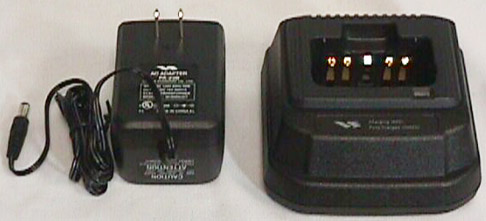
Recently, I decided to “splurge” and get desktop chargers for the pair of FT-60′s that inhabit our two-ham household. I never realized how handy the drop-in style charger could be until I had one…the HT is always sitting there ready to go. Most of these drop-in chargers are rapid chargers that sense the battery condition — charging them quickly but also dropping back to a trickle charge once they are full.
Since then, I’ve made it a point to always pick up a desktop charger with a new HT. Yes, it does cost $60 to 75 extra but it is well worth the convenience.
73, Bob K0NR
Handiham World for 04 January 2012
Welcome to Handiham World!

- Lack of organization. Any activity that involves a group of participants meeting at specific times for some stated purpose requires some organization. To understand this concept, let’s consider a simple job like mowing your lawn. You would be correct to assume that you can do this job yourself, so no formal organization is required. On the other hand, suppose you must mow a golf course. Now you need a formal organization, because the job is too large and complicated for one person. The head groundskeeper will be in charge, doling out job assignments to a crew. A net can also need formal organization, depending on its size and purpose. When you don’t have job assignments or other necessary organization, it can make a mess of the net.
- Failure to commit. This is a problem in every club, and can sure be a problem when it comes to net participation. You need a critical mass of committed participants to make a net happen. Not enough commitment equals dead net.
- Distractions & competition from other activities. This is a problem for every club, bowling group, TV network, newspaper, and amateur radio net. There is competition on every front from something else, no matter what you are trying to organize, and that in turn makes it hard to get participants to commit to the net.
- Crowded bands. Now that the solar cycle is yielding more favorable HF propagation conditions, the most popular HF bands are more crowded than ever. It can be difficult to find a clear frequency on which to gather for your net.
- Poor HF propagation. Ha, ha, this is also an excuse for a failing net, because just as good propagation can result in crowded bands, bad propagation can result in empty bands. You have to hear them if you want to work them, goes the old saying.
- QRM. This annoyance has been around as long as anyone can remember, but it can kill a net if the net participants don’t know how to manage it. Who wants to listen to all that noise and interference?
- Poor net control technique. Oh, man – don’t get me started. A net control station that cannot control the net is a real turn-off for many would be participants.
- Bad marketing. If no one knows about the net, it is unlikely to grow and prosper. You can’t leave it to chance that people will simply run across the net by tuning around the bands, although that sometimes does happen.
- Lack of flexibility. Everyone knows that people have lots going on in their lives and that they cannot make every net session. HF conditions change all the time. Sometimes there may be another QSO on the net frequency. If the net does not have flexibility built into it, these problems can turn into a failed net.
- Not having a plan. What if the frequency is already in use? What if the scheduled Net Control Station does not show up? What if the band is dead? If there is no plan to deal with such things, the net can fold like a tent in the wind!
[email protected]
Handiham Manager

Minimum-Loss Matching Pad
In my last post I promised to write about the minimum-loss matching pad that I’m using to couple my signal generator to the device I’m testing. The source impedance of the generator is 600 ohms and the output is intended to be terminated in a 600 ohm load, but the device I’m testing is only 228 ohms. The way to match this with the lowest loss is with a transformer, but it is inconvenient and unnecessary to come up with a transformer for every mismatch this piece of test-equipment will face.
Thanks to advice from the ham who is guiding me in this project, I’m using a minimum-loss matching pad, also known as an “L-pad,” to match these two impedances. (I’d tell you who this fine fellow is, but to keep you in suspense about my project I’ll wait until my final write-up. If I name him now, the cat will be out of the bag!) This quick, cheap, and easy match requires only two resistors:

Courtesy of http://www.microwaves101.com/encyclopedia/attenuatorL-pad.cfm#minloss
To calculate the value of the resistors and to calculate the loss of the matching pad, use these formulas (A spreadsheet that uses these formulas is available through this webpage.):

In my case R1=472, R2=290, and the loss is -9.25 dB. That loss is pretty significant, but it is acceptable for this application. Remember this is a minimum-loss matching pad, not a no-loss matching pad. Using what resistors I had on hand to come as close as I could to the required values, I soldered this pad on a generic PC board from Radio Shack that I cut in half using my Dremel tool with a cutting wheel:


For more on this topic, I commend to you this webpage on “Impedance and Impedance Matching.”


More Summits On The Air (SOTA) Info
 I recently wrote about the Summits On The Air (SOTA) program gaining traction here in Colorado. Catching up on some of my podcast listening, I came across Jerry KD0BIK’s Practical Amateur Radio Podcast (PARP) on the topic of SOTA. It turns out that Jerry has gotten hooked on the SOTA program and has been out activating some of the Colorado peaks in December.
Operating a ham radio on top of a mountain during winter may seem like the act of a person with only one oar in the water (or shall we say one half of a dipole in the air?). But actually, we’ve had quite a few days of favorable weather that have been begging us to get outdoors in December. Still, I am on guard for an activation by Jerry in the middle of a blizzard, as he seems a bit smitten by this SOTA thing.
Episode 49 of PARP introduces the SOTA concept near the end of the episode, which is followed by a deeper SOTA discussion in Episode 50. These two episodes run about 25 minutes each, so take some time out to give them a listen.
73, Bob K0NR
Mixed Signals from Yaesu
This just in from the Things That Make You Go Hmmm Department: the amateur radio portion of Yaesu splits from Mother Motorola while the land mobile portion stays. This is right on top of an announcement that Yaesu will pursue a digital amateur radio offering based on land mobile technology (i.e., definitely not D-STAR).
The K0KDS blog has a post about the split, so go there for the full story. The ARRL has this news item about the organizational change. Here’s the paper that Yaesu published about their move into digital technology for amateur radio.
73, Bob K0NR
Stubby Index Finger
For some reason around the Christmas season every year, I think of one of my favorite films… Evil Roy Slade. This year, I had planned to do some serious kit and homebrewing on my days off. But I managed to cut my stubby index finger while trying to fix our dishwasher. Somehow some broken glass was in the drain basket when I went feeling around. OUCH… ever try to solder and handle small parts with a wounded finger? How about operating a straight key like I do?
So I share a clip from my buddy Mickey Rooney and his character in the movie. Hope you have a Happy Holiday!













