Archive for the ‘ham radio’ Category
 Elecraft K3 Final Build Assessment and First On Air Testing
 April 20th, 2013 |
 Author:
Elecraft K3 Final Build Assessment and First On Air Testing
So the Elecraft K3 build is finished ☺ Yes it has been a long process for me but only because of my time and schedule. I think this is a project you could finish in a weekend if you really put dedication into it but I’m not sure you would want to. I will explain this as I go along…
The first questions I got were why would you do this? There are so many radios out there to purchase and some could argue many better. Well, that’s subjective of course and I’m a big fan of my Yeasu 1000mp, which I believe is my third one. I also love what Icom is doing with their new rigs but I remember a hobby that I used to table and build circuit boards, solder resisters and diodes and even build a Heathkit or two. I wanted to regain that experience in the hobby…. Get on air with something I assembled and tuned… something my hands were inside and I know where everything is and could replace if needed. How comfortable would you be installing a filter in your radio? I could do it in 10 mins now ☺ so that is a big part of the why.
The second part – FUN. Yes, if you read my posts you will see some frustration in my build. There are a few reasons but one is I was sick during the first phase… I was diagnosed with Ulcerative Colitis and was in the midst of an episode when I was doing the first few days of assembly. Take that out and I think you would find that I was having much more fun. ☺ Also – I have a really busy with work, life and family so I wanted something that I could have to sit down and take my mind away. This project seemed like a great one.
So here are the videos of assembly if you haven’t seen them and then I will provide you my overall thoughts below:
http://nicktoday.com/elecraft-k3-final-build-assessment-and-first-on-air-testing/
Checking Out A Baofeng UV-5RA
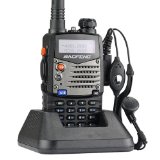 In the Winter 2013 issue of CQ VHF magazine, I wrote about some of the VHF/UHF handheld radios available from China. In that article, I reported on the measured performance of a few of the Wouxun and Baofeng transceivers. One of the Baofeng UV-5R radios that I tested showed harmonic distortion that was a bit high on the 2 Meter band, around -40 dBc.
I recently got my hands on a Baofeng UV-5RA, which is a newer version of the same radio (firmware BFB297), so I wanted to check its performance. Like the two UV-5R models I checked, the power output, transmit frequency and receiver sensitivity were all quite solid on both bands. I was more interested in the harmonic distortion present in the transmit signal.
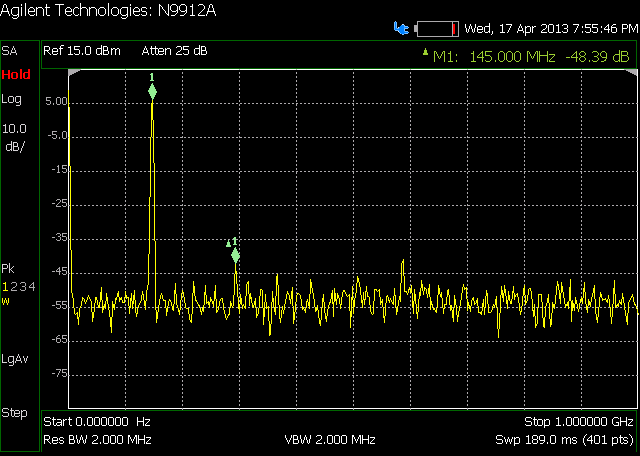
On the 2 Meter band, the 2nd harmonic measured -48.4 dB relative to the fundamental which is pretty good. Similar to the other radios I measured, the performance in the 70 cm band is a lot better (-56.1 dB).
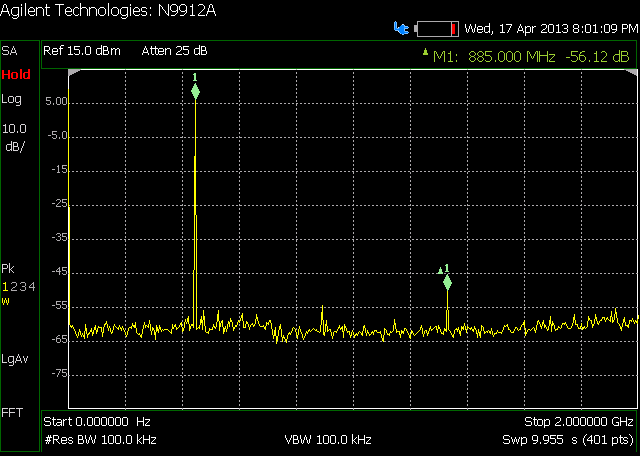
This radio has significantly better harmonic distortion than the older UV-5R radio. Of course, this is just a single sample, so performance of other radios may be different.
73, Bob K0NR
Nick N1IC – How to Save Ham Radio – Part 2 – Pay it Forward (5 Part Series)
Nick N1IC – How to Save Ham Radio – Part 2 – Pay it Forward (5 Part Series)
Thanks for all the feedback on the first part of my conversational view of how to Save Ham Radio. Now I know “SAVE” is a strong word and it’s not that we are “IN TROUBLE” but it’s always good to do some self-refection on the hobby from time to time.
Pay it forward is a simple concept – do something that will have in impact on others and help to do it for the next person.
How does that work for us being Hams? Well, I have thought of a few things but would love to hear your comments on things I might have missed:
- Operate – Actually use all that gear you have. When you do talk to someone new or get out of the normal net you’re in or circle that you always talk too. Sometimes talking to someone new will provide you a new view on the world, topic or life. You could even learn something!
I hear from new Ham’s as well as have experienced it myself – I got my license, my rig, antennas up and I get on the air and no one comes back to me. Or they are talking to people and are rude if I want to join in.
http://nicktoday.com/nick-n1ic-how-to-save-ham-radio-part-2-pay-it-forward-5-part-series/
Harold’s JA7HJ tower was not your average tower

Harold’s 30′ JA7HJ tower (Click to enlarge)
I meet some very interesting people in radio circles. My friend Harold Johnson (W4ZCB) is undoubtedly one of them.
Last year at my local ham radio/DXer club meeting, members were asked to bring photos of shacks and rigs, and describe our evolution as ham radio operators. In the series of photos that arrived at the following meeting, one in particular stood out: Harold Johnson’s radio tower in post-war Japan.
Johnson’s tower stood almost thirty feet tall and supported a 20 meter Yagi which you can see in the above photo. Johnson, who at the time operated under the callsign JA7HJ, also had a little ham shack built. The shack materials–including the tower, Johnson recalls–cost him “three bottles of Scotch for the army quartermaster…I paid the Japanese builder $15 or $20 for the complete enchilada.” This tower was built entirely of wood: the vertical members were 2′ x 4’s, the slats were 1′ x 3’s.
Of course, the tower didn’t have a mechanical rotor; instead, Johnson climbed inside the tower, lifted the wooden boom, rotated it manually, and placed it back on the uprights.
When asked how he powered his station, Johnson pointed to the wheeled generator in front of the radio shack in the photo. “The generator was called a B6B–it produced 24, 120, 240, and 480 volts, and was rated 10 kW.” When I asked how he managed to procure the generator, he replied that he “borrowed it from the flight line, which was about 300 feet away.”
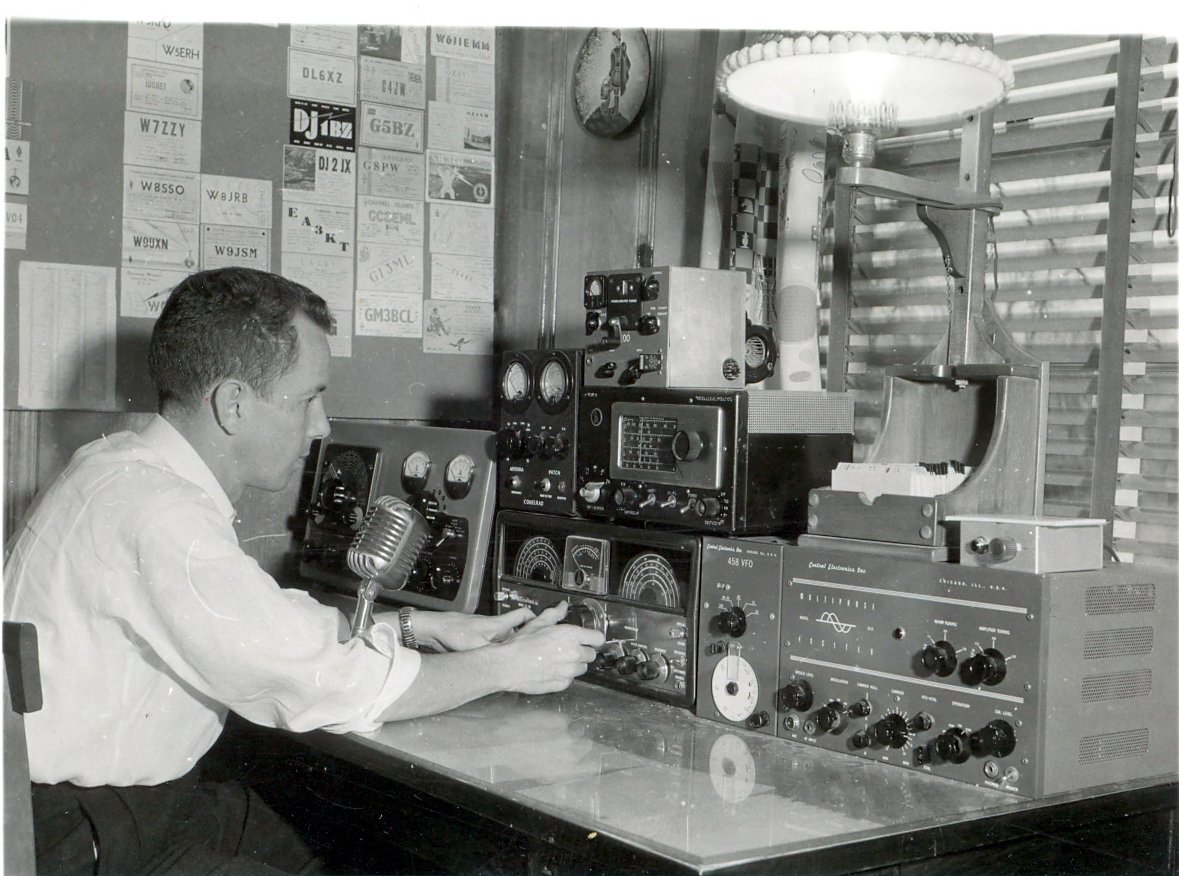
Johnson’s Nashville, TN shack, circa 1955/56. (Click to enlarge)
I always enjoy hearing personal histories in radio and I didn’t doubt for a moment that Harold Johnson’s would be intriguing, so I asked if he’d tell us how his interest in radio began. So, here’s Johnson’s story in his own words:
As a preteen, (and poor as a church mouse during our previous
Depression), I would visit my aunt and uncle in the summer, likely due to the fact that they were farmers and had food to eat. They owned an old Philco radio that had shortwave bands and I was intrigued with the phone amateurs on the 80 and 20 meter bands. Often, I could hear both sides of the conversation, after I found out that they were on various different frequencies, being crystal controlled back then! My…How times have changed.In high school, I found another afficianado, and can recall melting “Woods metal” in boiling water and floating a piece of Galena on it until it returned to a solid and [thus] made my own crystal set. WWII had started by then, and I would listen to the ground-to-air communications between ships in Lake Michigan and pilots taking off and landing on them. Great DX, perhaps 10 miles away.
In 1943, I had graduated from high school and joined the US Army Air Corps. Went through training and was still in training (…to be a pilot until they counted airplanes and pilots and decided they had enough of each […so instead] turned me into a B-29 gunner). The war was over whilst [I was] still in training and I “retired” in November 1945. Went home and found my high school sweetheart, married, went back to school to finish my education and started the Johnson family. Still married, and
to the same girl. What a sweetheart to have put up with me all these years. [No kidding, Harold!]Went back in the US Air Force in 1949, this time became a pilot, and just in time to go to Korea for a year. However, during training, had to learn the Morse and if you learned to 13 WPM, you had a free hour and didn’t have to attend class. That overcame my obstacle to amateur radio, and I took the exams in 1950 and became W9PJO. Our rules at that time were that you had to hold a “class B” ticket for a year before you could take the “class A” exams. That year I spent in Korea and Japan and managed to obtain my first foreign call, JA7HJ.
Returning home to wife and by that time two children, I took the class A exams and became W4ZCB. I decided that I enjoyed flying, (at least most of the time), and decided to make it a career. The ensuing years, I was always on and in the air, and usually spent the winters in Alaska and the summers in the Canal Zone, anything to practice how to be miserable. Lebanon in 1958, Vietnam in 1968 and by 1969 decided that I should start doing something else before my luck ran out.
During my last 4 years of service I flew an Army four star around the world four times. Fortunately he was Ted Conway, W4EII, and we mutually enjoyed operating under a couple dozen different call signs from a lot of exotic (and several not so exotic) places. Had G5AHB back when the 5 was reserved for foreign nationals. We were good friends after we both retired (on the same day; I always liked to say that he couldn’t stand to serve without me) until his death in 1990.
I started a small company manufacturing electronic test equipment for public utilities; spent the next 20 years doing that (and enjoying a much more stable life with family and radio.) Managed to work all the countries (entities these days) there are, win a few contests from a contest station I built and operated for 10 years. (80, 40, and 20 in the front room, 15 in one bedroom and since 160 and 10 were seldom open at the same time, they shared the other bedroom. To change bands, you just changed chairs. Five big towers and Yagis, a VERY high maintenance hobby in the lightning prone state of Florida. (Let’s not mention hurricanes!)
Retired again to the beautiful mountains of North Carolina in 1986. A much more modest station these days, but active on all the HF bands. I really enjoy building homebrew radios and maintaining daily schedules with friends worldwide. Can be found daily on 21.203 with G3XJP and often joined by other builders of the magnificent PicaStar transceiver designed by him. Sixty-three years a ham, still enjoying it. It’s guided my careers and interests. What a wonderful hobby!

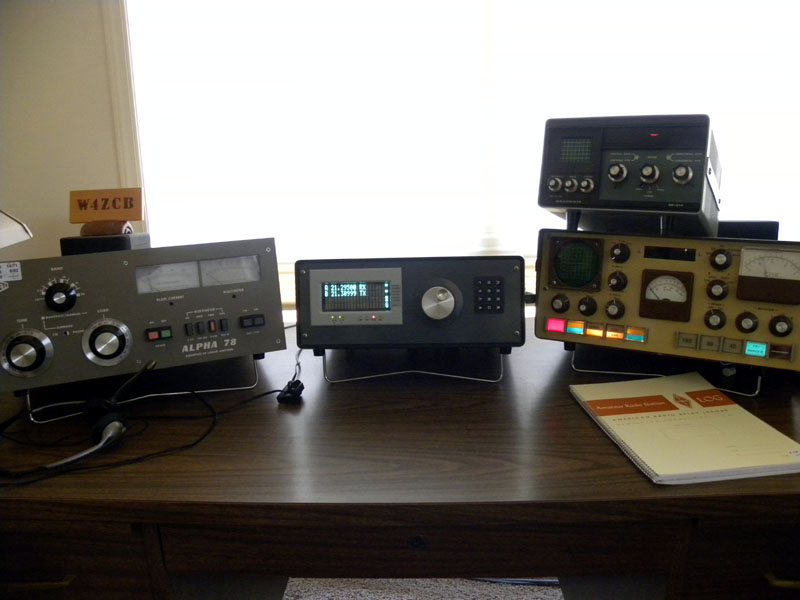
W4ZCB’s shack today is based around his home brew SDR transceiver, the PicaStar. (Click to enlarge)
Over the past few years, I’ve gotten to know Harold Johnson; I must say, he has to be one of the very few hams I know who knows the inner workings of tube/valve radios as well as he does the highest tech radios on the market, a rare talent indeed. If you’re trying to learn a bit more about the BC-348 series of radios and trying to diagnose a problem with it, Johnson’s your guy. If you’re trying to build an SDR from scratch, he’s also your guy. And clearly, if you want to hear a fascinating account of a life influenced by radio, this is most definitely your guy.
Thanks, Harold, for letting me share your story!
Check out Harold Johnson’s website by clicking here.
Nick N1IC – How to Save Ham Radio – 5 Part Series (Part 1)
When I was sitting back remembering how Ham – Amateur – Radio changed my life the other day it is a pretty remarkable story. I think my story is for another time but thinking about it made me want to sit back and give back to the hobby that I love so much and has done so much for me.
The best way I thought today was to think of ways we could work together and Save Ham Radio together. I of course am in no way saying I have all the ideas or answers and I would love to hear from others but I thought I would start with my opinions.
Ham Radio isn’t dead for sure: http://www.foxnews.com/tech/2011/11/17/radio-days-are-back-ham-radio-licenses-at-all-time-high/
But are we doing all we could to promote Ham Radio to a generation that loves technology. They are glued to their tables and smartphones – they love to text and communicate. I bet – with the right motivation and experiences many of them would be interested in Ham Radio.
Over the next few weeks I am going to sit down and provide the roadmap that I have followed to help give exposure to others on radio, the safety and emergency communications aspect and the pure fun of building something new.
My first part of this series is on Sharing Ham Radio News with others:
Part One of Series –
http://nicktoday.com/nick-n1ic-how-to-save-ham-radio-5-part-series/
PORTABLE EMCOMM STATION
PORTABLE EMCOMM STATION
In life you come across people – early on my life I think I was 16 years old I met a friend on the way into work in the mornings on our local 220mhz machine. I had gotten hurt and at the time my hand was wrapped up and I had taken some time off. I was a novice at the time so I only had privileges on 220. Mike N1RFD was one of the people that I met that convinced me take a step back from the construction work I was doing and look into computers. That changed my life I have been in the IT industry since and Mike was one of the people that I have to thank for this.
Not only did he help me then but has remained a friend, mentor and contact that I could rely on anytime it was needed.
The main reason I tell you this story is to tell you that when a friend like this gives me guidance I always listen but knowing Mike for the years I have in both business and personal I know he is very detailed and thoughtful when he works on something or builds something. Knowing he is now retired and has been working on a project that I really wanted to share with as many people as possible.
Take a look and tell me what you think of the:
What is my definition of a Communications Go-Kit?
A Communications Go-Kit (or Radio-Ready-Kit) is made up of a portable “Amateur radio” station and assorted personal gear that can quickly be assembled to respond to a “Call To Service”. There are more details on my blog and a link to his full setup.

Read more about this project on my blog: http://nicktoday.com/portable-emcomm-station/