Archive for the ‘dx’ Category
 Land (er, FREQUENCY) Grab (Part 1)
 May 30th, 2020 |
  Author:
 This article is part one in a multi-part series. Part 2 is located here: One Aspect of Amateur Radio: Good Will Ambassadors to the World. Part 3 is located here: In Response — Can’t We All Just Get Along?
We’ve all heard it at least once: no one owns a frequency.
By law, amateurs must keep the transmissions from their station within the bounds of the allocations granted to license-holding operators–within these bands that are allocated for amateur radio use. Amateurs are expected to follow band-plans, which guide us to which mode can be used in a band.
Subbands — Band Plans
There are many decades of constant refining of the standard operating procedures–perhaps we can call them, traditions–that, for the most part, work out pretty well for most amateur radio operations on our precious allocations in the radio spectrum. Each band–a slice of radio spectrum between a lower frequency and a higher frequency–is made up of subbands. These subbands are slices within a specific band (allocation), in which amateurs participate in two-way communications by using a particular mode of transmission, like single side band or CW.
For instance, Morse code enthusiasts use CW (continuous-wave modulation, i.e., A1A) between 14.000 MHz and 14.150, which is the subband that exists in the larger allocations known as the 20-Meter Band. The 20-Meter Band is 14.000 MHz to 14.350 MHz, and the regulating bodies (such as the FCC in the USA) have directed through law that voice modes cannot be used between those subband frequencies from 14.00 MHz to 14.15 MHz. Voice modes can be used from 14.15 MHz up to 14.35 MHz, with certain license class variations. Read the PDF from the FCC: FCC ONLINE TABLE OF FREQUENCY ALLOCATIONS
CW is not the only mode allowed in the 14.00-MHz-to-14.15-MHz subband. The regulations stipulate that a number of data modes can be used in this subband. There are specific requirements that a mode must meet, in order to comply with regulations–these are known as the authorized emission types.
Gentlemen’s Agreements
Amateur radio operators, decades ago, began discussing, then agreeing to, agreements between all operators as to where specific modes can be used, so those operating the different modes do not trample on each other’s transmissions. These agreements are known as our band-plan gentlemen’s agreements. They exist to help minimize interference–QRM–and to help foster good operating procedures between the different groups.
The band plans that have evolved through the decades are not regulations, and do not mean that any particular group of amateur radio operators own any frequency or subband. A mode does not own a particular subband. Amateur radio operators are not encouraged to start transmitting a mode that is typically found in that subband, if someone else is on that frequency using a mode not expected.
Just because some other operator is using the subband for a mode not in compliance with the gentlemen’s agreement, don’t purposefully try to eject that operator. At the same time, the gentlemen’s agreements exist to help amateurs avoid interference with others that are using different modes. Thus, the operator who has chosen to use a non-standard mode for a subband known to be used for some other mode should move that operation to the subband identified to be for that operator’s current mode of transmitter emissions. In other words, do not QRM another amateur radio operator, and do not cause confusion and frustration by barging into a subband for a mode that you are not intending to use. Use the mode expected in the subband of your current operations.
This concept is especially helpful when we consider weak-signal operations. If a very strong, loud teletype transmission begins in a subband that is set aside for weak-signal propagation modes like WSPR, then it defeats the efforts of the operators making the attempt to have successful weak-signal two-way communications. Thus, the teletype transmission should be made in a subband where teletype operation is expected and acceptable. And, WSPR should stay in the subband where people expect to find WSPR signals.
This concept is also applied to VHF or higher bands. Why? If repeaters are parked on known repeater subbands, then weak-signal single-sideband communications can take place in a subband where repeaters are not allowed. By allowed, though, I mean, by agreement with gentlemen’s agreements. Regulators have stayed out of the amateur radio operations except by creating regulations at a high-level–for instance, the FCC stipulating that voice communications are not allowed between 14.000 MHz and 14.150 MHz, in the 20-Meter band.
The Frequency Grabs by the WSJT Developers, Planners, and Leadership
With several current release candidates of the WSJT-X software by Joe Taylor, the group of developers and leadership have programmed into the WSJT-X software a set of NEW default frequencies. These new frequencies are in addition to their current pre-programmed frequencies that the amateur community now identifies as, The FT8 Subbands.
The new proposed frequencies are right on top of other subbands where other modes have been operating for decades (such as PSK and Olivia, and many others). There was no community discussion, except within the WSJT community. And, when someone protested the take-over of other well-established subbands, those protests were shot down. The stated reasons included, “Well, those other modes are not very active or popular, because spots are not showing up on various spotting networks.” Such reasons break down on deeper consideration–for instance, most spotting networks are not programmed to automatically identify Olivia transmissions. CW, PSK, and FT8 are programmed into scanners, but other modes are ignored.
This behavior, considered rude, arrogant, presumptuous, and anti-gentlemanly (referring to well-established gentlemen’s agreements) has happened before, with the initial release of FT8. They (the WSJT-X developers and leadership) simply picked a frequency slice of each subband, without true collaboration with the wider amateur radio community.
When this columnist and fellow amateur radio community member, attempted a discussion, the retort from an official representative was an absolute dismissal of any protest against the choice and method of frequency options within the WSJT software. While the software marks these frequency as suggestions, only, these defaults are used without question by the operators of said software. And, the mode is so fast that there’s no human way of truly monitoring the frequency before use, to see if some other mode is in operation. Besides, weak-signals that are present but cannot be heard by one’s ear, might well be in operation. Subbands exist to keep QRM from covering up the weak signals of the mode expected at that frequency.
Enter the IARU…
The IARU has decided to step in and join the discussion. “The International Amateur Radio Union has been the worldwide voice of radio amateurs, securing and safeguarding the amateur radio spectrum since 1925.” The IARU guides regulating bodies like the FCC, regarding the administration and rule-making pertaining to amateur radio.
The IARU states, on their website,
The radio spectrum is a priceless natural resource. Because radio waves do not respect borders, the use of the spectrum must be regulated internationally. This is accomplished through the International Telecommunication Union (ITU), a specialized agency of the United Nations. Through World Radiocommunication Conferences (WRCs) held approximately every four years the ITU revises the international Radio Regulations which have the force and effect of a treaty. The Radio Regulations allocate the spectrum to different radiocommunication services such as broadcasting, mobile, radar, and radionavigation (GPS). The most recent WRC was held in October-November 2019. The next one is not yet scheduled but is expected to be held in 2023, so it is usually referred to as WRC-23.
New uses of the spectrum are being developed every day. This puts enormous pressure on incumbent users who are called upon to share their spectrum access with new arrivals. The allocation process is extremely complex, especially when satellite services are involved.
Reportedly, from first-hand communication from one IARU representative,
WSJT-X RC3 has 14074 kHz again for FT8. IARU is intervening. Stay tuned. I am asking for further suggestions.
73 Tom DF5JL
IARU R1 HF Manager
This is very welcomed news!
What ought to take place, as quickly as possible, is to rally the different interested parties, like the Olivia group, the PSK groups, the various CW groups like CWOps, FISTS, and the SKCC, and many others, for ideas and suggestions. A discussion must take place in the hope that new gentlemen’s agreements can be made, that include the FT8 and FT4 operations, without stepping on the subbands of other digital modes.
As Tom says, STAY TUNED.
If you have suggestions, please comment. This columnist will summarize the main ideas of the comments and forward them to Tom. You may also contact the IARU managers and let them know your suggestions.
Discussions in the Olivia community are ongoing, too. Join in at OliviaDigitalMode.net even if you are not yet an Olivia operator.
On Facebook, you may also discuss your thoughts, in either the Olivia Digital Modes on HF group or in the Digital Modes on HF group.
If you use FT8 and FT4, voice your concerns and ideas, too. Open dialog, without declaring war, is welcomed and hopefully will prove productive.
This article is the first in a series focusing on band plans, and gentlemen’s agreements. Please stay tuned for more installments.

Tomas Hood, NW7US, is a regular contributor to AmateurRadio.com and writes from Nebraska, USA. Tomas is the Space Weather and Radio Propagation Contributing Editor to ‘CQ Amateur Radio Magazine’, and ‘The Spectrum Monitor’ magazine.
Yet in Quarantine, Life Blossoms!
About a month ago, I asked,
“What is going on with you during this challenging situation?” and, “How do you use amateur radio, now that we are all stuck at home? Are you using ham radio more, now? Less?“
I am moved to say, “Thank you, to each of you who commented and even those who made a video response. I sure appreciate it!“
During that video blog (or, Vlog), back a month ago (link: Chat From a Quarantined Software Engineer – Welfare Check!), I mentioned my need for dental surgery.
I did have to have the tooth removed. It was completely split down the middle (top to bottom), down to the root. There was no justifiable way to save the tooth.
I now am missing two bottom back-most teeth, and one bottom, back-most tooth. I can report that I have healed up nicely. I am starting to enjoy a hamburger or two.
Through all of this, I’ve still been working. Also, I’ve been involved with a LOT more ham radio–especially with Morse code activities.
How has the last month treated you? After watching this new video (below), please leave a comment or two, or three; let hear from you, okay?
More than anything, please leave a comment to let me know how you are doing. I hope to hear from you.
Here’s the video:
[embedyt]https://www.youtube.com/watch?v=vFGbw7d91GA[/embedyt]
73 de NW7US dit dit
Hunting For NDBs In CLE254

Once again it's a CLE weekend.
During these stressful times, the CLE might hopefully provide some peaceful relief for you.
'CLE's are 'Co-ordinated Listening Events, and NDB DXers around the world focus their listening time on one small slice of the NDB spectrum.
This time the hunting ground is the 20 slice from 400.0 - 419.9 kHz. kHz
A good target for this one is MOG (404kHz) in Montague, California, up near the border with Oregon. It gets out very well and has been logged from Finland to Hawaii. Its been on-and-off of late so maybe you can catch it while it's on again!
Listen for MOG's upper sideband on 405.027kHz with your receiver in the CW mode.
From CLE coordinator Brian Keyte (G3SIA), comes the following CLE info:
Hello all,
Our 254th Coordinated Listening Event starts on Friday.
This frequency range is not packed with signals for any of us, but if conditions are OK there should be some nice surprises.
Do join in, whether you have days to spare, or only an hour or so over the weekend. Staying at home seems to be essential advice for most of us at present - this could be a great way of spending time there!
Days: Friday 27 March - Monday 30 March 2020
Times: Start and end at midday your LOCAL time
(Many of us will be changing our home clocks this weekend -
however UTC time continues unaffected)
Range: 400 - 419.9 kHz
Please log all the NDBs that you can identify with nominal (listed) frequencies in the range - it includes 400 kHz, but not 420 kHz - plus any UNIDs that you come across there.
Send your final log to the List (no attachments please and ideally in a plain text email) with ‘FINAL CLE254’ in its title.
Show on each line:
# The Date (e.g. '2020-03-27', etc., or just '27' )
# The Time in UTC (the day changes at 00:00 UTC).
# kHz - the nominal published frequency, if known.
# The Call Ident.
Please show those main items FIRST. Other optional details such as Location and Distance go LATER in the same line.
As always, of course, tell us your own location and brief details of the equipment that you were using during the Event.
We will send the usual 'Any More Logs?' email at about 19:00 UTC on Tuesday so that you can check that your log has been found OK.
Do make sure that your log has arrived on the List by 08:00 UTC on Wednesday 1 April at the very latest.
We hope to complete making the combined results within a day or two.
You can find full details about current and past CLEs from the CLE page http://www.ndblist.info/cle.htm It includes access to CLE254 seeklists for your part of the World, prepared from the previous loggings in Rxx. (Thanks, Martin and Alan, for your help with that)
Good listening
- enjoy the CLE and do take care of yourself and your family.
Brian and Joachim
-----------------------------------------------------------------
From: Brian Keyte G3SIA ndbcle'at'gmail.com
Location: Surrey, SE England (CLE coordinator)
-----------------------------------------------------------------
(If you would like to listen remotely you could use any one remote
receiver for your loggings, stating its location and owner and with their
permission if required. A remote listener may NOT also use another
receiver, local or remote, to make further loggings for the same CLE)
- determine, worldwide, which beacons are actually in service and on-the-air so the online database can be kept up-to-date
- determine, worldwide, which beacons are out-of-service or have gone silent since the last CLE covering this range
- will indicate the state of propagation conditions at the various participant locations
- will give you an indication of how well your LF/MF receiving system is working
- give participants a fun yet challenging activity to keep their listening skills honed
The NDB List Group is a great place to learn more about the 'Art of NDB DXing' or to meet other listeners in your region. There is a lot of good information available there and new members are always very welcome. As well, you can follow the results of other CLE participants from night to night as propagation is always an active topic of discussion.
You need not be an NDB List member to participate in the CLEs and all reports, no matter how small, are of much value to the organizers.
Remember - 'First-time' logs are always VERY welcome!
Reports may be sent to the NDB List Group or e-mailed to CLE co-ordinator, Brian Keyte (G3SIA), whose address appears above. If you are a member of the group, all final results will also be e-mailed and posted there.
Please ... give the CLE a try ... then let us know what NDB's can be heard from your location! Your report can then be added to the worldwide database to help keep it up-to-date.
Have fun and good hunting!
Contest Morse Code, Computers, and an Icom Rig
This past weekend (third full weekend in February, February 15-16, 2020) is the ARRL International CW Contest (ARRL DX CW link: http://www.arrl.org/arrl-dx ). This is interesting to my study of radio signal propagation as a columnist and as an amateur radio operator because of the contest objective: “To encourage W/VE stations to expand knowledge of DX propagation on the HF and MF bands…” This contest is a good way to get a feel for current propagation–though there are caveats.
Speaking of Morse code and the CW mode on our amateur bands: those of you using CW during contests, do you send by hand or by computer? Do you copy the code by head, or do you use a computer for decoding?

Just curious about those of you who use CW. Do you send by hand or computer? Receive by head or computer?
In most contests like the ARRL DX CW contest, I copy by ear, and send mostly by rig keyer. If needed, I use a single paddle key with the Icom rig’s internal keyer to answer unique questions and so on.
Below is a quick demo of using the internal Morse code keyer in my Icom IC-7610 transceiver.
V47T, in the Saint Kitts and Nevis Island in the Caribbean, is calling CQ TEST in the ARRL DX CW contest.
Using the programmable virtual buttons, in which I programmed my callsign, NW7US, and other info, I answer and make a complete contest QSO.
In activity like the Straight Key Century Club (SKCC – https://SKCCGroup.com) K3Y special event, it is all manual. I send my Morse code using a WWII Navy Flameproof Signal Key, and decode with my ears. It is contextual for me.
[embedyt] https://www.youtube.com/watch?v=vm8UJst6umA[/embedyt]
How do you do contesting Morse code? Bonus question: How do you do logging while doing contest operation?
73 es best dx = de NW7US dit dit
Hunting For NDB Pairs In CLE251

A fairly popular CLE event held around this time of the year is the "Noah's Ark" Holiday CLE!
It calls for listeners to hunt down and log pairs of NDBs from as many 'radio countries' as possible.
As explained below, in NA and Australia, states and provinces count as separate 'radio countries' thankfully.
For those unfamiliar with this monthly activity, a 'CLE' is a 'Co-ordinated Listening Event', as NDB DXers around the world focus their listening time on one small slice of the NDB spectrum.
If you've been meaning to participate in CLE, then maybe this weekend is a fine time to try! We continue to have a lot of first time submissions so you won't be alone!
As well, if you're trying to learn CW, copying NDBs is perfect practice as the identifier speed is generally slow and the letters are repeated again every few seconds!
This past week has seen a long period of great propagation quickly get worse with the arrival of another coronal hole stream. This is quickly abating and the ionosphere may well have fully recovered for the nine-day event.
When tuning for NDBs, put your receiver in the CW mode and listen for the NDB's CW identifier, repeated every few seconds. Listen for U.S. NDB identifiers approximately 1 kHz higher or lower than the published transmitted frequency since these beacons are modulated with a 1020 Hz tone approximately.
For example, 'AA' near Fargo, ND, transmits on 365 kHz and its upper sideband CW identifier is tuned at 366.025 kHz while its lower sideband CW ident can be tuned at 363.946 kHz. Its USB tone is actually 1025 Hz while its LSB tone is 1054 Hz.
Often, one sideband will be much stronger than the other so if you don't hear the first one, try listening on the other sideband.
Canadian NDBs normally have an USB tone only, usually very close to 400 Hz. They also have a long dash (keydown) following the CW identifier.
All NDBs heard in North America will be listed in the RNA database (updated daily) while those heard in Europe may be found in the REU database. Beacons heard outside of these regions will be found in the RWW database.
From CLE organizer Brian Keyte, G3SIA, comes the details:
Hello all
We hope you are looking forward to our "Noah's Ark" Holiday CLE – it
starts at midday on Christmas Day and you can listen at any times
from then right through to midday on Thursday 2nd January.
It's very straightforward. Just as the animals went into the Ark two by two,
so the Radio Countries' NDBs will go into our logs two by two.
Days: Wednesday 25th December to Thursday 2nd January
Times: Start and End at midday, your LOCAL TIME
Target: A maximum of TWO NDBs from each Radio Country
Range: 190-1740 kHz
So during the course of the event we shall try to log TWO NDBs from each
of as many Radio Countries as we can - e.g. 2 from France, 2 from Spain,
2 from the Florida, 2 from Quebec, 2 from Brazil, 2 from New Zealand, etc.
Each Australian and USA State and each Canadian Province is a separate
Country. For our full list see: www.ndblist.info/beacons/countrylist.pdf
Each NDB making the pairs can be logged at any times during the event.
UNIDs, Amateur, DGPS and Navtex beacons are not included, but any
UNIDs can be shown in a separate 'non-CLE' list or in a separate email.
Noah didn't have single animals in the Ark, but if you can only log ONE
NDB from a Country, it will still be welcome in your log without a mate!
Everyone is asked to please listen for YOUR OWN NEAREST active NDB
and include it with the one other logging for that Country (if any).
For details of a country’s active NDBs go to www.classaxe.com/dx/ndb/rww/
If you are listening from Europe or North America replace the rww by
reu or rna respectively. Next to 'Locations' enter the State or Country
abbreviation(s), then select 'Only Active’ at the bottom.
Post your final, complete log to the List (please not in an attachment)
with CLE251 and FINAL in the Subject heading, to arrive at the very latest
by 09:00 UTC on Saturday 4th January.
As usual, please include on every line of your log:
# Date** and UTC (the day changes at 00:00 UTC)
# kHz (the nominal, published, frequency if possible)
# Call Ident
Those main log items must be shown FIRST with the country shown
LATER in the same line, together with any other (optional) details
such as location, offset and distance.
**IMPORTANT - IF YOU USE THE SIMPLE 'dd' DATE FORMAT.
The input program for REU/RNA/RWW does not allocate the month and year.
The good people who enter the information for us then have to tell the
program what month and year to use. That is not a problem IF ALL
LOGGINGS FOR THE SAME MONTH ARE GROUPED TOGETHER.
So please help us by making sure you separate your December and
January loggings, even if it breaks up some Noah pairs.
Where possible, we suggest that logs are in Radio Country order, instead
of in the usual kHz order, so that the country pairs appear together.
We'll send an ANY MORE LOGS? email at about 20:00 UTC on Friday 3rd
January showing whose logs we have found. Try to post your log to the
List before that so you will get confirmation that it has arrived OK.
Good listening, everyone. Enjoy the CLE.
And finally, radio or not, Joachim and I wish you a very HAPPY CHRISTMAS.
Brian
(CLE Coordinator)
Reminder 1:
This is an ideal event to help you qualify for one or more of Joe Miller's
attractive Award Certificates - they make great "wallpaper" for any
listening shack. Joe, our Awards Coordinator, invites us to submit
requests. http://www.ndblist.info/awards.htm will take you to the
different web pages containing the advice you will need.
Certificates can be ordered direct from the REU-RNA-RWW database.
Now is a good time to apply with so many NDBs going off air.
Reminder 2:
You could use any ONE remote receiver for your loggings, stating its
location and owner - with their permission if required.
( e.g. see https://sdr.hu/ )
A remote listener may NOT also use another receiver, whether local
or remote, to obtain further loggings for the same CLE.
These monthly listening events serve several purposes. They:
- determine, worldwide, which beacons are actually in service and on-the-air so the online database can be kept up-to-date
- determine, worldwide, which beacons are out-of-service or have gone silent since the last CLE covering this range
- will indicate the state of propagation conditions at the various participant locations
- will give you an indication of how well your LF/MF receiving system is working
- give participants a fun yet challenging activity to keep their listening skills honed
The NDB List Group is a great place to learn more about the 'Art of NDB DXing' or to meet other listeners in your region. There is a lot of good information available there and new members are always very welcome. As well, you can follow the results of other CLE participants from night to night as propagation is always an active topic of discussion.
You need not be an NDB List member to participate in the CLEs and all reports, no matter how small, are of much value to the organizers.
Remember - 'First-time' logs are always VERY welcome!
Reports may be sent to the NDB List Group or e-mailed to CLE co-ordinator, Brian Keyte (G3SIA), whose address appears above. If you are a member of the group, all final results will also be e-mailed and posted there.
Please ... give the CLE a try ... then let us know what NDB's can be heard from your location! Your report can then be added to the worldwide database to help keep it up-to-date.
Have fun good hunting and have a great Christmas!
FT8 … Such A Tease
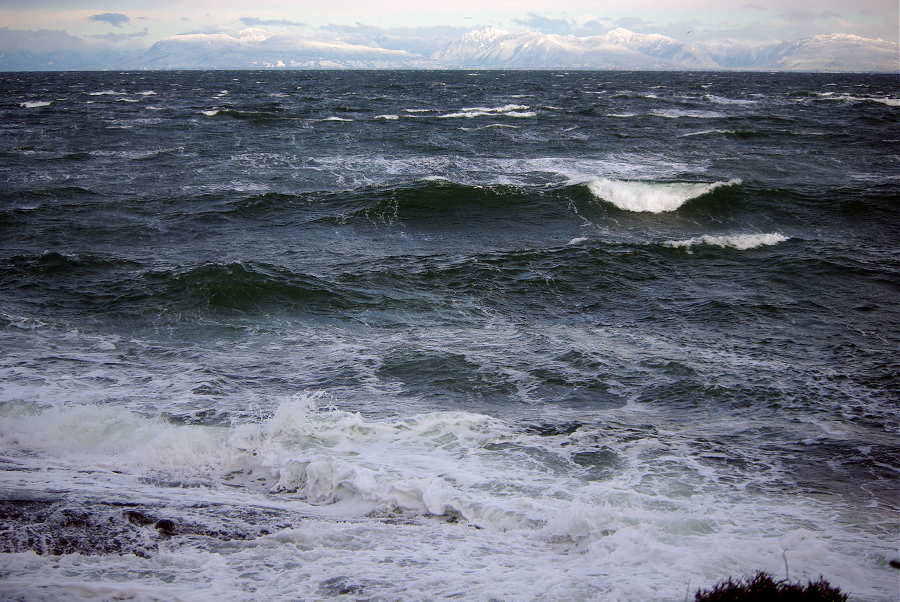 |
| Looking towards EU over Georgia Strait, last winter |
With the continued tsunami of FT8 activity on the HF bands, I decided to have a look at what was happening in the FT8 segment of 160m.
On Saturday afternoon, about ninety minutes before my local sunset here in south west British Columbia, I set my receiver and 160m half-sloper to work, along with WSJT-X, on 1840kHz USB mode.
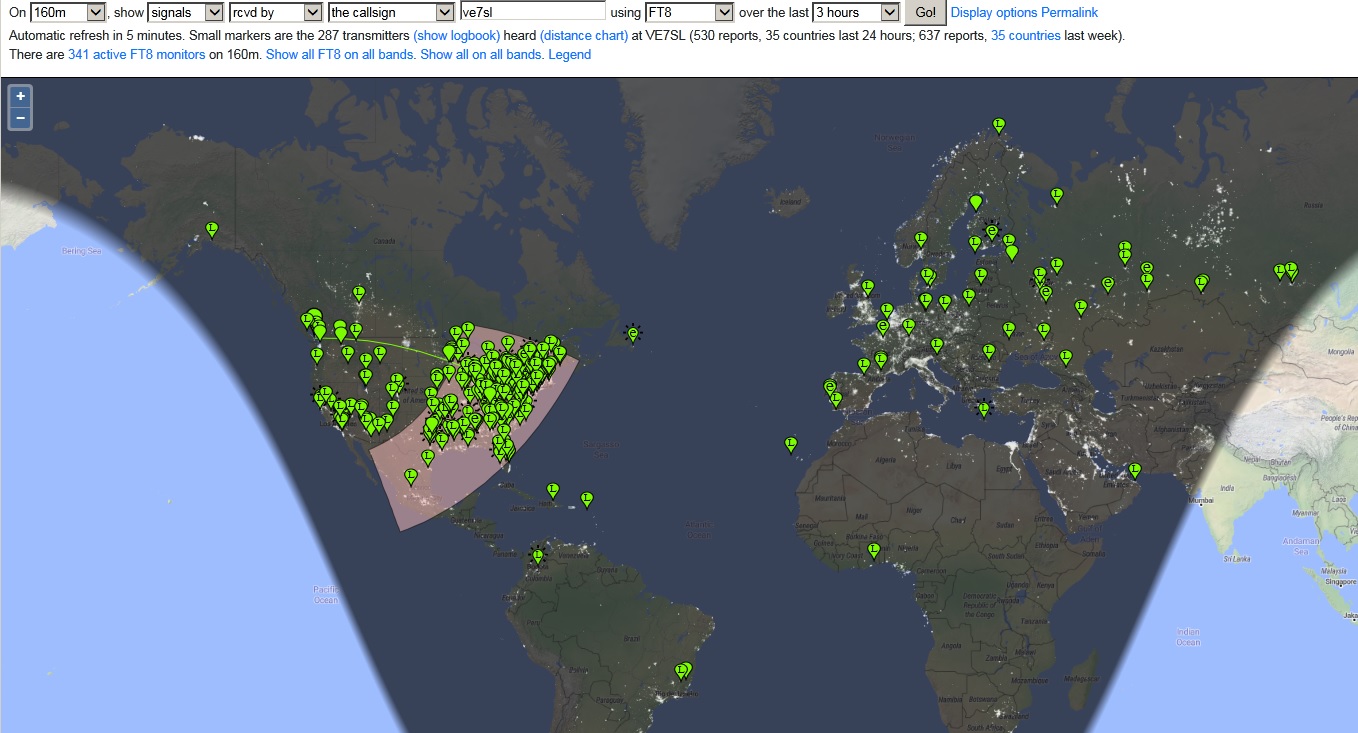
Although still in broad daylight, the waterfall was immediately flooded with signals! As I started to pay closer attention, I realized that many of the signals were from Europe! Many were audible while the rest were fast-approaching that level, being stronger than -20db. I let the receiver run for another few hours and took a screen capture of my PSK Reporter screen, illustrating what had been decoded over that time span:
 |
| courtesy: https://www.pskreporter.info/pskmap.html |
Checking other NW or VE7 monitors during the same time span showed no EU decodes at all, which I found surprising ... perhaps I missed someone. My location here on the eastern shoreline of Mayne Island looks towards EU and many other directions directly over a large body of saltwater ocean, Georgia Strait. The photo above was taken last winter, through the living room window. It is also very quiet, electrically, with little or no noise most of the time.
It appears that the lack of man-made noise combined with the theoretical 6db saltwater horizon gain (being realized), is enough to allow these signals to be heard. Signals continued to be decoded as darkness approached but at around 1800 local time, began to drop off ... evidently this appears to be a sunset enhancement, similar to what I often see to the east coast on the 630m band.
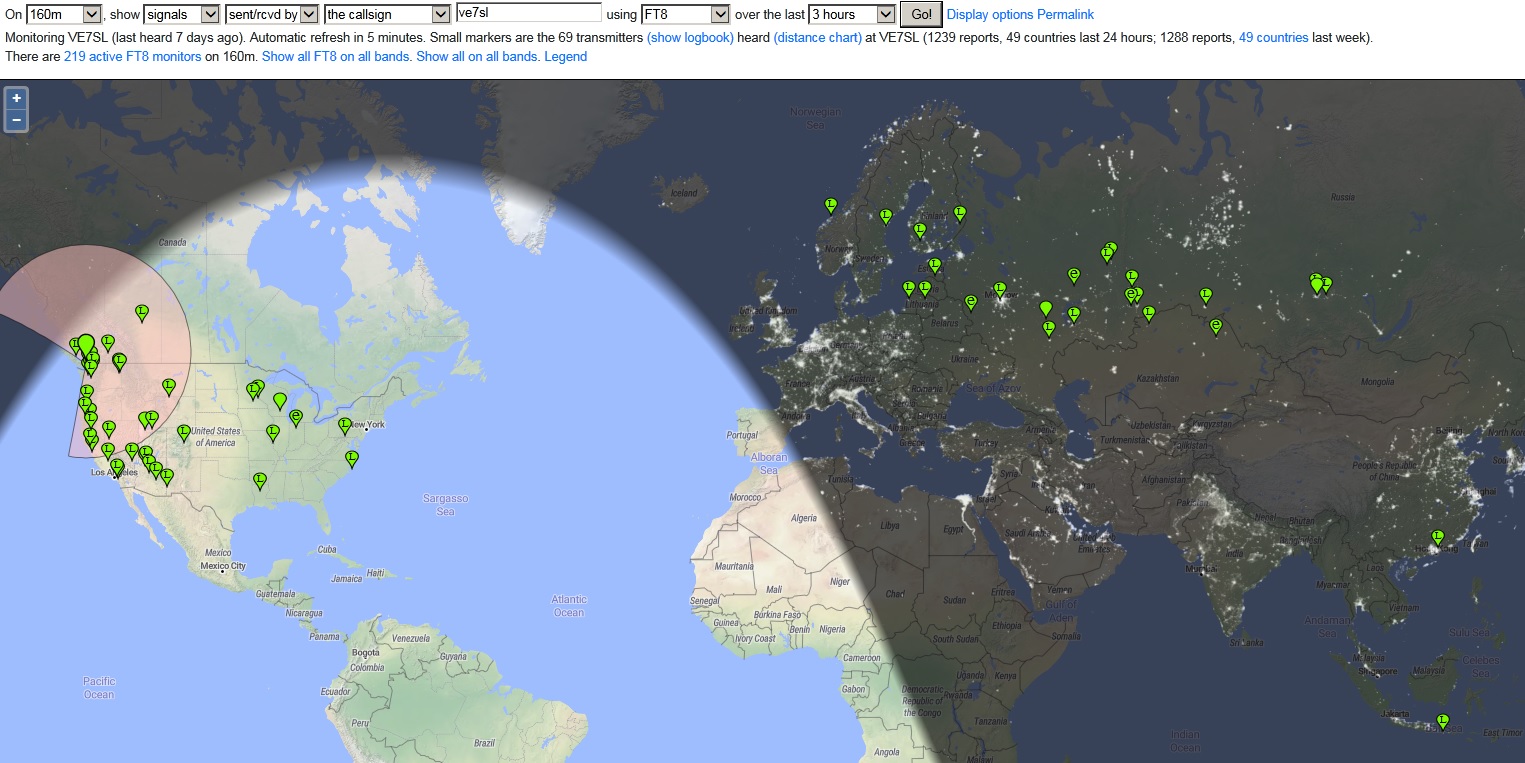
Now here’s where it gets even more interesting, as my decodes for the ninety minutes before and after local sunrise indicated a similar pattern!
The most probable path for these signals, around sunrise, would be via the long path in darkness. Although there is no saltwater directly behind me, it seems that the 'quietness' may be enough to do the job. Here’s the slightly post-sunrise screen cap from PSK Reporter:
 |
| courtesy: https://www.pskreporter.info/pskmap.html |
FT8 is surely a tempting seductress. So far I have resisted the fast-growing urge to spark-up in this mode on 160m ... but I may be growing weaker. This all looks so very interesting.
How Did You Fare in CQ WW CW Contest Weekend?
Man, lots and lots of Morse code on the ham bands, this weekend. The CQ Worldwide CW Contest weekend was hopping with signals!
How did you do this weekend? How were conditions on the various contest bands?
Comment here and your report may make it into the propagation column in an upcoming edition of the Radio Propagation column in CQ Amateur Radio Magazine.
Here are a few moments as heard at the station of the CQ Amateur Radio Magazine propagation columnist, in Lincoln, Nebraska (yeah, that’s me, NW7US).
[embedyt]https://www.youtube.com/watch?v=eWCbtIOJmLI[/embedyt]
Here are the results of my dabbling with the Icom rig and this contest:
 NW7US's Contest Summary Report for CQ-WW
 Created by N3FJP's CQ WW DX Contest Log
 Version 5.7  www.n3fjp.com

 Total Contacts = 55
 Total Points = 8,979

 Operating Period: 2019/11/24 10:23 - 2019/11/24 22:51

 Total op time (breaks > 30 min deducted): 3:58:46
 Total op time (breaks > 60 min deducted): 4:45:17

 Avg Qs/Hr (breaks > 30 min deducted): 13.8


 Total Contacts by Band and Mode:

 Band       CW   Phone     Dig   Total       %
 ----       --   -----     ---   -----     ---
   80        8       0       0       8      15
   40        7       0       0       7      13
   20       25       0       0      25      45
   15       15       0       0      15      27
            --   -----     ---   -----     ---
 Total      55       0       0      55     100

 Total Contacts by State \ Prov:

 State       Total     %
 -----       -----   ---
                52    95
 HI              3     5

 Total = 1


 Total Contacts by Country:

 Country                      Total     %
 -------                      -----   ---
 Canada                           6    11
 Brazil                           5     9
 USA                              5     9
 Argentina                        3     5
 Costa Rica                       3     5
 Hawaii                           3     5
 Bonaire                          2     4
 Cayman Is.                       2     4
 Chile                            2     4
 Cuba                             2     4
 Japan                            2     4
 Mexico                           2     4
 Aruba                            1     2
 Bahamas                          1     2
 Barbados                         1     2
 Belize                           1     2
 Curacao                          1     2
 Dominican Republic               1     2
 French Guiana                    1     2
 Haiti                            1     2
 Honduras                         1     2
 Martinique                       1     2
 Montserrat                       1     2
 Nicaragua                        1     2
 Senegal                          1     2
 St. Kitts & Nevis                1     2
 St. Lucia                        1     2
 Suriname                         1     2
 US Virgin Is.                    1     2
 Venezuela                        1     2

 Total = 30


 Total DX Miles (QSOs in USA not counted) = 151,407
 Average miles per DX QSO = 3,028


 Average bearing to the entities worked in each continent.
 QSOs in USA not counted.

 AF =  83
 AS = 318
 NA = 124
 OC = 268
 SA = 137


 Total Contacts by Continent:

 Continent   Total     %
 ---------   -----   ---
 NA             32    58
 SA             17    31
 OC              3     5
 AS              2     4
 AF              1     2

 Total = 5


 Total Contacts by CQ Zone:

 CQ Zone   Total     %
 -------   -----   ---
 08           13    24
 03            7    13
 09            7    13
 07            6    11
 11            5     9
 13            3     5
 31            3     5
 04            2     4
 05            2     4
 06            2     4
 12            2     4
 25            2     4
 35            1     2

 Total = 13














